A French Word to Live By
How to Conjugate Se achever in French
/sə aʃ.ve/
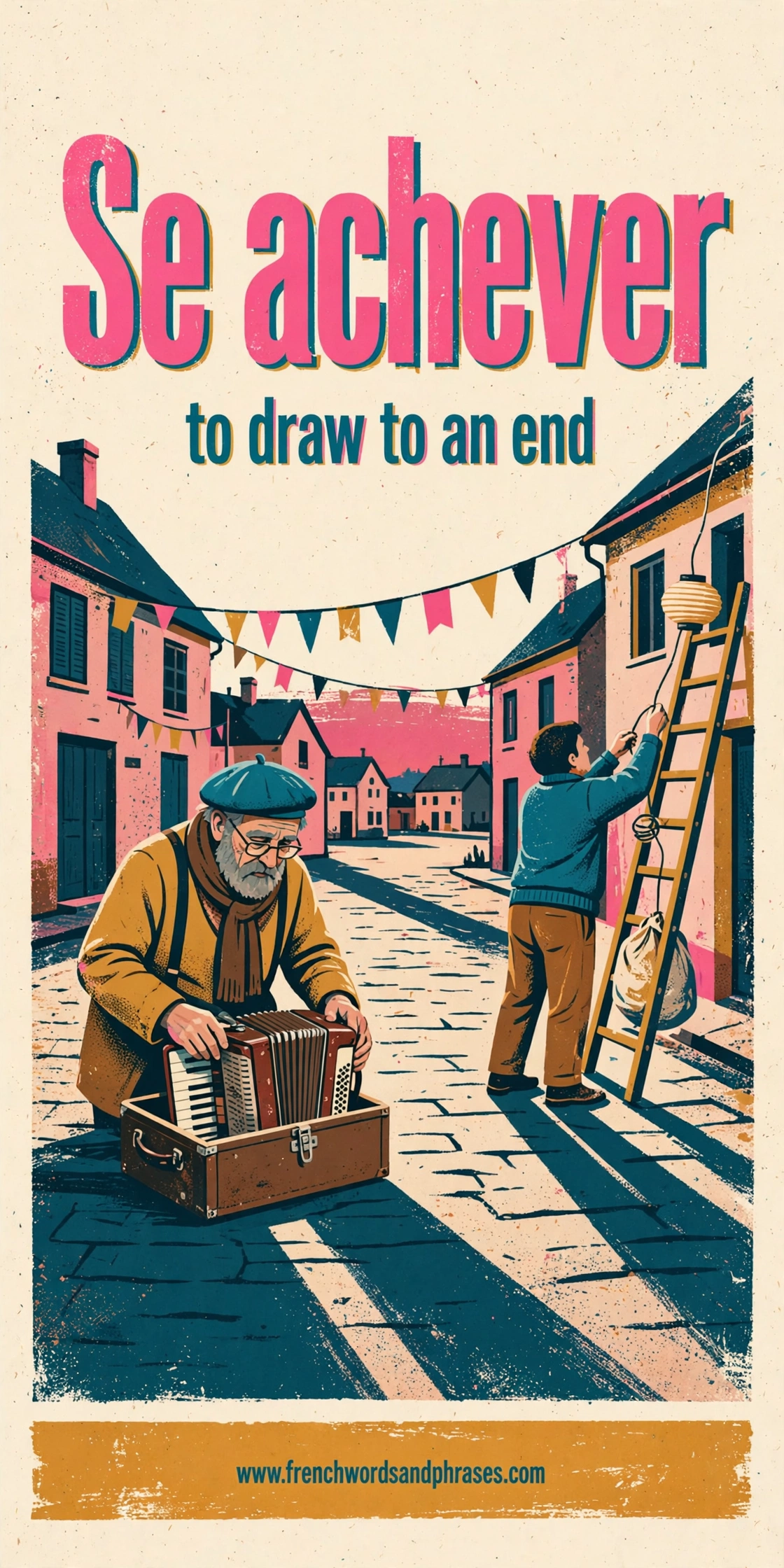
Se achever means to draw to an end — to move, slowly and completely, towards a close: a season, a reign, a long summer evening.
The last light leaving a harvest field, the final pages of a long reign in a history book — s’achever is the verb of things that end completely and gracefully: not cut off, but brought to their head.
In this guide, you’ll learn how to conjugate se achever in all the major French tenses and moods. Explore complete conjugation tables, French examples, English translations, and practice quizzes.
Understanding the French Verb Se achever
Se achever is a regular French verb belonging to the first group of verbs, those ending in-er.
It means to draw to an end. It is the elegant, slightly literary verb for an ending that completes itself: l’année scolaire s’achève, le chantier s’achève, une époque s’achève. Where finir simply stops, s’achever rounds a thing off to its natural, finished close — often with a touch of melancholy.
Verb classification: First group (-er), reflexive
Auxiliary verb: Être
Past participle: achevé
Present participle: achevant
English equivalents: To draw to an end, to come to an end, to be completed; l’été s’achève — the summer is drawing to an end; son règne s’achève — his reign is coming to an end; la fête s’achève — the celebration is drawing to a close; un monde qui s’achève — a world that is ending.
One important detail: s’achever keeps the lever-type stem change of achever — the mute e opens to è before a mute syllable: l’été s’achève, les travaux s’achèvent, and in the future la saison s’achèvera — while the sounded endings keep the plain e: le jour s’achevait, ils s’achevaient. Its subjects are never people doing the finishing, but things that finish themselves: seasons, works, reigns, evenings. Being reflexive, it takes être: l’été s’est achevé, la fête s’est achevée, the participle agreeing with the subject.
Experience the Word
Se achever is the verb of the golden ending — the close that arrives because everything in the thing has been fulfilled.
Imagine the last evening of August in a village in Provence. The swallows are gathering on the wires, the café is half empty, the light stays a little less long each day — l’été s’achève, and everyone at the café tables can feel the season turning its final page.
Nothing has been interrupted. The summer is drawing to its end — achevé à son heure, complete to its last evening.
How to Conjugate Se achever: Complete French Conjugation Guide
Let’s explore every major conjugation of se achever, beginning with the indicative mood.
How to Conjugate Se achever in the Indicative Mood
The indicative mood is used to express facts, observations, actions, and events.
How to Conjugate Se achever in the Present Tense (Présent)
Used for actions happening now, habitual actions, and general truths.
| Subject | Conjugation |
|---|---|
| je | m’achève |
| tu | t’achèves |
| il / elle | s’achève |
| nous | nous achevons |
| vous | vous achevez |
| ils / elles | s’achèvent |
Example
L’été s’achève et les hirondelles se rassemblent.
The summer is drawing to an end and the swallows are gathering.
Quick Quiz 1
Complete the sentence:
Les travaux ______ à la fin du mois.
Reveal the answer
s’achèvent
Les travaux s’achèvent à la fin du mois.
The work draws to an end at the end of the month.
How to Conjugate Se achever in the Passé Composé
Used for completed actions in the past. Se achever takes the auxiliary verb être.
| Subject | Conjugation |
|---|---|
| je | me suis achevé / me suis achevée |
| tu | t’es achevé / t’es achevée |
| il / elle | s’est achevé / s’est achevée |
| nous | nous sommes achevés / nous sommes achevées |
| vous | vous êtes achevés / vous êtes achevées / vous êtes achevé / vous êtes achevée |
| ils / elles | se sont achevés / se sont achevées |
Example
La fête s’est achevée à l’aube.
The celebration drew to a close at dawn.
How to Conjugate Se achever in the Imparfait (Imperfect Tense)
Used for habitual past actions, descriptions, and ongoing situations in the past.
| Subject | Conjugation |
|---|---|
| je | m’achevais |
| tu | t’achevais |
| il / elle | s’achevait |
| nous | nous achevions |
| vous | vous acheviez |
| ils / elles | s’achevaient |
Example
Le règne du vieux roi s’achevait lentement.
The old king’s reign was slowly coming to an end.
Quick Quiz 2
Choose the correct form:
The celebration drew to a close at dawn.
La fête ______ à l’aube. (s’est achevée / a achevé)
Reveal the answer
s’est achevée
La fête s’est achevée à l’aube.
Se achever is reflexive, takes être, and the participle agrees: achevée.
How to Conjugate Se achever in the Plus-que-parfait
Used to describe an action that had already been completed before another past event.
| Subject | Conjugation |
|---|---|
| je | m’étais achevé / m’étais achevée |
| tu | t’étais achevé / t’étais achevée |
| il / elle | s’était achevé / s’était achevée |
| nous | nous étions achevés / nous étions achevées |
| vous | vous étiez achevés / vous étiez achevées / vous étiez achevé / vous étiez achevée |
| ils / elles | s’étaient achevés / s’étaient achevées |
Example
La saison s’était achevée quand les pluies sont arrivées.
The season had drawn to an end when the rains arrived.
How to Conjugate Se achever in the Passé Simple
Primarily used in formal writing, literature, and historical narratives. It is rarely used in everyday conversation.
| Subject | Conjugation |
|---|---|
| je | m’achevai |
| tu | t’achevas |
| il / elle | s’acheva |
| nous | nous achevâmes |
| vous | vous achevâtes |
| ils / elles | s’achevèrent |
Example
Son règne s’acheva dans le silence du palais.
His reign came to an end in the silence of the palace.
How to Conjugate Se achever in the Passé Antérieur
A literary tense used to express an action completed immediately before another past action, generally in the passé simple.
| Subject | Conjugation |
|---|---|
| je | me fus achevé / me fus achevée |
| tu | te fus achevé / te fus achevée |
| il / elle | se fut achevé / se fut achevée |
| nous | nous fûmes achevés / nous fûmes achevées |
| vous | vous fûtes achevés / vous fûtes achevées / vous fûtes achevé / vous fûtes achevée |
| ils / elles | se furent achevés / se furent achevées |
Example
Dès que la cérémonie se fut achevée, la foule se dispersa.
As soon as the ceremony had drawn to a close, the crowd dispersed.
How to Conjugate Se achever in the Future Tense (Futur Simple)
Used to describe actions that will take place in the future.
| Subject | Conjugation |
|---|---|
| je | m’achèverai |
| tu | t’achèveras |
| il / elle | s’achèvera |
| nous | nous achèverons |
| vous | vous achèverez |
| ils / elles | s’achèveront |
Example
L’année scolaire s’achèvera en juin.
The school year will draw to an end in June.
How to Conjugate Se achever in the Futur Antérieur (Future Perfect)
Used for an action that will have been completed before a particular point in the future.
| Subject | Conjugation |
|---|---|
| je | me serai achevé / me serai achevée |
| tu | te seras achevé / te seras achevée |
| il / elle | se sera achevé / se sera achevée |
| nous | nous serons achevés / nous serons achevées |
| vous | vous serez achevés / vous serez achevées / vous serez achevé / vous serez achevée |
| ils / elles | se seront achevés / se seront achevées |
Example
À Noël, les travaux se seront achevés depuis un mois.
By Christmas, the work will have been finished for a month.
How to Conjugate Se achever in the Near Future (Futur Proche)
Used to describe something that is going to happen soon. Formed with aller + infinitive.
| Subject | Conjugation |
|---|---|
| je | vais m’achever |
| tu | vas t’achever |
| il / elle | va s’achever |
| nous | allons nous achever |
| vous | allez vous achever |
| ils / elles | vont s’achever |
Example
Le jour va s’achever, rentrons.
The day is going to draw to an end, let us go home.
How to Conjugate Se achever in the Conditional Mood
The conditional mood expresses what would happen under certain circumstances. It is also frequently used to make polite requests or express wishes.
How to Conjugate Se achever in the Present Conditional
| Subject | Conjugation |
|---|---|
| je | m’achèverais |
| tu | t’achèverais |
| il / elle | s’achèverait |
| nous | nous achèverions |
| vous | vous achèveriez |
| ils / elles | s’achèveraient |
Example
Sans cet accident, la fête s’achèverait en musique.
Without this accident, the celebration would draw to a close in music.
How to Conjugate Se achever in the Past Conditional
| Subject | Conjugation |
|---|---|
| je | me serais achevé / me serais achevée |
| tu | te serais achevé / te serais achevée |
| il / elle | se serait achevé / se serait achevée |
| nous | nous serions achevés / nous serions achevées |
| vous | vous seriez achevés / vous seriez achevées / vous seriez achevé / vous seriez achevée |
| ils / elles | se seraient achevés / se seraient achevées |
Example
La construction se serait achevée plus tôt sans la grève.
The building work would have been completed earlier without the strike.
Se achever in the Literary Past Conditional Form
This less common literary form uses the imperfect subjunctive of être.
| Subject | Conjugation |
|---|---|
| je | me fusse achevé / me fusse achevée |
| tu | te fusses achevé / te fusses achevée |
| il / elle | se fût achevé / se fût achevée |
| nous | nous fussions achevés / nous fussions achevées |
| vous | vous fussiez achevés / vous fussiez achevées / vous fussiez achevé / vous fussiez achevée |
| ils / elles | se fussent achevés / se fussent achevées |
Example
Le règne se fût achevé dans la gloire sans cette guerre.
The reign would have ended in glory without this war.
How to Conjugate Se achever in the Subjunctive Mood
The subjunctive is used to express wishes, emotions, doubts, necessity, and uncertainty. It frequently follows expressions such as il faut que (it is necessary that) or bien que (although).
How to Conjugate Se achever in the Present Subjunctive
| Subject | Conjugation |
|---|---|
| que je | m’achève |
| que tu | t’achèves |
| qu’il / qu’elle | s’achève |
| que nous | nous achevions |
| que vous | vous acheviez |
| qu’ils / qu’elles | s’achèvent |
Example
Il est triste que l’été s’achève déjà.
It is sad that the summer is already drawing to an end.
Quick Quiz 3
Complete the sentence using the subjunctive:
Il est triste que les vacances ______ déjà.
Reveal the answer
s’achèvent
Il est triste que les vacances s’achèvent déjà.
It is sad that the holidays are already drawing to an end.
How to Conjugate Se achever in the Imperfect Subjunctive
A literary tense, rarely encountered in modern spoken French.
| Subject | Conjugation |
|---|---|
| que je | m’achevasse |
| que tu | t’achevasses |
| qu’il / qu’elle | s’achevât |
| que nous | nous achevassions |
| que vous | vous achevassiez |
| qu’ils / qu’elles | s’achevassent |
Example
On sentait que le monde d’hier s’achevât doucement.
One felt that yesterday’s world was gently coming to an end.
How to Conjugate Se achever in the Pluperfect Subjunctive
A literary construction used to express an action completed before another past action.
| Subject | Conjugation |
|---|---|
| que je | me fusse achevé / me fusse achevée |
| que tu | te fusses achevé / te fusses achevée |
| qu’il / qu’elle | se fût achevé / se fût achevée |
| que nous | nous fussions achevés / nous fussions achevées |
| que vous | vous fussiez achevés / vous fussiez achevées / vous fussiez achevé / vous fussiez achevée |
| qu’ils / qu’elles | se fussent achevés / se fussent achevées |
Example
On racontait que la fête se fût achevée avant minuit.
People said the celebration had drawn to a close before midnight.
How to Conjugate Se achever in the Past Subjunctive
| Subject | Conjugation |
|---|---|
| que je | me sois achevé / me sois achevée |
| que tu | te sois achevé / te sois achevée |
| qu’il / qu’elle | se soit achevé / se soit achevée |
| que nous | nous soyons achevés / nous soyons achevées |
| que vous | vous soyez achevés / vous soyez achevées / vous soyez achevé / vous soyez achevée |
| qu’ils / qu’elles | se soient achevés / se soient achevées |
Example
Je suis heureux que les travaux se soient achevés à temps.
I am happy the work was completed in time.
How to Conjugate Se achever in the Imperative
The imperative is used to give commands, instructions, invitations, or suggestions. Subject pronouns are omitted.
How to Conjugate Se achever in the Present Imperative
| Person | Conjugation |
|---|---|
| (tu) | achève-toi |
| (nous) | achevons-nous |
| (vous) | achevez-vous |
Example
Que tout s’achève en paix ce soir !
May everything draw to a close in peace tonight!
Quick Quiz 4
How would you say May everything draw to a close in peace (tu form)?
Reveal the answer
Que tout s’achève en paix !
French Participles of Se achever
Participles are verb forms that can be used in compound tenses and other grammatical constructions.
Present Participle of Se achever
achevant
En s’achevant, le jour laissait le ciel tout rose.
As it drew to an end, the day left the sky all pink.
Past Participle of Se achever
achevé
Achevée dans la joie, la fête restera dans les mémoires.
Drawn to a close in joy, the celebration will stay in people’s memories.
Se achever in Everyday French: Real-Life Examples
Now that you know the conjugations, let’s see how se achever appears in everyday French.
Example 1 — Present
L’été s’achève et les jours raccourcissent.
The summer is drawing to an end and the days are shortening.
Example 2 — Passé composé
La fête s’est achevée à l’aube.
The celebration drew to a close at dawn.
Example 3 — Imparfait
Le règne du vieux roi s’achevait lentement.
The old king’s reign was slowly coming to an end.
Example 4 — Future
L’année scolaire s’achèvera en juin.
The school year will draw to an end in June.
Example 5 — Conditional
La fête s’achèverait en musique sans cet orage.
The celebration would draw to a close in music without this storm.
Example 6 — Imperative
Que tout s’achève en paix ce soir !
May everything draw to a close in peace tonight!
Beyond Translation: The Meaning of Se achever
The same hidden head — chef, from caput — crowns this verb too: what s’achève comes to its head, its full and final height, before it closes.
French reserves it for endings with dignity.
Seasons, reigns, works and worlds s’achèvent; a bus ride merely finit. When a historian writes un monde s’achève, a whole world is ending, the phrase lends the ending the gravity of a completed life.
How to Remember the French Verb Se achever
Remember it this way: Se achever is about the last evening of August — a summer completing itself.
- Its subjects are things, not people: l’été s’achève, la fête s’achève, un règne s’achève.
- Lever-type stem: s’achève with è in the present, but s’achevait with plain e in the imperfect.
- Always reflexive: la fête s’est achevée — être, and the participle agrees with the subject.
The key idea is the last evening of August — a summer completing itself.
Test Your Knowledge of Se achever
Let’s see how much you’ve learned. Try answering these questions before revealing the answers.
Question 1
What kind of subject does se achever take?
Reveal the answer
Things, not people — seasons, celebrations, reigns and works draw to an end by themselves.
Question 2
How do you say The summer is drawing to an end in French?
Reveal the answer
L’été s’achève.
Question 3
Translate: The celebration drew to a close at dawn.
Reveal the answer
La fête s’est achevée à l’aube.
Question 4
What is the past participle of se achever, for la fête?
Reveal the answer
Achevée — la fête s’est achevée.
Question 5
Complete the sentence:
Il est triste que l’été ______ déjà.
Reveal the answer
s’achève
Il est triste que l’été s’achève déjà.
It is sad that the summer is already drawing to an end.
Your Final Challenge
Can You Use It?
How would you say this in French?
The summer draws to an end over the village square, and the swallows write their farewell in the sky.
Reveal the answer
L’été s’achève sur la place du village, et les hirondelles écrivent leur adieu dans le ciel.
The summer draws to an end over the village square, and the swallows write their farewell in the sky.
A little French. A little curiosity. A richer everyday life.
LEARN FRENCH ONE WORD AT A TIME