
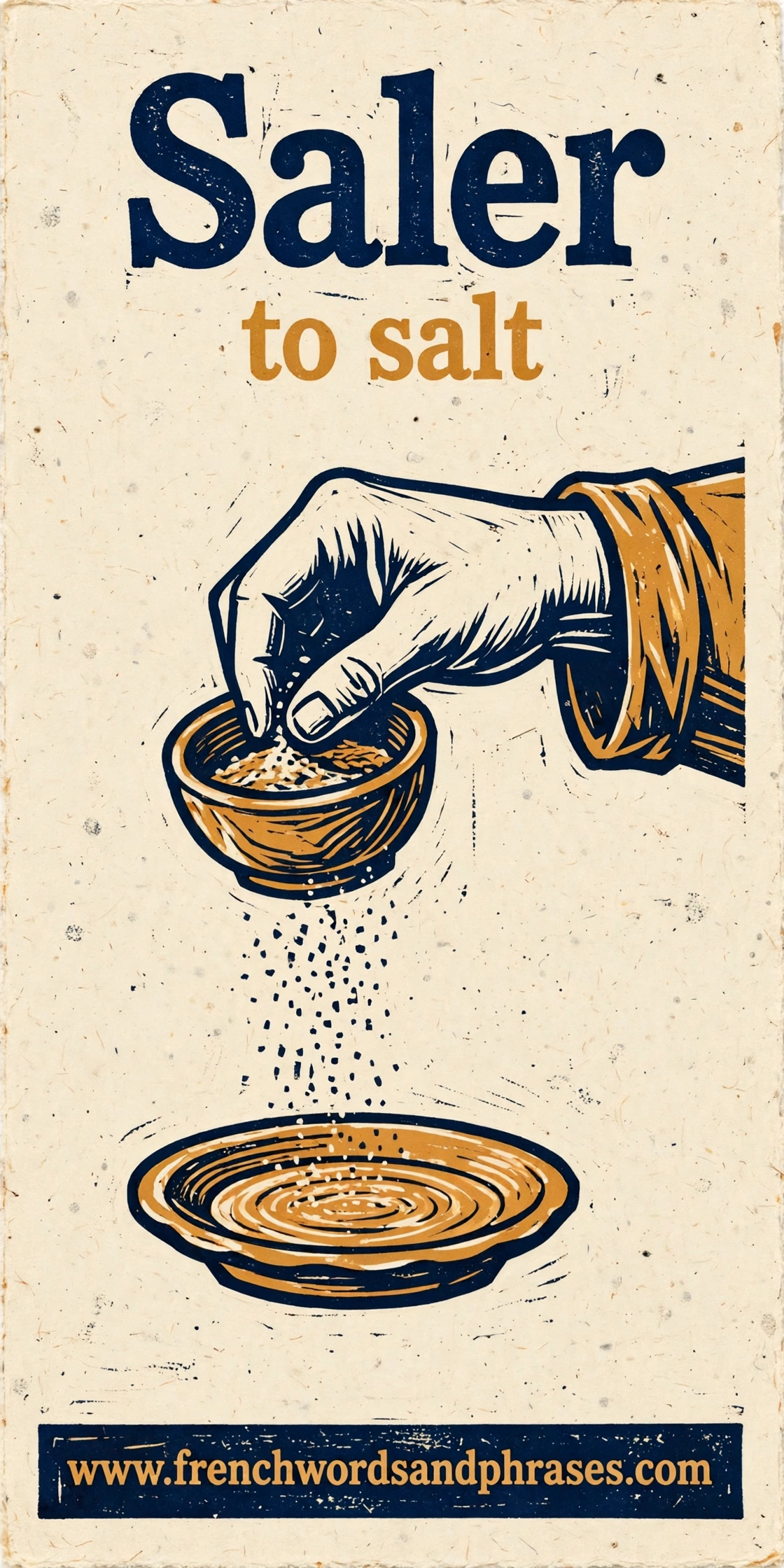
A French Word to Live By
How to Conjugate Saler in French
/sa.le/
Saler means to salt — to add salt to food.
A pinch over the pasta water, a careful hand over the roast, chips salted the second they leave the fryer — saler is the verb of the oldest seasoning in the world, the one that makes food taste like itself.
In this guide, you’ll learn how to conjugate saler in all the major French tenses and moods. Explore complete conjugation tables, French examples, English translations, and practice quizzes.
Understanding the French Verb Saler
Saler is a regular French verb belonging to the first group of verbs, those ending in -er.
It means to salt, to add salt to. It is commonly used for salting pasta water, soups, sauces and meat before cooking, for salting chips straight from the fryer, for curing ham and fish in salt, and in winter for salting icy roads — saler les routes, to grit the roads.
Verb classification: First group (-er)
Auxiliary verb: Avoir
Past participle: salé
Present participle: salant
English equivalents: To salt, to add salt to; to cure in salt; (familiar) to pad the bill — saler l’addition.
One important detail: saler seasons, but it also preserves — generations salaient le jambon, salted the ham to keep it all winter. In familiar speech it turns cheeky: saler l’addition is to pad the bill, and une note salée is a hefty one. Its family is on every table: le sel is the salt, la salière the salt cellar, and salé describes both the dish and, figuratively, a risqué joke.
Experience the Word
Saler is the verb of the pinch — a few grains between finger and thumb that decide whether a dish sings or stays silent.
Imagine a cook in Naples tasting the pasta water and nodding: it should taste like the sea, as the old rule says. Too little salt and no sauce can save the dish; that judgment, made in one second, is saler done well.
Nothing has been added but a pinch. The food has been salé — and it tastes like itself, only more.
How to Conjugate Saler: Complete French Conjugation Guide
Let’s explore every major conjugation of saler, beginning with the indicative mood.
How to Conjugate Saler in the Indicative Mood
The indicative mood is used to express facts, observations, actions, and events.
How to Conjugate Saler in the Present Tense (Présent)
Used for actions happening now, habitual actions, and general truths.
| Subject | Conjugation |
|---|---|
| je | sale |
| tu | sales |
| il / elle | sale |
| nous | salons |
| vous | salez |
| ils / elles | salent |
Example
Elle sale l’eau avant de mettre les pâtes.
She salts the water before adding the pasta.
Quick Quiz 1
Complete the sentence:
Nous ______ la viande des deux côtés.
Reveal the answer
salons
Nous salons la viande des deux côtés.
We salt the meat on both sides.
How to Conjugate Saler in the Passé Composé
Used for completed actions in the past. Saler takes the auxiliary verb avoir.
| Subject | Conjugation |
|---|---|
| j’ | ai salé |
| tu | as salé |
| il / elle | a salé |
| nous | avons salé |
| vous | avez salé |
| ils / elles | ont salé |
Example
Il a salé la soupe deux fois par erreur.
He salted the soup twice by mistake.
How to Conjugate Saler in the Imparfait (Imperfect Tense)
Used for habitual past actions, descriptions, and ongoing situations in the past.
| Subject | Conjugation |
|---|---|
| je | salais |
| tu | salais |
| il / elle | salait |
| nous | salions |
| vous | saliez |
| ils / elles | salaient |
Example
Autrefois, on salait le jambon pour le conserver tout l’hiver.
In the old days, people salted ham to keep it all winter.
Quick Quiz 2
Choose the correct form:
He salted the soup twice.
Il ______ la soupe deux fois. (a salé / est salé)
Reveal the answer
a salé
Il a salé la soupe deux fois.
Saler takes avoir.
How to Conjugate Saler in the Plus-que-parfait
Used to describe an action that had already been completed before another past event.
| Subject | Conjugation |
|---|---|
| j’ | avais salé |
| tu | avais salé |
| il / elle | avait salé |
| nous | avions salé |
| vous | aviez salé |
| ils / elles | avaient salé |
Example
Nous avions salé la viande avant l’arrivée des invités.
We had salted the meat before the guests arrived.
How to Conjugate Saler in the Passé Simple
Primarily used in formal writing, literature, and historical narratives. It is rarely used in everyday conversation.
| Subject | Conjugation |
|---|---|
| je | salai |
| tu | salas |
| il / elle | sala |
| nous | salâmes |
| vous | salâtes |
| ils / elles | salèrent |
Example
Le cuisinier sala le bouillon et le goûta.
The cook salted the broth and tasted it.
How to Conjugate Saler in the Passé Antérieur
A literary tense used to express an action completed immediately before another past action, generally in the passé simple.
| Subject | Conjugation |
|---|---|
| j’ | eus salé |
| tu | eus salé |
| il / elle | eut salé |
| nous | eûmes salé |
| vous | eûtes salé |
| ils / elles | eurent salé |
Example
Quand elle eut salé les frites, elle les servit aussitôt.
When she had salted the chips, she served them at once.
How to Conjugate Saler in the Future Tense (Futur Simple)
Used to describe actions that will take place in the future.
| Subject | Conjugation |
|---|---|
| je | salerai |
| tu | saleras |
| il / elle | salera |
| nous | salerons |
| vous | salerez |
| ils / elles | saleront |
Example
Tu saleras les tomates au dernier moment.
You will salt the tomatoes at the last moment.
How to Conjugate Saler in the Futur Antérieur (Future Perfect)
Used for an action that will have been completed before a particular point in the future.
| Subject | Conjugation |
|---|---|
| j’ | aurai salé |
| tu | auras salé |
| il / elle | aura salé |
| nous | aurons salé |
| vous | aurez salé |
| ils / elles | auront salé |
Example
À midi, il aura salé et poivré le rôti.
By noon, he will have salted and peppered the roast.
How to Conjugate Saler in the Near Future (Futur Proche)
Used to describe something that is going to happen soon. Formed with aller + infinitive.
| Subject | Conjugation |
|---|---|
| je | vais saler |
| tu | vas saler |
| il / elle | va saler |
| nous | allons saler |
| vous | allez saler |
| ils / elles | vont saler |
Example
Je vais saler l’eau, les pâtes attendent.
I am going to salt the water, the pasta is waiting.
How to Conjugate Saler in the Conditional Mood
The conditional mood expresses what would happen under certain circumstances. It is also frequently used to make polite requests or express wishes.
How to Conjugate Saler in the Present Conditional
| Subject | Conjugation |
|---|---|
| je | salerais |
| tu | salerais |
| il / elle | salerait |
| nous | salerions |
| vous | saleriez |
| ils / elles | saleraient |
Example
Je salerais un peu plus, mais les enfants n’aiment pas ça.
I would salt a little more, but the children do not like it.
How to Conjugate Saler in the Past Conditional
| Subject | Conjugation |
|---|---|
| j’ | aurais salé |
| tu | aurais salé |
| il / elle | aurait salé |
| nous | aurions salé |
| vous | auriez salé |
| ils / elles | auraient salé |
Example
Elle aurait salé la soupe si elle avait trouvé la salière.
She would have salted the soup if she had found the salt cellar.
Saler in the Literary Past Conditional Form
This less common literary form uses the imperfect subjunctive of avoir.
| Subject | Conjugation |
|---|---|
| j’ | eusse salé |
| tu | eusses salé |
| il / elle | eût salé |
| nous | eussions salé |
| vous | eussiez salé |
| ils / elles | eussent salé |
Example
Il eût salé le plat avec plus de prudence.
He would have salted the dish more cautiously.
How to Conjugate Saler in the Subjunctive Mood
The subjunctive is used to express wishes, emotions, doubts, necessity, and uncertainty. It frequently follows expressions such as il faut que (it is necessary that) or bien que (although).
How to Conjugate Saler in the Present Subjunctive
| Subject | Conjugation |
|---|---|
| que je | sale |
| que tu | sales |
| qu’il / qu’elle | sale |
| que nous | salions |
| que vous | saliez |
| qu’ils / qu’elles | salent |
Example
Il faut que tu sales l’eau des pâtes généreusement.
You must salt the pasta water generously.
Quick Quiz 3
Complete the sentence using the subjunctive:
Il faut que vous ______ les frites.
Reveal the answer
saliez
Il faut que vous saliez les frites.
You must salt the chips.
How to Conjugate Saler in the Imperfect Subjunctive
A literary tense, rarely encountered in modern spoken French.
| Subject | Conjugation |
|---|---|
| que je | salasse |
| que tu | salasses |
| qu’il / qu’elle | salât |
| que nous | salassions |
| que vous | salassiez |
| qu’ils / qu’elles | salassent |
Example
Je craignais qu’il salât trop la sauce.
I feared he might salt the sauce too much.
How to Conjugate Saler in the Pluperfect Subjunctive
A literary construction used to express an action completed before another past action.
| Subject | Conjugation |
|---|---|
| que j’ | eusse salé |
| que tu | eusses salé |
| qu’il / qu’elle | eût salé |
| que nous | eussions salé |
| que vous | eussiez salé |
| qu’ils / qu’elles | eussent salé |
Example
Il regrettait que nous eussions salé le poisson deux fois.
He regretted that we had salted the fish twice.
How to Conjugate Saler in the Past Subjunctive
| Subject | Conjugation |
|---|---|
| que j’ | aie salé |
| que tu | aies salé |
| qu’il / qu’elle | ait salé |
| que nous | ayons salé |
| que vous | ayez salé |
| qu’ils / qu’elles | aient salé |
Example
Je suis content que tu aies salé les frites, elles sont parfaites.
I am glad you salted the chips, they are perfect.
How to Conjugate Saler in the Imperative
The imperative is used to give commands, instructions, invitations, or suggestions. Subject pronouns are omitted.
How to Conjugate Saler in the Present Imperative
| Person | Conjugation |
|---|---|
| (tu) | sale |
| (nous) | salons |
| (vous) | salez |
Example
Sale l’eau avant de mettre le riz !
Salt the water before adding the rice!
Quick Quiz 4
How would you say Salt the water (tu form)?
Reveal the answer
Sale l’eau !
French Participles of Saler
Participles are verb forms that can be used in compound tenses and other grammatical constructions.
Present Participle of Saler
salant
En salant la soupe, il a fait tomber la salière dedans.
While salting the soup, he dropped the salt cellar into it.
Past Participle of Saler
salé
Salée à point, la soupe fut applaudie par toute la famille.
Salted just right, the soup was applauded by the whole family.
Saler in Everyday French: Real-Life Examples
Now that you know the conjugations, let’s see how saler appears in everyday French.
Example 1 — Present
Je sale toujours l’eau des pâtes.
I always salt the pasta water.
Example 2 — Passé composé
Elle a salé le rôti avant de l’enfourner.
She salted the roast before putting it in the oven.
Example 3 — Imparfait
On salait les routes quand il gelait.
They used to salt the roads when it froze.
Example 4 — Future
Nous salerons les frites à la sortie de la friteuse.
We will salt the chips as they come out of the fryer.
Example 5 — Conditional
Tu salerais un peu moins, s’il te plaît ?
Would you salt a little less, please?
Example 6 — Imperative
Salez la viande des deux côtés !
Salt the meat on both sides!
Beyond Translation: The Meaning of Saler
English uses one word, salt, for the grains and the action; French splits them — le sel sits in the cellar, saler does the work.
Salt was once money.
The Roman soldiers’ salarium — salt money — became the English word salary, and the French salaire. Every time you salez la soupe, you are handling the seasoning that once paid armies.
How to Remember the French Verb Saler
Remember it this way: Saler is about salting — pasta water, soups and winter roads.
- Salt goes in with saler — saler l’eau des pâtes, saler la soupe, saler les frites.
- Saler l’addition — to pad the bill: the same verb, a painful seasoning.
- Regular -er: je sale, nous salons, past participle salé.
The key idea is salting — pasta water, soups and winter roads.
Test Your Knowledge of Saler
Let’s see how much you’ve learned. Try answering these questions before revealing the answers.
Question 1
How do you say I always salt the pasta water in French?
Reveal the answer
Je sale toujours l’eau des pâtes.
Question 2
What does saler l’addition mean in familiar French?
Reveal the answer
To pad the bill — to make it painfully salty.
Question 3
Translate: She salted the roast before putting it in the oven.
Reveal the answer
Elle a salé le rôti avant de l’enfourner.
Question 4
What is the past participle of saler?
Reveal the answer
Salé.
Question 5
Complete the sentence:
Il faut que tu ______ l’eau des pâtes.
Reveal the answer
sales
Il faut que tu sales l’eau des pâtes.
You must salt the pasta water.
Your Final Challenge
Can You Use It?
How would you say this in French?
She salts the water, and the pasta will finally have flavour.
Reveal the answer
Elle sale l’eau, et les pâtes auront enfin du goût.
She salts the water, and the pasta will finally have flavour.
A little French. A little curiosity. A richer everyday life.
LEARN FRENCH ONE WORD AT A TIME




