A French Word to Live By
Translate Sable to English
/sabl/
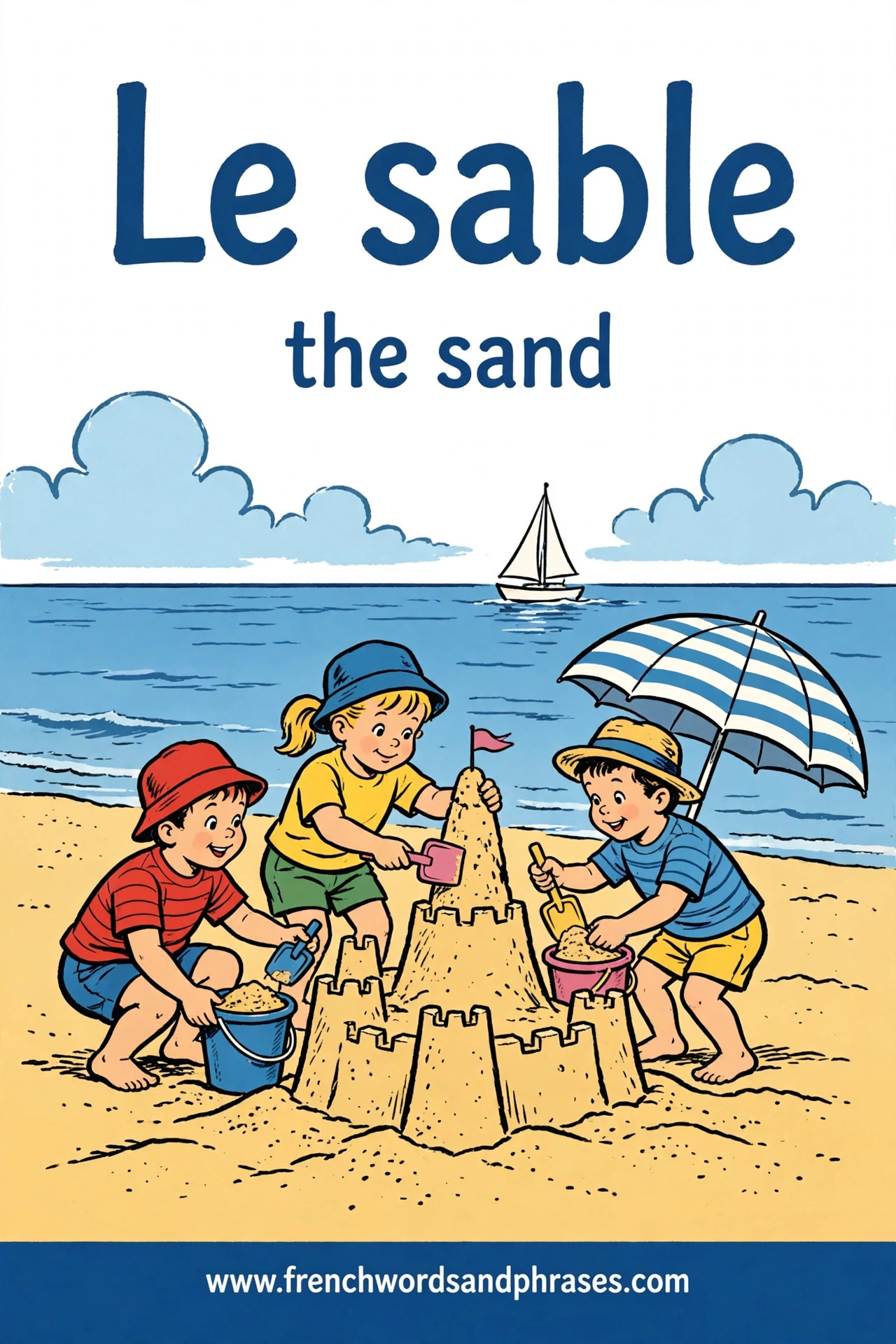
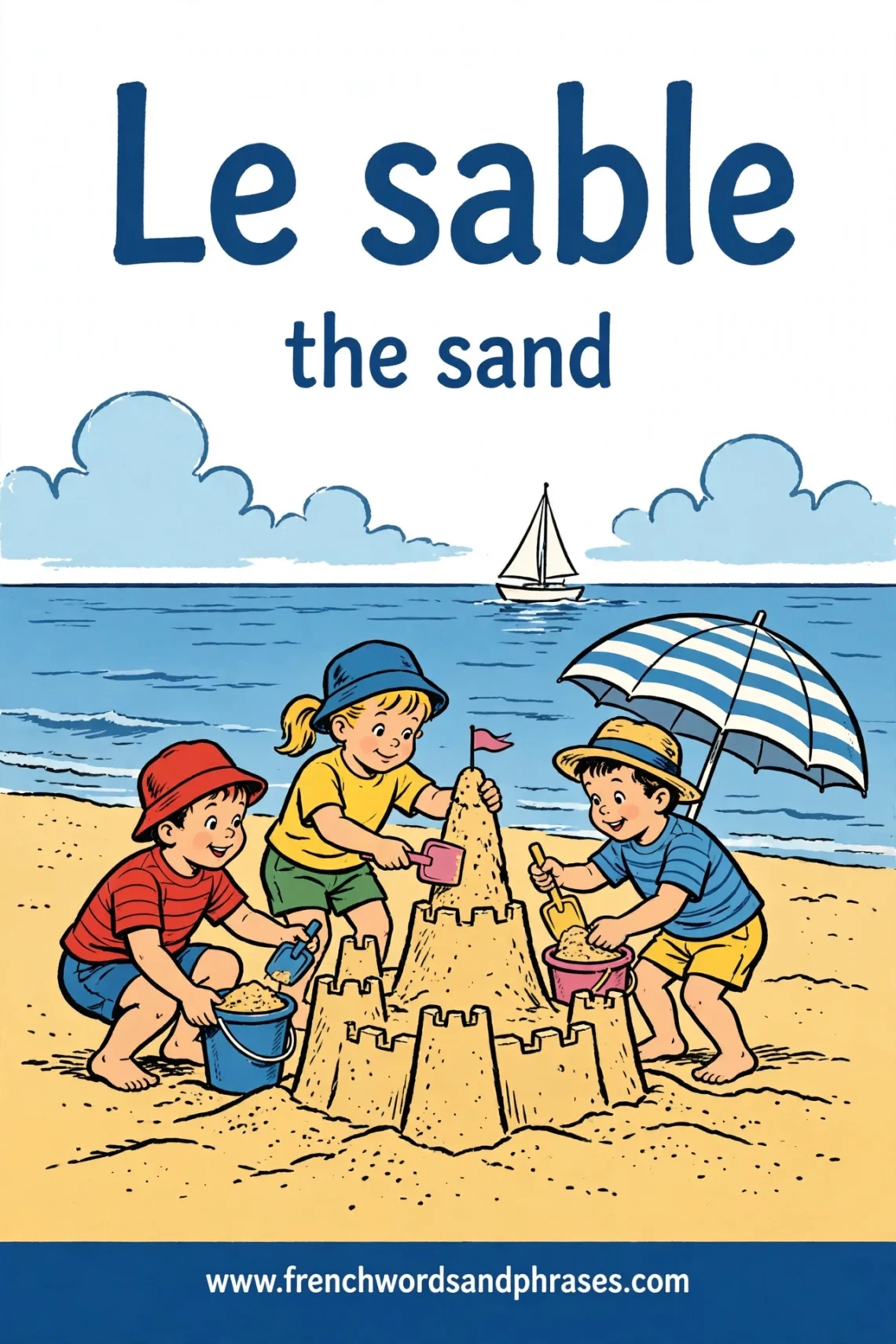
Le sable means the sand.
Warm grains running through a child’s fingers, dunes at the edge of the sea, the hourglass counting quietly on the desk: le sable, the sand — stone ground down by time until it flows like water.
In this guide, you’ll learn what sable means in English, how to use it with its articles, how to form its plural, and how it appears in everyday French. Explore French examples, English translations, and practice quizzes.
Understanding the French Noun Sable
Sable is a masculine French noun, learned with its article: le sable, du sable. Sand is a mass in French, counted by grains and handfuls rather than by pieces. As a colour word it also works as an invariable adjective: une robe sable, a sand-coloured dress.
It means sand — the fine grains of beaches, deserts and playgrounds: le sable fin, fine sand, une plage de sable, a sandy beach, un château de sable, a sandcastle. It lends itself to famous pictures: les sables mouvants, quicksand, un grain de sable, a grain of sand — and, figuratively, the tiny thing that jams a big machine. Builders know le sable as an ingredient of concrete and mortar.
Gender: Masculine — le sable
Definite article: le — le sable (the sand)
Indefinite article: du — du sable (some sand); un is rare, sand is a mass
Plural: les sables — used for stretches of sand: les sables du désert
Spelling note: also a colour: une robe sable, a sand-coloured dress (invariable)
Famous image: les sables mouvants — quicksand
English equivalents: The sand.
Because sand is a mass noun, French says du sable, some sand, and counts it in grains and handfuls: un grain de sable, une poignée de sable. At the beach, children build des châteaux de sable; in politics and machinery, un grain de sable dans l’engrenage is the small hitch that stops everything.
Experience the Word
Sable is stone that learned patience — mountains worn grain by grain until they pour through your fingers.
Imagine the dune at the end of the beach path, higher than the pines, warm on its sunny side. A child climbs it, slides down shrieking, and climbs again: le sable keeps no footprint for long, and forgives every fall.
You have not just named a material. You have named time made visible — le sable, the sand, the hourglass’s slow river.
How to Use Sable in French: Complete Guide
Let’s explore how sable works in French, beginning with its articles — le sable, du sable, un grain de sable.
Sable with the Definite Article (Le, Les)
Used for sand in general, or a known stretch of it — the beach’s, the desert’s.
| Form | French |
|---|---|
| Masculine singular | le sable |
| Plural | les sables |
Example
Le sable de cette plage est presque blanc.
The sand on this beach is almost white.
Sable with the Partitive (Du sable…)
Sand is a mass: French takes some of it with du, and measures it in grains and handfuls.
| Quantity | French |
|---|---|
| some sand | du sable |
| a grain of sand | un grain de sable |
| a handful of sand | une poignée de sable |
| a lot of sand | beaucoup de sable |
| no sand (after negation) | pas de sable |
Example
Il y a du sable partout dans la voiture.
There is sand everywhere in the car.
Sable with Kinds and Places (Fin, Chaud, Mouvant…)
Sand changes its adjectives with its places — beach, desert, building site.
| Kind | French |
|---|---|
| fine sand | le sable fin |
| hot sand | le sable chaud |
| wet sand | le sable mouillé |
| quicksand | les sables mouvants |
| a sandy beach | une plage de sable |
Example
Les enfants adorent le sable fin de cette crique.
The children love the fine sand of this cove.
Quick Quiz 1
Complete the sentence:
Il y a ______ sable dans ses chaussures. (some)
Reveal the answer
du
Il y a du sable dans ses chaussures.
There is sand in his shoes — the partitive du, because sand is a mass.
The Plural of Sable
Les sables names stretches and expanses — the sands of a desert, of a shore.
| Number | French |
|---|---|
| Singular | le sable |
| Plural | les sables |
Example
Les sables du désert changent de forme avec le vent.
The sands of the desert change shape with the wind.
Sable with Possessive Adjectives (Mon, Ton, Son…)
Possessives agree with the noun: sable is masculine, so mon, ton, son in the singular.
| Owner | French |
|---|---|
| my | mon sable |
| your (tu) | ton sable |
| his / her | son sable |
| our | notre sable |
| your (vous) | votre sable |
| their | leur sable |
Example
Le chat a renversé son sable partout.
The cat spilled its litter (its sand) everywhere.
Quick Quiz 2
Complete the sentence:
Un grain de ______ a bloqué la machine. (sand)
Reveal the answer
sable
Un grain de sable a bloqué la machine.
A grain of sand jammed the machine — the famous figurative grain.
Sable with Demonstrative Adjectives (Ce, Ces)
Used to point: ce sable, this sand — warm, white, or full of shells.
| Form | French |
|---|---|
| Masculine singular | ce sable |
| Plural | ces sables |
Example
Ce sable brûle les pieds à midi.
This sand burns your feet at midday.
Sable with Adjectives
Adjectives agree with sable — masculine singular: du sable fin, le sable chaud.
| Adjective | With Sable |
|---|---|
| fin (fine) | le sable fin |
| chaud (hot) | le sable chaud |
| mouillé (wet) | le sable mouillé |
| blanc (white) | le sable blanc |
| mouvant (shifting — quicksand) | les sables mouvants |
Example
Le sable chaud glisse entre les orteils.
The hot sand slips between your toes.
Quick Quiz 3
Complete the sentence:
Attention aux sables ______ près de la rivière. (shifting)
Reveal the answer
mouvants
Attention aux sables mouvants près de la rivière.
Beware of the quicksand near the river — mouvants, masculine plural.
Everyday Expressions with Sable
Beaches, hourglasses and machinery — the sable phrases of daily life.
| Expression | In English |
|---|---|
| un château de sable | a sandcastle |
| les sables mouvants | quicksand |
| un grain de sable | a grain of sand; (figurative) a small hitch |
| un marchand de sable | the Sandman (who brings sleep) |
| être sur le sable | to be broke, stranded (familiar) |
Example
Le marchand de sable est passé, les enfants bâillent.
The Sandman has been, the children are yawning.
Words from the Same Family as Sable
Grains and shores — the words that travel with sable.
| French | In English |
|---|---|
| sablé | shortbread (the crumbly biscuit); also sanded, gritted |
| une dune | a dune |
| un grain | a grain |
| le gravier | gravel — sand’s bigger brother |
| un sablier | an hourglass |
Example
Elle retourne le sablier et attend trois minutes.
She turns the hourglass and waits three minutes.
Quick Quiz 4
What are les sables mouvants?
Reveal the answer
Quicksand — the shifting sands that swallow what steps on them.
Ne t’approche pas des sables mouvants.
Don’t go near the quicksand.
Sable in Everyday French: Real-Life Examples
Now that you know the word, let’s see how sable appears in everyday French.
Example 1 — At the beach
Les enfants construisent un château de sable.
The children are building a sandcastle.
Example 2 — After the beach
Il y a du sable partout dans la voiture.
There is sand everywhere in the car.
Example 3 — The desert
Les sables du désert brillent sous le soleil.
The sands of the desert shine under the sun.
Example 4 — The playground
Le petit joue dans le bac à sable.
The little boy is playing in the sandpit.
Example 5 — The hitch
Un grain de sable a retardé tout le projet.
A small hitch delayed the whole project.
Example 6 — Bedtime
Le marchand de sable est passé, au lit !
The Sandman has been — to bed!
Beyond Translation: The Meaning of Sable
Sable is the word of the hourglass and the dune: matter at its most patient. French poetry loves it because it measures what cannot be held — time, tides, fortunes. The figurative grain de sable does the opposite work: the smallest thing in the world, stopping the largest machine. And every French child knows the marchand de sable, the Sandman, whose grains in the eyes mean sleep — le sable is in the language of bedtime itself.
To say sable is to hold a mountain that fits in your hand.
It evokes the warm beach, the desert wind and the quiet ticking of the sablier — stone, time and sleep in one small word.
How to Remember the French Noun Sable
Remember it this way: Sable is the sand — masculine, a mass noun: le sable, du sable, and counted in grains.
- Always masculine — le sable, du sable, mon sable.
- A mass — some sand is du sable; one unit is un grain de sable.
- The famous image — les sables mouvants, quicksand.
The key idea is le sable — the sand, masculine; un grain de sable = a grain of sand.
Test Your Knowledge of Sable
Let’s see how much you’ve learned. Try answering these questions before revealing the answers.
Question 1
Is sable masculine or feminine?
Reveal the answer
Masculine — le sable, du sable.
Question 2
How do you say some sand?
Reveal the answer
Du sable — sand is a mass noun and takes the partitive.
Question 3
Translate: The children are building a sandcastle.
Reveal the answer
Les enfants construisent un château de sable.
Question 4
What is un grain de sable in a machine?
Reveal the answer
A small hitch — the tiny grain that jams the works, in the figurative phrase.
Question 5
Complete the sentence:
______ sable de cette plage est très fin. (the)
Reveal the answer
Le
Le sable de cette plage est très fin.
The sand on this beach is very fine.
Your Final Challenge
Can You Use It?
How would you say this in French?
“There is sand everywhere in the car.”
Reveal the answer
Il y a du sable partout dans la voiture.
There is sand everywhere in the car.
A little French. A little curiosity. A richer everyday life.
LEARN FRENCH ONE WORD AT A TIME