A French Word to Live By
Translate Ridé to English
/ʁide/
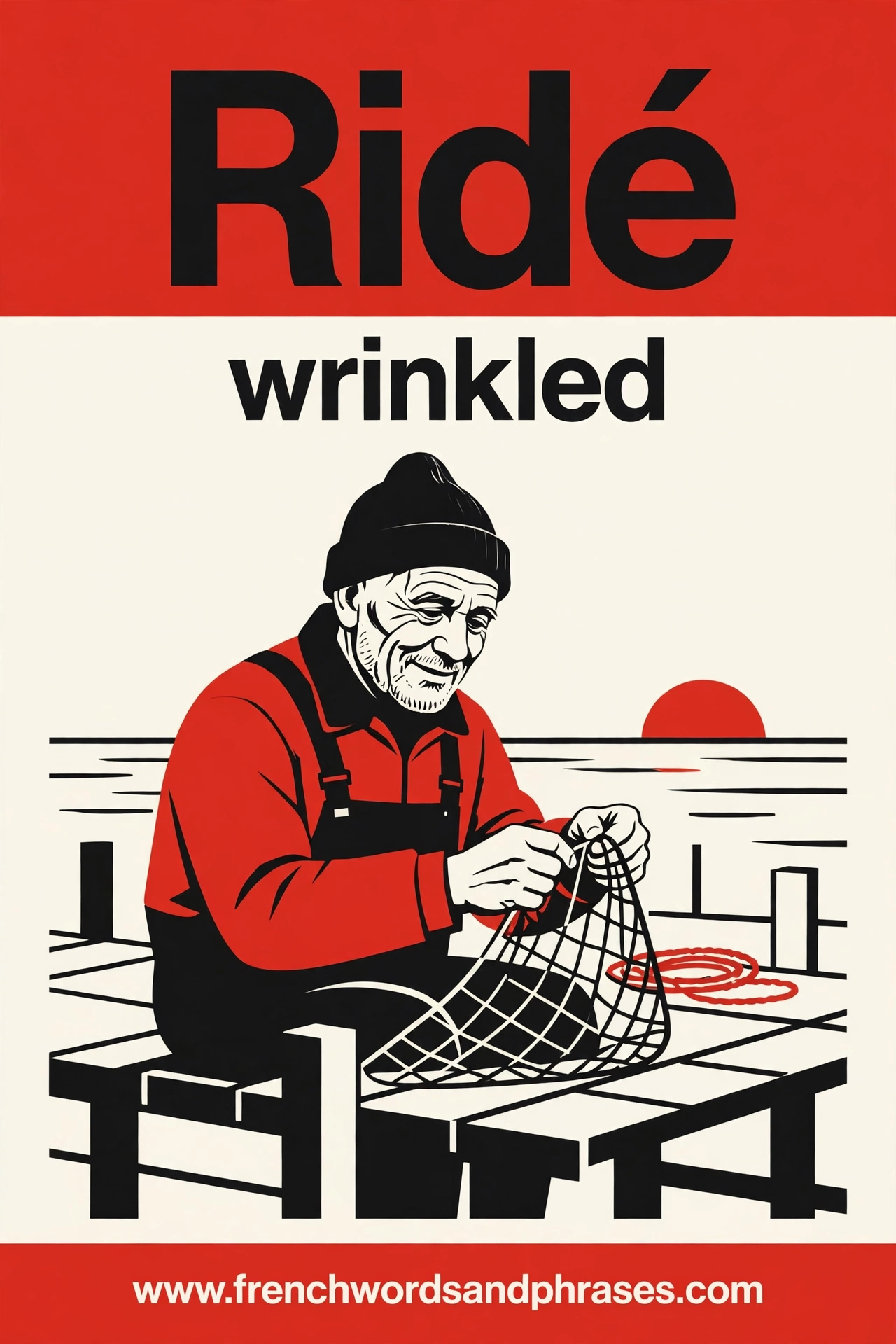
Ridé means wrinkled.
At the end of the orchard path stands a tree older than the house, and at its foot, the last apple of October — small, golden, its skin drawn into fine lines like a face that has smiled all summer. The farmer turns it in his hand and smiles himself. The apple is ridé, and so, a little, is he.
In this guide, you’ll learn what ridé means in English, how its feminine is formed, why it stands after the noun, and how the same small lines appear on faces, on fruit and on the surface of water. Explore French examples, English translations, and practice quizzes.
Understanding the French Adjective Ridé
Ridé is a French adjective of appearance — the adjective of fine lines, built on the noun une ride, a wrinkle or a ripple. It agrees like a regular -é adjective: ridé, ridée, ridés, ridées.
It means wrinkled — of a face marked by fine lines (un visage ridé), of fruit whose skin has tightened (une pomme ridée), and even of water stirred into tiny waves: une surface ridée par le vent, a surface rippled by the wind. It is the gentle word for lines that time and weather draw.
Type: Adjective of appearance — wrinkles and fine lines
Answers the question: What does it look like? — wrinkled
Changes form: Yes — ridé, ridée, ridés, ridées
English equivalents: Wrinkled; lined; rippled (of water).
One important usage detail: ridé stands AFTER the noun — un visage ridé. For clothes that need ironing, French uses a different word, froissé: ridé is for skin, fruit and water, not for shirts.
Experience the Word
Ridé is the adjective of the map of a life — every line on a grandmother’s face is a road she has actually travelled.
Imagine her hands around a teacup, the skin fine as paper, each wrinkle placed by eighty years of work, weather and laughter. Nothing about those lines is a defect. They are the handwriting of the years.
You have not just described old skin. You have described time made visible.
How to Use Ridé in French: Complete Guide
Let’s explore how ridé works in French, beginning with the whole word on one card.
Ridé at a Glance
Before the details, here is the whole word on one card.
The Whole Word on One Card
Meaning, type, position and forms — ridé in four lines.
| Point | Ridé |
|---|---|
| Meaning | wrinkled |
| Type | adjective of appearance — wrinkles and fine lines |
| Usual position | after the noun — un visage ridé |
| Form | ridé / ridée / ridés / ridées |
Example
Il a un visage ridé et doux.
He has a wrinkled, gentle face.
The Four Forms of Ridé
Ridé agrees with the noun it describes. The feminine adds an e, the plurals add an s, and the sound never changes.
| Form | Ridé | Example |
|---|---|---|
| Masculine singular | ridé | un visage ridé — a wrinkled face |
| Feminine singular | ridée | une pomme ridée — a wrinkled apple |
| Masculine plural | ridés | des fronts ridés — wrinkled brows |
| Feminine plural | ridées | des mains ridées — wrinkled hands |
Example
Ses mains ridées tiennent la tasse avec soin.
Her wrinkled hands hold the cup carefully.
Quick Quiz 1
Which form of ridé goes with mains (feminine plural)?
Reveal the answer
ridées
Des mains ridées.
Wrinkled hands.
Ridée: The Feminine Just Adds an E
The feminine of ridé is formed the regular way: add an e and keep the é. The spelling changes; the sound stays exactly the same.
| Situation | Example |
|---|---|
| The rule | just add -e — ridé → ridée |
| The sound | ridé and ridée sound the same: /ʁide/ |
| Masculine plural | ridés — des visages ridés |
| Feminine plural | ridées — des pommes ridées |
Example
La vieille pomme ridée tombe dans l’herbe.
The old wrinkled apple falls into the grass.
Where Ridé Goes: After the Noun
Ridé follows the noun it describes, like most adjectives of appearance, and it appears just as naturally after être.
| Pattern | Example |
|---|---|
| After the noun | un visage ridé — a wrinkled face |
| After être | son front est ridé — his brow is wrinkled |
| With an adverb | légèrement ridé — slightly wrinkled |
| Before the noun | un ridé visage — not in everyday French |
Example
Le vieux pommier donne des pommes ridées et sucrées.
The old apple tree gives wrinkled, sweet apples.
Quick Quiz 2
How do you say ‘a wrinkled face’ — un ridé visage or un visage ridé?
Reveal the answer
un visage ridé
Ridé stands after the noun.
A wrinkled face.
More Wrinkled: Comparing with Ridé
Ridé compares the regular way, with plus, moins and aussi — and the superlative agrees as usual: le plus ridé, la plus ridée.
| Degree | Example |
|---|---|
| As wrinkled as | aussi ridé que — as wrinkled as |
| More wrinkled | plus ridé — more wrinkled |
| Less wrinkled | moins ridé — less wrinkled |
| The most wrinkled (masc.) | le plus ridé — le plus ridé des visages |
| The most wrinkled (fem.) | la plus ridée — la plus ridée des pommes |
Example
Cette pomme est plus ridée que l’autre.
This apple is more wrinkled than the other one.
Everyday Expressions with Ridé
Ridé belongs to the mirror, the orchard and the lakeside — and French has a lovely compliment built on its noun: to not take a single wrinkle is to not age a day.
| Expression | In English |
|---|---|
| un visage ridé | a wrinkled face |
| les rides | wrinkles (the noun) |
| une pomme ridée | a wrinkled apple |
| ne pas prendre une ride | to not age a day (not to take a single wrinkle) |
| ridé comme une vieille pomme | wrinkled like an old apple |
| l’eau ridée par le vent | water rippled by the wind |
Example
À quatre-vingts ans, elle n’a pas pris une ride.
At eighty, she hasn’t aged a day.
Quick Quiz 3
What does ne pas prendre une ride mean?
Reveal the answer
To not age a day
Ce village n’a pas pris une ride.
This village hasn’t aged a day.
Ridé and Its Neighbours
Ridé shares its mirror with lisse, its opposite, and with the words for skin that has lived in the sun — while froissé keeps to the laundry basket.
| French | In English |
|---|---|
| lisse | smooth — the opposite, of skin or surfaces |
| âgé | elderly — the polite word for the person |
| vieux | old — plain and direct |
| froissé | creased, crumpled — of clothes and paper |
| bronzé | tanned — the other souvenir the sun leaves on skin |
Example
Sa peau n’est plus lisse, elle est doucement ridée.
Her skin is no longer smooth, it is gently wrinkled.
Watch Out: The Traps Around Ridé
The traps here are a shirt that needs the wrong word, and a noun — le rideau, the curtain — that looks like family and is not.
| Trap | The truth |
|---|---|
| ridé vs froissé | a wrinkled shirt is une chemise froissée; ridé is for skin, fruit and water |
| le rideau | a curtain — nothing to do with wrinkles despite the look of the word |
| Agreement | hands are feminine plural: des mains ridées |
| Tone | ridé is descriptive, not rude — French often pairs it with doux, kind |
Example
Ta chemise est froissée, mais ton visage n’est pas ridé.
Your shirt is creased, but your face isn’t wrinkled.
Quick Quiz 4
Which word describes a shirt that needs ironing — ridé or froissé?
Reveal the answer
froissé
Une chemise froissée.
A creased shirt.
Ridé in Everyday French: Real-Life Examples
Now that you know the word, let’s see how ridé appears in everyday French.
Example 1 — At the market
Ces pommes ridées sont parfaites pour la compote.
These wrinkled apples are perfect for stewing.
Example 2 — A portrait
Le peintre dessine un visage ridé plein de bonté.
The painter draws a wrinkled face full of kindness.
Example 3 — By the lake
La surface du lac est ridée par un vent léger.
The surface of the lake is rippled by a light wind.
Example 4 — Family
Les mains ridées de grand-père racontent sa vie.
Grandfather’s wrinkled hands tell the story of his life.
Example 5 — A compliment
Elle a quatre-vingt-dix ans et n’a pas pris une ride.
She is ninety and hasn’t aged a day.
Example 6 — In the garden
Les feuilles ridées montrent que la plante a soif.
The wrinkled leaves show that the plant is thirsty.
Beyond Translation: The Meaning of Ridé
English says wrinkled for the meaning of ridé — a word most people would rather not hear about themselves. French is gentler with the idea: une ride is also a ripple on water, so a ridé face is lined the way a lake is lined by a light wind.
To call a face ridé is to read it, not to judge it.
That is why the finest compliment in this family costs nothing: tu n’as pas pris une ride — you haven’t taken a single wrinkle; you haven’t aged a day.
How to Remember the French Adjective Ridé
Remember it this way: Ridé is the adjective of fine lines — on faces, on fruit, on water — and it follows the noun with a regular feminine.
- You picture the ripple — une ride — because ridé lines are drawn like ripples.
- You put it after the noun — un visage ridé, une pomme ridée.
- You keep shirts for froissé — ridé belongs to skin, fruit and water.
The key idea is ridé stands after the noun, its feminine ridée just adds an e, and clothes take froissé instead.
Test Your Knowledge of Ridé
Let’s see how much you’ve learned. Try answering these questions before revealing the answers.
Question 1
What does ridé mean?
Reveal the answer
Wrinkled — marked with fine lines.
Question 2
What is the feminine of ridé?
Reveal the answer
ridée — just add an e.
Question 3
Translate: a wrinkled face.
Reveal the answer
Un visage ridé.
Question 4
Complete the sentence:
Ses mains ______ tiennent la tasse.
Reveal the answer
ridées
Ses mains ridées tiennent la tasse.
Her wrinkled hands hold the cup.
Question 5
What does ne pas prendre une ride mean?
Reveal the answer
To not age a day — literally, to not take a single wrinkle.
Your Final Challenge
Can You Use It?
How would you say this in French?
“Her grandmother has a kind, wrinkled face.”
Reveal the answer
Sa grand-mère a un visage ridé et doux.
Her grandmother has a kind, wrinkled face.
A little French. A little curiosity. A richer everyday life.
LEARN FRENCH ONE WORD AT A TIME