A French Word to Live By
How to Conjugate Réjouir in French
/ʁe.ʒwiʁ/
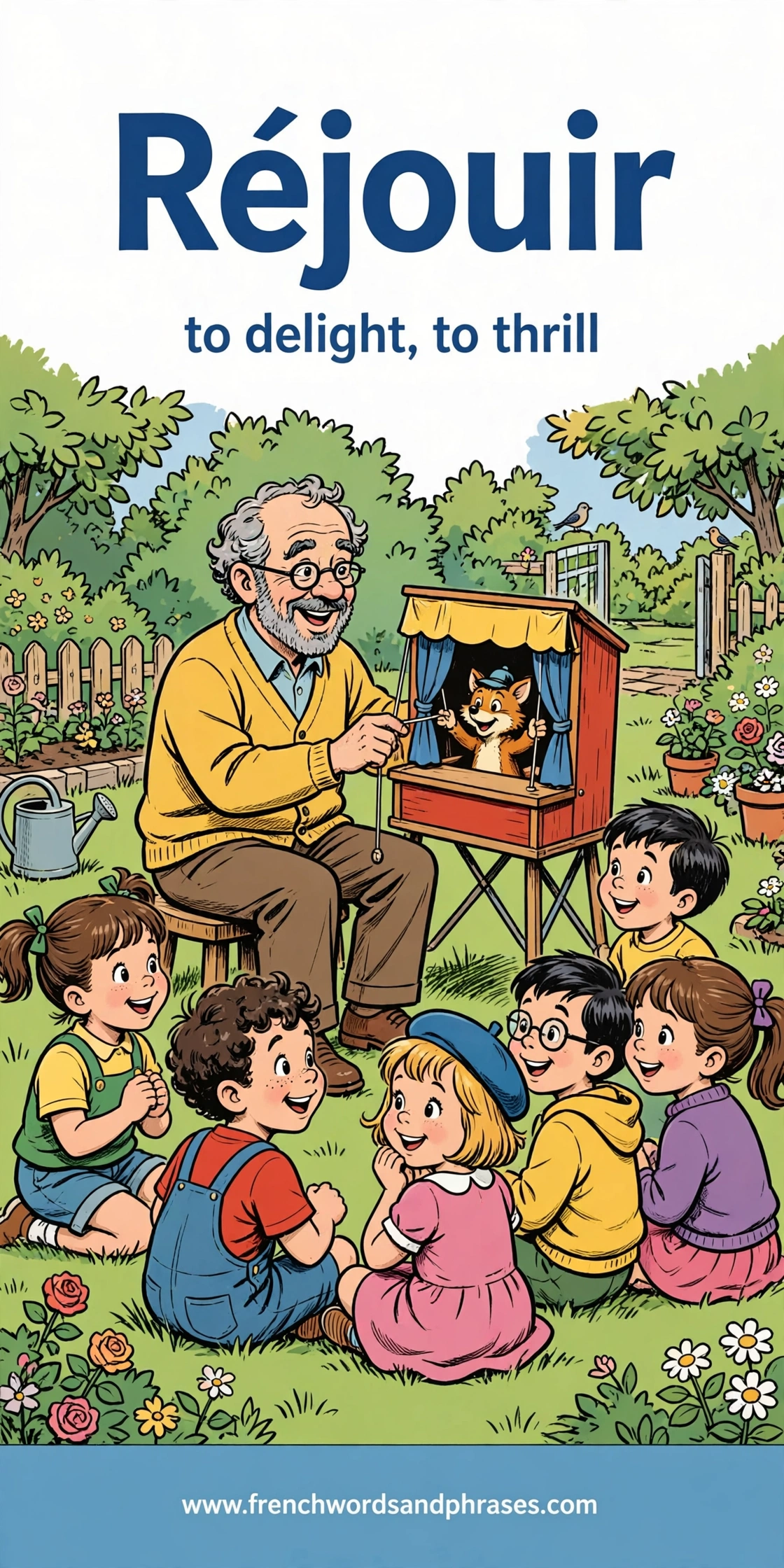
Réjouir means to delight, to thrill — to fill someone with joy, the way long-awaited news gladdens a heart.
A letter arriving with wonderful news, a son walking through the door after a year abroad, an unexpected prize announced at dinner — réjouir is the warm, slightly literary verb for making someone’s heart light up: whatever brings deep pleasure to another person réjouit them.
In this guide, you’ll learn how to conjugate réjouir in all the major French tenses and moods. Explore complete conjugation tables, French examples, English translations, and practice quizzes.
Understanding the French Verb Réjouir
Réjouir is a regular French verb belonging to the second group of verbs, those ending in -ir.
It means to delight, to thrill. It is warmer and more elevated than faire plaisir, and it belongs to letters, speeches and literature: votre lettre m’a réjoui is the classic opening of a grateful reply. The delight it names is deep rather than fleeting — good news, reunions, successes — and its present participle réjouissant has become an adjective meaning delightful, heartening: un spectacle réjouissant.
Verb classification: Second group (-ir)
Auxiliary verb: Avoir
Past participle: réjoui
Present participle: réjouissant
English equivalents: To delight, to gladden, to thrill; réjouir quelqu’un — to delight someone; réjouir le cœur de quelqu’un — to gladden someone’s heart; une nouvelle qui réjouit — heart-warming news; réjouissant — delightful, cheering (as an adjective).
One important detail: réjouir is a second-group -ir verb, so the -iss- appears wherever the ending is long: nous réjouissons, vous réjouissez, ils réjouissent, je réjouissais, que je réjouisse. The short forms stay lean: je réjouis, tu réjouis, il réjouit, past participle réjoui. This page is the transitive verb — to delight someone else. The reflexive se réjouir, to rejoice and be delighted oneself, has its own page. Note that the participle only agrees with a direct object placed before it: la nouvelle les a réjouis.
Experience the Word
Réjouir is joy delivered to someone else — you do not feel it yourself, you cause it, and you watch it land.
Imagine a small kitchen in the Auvergne. A grandmother opens a letter with shaking hands: her grandson, gone two years to Canada, will be home for Christmas. She reads the page twice, then presses it to her chest — cette lettre l’a réjouie more than any gift could; the whole street will hear about it by noon.
Nothing in the house has changed. She has been gladdened — réjouie — by nine lines of handwriting.
How to Conjugate Réjouir: Complete French Conjugation Guide
Let’s explore every major conjugation of réjouir, beginning with the indicative mood.
How to Conjugate Réjouir in the Indicative Mood
The indicative mood is used to express facts, observations, actions, and events.
How to Conjugate Réjouir in the Present Tense (Présent)
Used for actions happening now, habitual actions, and general truths.
| Subject | Conjugation |
|---|---|
| je | réjouis |
| tu | réjouis |
| il / elle | réjouit |
| nous | réjouissons |
| vous | réjouissez |
| ils / elles | réjouissent |
Example
Cette bonne nouvelle réjouit toute la famille.
This good news delights the whole family.
Quick Quiz 1
Complete the sentence:
Nous ______ nos invités avec ce dîner.
Reveal the answer
réjouissons
Nous réjouissons nos invités avec ce dîner.
We are delighting our guests with this dinner.
How to Conjugate Réjouir in the Passé Composé
Used for completed actions in the past. Réjouir takes the auxiliary verb avoir.
| Subject | Conjugation |
|---|---|
| j’ | ai réjoui |
| tu | as réjoui |
| il / elle | a réjoui |
| nous | avons réjoui |
| vous | avez réjoui |
| ils / elles | ont réjoui |
Example
Ton succès a réjoui tes anciens professeurs.
Your success delighted your former teachers.
How to Conjugate Réjouir in the Imparfait (Imperfect Tense)
Used for habitual past actions, descriptions, and ongoing situations in the past.
| Subject | Conjugation |
|---|---|
| je | réjouissais |
| tu | réjouissais |
| il / elle | réjouissait |
| nous | réjouissions |
| vous | réjouissiez |
| ils / elles | réjouissaient |
Example
Autrefois, ses histoires réjouissaient les enfants du village.
In the old days, his stories used to delight the village children.
Quick Quiz 2
Choose the correct form:
Your success delighted your teachers.
Ton succès ______ tes professeurs. (a réjoui / est réjoui)
Reveal the answer
a réjoui
Ton succès a réjoui tes professeurs.
Réjouir takes avoir.
How to Conjugate Réjouir in the Plus-que-parfait
Used to describe an action that had already been completed before another past event.
| Subject | Conjugation |
|---|---|
| j’ | avais réjoui |
| tu | avais réjoui |
| il / elle | avait réjoui |
| nous | avions réjoui |
| vous | aviez réjoui |
| ils / elles | avaient réjoui |
Example
Elle avait réjoui ses parents en annonçant son retour.
She had delighted her parents by announcing her return.
How to Conjugate Réjouir in the Passé Simple
Primarily used in formal writing, literature, and historical narratives. It is rarely used in everyday conversation.
| Subject | Conjugation |
|---|---|
| je | réjouis |
| tu | réjouis |
| il / elle | réjouit |
| nous | réjouîmes |
| vous | réjouîtes |
| ils / elles | réjouirent |
Example
Le retour du printemps réjouit les jardiniers de la vallée.
The return of spring gladdened the gardeners of the valley.
How to Conjugate Réjouir in the Passé Antérieur
A literary tense used to express an action completed immediately before another past action, generally in the passé simple.
| Subject | Conjugation |
|---|---|
| j’ | eus réjoui |
| tu | eus réjoui |
| il / elle | eut réjoui |
| nous | eûmes réjoui |
| vous | eûtes réjoui |
| ils / elles | eurent réjoui |
Example
Quand la lettre eut réjoui toute la maison, on ouvrit une bouteille.
When the letter had gladdened the whole household, they opened a bottle.
How to Conjugate Réjouir in the Future Tense (Futur Simple)
Used to describe actions that will take place in the future.
| Subject | Conjugation |
|---|---|
| je | réjouirai |
| tu | réjouiras |
| il / elle | réjouira |
| nous | réjouirons |
| vous | réjouirez |
| ils / elles | réjouiront |
Example
Cette décision réjouira les petits commerçants.
This decision will delight the small shopkeepers.
How to Conjugate Réjouir in the Futur Antérieur (Future Perfect)
Used for an action that will have been completed before a particular point in the future.
| Subject | Conjugation |
|---|---|
| j’ | aurai réjoui |
| tu | auras réjoui |
| il / elle | aura réjoui |
| nous | aurons réjoui |
| vous | aurez réjoui |
| ils / elles | auront réjoui |
Example
À Noël, ce cadeau aura réjoui trois générations.
By Christmas, this present will have delighted three generations.
How to Conjugate Réjouir in the Near Future (Futur Proche)
Used to describe something that is going to happen soon. Formed with aller + infinitive.
| Subject | Conjugation |
|---|---|
| je | vais réjouir |
| tu | vas réjouir |
| il / elle | va réjouir |
| nous | allons réjouir |
| vous | allez réjouir |
| ils / elles | vont réjouir |
Example
Je vais vous annoncer quelque chose qui va vous réjouir.
I am going to tell you something that will delight you.
How to Conjugate Réjouir in the Conditional Mood
The conditional mood expresses what would happen under certain circumstances. It is also frequently used to make polite requests or express wishes.
How to Conjugate Réjouir in the Present Conditional
| Subject | Conjugation |
|---|---|
| je | réjouirais |
| tu | réjouirais |
| il / elle | réjouirait |
| nous | réjouirions |
| vous | réjouiriez |
| ils / elles | réjouiraient |
Example
Un peu de soleil réjouirait les vacanciers.
A little sunshine would cheer the holidaymakers.
How to Conjugate Réjouir in the Past Conditional
| Subject | Conjugation |
|---|---|
| j’ | aurais réjoui |
| tu | aurais réjoui |
| il / elle | aurait réjoui |
| nous | aurions réjoui |
| vous | auriez réjoui |
| ils / elles | auraient réjoui |
Example
Ta visite aurait réjoui ta grand-mère.
Your visit would have delighted your grandmother.
Réjouir in the Literary Past Conditional Form
This less common literary form uses the imperfect subjunctive of avoir.
| Subject | Conjugation |
|---|---|
| j’ | eusse réjoui |
| tu | eusses réjoui |
| il / elle | eût réjoui |
| nous | eussions réjoui |
| vous | eussiez réjoui |
| ils / elles | eussent réjoui |
Example
Cette victoire eût réjoui le vieux roi.
This victory would have gladdened the old king.
How to Conjugate Réjouir in the Subjunctive Mood
The subjunctive is used to express wishes, emotions, doubts, necessity, and uncertainty. It frequently follows expressions such as il faut que (it is necessary that) or bien que (although).
How to Conjugate Réjouir in the Present Subjunctive
| Subject | Conjugation |
|---|---|
| que je | réjouisse |
| que tu | réjouisses |
| qu’il / qu’elle | réjouisse |
| que nous | réjouissions |
| que vous | réjouissiez |
| qu’ils / qu’elles | réjouissent |
Example
Je veux que ce repas réjouisse nos invités.
I want this meal to delight our guests.
Quick Quiz 3
Complete the sentence using the subjunctive:
Je veux que cette fête ______ les enfants.
Reveal the answer
réjouisse
Je veux que cette fête réjouisse les enfants.
I want this party to delight the children.
How to Conjugate Réjouir in the Imperfect Subjunctive
A literary tense, rarely encountered in modern spoken French.
| Subject | Conjugation |
|---|---|
| que je | réjouisse |
| que tu | réjouisses |
| qu’il / qu’elle | réjouît |
| que nous | réjouissions |
| que vous | réjouissiez |
| qu’ils / qu’elles | réjouissent |
Example
On ne s’attendait pas que la nouvelle réjouît tout le quartier.
Nobody expected the news to delight the whole neighbourhood.
How to Conjugate Réjouir in the Pluperfect Subjunctive
A literary construction used to express an action completed before another past action.
| Subject | Conjugation |
|---|---|
| que j’ | eusse réjoui |
| que tu | eusses réjoui |
| qu’il / qu’elle | eût réjoui |
| que nous | eussions réjoui |
| que vous | eussiez réjoui |
| qu’ils / qu’elles | eussent réjoui |
Example
Elle souriait comme si la lettre l’eût réjouie au-delà des mots.
She smiled as if the letter had delighted her beyond words.
How to Conjugate Réjouir in the Past Subjunctive
| Subject | Conjugation |
|---|---|
| que j’ | aie réjoui |
| que tu | aies réjoui |
| qu’il / qu’elle | ait réjoui |
| que nous | ayons réjoui |
| que vous | ayez réjoui |
| qu’ils / qu’elles | aient réjoui |
Example
Je suis heureux que ce prix vous ait réjoui.
I am happy that this prize delighted you.
How to Conjugate Réjouir in the Imperative
The imperative is used to give commands, instructions, invitations, or suggestions. Subject pronouns are omitted.
How to Conjugate Réjouir in the Present Imperative
| Person | Conjugation |
|---|---|
| (tu) | réjouis |
| (nous) | réjouissons |
| (vous) | réjouissez |
Example
Réjouis tes parents, écris-leur plus souvent !
Delight your parents, write to them more often!
Quick Quiz 4
How would you say Delight us with a song (tu form)?
Reveal the answer
Réjouis-nous avec une chanson !
French Participles of Réjouir
Participles are verb forms that can be used in compound tenses and other grammatical constructions.
Present Participle of Réjouir
réjouissant
En réjouissant ses élèves par ses blagues, le professeur rend la grammaire supportable.
By delighting his pupils with his jokes, the teacher makes grammar bearable.
Past Participle of Réjouir
réjoui
Réjouis par la nouvelle, ils ont ouvert le champagne.
Delighted by the news, they opened the champagne.
Réjouir in Everyday French: Real-Life Examples
Now that you know the conjugations, let’s see how réjouir appears in everyday French.
Example 1 — Present
Cette nouvelle réjouit tout le monde.
This news delights everyone.
Example 2 — Passé composé
Ton cadeau a réjoui les enfants.
Your present delighted the children.
Example 3 — Imparfait
Ses chansons réjouissaient le village entier.
His songs used to delight the whole village.
Example 4 — Future
Ce spectacle réjouira petits et grands.
This show will delight young and old alike.
Example 5 — Conditional
Ta présence réjouirait ta mère.
Your being here would delight your mother.
Example 6 — Imperative
Réjouis-nous avec une de tes histoires !
Delight us with one of your stories!
Beyond Translation: The Meaning of Réjouir
English rejoice and French réjouir are the same word twice borrowed — both descend from Old French esjouir, built on Latin gaudere, to rejoice, which also gave French la joie and English joy.
Réjouir is literally to joy someone.
Its noun, la réjouissance, means merrymaking: les réjouissances publiques are the official festivities — fireworks, dances and all — that follow a royal wedding or a national victory.
How to Remember the French Verb Réjouir
Remember it this way: Réjouir is about a grandmother’s face lighting up over a letter.
- Second-group -ir: the -iss- appears in the long forms — nous réjouissons, je réjouissais, que je réjouisse.
- Transitive here: réjouir quelqu’un is to delight someone else; to be delighted yourself is se réjouir.
- Warmer than faire plaisir — the verb of letters and good news: votre lettre m’a réjoui.
The key idea is a grandmother’s face lighting up over a letter.
Test Your Knowledge of Réjouir
Let’s see how much you’ve learned. Try answering these questions before revealing the answers.
Question 1
What is the difference between réjouir and se réjouir?
Reveal the answer
Réjouir quelqu’un is to delight someone else; se réjouir is to rejoice, to be delighted oneself.
Question 2
How do you say This good news delights the whole family in French?
Reveal the answer
Cette bonne nouvelle réjouit toute la famille.
Question 3
Translate: Your visit would have delighted your grandmother.
Reveal the answer
Ta visite aurait réjoui ta grand-mère.
Question 4
What is the past participle of réjouir?
Reveal the answer
Réjoui — agreeing with a preceding direct object: la nouvelle les a réjouis.
Question 5
Complete the sentence:
Je veux que ce repas ______ nos invités.
Reveal the answer
réjouisse
Je veux que ce repas réjouisse nos invités.
I want this meal to delight our guests.
Your Final Challenge
Can You Use It?
How would you say this in French?
A single piece of good news, spoken at the right moment, can delight a whole household.
Reveal the answer
Une seule bonne nouvelle, dite au bon moment, peut réjouir toute une maison.
A single piece of good news, spoken at the right moment, can delight a whole household.
A little French. A little curiosity. A richer everyday life.
LEARN FRENCH ONE WORD AT A TIME