
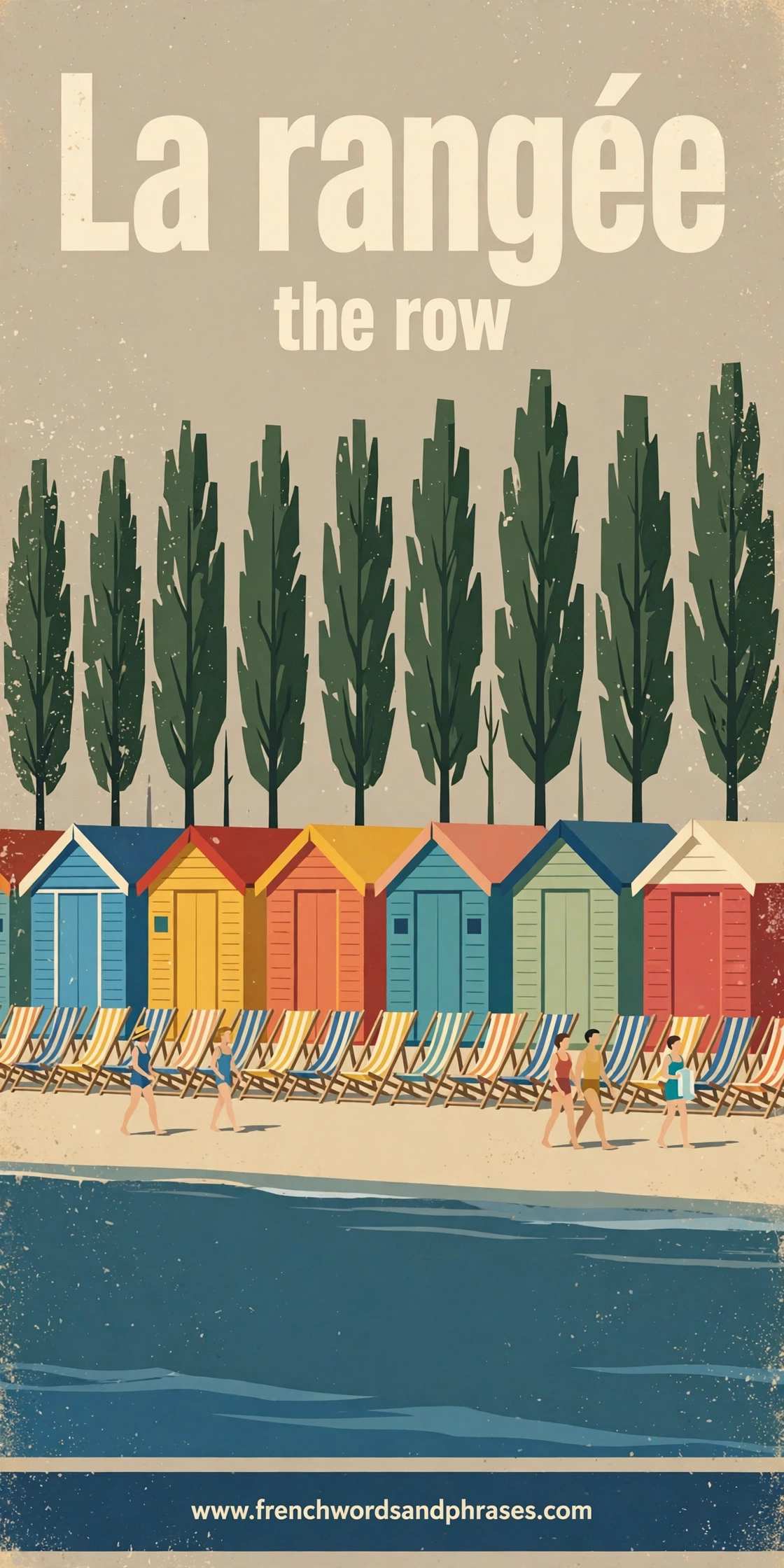
A French Word to Live By
Translate Rangée to English
/ʁɑ̃.ʒe/
La rangée means the row.
Chairs in a line at the theatre, vines marching over the hill, books shoulder to shoulder on the shelf: la rangée, the row — the line things form when order wins, one behind another or side by side.
In this guide, you’ll learn what rangée means in English, how to use it with its articles, how to form its plural, and how it appears in everyday French. Explore French examples, English translations, and practice quizzes.
Understanding the French Noun Rangée
Rangée is a feminine French noun, learned with its article: la rangée, une rangée. It comes from ranger, to arrange: a rangée is a set of things placed in a line — une rangée de chaises, a row of chairs.
It means a row: la première rangée, the front row; une rangée de sièges, a row of seats; des rangées de vignes, rows of vines. The pattern is rangée de plus the things lined up. In the classroom and the vineyard alike, the rangée is how French organises space — in straight, countable lines.
Gender: Feminine — la rangée
Definite article: la — la rangée (the row)
Indefinite article: une — une rangée (a row)
Plural: les rangées — regular, with a simple -s
Pattern: une rangée de + the things in line: une rangée de chaises
Theatre life: la première rangée — the front row
English equivalents: The row.
After rangée, the things in the row follow with de and no article: une rangée d’arbres, a row of trees. To line things up is mettre en rangée — and schoolchildren lining up form des rangs, the close cousin for people in file.
Experience the Word
Rangée is order made visible: the moment scattered things agree to stand in a line, the world becomes countable.
Imagine the theatre lights going down: twenty rangées of seats, and in the very first one — la première rangée — the actors’ faces are close enough to touch.
You have not just named a line. You have named arrangement itself — la rangée, the row, order you can sit in.
How to Use Rangée in French: Complete Guide
Let’s explore how rangée works in French, beginning with its articles — la rangée, une rangée, une rangée de chaises.
Rangée with the Definite Article (La, Les)
Used for a specific row — the front one, the one by the aisle.
| Form | French |
|---|---|
| Feminine singular | la rangée |
| Plural | les rangées |
Example
La rangée du fond est presque vide.
The back row is almost empty.
Rangée with the Indefinite Article (Une, Des)
Used for a row in general — any line of things.
| Form | French |
|---|---|
| Feminine singular | une rangée |
| Plural | des rangées |
Example
Il a planté une rangée de pommes de terre.
He planted a row of potatoes.
Rangée with Quantities (Une, Deux, Assez de…)
Rows are counted one by one — in theatres, fields and classrooms.
| Quantity | French |
|---|---|
| one row | une rangée |
| two rows | deux rangées |
| several rows | plusieurs rangées |
| enough rows | assez de rangées |
| a row of chairs | une rangée de chaises |
Example
Ajoute deux rangées de chaises pour les invités.
Add two rows of chairs for the guests.
Quick Quiz 1
Complete the sentence:
______ première rangée est réservée. (the)
Reveal the answer
La
La première rangée est réservée.
The front row is reserved — rangée is feminine, so la.
The Plural of Rangée
Rangée takes a regular plural in -s — rows come in sets.
| Number | French |
|---|---|
| Singular | la rangée |
| Plural | les rangées |
Example
Les rangées de vignes couvrent la colline.
The rows of vines cover the hill.
Rangée with Possessive Adjectives (Ma, Ta, Sa…)
Possessives agree with the noun: rangée is feminine, so ma, ta, sa in the singular.
| Owner | French |
|---|---|
| my | ma rangée |
| your (tu) | ta rangée |
| his / her | sa rangée |
| our | notre rangée |
| your (vous) | votre rangée |
| their | leur rangée |
Example
Ma rangée est la troisième à partir du fond.
My row is the third from the back.
Quick Quiz 2
Complete the sentence:
Le jardinier a fini ______ rangée de salades. (his)
Reveal the answer
sa
Le jardinier a fini sa rangée de salades.
The gardener finished his row of lettuces — sa agrees with rangée, feminine.
Rangée with Demonstrative Adjectives (Cette, Ces)
Used to point: cette rangée, this row — usually the one being filled or planted.
| Form | French |
|---|---|
| Feminine singular | cette rangée |
| Plural | ces rangées |
Example
Cette rangée est pour les invités.
This row is for the guests.
Rangée with Adjectives
Adjectives agree with rangée — feminine singular.
| Adjective | With Rangée |
|---|---|
| première (first) | la première rangée |
| dernière (last) | la dernière rangée |
| longue (long) | une longue rangée |
| droite (straight) | une rangée droite |
| double (double) | une double rangée |
Example
Une longue rangée d’arbres borde la route.
A long row of trees lines the road.
Quick Quiz 3
Complete the sentence:
Nous sommes assis dans la ______ rangée. (last)
Reveal the answer
dernière
Nous sommes assis dans la dernière rangée.
We are sitting in the last row — dernière, feminine, to agree with rangée.
Everyday Expressions with Rangée
Theatres, vineyards and gardens — the rangée phrases of daily life.
| Expression | In English |
|---|---|
| la première rangée | the front row |
| une rangée de chaises | a row of chairs |
| une rangée de sièges | a row of seats |
| des rangées de vignes | rows of vines |
| mettre en rangée | to put in a row, to line up |
Example
Mets les verres en rangée sur la table.
Put the glasses in a row on the table.
Words from the Same Family as Rangée
Arranging and lining up — the words that travel with rangée.
| French | In English |
|---|---|
| ranger | to arrange, to tidy (the verb) |
| un rang | a rank; a line of people |
| une file | a line, a queue (single file) |
| aligner | to line up, to align |
| un ordre | order |
Example
Les enfants se mettent en rang deux par deux.
The children line up two by two.
Quick Quiz 4
What does la première rangée mean at the theatre?
Reveal the answer
The front row — the row closest to the stage.
À la première rangée, on voit tout.
In the front row, you see everything.
Rangée in Everyday French: Real-Life Examples
Now that you know the word, let’s see how rangée appears in everyday French.
Example 1 — At the theatre
Nous sommes à la première rangée.
We are in the front row.
Example 2 — Chairs
Ajoute une rangée de chaises.
Add a row of chairs.
Example 3 — In the garden
Il plante une rangée de carottes.
He is planting a row of carrots.
Example 4 — Vines
Les rangées de vignes montent la colline.
The rows of vines climb the hill.
Example 5 — Finding seats
Ma rangée est la troisième.
My row is the third.
Example 6 — Trees
Une rangée d’arbres borde le chemin.
A row of trees lines the path.
Beyond Translation: The Meaning of Rangée
La rangée is the geometry of patience: vines planted in rangées will be harvested by grandchildren; books in rangées wait decades for their reader; the première rangée is fought over because proximity is a privilege. French, a language that loves order, keeps the word ready for every field, shelf and theatre.
Wherever things agree to stand in line, there is une rangée.
And mettre en rangée — to line things up — is the small daily victory of tidiness over chaos.
How to Remember the French Noun Rangée
Remember it this way: Rangée is the row — feminine: la première rangée at the theatre, une rangée de chaises in the hall.
- Always feminine — la rangée, une rangée, ma rangée.
- The pattern — une rangée de plus the things lined up, with no article: une rangée de chaises.
- From ranger, to arrange — a rangée is things arranged in a line.
The key idea is la rangée — the row, feminine; une rangée de chaises = a row of chairs.
Test Your Knowledge of Rangée
Let’s see how much you’ve learned. Try answering these questions before revealing the answers.
Question 1
Is rangée masculine or feminine?
Reveal the answer
Feminine — la rangée, une rangée.
Question 2
How do you say the front row in French?
Reveal the answer
La première rangée.
Question 3
Translate: A long row of trees lines the road.
Reveal the answer
Une longue rangée d’arbres borde la route.
Question 4
What does mettre en rangée mean?
Reveal the answer
To put in a row, to line up.
Question 5
Complete the sentence:
______ rangées de vignes couvrent la colline. (the)
Reveal the answer
Les
Les rangées de vignes couvrent la colline.
The rows of vines cover the hill.
Your Final Challenge
Can You Use It?
How would you say this in French?
“We are sitting in the front row.”
Reveal the answer
Nous sommes assis à la première rangée.
We are sitting in the front row.
A little French. A little curiosity. A richer everyday life.
LEARN FRENCH ONE WORD AT A TIME




