A French Word to Live By
How to Conjugate Rabâcher in French
/ʁa.bɑ.ʃe/
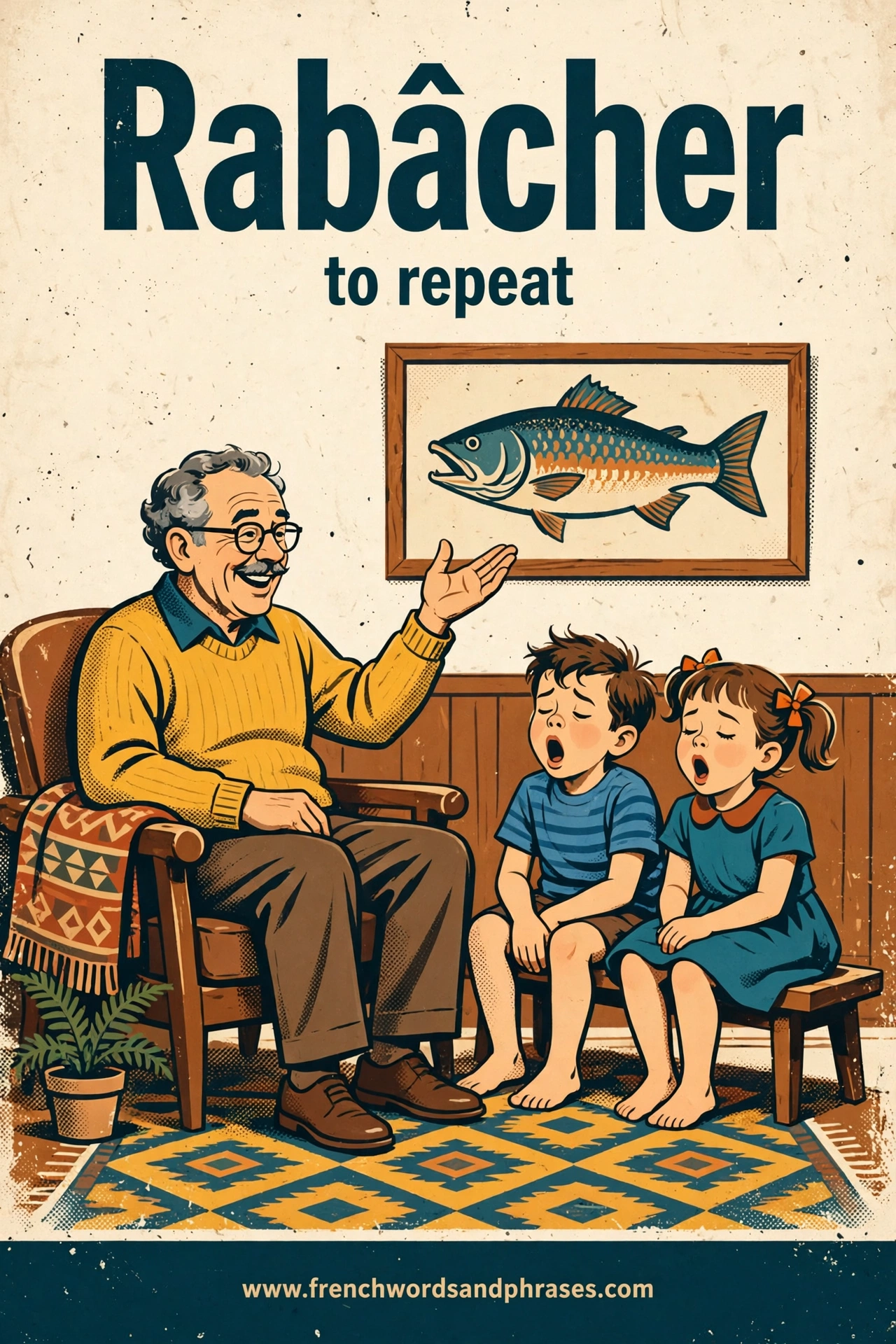
Rabâcher means to repeat — to go over the same thing again and again, until it sinks in or drives everyone mad.
The same story at every family lunch, the same lesson drummed in for the tenth time, the same warning before every departure — rabâcher is the verb of repetition with a sigh in it: saying it again, and again, and again.
In this guide, you’ll learn how to conjugate rabâcher in all the major French tenses and moods. Explore complete conjugation tables, French examples, English translations, and practice quizzes.
Understanding the French Verb Rabâcher
Rabâcher is a regular French verb belonging to the first group of verbs, those ending in -er.
It means to repeat. It is commonly used for teachers drilling lessons and pupils revising them (rabâcher ses conjugaisons), for people who repeat the same stories, advice and complaints, and in criticism of speeches and media that hammer the same message.
Verb classification: First group (-er)
Auxiliary verb: Avoir
Past participle: rabâché
Present participle: rabâchant
English equivalents: To repeat endlessly, to harp on, to go over and over; (at school) to keep revising, to drill; un rabâchage — endless repetition.
One important detail: rabâcher keeps its circumflex on the â in every form — je rabâche, nous rabâchons, rabâché — a hat the verb never takes off. Its tone is double: teachers rabâchent their lessons until the class knows them by heart, which is useful; but un rabâcheur is also a bore who tells the same story at every meal. Context decides whether the repetition is a method or a menace, and the noun le rabâchage names the drumming-in itself.
Experience the Word
Rabâcher is the verb of the loop — the sentence that comes back like a chorus nobody ordered.
Imagine a classroom on a June afternoon. The teacher writes the same conjugation on the board for the fifth time, the pupils chant it back half asleep — and in September, every one of them will know it for life. That is rabâcher working as it should.
Nothing new has been said for an hour. It has been rabâché — repeated until it can never be forgotten.
How to Conjugate Rabâcher: Complete French Conjugation Guide
Let’s explore every major conjugation of rabâcher, beginning with the indicative mood.
How to Conjugate Rabâcher in the Indicative Mood
The indicative mood is used to express facts, observations, actions, and events.
How to Conjugate Rabâcher in the Present Tense (Présent)
Used for actions happening now, habitual actions, and general truths.
| Subject | Conjugation |
|---|---|
| je | rabâche |
| tu | rabâches |
| il / elle | rabâche |
| nous | rabâchons |
| vous | rabâchez |
| ils / elles | rabâchent |
Example
Le professeur rabâche les mêmes règles chaque semaine.
The teacher repeats the same rules every week.
Quick Quiz 1
Complete the sentence:
Nous ______ la leçon avant l’examen.
Reveal the answer
rabâchons
Nous rabâchons la leçon avant l’examen.
We go over the lesson again and again before the exam.
How to Conjugate Rabâcher in the Passé Composé
Used for completed actions in the past. Rabâcher takes the auxiliary verb avoir.
| Subject | Conjugation |
|---|---|
| j’ | ai rabâché |
| tu | as rabâché |
| il / elle | a rabâché |
| nous | avons rabâché |
| vous | avez rabâché |
| ils / elles | ont rabâché |
Example
Il a rabâché son histoire toute la soirée.
He repeated his story all evening.
How to Conjugate Rabâcher in the Imparfait (Imperfect Tense)
Used for habitual past actions, descriptions, and ongoing situations in the past.
| Subject | Conjugation |
|---|---|
| je | rabâchais |
| tu | rabâchais |
| il / elle | rabâchait |
| nous | rabâchions |
| vous | rabâchiez |
| ils / elles | rabâchaient |
Example
Ma grand-mère rabâchait toujours les mêmes conseils.
My grandmother always used to repeat the same advice.
Quick Quiz 2
Choose the correct form:
He repeated his story all evening.
Il ______ son histoire toute la soirée. (a rabâché / est rabâché)
Reveal the answer
a rabâché
Il a rabâché son histoire toute la soirée.
Rabâcher takes avoir.
How to Conjugate Rabâcher in the Plus-que-parfait
Used to describe an action that had already been completed before another past event.
| Subject | Conjugation |
|---|---|
| j’ | avais rabâché |
| tu | avais rabâché |
| il / elle | avait rabâché |
| nous | avions rabâché |
| vous | aviez rabâché |
| ils / elles | avaient rabâché |
Example
Les élèves avaient rabâché la leçon avant l’examen.
The pupils had gone over the lesson again and again before the exam.
How to Conjugate Rabâcher in the Passé Simple
Primarily used in formal writing, literature, and historical narratives. It is rarely used in everyday conversation.
| Subject | Conjugation |
|---|---|
| je | rabâchai |
| tu | rabâchas |
| il / elle | rabâcha |
| nous | rabâchâmes |
| vous | rabâchâtes |
| ils / elles | rabâchèrent |
Example
Le vieil instituteur rabâcha la table de multiplication jusqu’au soir.
The old schoolmaster drilled the multiplication table until evening.
How to Conjugate Rabâcher in the Passé Antérieur
A literary tense used to express an action completed immediately before another past action, generally in the passé simple.
| Subject | Conjugation |
|---|---|
| j’ | eus rabâché |
| tu | eus rabâché |
| il / elle | eut rabâché |
| nous | eûmes rabâché |
| vous | eûtes rabâché |
| ils / elles | eurent rabâché |
Example
Quand ils eurent rabâché le refrain, la chorale se reposa.
When they had repeated the chorus over and over, the choir rested.
How to Conjugate Rabâcher in the Future Tense (Futur Simple)
Used to describe actions that will take place in the future.
| Subject | Conjugation |
|---|---|
| je | rabâcherai |
| tu | rabâcheras |
| il / elle | rabâchera |
| nous | rabâcherons |
| vous | rabâcherez |
| ils / elles | rabâcheront |
Example
Je rabâcherai ce discours jusqu’à le connaître par cœur.
I will repeat this speech until I know it by heart.
How to Conjugate Rabâcher in the Futur Antérieur (Future Perfect)
Used for an action that will have been completed before a particular point in the future.
| Subject | Conjugation |
|---|---|
| j’ | aurai rabâché |
| tu | auras rabâché |
| il / elle | aura rabâché |
| nous | aurons rabâché |
| vous | aurez rabâché |
| ils / elles | auront rabâché |
Example
À force de répéter, tu auras rabâché toute la grammaire.
By dint of repeating, you will have gone over all the grammar.
How to Conjugate Rabâcher in the Near Future (Futur Proche)
Used to describe something that is going to happen soon. Formed with aller + infinitive.
| Subject | Conjugation |
|---|---|
| je | vais rabâcher |
| tu | vas rabâcher |
| il / elle | va rabâcher |
| nous | allons rabâcher |
| vous | allez rabâcher |
| ils / elles | vont rabâcher |
Example
Il va encore rabâcher ses souvenirs de guerre, écoute-le.
He is going to repeat his war memories again, listen to him.
How to Conjugate Rabâcher in the Conditional Mood
The conditional mood expresses what would happen under certain circumstances. It is also frequently used to make polite requests or express wishes.
How to Conjugate Rabâcher in the Present Conditional
| Subject | Conjugation |
|---|---|
| je | rabâcherais |
| tu | rabâcherais |
| il / elle | rabâcherait |
| nous | rabâcherions |
| vous | rabâcheriez |
| ils / elles | rabâcheraient |
Example
Sans notes, je rabâcherais les mêmes idées.
Without notes, I would keep repeating the same ideas.
How to Conjugate Rabâcher in the Past Conditional
| Subject | Conjugation |
|---|---|
| j’ | aurais rabâché |
| tu | aurais rabâché |
| il / elle | aurait rabâché |
| nous | aurions rabâché |
| vous | auriez rabâché |
| ils / elles | auraient rabâché |
Example
Elle aurait moins rabâché si on l’avait écoutée la première fois.
She would have repeated herself less if people had listened the first time.
Rabâcher in the Literary Past Conditional Form
This less common literary form uses the imperfect subjunctive of avoir.
| Subject | Conjugation |
|---|---|
| j’ | eusse rabâché |
| tu | eusses rabâché |
| il / elle | eût rabâché |
| nous | eussions rabâché |
| vous | eussiez rabâché |
| ils / elles | eussent rabâché |
Example
Le précepteur eût rabâché la leçon jusqu’à la nuit tombée.
The tutor would have drilled the lesson until nightfall.
How to Conjugate Rabâcher in the Subjunctive Mood
The subjunctive is used to express wishes, emotions, doubts, necessity, and uncertainty. It frequently follows expressions such as il faut que (it is necessary that) or bien que (although).
How to Conjugate Rabâcher in the Present Subjunctive
| Subject | Conjugation |
|---|---|
| que je | rabâche |
| que tu | rabâches |
| qu’il / qu’elle | rabâche |
| que nous | rabâchions |
| que vous | rabâchiez |
| qu’ils / qu’elles | rabâchent |
Example
Il faut que tu rabâches tes verbes irréguliers.
You must go over your irregular verbs again and again.
Quick Quiz 3
Complete the sentence using the subjunctive:
Il faut que vous ______ le refrain.
Reveal the answer
rabâchiez
Il faut que vous rabâchiez le refrain.
You must repeat the chorus over and over.
How to Conjugate Rabâcher in the Imperfect Subjunctive
A literary tense, rarely encountered in modern spoken French.
| Subject | Conjugation |
|---|---|
| que je | rabâchasse |
| que tu | rabâchasses |
| qu’il / qu’elle | rabâchât |
| que nous | rabâchassions |
| que vous | rabâchassiez |
| qu’ils / qu’elles | rabâchassent |
Example
La maîtresse exigeait que la classe rabâchât la poésie.
The teacher demanded that the class repeat the poem over and over.
How to Conjugate Rabâcher in the Pluperfect Subjunctive
A literary construction used to express an action completed before another past action.
| Subject | Conjugation |
|---|---|
| que j’ | eusse rabâché |
| que tu | eusses rabâché |
| qu’il / qu’elle | eût rabâché |
| que nous | eussions rabâché |
| que vous | eussiez rabâché |
| qu’ils / qu’elles | eussent rabâché |
Example
On souriait qu’il eût rabâché la même anecdote trois fois.
People smiled that he had repeated the same anecdote three times.
How to Conjugate Rabâcher in the Past Subjunctive
| Subject | Conjugation |
|---|---|
| que j’ | aie rabâché |
| que tu | aies rabâché |
| qu’il / qu’elle | ait rabâché |
| que nous | ayons rabâché |
| que vous | ayez rabâché |
| qu’ils / qu’elles | aient rabâché |
Example
Je suis content que vous ayez rabâché la leçon, tout le monde la sait.
I am glad you drilled the lesson, everyone knows it now.
How to Conjugate Rabâcher in the Imperative
The imperative is used to give commands, instructions, invitations, or suggestions. Subject pronouns are omitted.
How to Conjugate Rabâcher in the Present Imperative
| Person | Conjugation |
|---|---|
| (tu) | rabâche |
| (nous) | rabâchons |
| (vous) | rabâchez |
Example
Rabâche tes conjugaisons avant le contrôle !
Go over your conjugations again and again before the test!
Quick Quiz 4
How would you say Go over your conjugations (tu form)?
Reveal the answer
Rabâche tes conjugaisons !
French Participles of Rabâcher
Participles are verb forms that can be used in compound tenses and other grammatical constructions.
Present Participle of Rabâcher
rabâchant
En rabâchant ses gammes, la pianiste a fini par les jouer sans faute.
By repeating her scales over and over, the pianist ended up playing them faultlessly.
Past Participle of Rabâcher
rabâché
Rabâchée cent fois, la règle est enfin entrée dans les têtes.
Repeated a hundred times, the rule finally sank in.
Rabâcher in Everyday French: Real-Life Examples
Now that you know the conjugations, let’s see how rabâcher appears in everyday French.
Example 1 — Present
Les journaux rabâchent la même nouvelle depuis lundi.
The papers have been repeating the same news since Monday.
Example 2 — Passé composé
Tu as rabâché cette phrase toute la journée.
You have repeated that sentence all day.
Example 3 — Imparfait
Le professeur rabâchait la leçon jusqu’à ce que tout le monde comprenne.
The teacher used to repeat the lesson until everyone understood.
Example 4 — Future
Nous rabâcherons les tables avant l’examen.
We will go over the tables again and again before the exam.
Example 5 — Conditional
Il rabâcherait moins si on prenait des notes.
He would repeat himself less if people took notes.
Example 6 — Imperative
Rabâchez le refrain tous ensemble !
Repeat the chorus all together, over and over!
Beyond Translation: The Meaning of Rabâcher
English separates the useful repetition (revise, drill, go over) from the tedious (harp on, repeat yourself); French rabâcher keeps both in one word and lets the listener’s patience decide.
Every rabâchage is a wager.
Repeat a lesson and it becomes knowledge; repeat a story and it becomes a legend — or a bore. The verb sits exactly on the line between the two.
How to Remember the French Verb Rabâcher
Remember it this way: Rabâcher is about the same thing said again and again — until it sinks in.
- Rabâcher une leçon — to drill a lesson; rabâcher une histoire — to tell the same story yet again.
- The â keeps its hat in every form: je rabâche, nous rabâchons, rabâché.
- Regular -er: je rabâche, nous rabâchons, past participle rabâché.
The key idea is the same thing said again and again — until it sinks in.
Test Your Knowledge of Rabâcher
Let’s see how much you’ve learned. Try answering these questions before revealing the answers.
Question 1
What is un rabâchage?
Reveal the answer
Endless repetition — the same thing gone over and over.
Question 2
How do you say The teacher repeats the same rules in French?
Reveal the answer
Le professeur rabâche les mêmes règles.
Question 3
Translate: My grandmother always used to repeat the same advice.
Reveal the answer
Ma grand-mère rabâchait toujours les mêmes conseils.
Question 4
What is the past participle of rabâcher?
Reveal the answer
Rabâché.
Question 5
Complete the sentence:
Il faut que tu ______ tes verbes irréguliers.
Reveal the answer
rabâches
Il faut que tu rabâches tes verbes irréguliers.
You must go over your irregular verbs again and again.
Your Final Challenge
Can You Use It?
How would you say this in French?
The teacher repeats the rule one last time, and suddenly the whole class knows it.
Reveal the answer
Le professeur rabâche la règle une dernière fois, et soudain toute la classe la connaît.
The teacher repeats the rule one last time, and suddenly the whole class knows it.
A little French. A little curiosity. A richer everyday life.
LEARN FRENCH ONE WORD AT A TIME