A French Word to Live By
How to Conjugate Quittancer in French
/ki.tɑ̃.se/
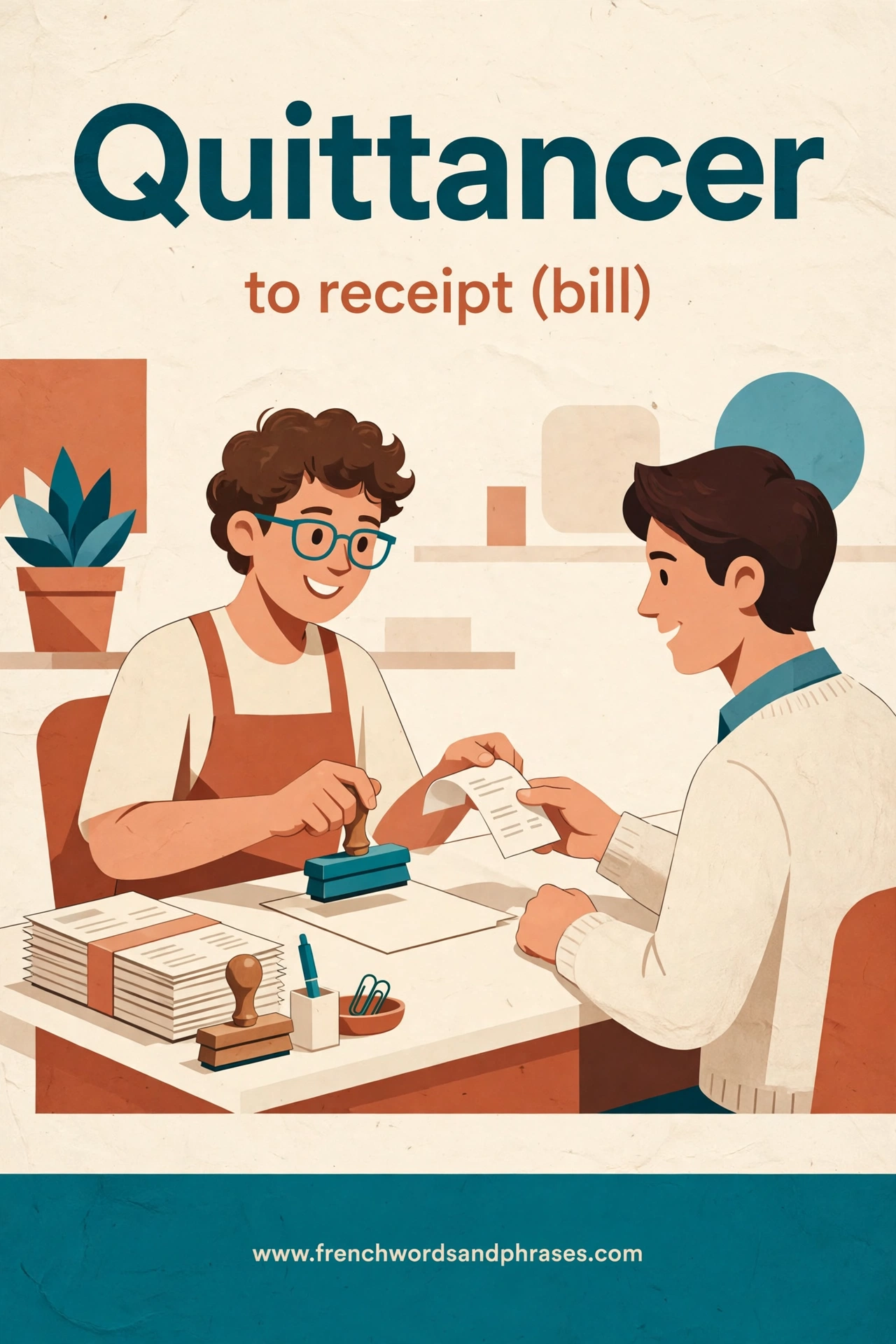
Quittancer means to receipt a bill — to give a formal receipt acknowledging that a payment has been made.
A stamp comes down, a signature is added, and a debt officially dies — quittancer is the clerk’s verb of the receipt, the moment a paid bill becomes a proven, filed, finished thing.
In this guide, you’ll learn how to conjugate quittancer in all the major French tenses and moods. Explore complete conjugation tables, French examples, English translations, and practice quizzes.
Understanding the French Verb Quittancer
Quittancer is a regular French verb belonging to the first group of verbs, those ending in -er.
It means to receipt (bill). It is commonly used in administration, renting and business for issuing receipts for rent, bills and payments, in legal language for discharging a debt (quittancer une dette), and wherever a signature must prove that money changed hands.
Verb classification: First group (-er)
Auxiliary verb: Avoir
Past participle: quittancé
Present participle: quittançant
English equivalents: To receipt a bill, to give a receipt for; une quittance — a receipt, a discharge; donner quittance — to give a formal discharge.
One important detail: quittancer is a -cer verb, so the c becomes ç before a and o to keep its soft sound: nous quittançons, je quittançais, quittançant — but je quittance, nous quittancions keep the plain c before e and i. The verb belongs to the noun une quittance, the receipt or discharge itself — la quittance de loyer is the rent receipt every French tenant keeps, and donner quittance means to formally declare a debt settled.
Experience the Word
Quittancer is the verb of paper proof — the payment is real, but only the receipt makes it official.
Imagine a small landlord’s office in Lyon. The tenant pays the rent in cash, and the landlord opens a worn register, writes the sum, stamps the page and quittance le loyer. That little stamped paper will guard them both for years.
The money has changed hands. It has been quittancé — receipted, recorded, beyond argument.
How to Conjugate Quittancer: Complete French Conjugation Guide
Let’s explore every major conjugation of quittancer, beginning with the indicative mood.
How to Conjugate Quittancer in the Indicative Mood
The indicative mood is used to express facts, observations, actions, and events.
How to Conjugate Quittancer in the Present Tense (Présent)
Used for actions happening now, habitual actions, and general truths.
| Subject | Conjugation |
|---|---|
| je | quittance |
| tu | quittances |
| il / elle | quittance |
| nous | quittançons |
| vous | quittancez |
| ils / elles | quittancent |
Example
Le propriétaire quittance le loyer chaque mois.
The landlord receipts the rent every month.
Quick Quiz 1
Complete the sentence:
Nous ______ les loyers le premier du mois.
Reveal the answer
quittançons
Nous quittançons les loyers le premier du mois.
We receipt the rents on the first of the month.
How to Conjugate Quittancer in the Passé Composé
Used for completed actions in the past. Quittancer takes the auxiliary verb avoir.
| Subject | Conjugation |
|---|---|
| j’ | ai quittancé |
| tu | as quittancé |
| il / elle | a quittancé |
| nous | avons quittancé |
| vous | avez quittancé |
| ils / elles | ont quittancé |
Example
La comptable a quittancé toutes les factures du trimestre.
The accountant receipted all the quarter’s bills.
How to Conjugate Quittancer in the Imparfait (Imperfect Tense)
Used for habitual past actions, descriptions, and ongoing situations in the past.
| Subject | Conjugation |
|---|---|
| je | quittançais |
| tu | quittançais |
| il / elle | quittançait |
| nous | quittancions |
| vous | quittanciez |
| ils / elles | quittançaient |
Example
Autrefois, le percepteur quittançait les impôts à la main.
In the old days, the tax collector used to receipt taxes by hand.
Quick Quiz 2
Choose the correct form:
She receipted the bill.
Elle ______ la facture. (a quittancé / est quittancée)
Reveal the answer
a quittancé
Elle a quittancé la facture.
Quittancer takes avoir.
How to Conjugate Quittancer in the Plus-que-parfait
Used to describe an action that had already been completed before another past event.
| Subject | Conjugation |
|---|---|
| j’ | avais quittancé |
| tu | avais quittancé |
| il / elle | avait quittancé |
| nous | avions quittancé |
| vous | aviez quittancé |
| ils / elles | avaient quittancé |
Example
Elle avait quittancé la facture avant de partir en congé.
She had receipted the bill before going on leave.
How to Conjugate Quittancer in the Passé Simple
Primarily used in formal writing, literature, and historical narratives. It is rarely used in everyday conversation.
| Subject | Conjugation |
|---|---|
| je | quittançai |
| tu | quittanças |
| il / elle | quittança |
| nous | quittançâmes |
| vous | quittançâtes |
| ils / elles | quittançèrent |
Example
Le greffier quittança la somme et ferma le registre.
The clerk receipted the sum and closed the register.
How to Conjugate Quittancer in the Passé Antérieur
A literary tense used to express an action completed immediately before another past action, generally in the passé simple.
| Subject | Conjugation |
|---|---|
| j’ | eus quittancé |
| tu | eus quittancé |
| il / elle | eut quittancé |
| nous | eûmes quittancé |
| vous | eûtes quittancé |
| ils / elles | eurent quittancé |
Example
Quand il eut quittancé le paiement, le dossier fut classé.
When he had receipted the payment, the file was closed.
How to Conjugate Quittancer in the Future Tense (Futur Simple)
Used to describe actions that will take place in the future.
| Subject | Conjugation |
|---|---|
| je | quittancerai |
| tu | quittanceras |
| il / elle | quittancera |
| nous | quittancerons |
| vous | quittancerez |
| ils / elles | quittanceront |
Example
Le secrétariat quittancera votre facture demain.
The office will receipt your bill tomorrow.
How to Conjugate Quittancer in the Futur Antérieur (Future Perfect)
Used for an action that will have been completed before a particular point in the future.
| Subject | Conjugation |
|---|---|
| j’ | aurai quittancé |
| tu | auras quittancé |
| il / elle | aura quittancé |
| nous | aurons quittancé |
| vous | aurez quittancé |
| ils / elles | auront quittancé |
Example
À la fin du mois, nous aurons quittancé tous les loyers.
By the end of the month, we will have receipted all the rents.
How to Conjugate Quittancer in the Near Future (Futur Proche)
Used to describe something that is going to happen soon. Formed with aller + infinitive.
| Subject | Conjugation |
|---|---|
| je | vais quittancer |
| tu | vas quittancer |
| il / elle | va quittancer |
| nous | allons quittancer |
| vous | allez quittancer |
| ils / elles | vont quittancer |
Example
Je vais quittancer ce règlement tout de suite.
I am going to receipt this payment right away.
How to Conjugate Quittancer in the Conditional Mood
The conditional mood expresses what would happen under certain circumstances. It is also frequently used to make polite requests or express wishes.
How to Conjugate Quittancer in the Present Conditional
| Subject | Conjugation |
|---|---|
| je | quittancerais |
| tu | quittancerais |
| il / elle | quittancerait |
| nous | quittancerions |
| vous | quittanceriez |
| ils / elles | quittanceraient |
Example
Un bon logiciel quittancerait les factures automatiquement.
Good software would receipt the bills automatically.
How to Conjugate Quittancer in the Past Conditional
| Subject | Conjugation |
|---|---|
| j’ | aurais quittancé |
| tu | aurais quittancé |
| il / elle | aurait quittancé |
| nous | aurions quittancé |
| vous | auriez quittancé |
| ils / elles | auraient quittancé |
Example
Elle aurait quittancé la note si le client avait payé.
She would have receipted the bill if the client had paid.
Quittancer in the Literary Past Conditional Form
This less common literary form uses the imperfect subjunctive of avoir.
| Subject | Conjugation |
|---|---|
| j’ | eusse quittancé |
| tu | eusses quittancé |
| il / elle | eût quittancé |
| nous | eussions quittancé |
| vous | eussiez quittancé |
| ils / elles | eussent quittancé |
Example
Le receveur eût quittancé l’impôt selon l’usage ancien.
The collector would have receipted the tax according to the old custom.
How to Conjugate Quittancer in the Subjunctive Mood
The subjunctive is used to express wishes, emotions, doubts, necessity, and uncertainty. It frequently follows expressions such as il faut que (it is necessary that) or bien que (although).
How to Conjugate Quittancer in the Present Subjunctive
| Subject | Conjugation |
|---|---|
| que je | quittance |
| que tu | quittances |
| qu’il / qu’elle | quittance |
| que nous | quittancions |
| que vous | quittanciez |
| qu’ils / qu’elles | quittancent |
Example
Il faut que le trésorier quittance chaque don.
The treasurer must receipt every donation.
Quick Quiz 3
Complete the sentence using the subjunctive:
Il faut que vous ______ chaque paiement.
Reveal the answer
quittanciez
Il faut que vous quittanciez chaque paiement.
You must receipt every payment.
How to Conjugate Quittancer in the Imperfect Subjunctive
A literary tense, rarely encountered in modern spoken French.
| Subject | Conjugation |
|---|---|
| que je | quittancasse |
| que tu | quittancasses |
| qu’il / qu’elle | quittancât |
| que nous | quittancassions |
| que vous | quittancassiez |
| qu’ils / qu’elles | quittancassent |
Example
Le règlement exigeait qu’on quittançât les paiements en espèces.
The rules required cash payments to be receipted.
How to Conjugate Quittancer in the Pluperfect Subjunctive
A literary construction used to express an action completed before another past action.
| Subject | Conjugation |
|---|---|
| que j’ | eusse quittancé |
| que tu | eusses quittancé |
| qu’il / qu’elle | eût quittancé |
| que nous | eussions quittancé |
| que vous | eussiez quittancé |
| qu’ils / qu’elles | eussent quittancé |
Example
On vérifia qu’elle eût quittancé la somme avant le contrôle.
They checked that she had receipted the sum before the inspection.
How to Conjugate Quittancer in the Past Subjunctive
| Subject | Conjugation |
|---|---|
| que j’ | aie quittancé |
| que tu | aies quittancé |
| qu’il / qu’elle | ait quittancé |
| que nous | ayons quittancé |
| que vous | ayez quittancé |
| qu’ils / qu’elles | aient quittancé |
Example
Je suis rassuré que vous ayez quittancé mon loyer.
I am relieved that you receipted my rent.
How to Conjugate Quittancer in the Imperative
The imperative is used to give commands, instructions, invitations, or suggestions. Subject pronouns are omitted.
How to Conjugate Quittancer in the Present Imperative
| Person | Conjugation |
|---|---|
| (tu) | quittance |
| (nous) | quittançons |
| (vous) | quittancez |
Example
Quittancez cette facture et envoyez-la au client !
Receipt this bill and send it to the client!
Quick Quiz 4
How would you say Receipt this rent (tu form)?
Reveal the answer
Quittance ce loyer !
French Participles of Quittancer
Participles are verb forms that can be used in compound tenses and other grammatical constructions.
Present Participle of Quittancer
quittançant
En quittançant les loyers, elle vérifie chaque montant.
While receipting the rents, she checks every amount.
Past Participle of Quittancer
quittancé
Quittancée et classée, la facture ne pose plus de question.
Receipted and filed, the bill raises no more questions.
Quittancer in Everyday French: Real-Life Examples
Now that you know the conjugations, let’s see how quittancer appears in everyday French.
Example 1 — Present
La mairie quittance les paiements sur place.
The town hall receipts payments on the spot.
Example 2 — Passé composé
Il a quittancé mon dépôt de garantie.
He receipted my security deposit.
Example 3 — Imparfait
Le caissier quittançait chaque versement avec un tampon.
The cashier used to receipt each payment with a stamp.
Example 4 — Future
Nous quittancerons les dons à la fin de la soirée.
We will receipt the donations at the end of the evening.
Example 5 — Conditional
Tu quittancerais ce chèque si tu avais le registre.
You would receipt this cheque if you had the register.
Example 6 — Imperative
Quittance ce loyer avant de partir !
Receipt this rent before you leave!
Beyond Translation: The Meaning of Quittancer
English to receipt survives in old bookkeeping; French quittancer still works daily, because French life runs on la quittance.
The receipt is a legal shield.
Tenants guard their quittances de loyer for years, landlords must provide them free on request, and the verb quittancer is the quiet ceremony that turns money handed over into a debt officially dead.
How to Remember the French Verb Quittancer
Remember it this way: Quittancer is about the stamp that kills a debt — the official receipt.
- Une quittance — the receipt itself; quittancer is issuing it.
- -cer verb: the c becomes ç before a and o — nous quittançons, je quittançais.
- Regular -er: je quittance, nous quittançons, past participle quittancé.
The key idea is the stamp that kills a debt — the official receipt.
Test Your Knowledge of Quittancer
Let’s see how much you’ve learned. Try answering these questions before revealing the answers.
Question 1
What is une quittance de loyer?
Reveal the answer
A rent receipt — the landlord’s proof that the rent was paid.
Question 2
How do you say The landlord receipts the rent in French?
Reveal the answer
Le propriétaire quittance le loyer.
Question 3
Translate: The accountant receipted all the bills.
Reveal the answer
La comptable a quittancé toutes les factures.
Question 4
What is the past participle of quittancer?
Reveal the answer
Quittancé.
Question 5
Complete the sentence:
Il faut que le trésorier ______ chaque don.
Reveal the answer
quittance
Il faut que le trésorier quittance chaque don.
The treasurer must receipt every donation.
Your Final Challenge
Can You Use It?
How would you say this in French?
The landlord receipts the rent, and the tenant leaves with his precious piece of paper.
Reveal the answer
Le propriétaire quittance le loyer, et le locataire repart avec son précieux papier.
The landlord receipts the rent, and the tenant leaves with his precious piece of paper.
A little French. A little curiosity. A richer everyday life.
LEARN FRENCH ONE WORD AT A TIME