A French Word to Live By
How to Conjugate Quitter in French
/ki.te/
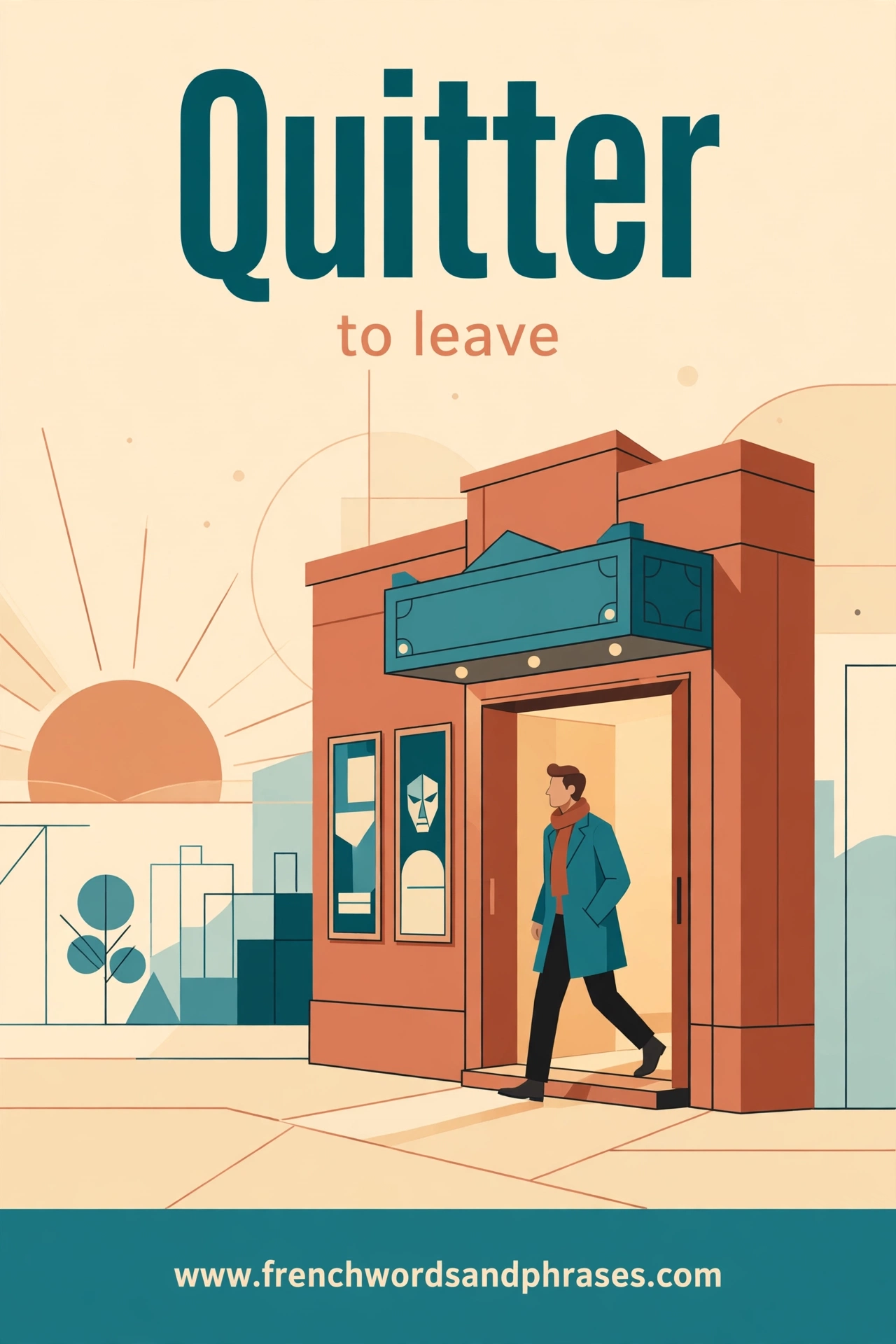
Quitter means to leave.
Every room has a door, and every day has a moment to walk through it. You leave the office at six, you leave a noisy party early, or you leave the house with your bag on your shoulder — that is quitter.
In this guide, you’ll learn how to conjugate quitter in all the major French tenses and moods. Explore complete conjugation tables, French examples, English translations, and practice quizzes.
Understanding the French Verb Quitter
Quitter is a regular French verb belonging to the first group of verbs, those ending in -er.
It means to leave (a room). It is commonly used for leaving a place, a room, or a person. Unlike laisser, which means to leave something behind, quitter always means to go away from a place or a person — you never go back in the same sentence, as in il a quitté la pièce.
Verb classification: First group (-er)
Auxiliary verb: Avoir
Past participle: quitté
Present participle: quittant
English equivalents: To leave, to quit.
One important spelling detail: the double tt of quitter appears in every form, and the stem quitt- never changes: je quitte, nous quittons, je quittais, je quitterai.
Experience the Word
Quitter is more than walking out of a room. It is closing a door behind you and not looking back.
Imagine the last evening in an old flat. The boxes are packed, the walls are bare, and you stand in the doorway for one long moment before turning the key.
You have not just left a flat. You have left a chapter of your life.
How to Conjugate Quitter: Complete French Conjugation Guide
Let’s explore every major conjugation of quitter, beginning with the indicative mood.
How to Conjugate Quitter in the Indicative Mood
The indicative mood is used to express facts, observations, actions, and events.
How to Conjugate Quitter in the Present Tense (Présent)
Used for actions happening now, habitual actions, and general truths.
| Subject | Conjugation |
|---|---|
| je | quitte |
| tu | quittes |
| il / elle | quitte |
| nous | quittons |
| vous | quittez |
| ils / elles | quittent |
Example
Je quitte la maison à sept heures chaque matin.
I leave the house at seven o’clock every morning.
Quick Quiz 1
Complete the sentence:
Nous ______ le bureau à dix-huit heures.
Reveal the answer
quittons
Nous quittons le bureau à dix-huit heures.
We leave the office at six in the evening.
How to Conjugate Quitter in the Passé Composé
Used for completed actions in the past. Quitter takes the auxiliary verb avoir.
| Subject | Conjugation |
|---|---|
| j’ | ai quitté |
| tu | as quitté |
| il / elle | a quitté |
| nous | avons quitté |
| vous | avez quitté |
| ils / elles | ont quitté |
Example
Il a quitté la pièce sans un mot.
He left the room without a word.
How to Conjugate Quitter in the Imparfait (Imperfect Tense)
Used for habitual past actions, descriptions, and ongoing situations in the past.
| Subject | Conjugation |
|---|---|
| je | quittais |
| tu | quittais |
| il / elle | quittait |
| nous | quittions |
| vous | quittiez |
| ils / elles | quittaient |
Example
Quand il était étudiant, il quittait rarement sa chambre.
When he was a student, he rarely left his room.
Quick Quiz 2
Choose the correct form:
When we were students, we used to leave the house late.
Quand nous étions étudiants, nous ______ la maison tard.
Reveal the answer
quittions
Quand nous étions étudiants, nous quittions la maison tard.
How to Conjugate Quitter in the Plus-que-parfait
Used to describe an action that had already been completed before another past event.
| Subject | Conjugation |
|---|---|
| j’ | avais quitté |
| tu | avais quitté |
| il / elle | avait quitté |
| nous | avions quitté |
| vous | aviez quitté |
| ils / elles | avaient quitté |
Example
Elle avait déjà quitté le bureau quand je suis arrivé.
She had already left the office when I arrived.
How to Conjugate Quitter in the Passé Simple
Primarily used in formal writing, literature, and historical narratives. It is rarely used in everyday conversation.
| Subject | Conjugation |
|---|---|
| je | quittai |
| tu | quittas |
| il / elle | quitta |
| nous | quittâmes |
| vous | quittâtes |
| ils / elles | quittèrent |
Example
Il quitta la salle en silence.
He left the hall in silence.
How to Conjugate Quitter in the Passé Antérieur
A literary tense used to express an action completed immediately before another past action, generally in the passé simple.
| Subject | Conjugation |
|---|---|
| j’ | eus quitté |
| tu | eus quitté |
| il / elle | eut quitté |
| nous | eûmes quitté |
| vous | eûtes quitté |
| ils / elles | eurent quitté |
Example
Dès qu’il eut quitté la réunion, les discussions reprirent.
As soon as he had left the meeting, the discussions resumed.
How to Conjugate Quitter in the Future Tense (Futur Simple)
Used to describe actions that will take place in the future.
| Subject | Conjugation |
|---|---|
| je | quitterai |
| tu | quitteras |
| il / elle | quittera |
| nous | quitterons |
| vous | quitterez |
| ils / elles | quitteront |
Example
Demain, nous quitterons l’hôtel de bonne heure.
Tomorrow, we will leave the hotel early.
How to Conjugate Quitter in the Futur Antérieur (Future Perfect)
Used for an action that will have been completed before a particular point in the future.
| Subject | Conjugation |
|---|---|
| j’ | aurai quitté |
| tu | auras quitté |
| il / elle | aura quitté |
| nous | aurons quitté |
| vous | aurez quitté |
| ils / elles | auront quitté |
Example
À midi, ils auront déjà quitté la ville.
By noon, they will already have left the town.
How to Conjugate Quitter in the Near Future (Futur Proche)
Used to describe something that is going to happen soon. Formed with aller + infinitive.
| Subject | Conjugation |
|---|---|
| je | vais quitter |
| tu | vas quitter |
| il / elle | va quitter |
| nous | allons quitter |
| vous | allez quitter |
| ils / elles | vont quitter |
Example
Je vais quitter le travail dans dix minutes.
I am going to leave work in ten minutes.
How to Conjugate Quitter in the Conditional Mood
The conditional mood expresses what would happen under certain circumstances. It is also frequently used to make polite requests or express wishes.
How to Conjugate Quitter in the Present Conditional
| Subject | Conjugation |
|---|---|
| je | quitterais |
| tu | quitterais |
| il / elle | quitterait |
| nous | quitterions |
| vous | quitteriez |
| ils / elles | quitteraient |
Example
Je quitterais volontiers cet appartement pour une maison.
I would gladly leave this flat for a house.
How to Conjugate Quitter in the Past Conditional
| Subject | Conjugation |
|---|---|
| j’ | aurais quitté |
| tu | aurais quitté |
| il / elle | aurait quitté |
| nous | aurions quitté |
| vous | auriez quitté |
| ils / elles | auraient quitté |
Example
Nous aurions quitté la fête plus tôt si nous avions su.
We would have left the party earlier if we had known.
Quitter in the Literary Past Conditional Form
This less common literary form uses the imperfect subjunctive of avoir.
| Subject | Conjugation |
|---|---|
| j’ | eusse quitté |
| tu | eusses quitté |
| il / elle | eût quitté |
| nous | eussions quitté |
| vous | eussiez quitté |
| ils / elles | eussent quitté |
Example
Il eût quitté la pièce s’il avait pu.
He would have left the room if he had been able to.
How to Conjugate Quitter in the Subjunctive Mood
The subjunctive is used to express wishes, emotions, doubts, necessity, and uncertainty. It frequently follows expressions such as il faut que (it is necessary that) or bien que (although).
How to Conjugate Quitter in the Present Subjunctive
| Subject | Conjugation |
|---|---|
| que je | quitte |
| que tu | quittes |
| qu’il / qu’elle | quitte |
| que nous | quittions |
| que vous | quittiez |
| qu’ils / qu’elles | quittent |
Example
Il faut que je quitte la maison avant huit heures.
I need to leave the house before eight o’clock.
Quick Quiz 3
Complete the sentence using the subjunctive:
Il faut que nous ______ la maison avant huit heures.
Reveal the answer
quittions
Il faut que nous quittions la maison avant huit heures.
We need to leave the house before eight o’clock.
How to Conjugate Quitter in the Imperfect Subjunctive
A literary tense, rarely encountered in modern spoken French.
| Subject | Conjugation |
|---|---|
| que je | quittasse |
| que tu | quittasses |
| qu’il / qu’elle | quittât |
| que nous | quittassions |
| que vous | quittassiez |
| qu’ils / qu’elles | quittassent |
Example
Il souhaitait qu’elle quittât la pièce en silence.
He wished that she would leave the room in silence.
How to Conjugate Quitter in the Pluperfect Subjunctive
A literary construction used to express an action completed before another past action.
| Subject | Conjugation |
|---|---|
| que j’ | eusse quitté |
| que tu | eusses quitté |
| qu’il / qu’elle | eût quitté |
| que nous | eussions quitté |
| que vous | eussiez quitté |
| qu’ils / qu’elles | eussent quitté |
Example
Il regrettait que nous eussions quitté la ville si tôt.
He regretted that we had left the town so early.
How to Conjugate Quitter in the Past Subjunctive
| Subject | Conjugation |
|---|---|
| que j’ | aie quitté |
| que tu | aies quitté |
| qu’il / qu’elle | ait quitté |
| que nous | ayons quitté |
| que vous | ayez quitté |
| qu’ils / qu’elles | aient quitté |
Example
Je suis surpris que tu aies quitté ton poste.
I am surprised that you left your job.
How to Conjugate Quitter in the Imperative
The imperative is used to give commands, instructions, invitations, or suggestions. Subject pronouns are omitted.
How to Conjugate Quitter in the Present Imperative
| Person | Conjugation |
|---|---|
| (tu) | quitte |
| (nous) | quittons |
| (vous) | quittez |
Example
Quitte cette pièce tout de suite !
Leave this room at once!
Quick Quiz 4
How would you say Leave this room at once! (tu form)?
Reveal the answer
Quitte cette pièce tout de suite !
French Participles of Quitter
Participles are verb forms that can be used in compound tenses and other grammatical constructions.
Present Participle of Quitter
quittant
En quittant la salle, il a salué ses collègues.
While leaving the hall, he greeted his colleagues.
Past Participle of Quitter
quitté
Nous avons quitté le restaurant vers onze heures.
We left the restaurant at about eleven o’clock.
Quitter in Everyday French: Real-Life Examples
Now that you know the conjugations, let’s see how quitter appears in everyday French.
Example 1 — Present
Je quitte le bureau à dix-huit heures.
I leave the office at six in the evening.
Example 2 — Passé composé
Elle a quitté la réunion avant la fin.
She left the meeting before the end.
Example 3 — Imparfait
Il quittait toujours la maison en courant.
He always left the house in a rush.
Example 4 — Future
Ils quitteront Paris au printemps.
They will leave Paris in the spring.
Example 5 — Conditional
Je quitterais cette ville si je trouvais un autre travail.
I would leave this town if I found another job.
Example 6 — Subjunctive
Bien que nous quittions la fête tôt, nous nous sommes bien amusés.
Although we left the party early, we had a great time.
Beyond Translation: The Meaning of Quitter
English has leave for almost everything. French makes a choice: quitter is the leaving that separates — you quitter a room, a city, a job, a person — while laisser leaves something behind and partir simply sets off.
To leave is to decide.
To quitter is to draw a line between before and after. It evokes endings, courage, and the click of a door closing.
How to Remember the French Verb Quitter
Remember it this way: Quitter is about walking out and closing the door.
- You pick up your bag and walk out of the office — tu quittes le bureau.
- The argument is over and he walks out without a word — il quitte la pièce.
- You lock the door of the old flat one last time — tu quittes l’appartement.
The key idea is walking out and closing the door.
Test Your Knowledge of Quitter
Let’s see how much you’ve learned. Try answering these questions before revealing the answers.
Question 1
What auxiliary verb is used with quitter in compound tenses?
Reveal the answer
Avoir
Question 2
How do you say I will leave in French?
Reveal the answer
Je quitterai.
Question 3
Translate: We left the restaurant at about eleven o’clock.
Reveal the answer
Nous avons quitté le restaurant vers onze heures.
Question 4
What is the present participle of quitter?
Reveal the answer
Quittant.
Question 5
Complete the sentence:
Si nous avions su, nous ______ la fête plus tôt.
Reveal the answer
aurions quitté
Si nous avions su, nous aurions quitté la fête plus tôt.
If we had known, we would have left the party earlier.
Your Final Challenge
Can You Use It?
How would you say this in French?
“Tomorrow, I want to leave the town for a few days.”
Reveal the answer
Demain, je veux quitter la ville pour quelques jours.
Tomorrow, I want to leave the town for a few days.
A little French. A little curiosity. A richer everyday life.
LEARN FRENCH ONE WORD AT A TIME