A French Word to Live By
Translate Qui va à la chasse perd sa place to English
/ki va a la ʃas pɛʁ sa plas/
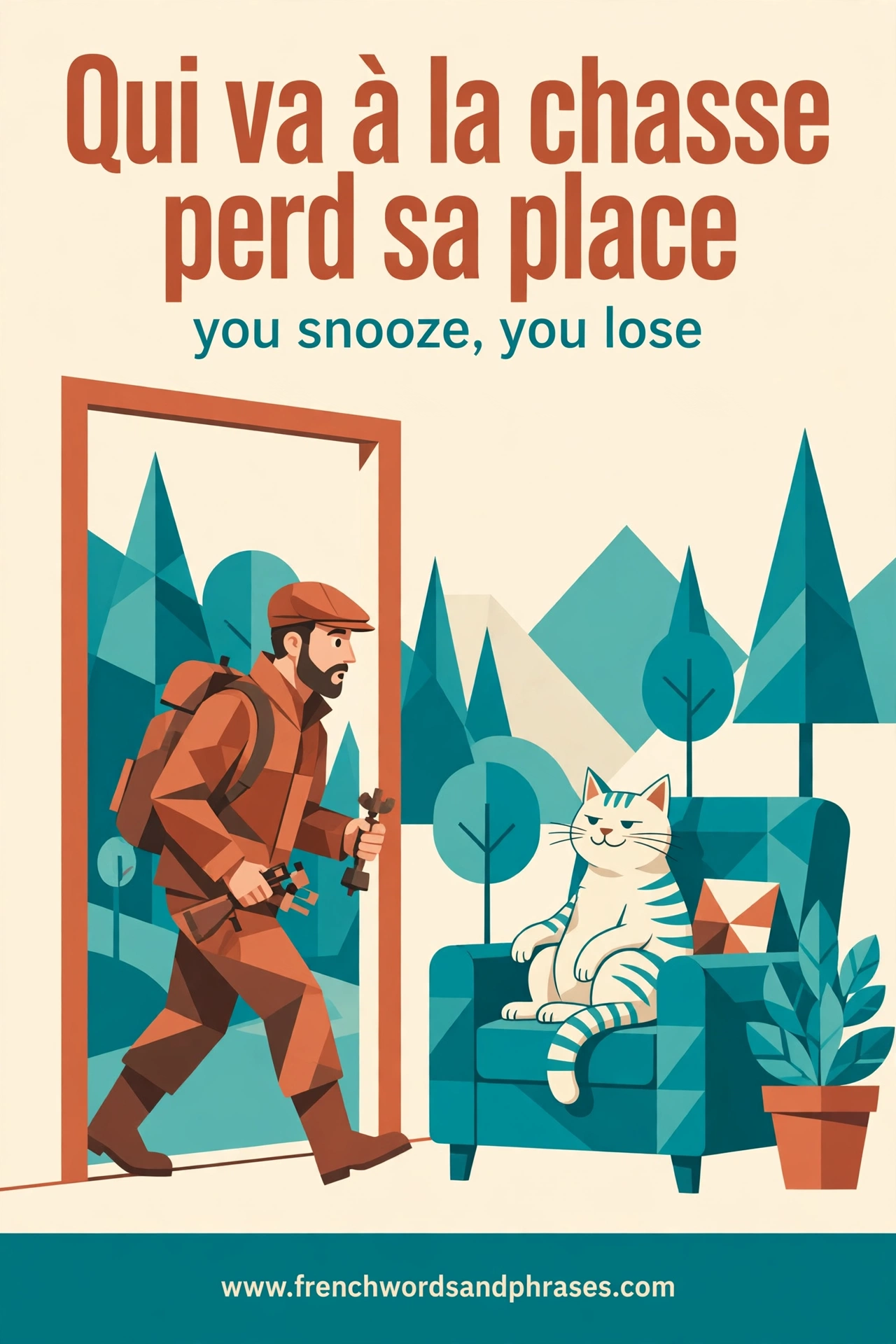
Qui va à la chasse perd sa place means you snooze, you lose — leave your place and someone else takes it.
The café terrace is full, and your friend has the last sunny table. He goes inside to order a second coffee, leaving his jacket over the chair — but a gust of wind takes the jacket, two students arrive, and by the time he returns, smiling, with two cups, his table is gone. His sister shrugs: « Qui va à la chasse perd sa place. »
Let’s explore how qui va à la chasse perd sa place works in French, beginning with the whole phrase on one card.
Understanding the French Phrase Qui va à la chasse perd sa place
Qui va à la chasse perd sa place is a French proverb built from qui (whoever), va à la chasse (goes hunting) and perd sa place (loses his place, his seat). It comes from the hunting field: the hunter who left his post at the shoot came back to find another hunter standing in it.
It means that if you leave a place, a seat or an opportunity unguarded, someone else will take it — the French twin of ‘you snooze, you lose’. Nobody is really hunting: la chasse is simply the errand, the distraction, the reason you stood up. Leave, and the world quite fairly fills the gap behind you.
Type: Proverb — opportunity (qui = whoever, present tense throughout)
Answers the need: Teasing or warning someone who lost their spot by leaving it
Register: Neutral to playful — everyday speech, often with a shrug and a smile
Strength: Light — a rule of the playground and the café terrace, not a tragedy
One important usage detail: the proverb is a complete little law, quoted whole in the present tense — qui va à la chasse perd sa place. It is said to the person who lost the place, or about them, and it works for seats, parking spots, jobs and chances alike. A playful reply exists: qui va à la chasse perd sa place, mais qui revient trouve une autre place — whoever comes back finds another place.
Experience the Word
Qui va à la chasse perd sa place is the law of every full terrace, every busy beach and every crowded train — the world does not hold seats.
Imagine the last slice of cake on the buffet table. You go to fetch a clean plate, proud of your manners, and return to an empty dish and a cousin with crumbs on his chin. No villain, no injustice — just the proverb, working exactly as it has for centuries.
French says it without cruelty. The place was never yours; it was only yours while you were in it.
How to Use Qui va à la chasse perd sa place in French: Complete Guide
Let’s explore how qui va à la chasse perd sa place works in French, beginning with the whole phrase on one card.
Qui va à la chasse perd sa place at a Glance
The Whole Phrase on One Card
Real meaning, literal picture, English twin and register — qui va à la chasse perd sa place in five lines.
| Point | Qui va à la chasse perd sa place |
|---|---|
| What it really means | leave your place unguarded and someone else takes it |
| Word for word | whoever goes hunting loses his place |
| English equivalent | you snooze, you lose / move your feet, lose your seat |
| Register | neutral to playful — a tease more than a scolding |
| Use it for | taken seats, lost parking spots, missed chances, queues |
Example
Tu es parti téléphoner, et ta chaise a disparu : qui va à la chasse perd sa place.
You went off to make a call, and your chair vanished: you snooze, you lose.
Word by Word: Building the Empty Seat
Five small pieces — take them one by one and the seat empties itself.
| Word | Literal meaning | Its job in the phrase |
|---|---|---|
| qui | whoever | the law applies to anyone — no names, no exceptions |
| va | goes | from aller, to go — the fatal step away |
| à la chasse | hunting, to the hunt | any errand or distraction that takes you away |
| perd | loses | from perdre, to lose — present tense, because it always happens |
| sa place | his / her place, seat | the spot itself — a chair, a post, a chance |
Example
À la chasse ou au café, qui part perd sa place.
Hunting or coffee — whoever leaves loses his place.
Quick Quiz 1
In the proverb, does la chasse have to mean real hunting?
Reveal the answer
No — la chasse stands for any errand that takes you away from your place: a phone call, a coffee, a distraction.
Il est allé chercher un verre d’eau, et voilà : qui va à la chasse perd sa place.
He went to fetch a glass of water, and there you are: you snooze, you lose.
When You Say It: The Lost-Spot Moments
Qui va à la chasse perd sa place fires at moments like these — someone stood up, and the world moved in.
| Situation | Example |
|---|---|
| A taken café chair | je reviens, ma chaise est prise : qui va à la chasse perd sa place — I come back, my chair is taken: you snooze, you lose |
| A parking spot | tu as tourné trop longtemps, la place est partie — you circled too long, the spot is gone |
| A job or a role | il a hésité, un autre a signé — he hesitated, someone else signed |
| The beach towel spot | une baignade trop longue, et l’ombre a changé de propriétaire — too long a swim, and the shade has a new owner |
| Consoling yourself | tant pis pour moi : qui va à la chasse perd sa place — too bad for me: you snooze, you lose |
Example
Elle est partie payer, et la dernière part de tarte a disparu.
She went off to pay, and the last slice of tart disappeared.
Make It Yours: The Proverb in Use
The proverb is quoted whole — what changes is who you aim it at, and how kindly.
| Form | French | In English |
|---|---|---|
| The full proverb | qui va à la chasse perd sa place | you snooze, you lose |
| Teasing a friend | eh oui, qui va à la chasse perd sa place | well yes — you snooze, you lose |
| About yourself | c’est de ma faute : qui va à la chasse perd sa place | my own fault: you snooze, you lose |
| As a warning before leaving | garde ma place, sinon tu connais le proverbe | save my place, or you know the proverb |
| The hopeful reply | qui revient trouve une autre place | whoever comes back finds another place |
Example
Garde ma place deux minutes, je connais le proverbe par cœur.
Save my place for two minutes — I know the proverb by heart.
Quick Quiz 2
Your friend leaves the cinema queue to buy popcorn and loses his spot. What do you say, smiling?
Reveal the answer
Qui va à la chasse perd sa place — the popcorn was his chasse, and the queue filled the gap.
La file a avancé sans lui : qui va à la chasse perd sa place.
The queue moved on without him: you snooze, you lose.
Everyday Expressions: Building on the Hunt
Qui va à la chasse perd sa place slots into these everyday frames — each one ready to use as it stands.
| Frame | In English |
|---|---|
| qui va à la chasse perd sa place | you snooze, you lose |
| garder la place de quelqu’un | to save someone’s place |
| prendre la place de quelqu’un | to take someone’s place |
| premier arrivé, premier servi | first come, first served — the cousin rule |
| une place libre | a free seat, an available spot |
Example
Premier arrivé, premier servi : garde-moi une place près de la fenêtre.
First come, first served: save me a seat by the window.
Close Cousins: The Other Opportunity Sayings
French has a whole shelf of opportunity sayings — this proverb guards a place; its cousins chase, seize or miss the moment.
| Expression | The difference |
|---|---|
| qui va à la chasse perd sa place | you snooze, you lose — about a place left unguarded |
| premier arrivé, premier servi | first come, first served — about arrival order, not departure |
| il faut battre le fer tant qu’il est chaud | strike while the iron is hot — seize the moment before it cools |
| l’occasion fait le larron | opportunity makes the thief — a chance tempts whoever is near |
| qui ne risque rien n’a rien | nothing ventured, nothing gained — about daring, not guarding |
Example
Il faut battre le fer tant qu’il est chaud, avant qu’un autre prenne ta place.
Strike while the iron is hot, before someone else takes your place.
Quick Quiz 3
Which cousin is about arriving first rather than leaving — premier arrivé, premier servi or qui va à la chasse?
Reveal the answer
Premier arrivé, premier servi — first come, first served rewards arrival; the chasse proverb punishes departure.
Premier arrivé, premier servi : la meilleure table est pour nous.
First come, first served: the best table is ours.
Qui va à la chasse perd sa place and Its Neighbours
The seat-and-chance shelf around the proverb — from the hunt itself to the empty chair.
| French | In English |
|---|---|
| la chasse | hunting, the hunt |
| un chasseur | a hunter |
| une place | a place, a seat, a spot |
| perdre | to lose |
| une occasion | an opportunity, a chance |
| un siège | a seat — the formal word, for trains and theatres |
Example
Sur le quai, chaque siège libre trouve vite un voyageur.
On the platform, every free seat quickly finds a traveller.
Watch Out: The Traps Around Qui va à la chasse perd sa place
The traps: a place that is not a square, a hunting word with a second life, and teasing that needs a smile.
| Trap | The truth |
|---|---|
| place is not only a square | une place is a seat or a spot here — the town-square sense is real, but the proverb means your seat |
| chasse’s second life | la chasse also gives chasser, to chase away, and la chasse d’eau, the toilet flush — context keeps them apart |
| say it with a smile | aimed at a stranger who took your seat by accident, the proverb can sound rude — it belongs among friends, or said of yourself |
| qui means whoever | the proverb opens with a law for everyone, not a question — there is no question mark and no ‘who is going?’ |
Example
Il a dit le proverbe en souriant, et on lui a rendu sa place.
He said the proverb with a smile, and they gave him his place back.
Quick Quiz 4
True or false: in this proverb, qui asks a question — ‘who is going hunting?’
Reveal the answer
False — qui here means whoever: the proverb states a general law, it does not ask anything.
Qui arrive tôt choisit sa place.
Whoever arrives early chooses their seat.
Qui va à la chasse perd sa place in Everyday French: Real-Life Examples
Now that you know the word, let’s see how qui va à la chasse perd sa place appears in everyday French.
Example 1 — At the café
Je reviens de la caisse, et ma table est prise : qui va à la chasse perd sa place.
I come back from the till, and my table is taken: you snooze, you lose.
Example 2 — On the train
Elle descend acheter un journal, son siège est occupé au retour.
She gets off to buy a newspaper; her seat is taken when she returns.
Example 3 — The parking spot
Tu as hésité une minute, et la place devant la boulangerie a disparu.
You hesitated one minute, and the spot in front of the bakery vanished.
Example 4 — At work
Il a attendu pour demander le poste, un collègue l’a pris : qui va à la chasse perd sa place.
He waited to ask for the post, a colleague took it: you snooze, you lose.
Example 5 — At the beach
Après une longue baignade, notre coin d’ombre appartient à une autre famille.
After a long swim, our patch of shade belongs to another family.
Example 6 — Laughing at yourself
C’est bien fait pour moi : qui va à la chasse perd sa place.
It serves me right: you snooze, you lose.
Beyond Translation: The Meaning of Qui va à la chasse perd sa place
English loses the seat in a doze — you snooze, you lose, a rhyme about sleepiness. French loses it on an adventure: you left for the hunt, for glory, for something better, and the humble seat stayed behind for someone humbler. There is a gentle philosophy in the French version — the world rewards presence, not intention.
Every place you love is a place you are, for now, still sitting in.
That is why the proverb is told with a shrug rather than a scolding: no one stole anything. Life simply continued, in your chair, without you.
How to Remember the French Phrase Qui va à la chasse perd sa place
Remember it this way: Qui va à la chasse perd sa place is the terrace law — the seat belongs to whoever is sitting in it.
- You picture the empty chair — you stood up for one small errand, and the chair already has a new owner.
- You read qui as whoever — a law for everyone, not a question about a hunter.
- You keep a jacket on the chair — French terraces honour a saved place, but the proverb honours presence more.
The key idea is qui va à la chasse perd sa place means you snooze, you lose — leave a place and it is taken.
Test Your Knowledge of Qui va à la chasse perd sa place
Let’s see how much you’ve learned. Try answering these questions before revealing the answers.
Question 1
What does qui va à la chasse perd sa place mean?
Reveal the answer
You snooze, you lose — leave a place or a chance unguarded and someone else takes it.
Question 2
What is the literal, word-for-word meaning?
Reveal the answer
Whoever goes hunting loses his place — la chasse is the hunt, and sa place is his seat or spot.
Question 3
Your seat is taken while you fetch a coffee. What do your friends say?
Reveal the answer
Qui va à la chasse perd sa place — the coffee was your hunt, and the seat is gone.
Question 4
What does premier arrivé, premier servi mean, and how does it differ?
Reveal the answer
First come, first served — it rewards arriving first, while the chasse proverb is about losing what you left.
Question 5
Complete the sentence:
Qui va à la chasse ______ sa place. (You snooze, you lose.)
Reveal the answer
perd
Qui va à la chasse perd sa place.
You snooze, you lose.
Your Final Challenge
Can You Use It?
How would you say this in French?
“You snooze, you lose.”
Reveal the answer
Qui va à la chasse perd sa place.
You snooze, you lose.
A little French. A little curiosity. A richer everyday life.
LEARN FRENCH ONE WORD AT A TIME