A French Word to Live By
How to Conjugate Punir in French
/py.niʁ/
Punir means to punish.
A child sent to the corner, a fine for the careless driver, a judge’s gavel coming down — punir is the verb of consequences, the moment a fault meets its price.
In this guide, you’ll learn how to conjugate punir in all the major French tenses and moods. Explore complete conjugation tables, French examples, English translations, and practice quizzes.
Understanding the French Verb Punir
Punir is a regular French verb belonging to the second group of verbs, those ending in -ir.
It means to punish. It is commonly used by parents, teachers, judges and laws — for punishing children, crimes, lies and lateness — and in the passive-flavoured phrase être puni, to be punished, which every French schoolchild knows well.
Verb classification: Second group (-ir)
Auxiliary verb: Avoir
Past participle: puni
Present participle: punissant
English equivalents: To punish, to discipline, to penalise, to fine.
One important detail: punir says what the punishment answers to — punir quelqu’un de quelque chose or punir quelqu’un pour quelque chose: elle a puni son fils de son mensonge, she punished her son for his lie. The punishment itself follows the same pattern: puni d’une amende, punished with a fine.
Experience the Word
Punir is the verb of the bill arriving — every fault, sooner or later, is presented with one.
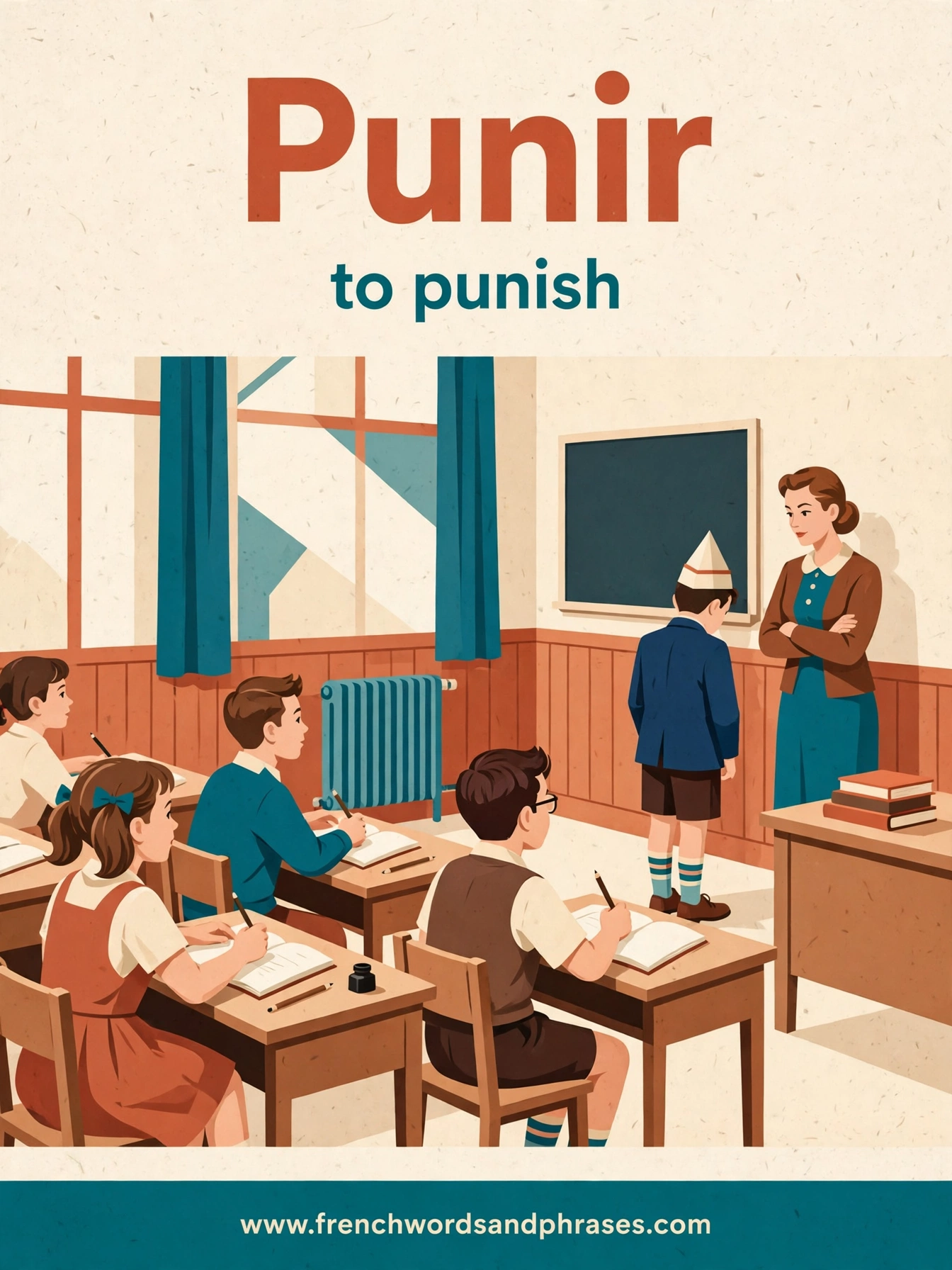
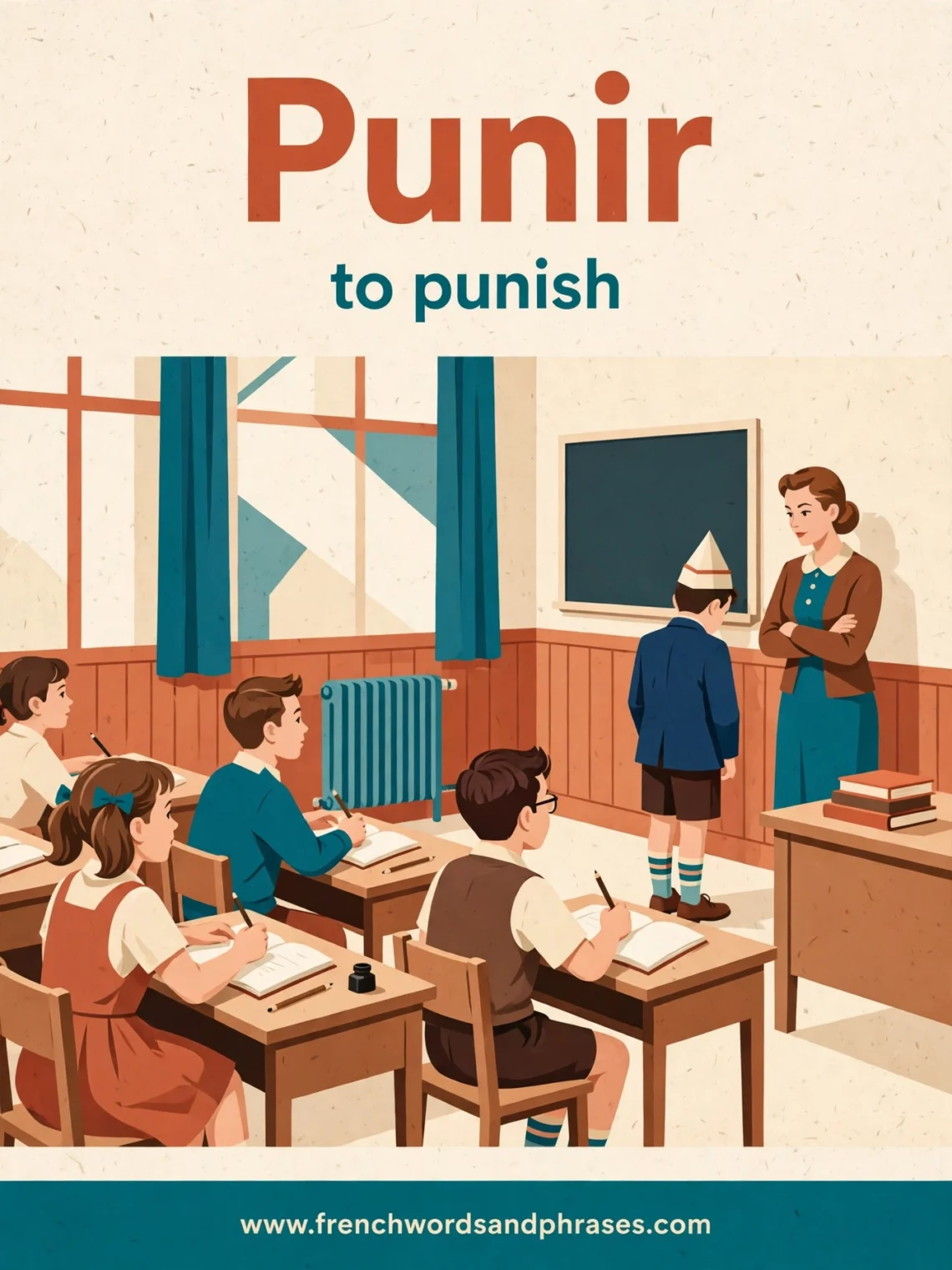
Imagine a village classroom in 1950. The inkwell has been knocked over, the culprit stands very straight, and the master’s voice is quiet: quiet voices, in that world, punished more than shouting.
The fault has not been erased. It has been answered — and the account is closed.
How to Conjugate Punir: Complete French Conjugation Guide
Let’s explore every major conjugation of punir, beginning with the indicative mood.
How to Conjugate Punir in the Indicative Mood
The indicative mood is used to express facts, observations, actions, and events.
How to Conjugate Punir in the Present Tense (Présent)
Used for actions happening now, habitual actions, and general truths.
| Subject | Conjugation |
|---|---|
| je | punis |
| tu | punis |
| il / elle | punit |
| nous | punissons |
| vous | punissez |
| ils / elles | punissent |
Example
Le maître punit rarement, mais fermement.
The teacher punishes rarely, but firmly.
Quick Quiz 1
Complete the sentence:
Nous ne ______ jamais sans écouter.
Reveal the answer
punissons
Nous ne punissons jamais sans écouter.
We never punish without listening.
How to Conjugate Punir in the Passé Composé
Used for completed actions in the past. Punir takes the auxiliary verb avoir.
| Subject | Conjugation |
|---|---|
| j’ | ai puni |
| tu | as puni |
| il / elle | a puni |
| nous | avons puni |
| vous | avez puni |
| ils / elles | ont puni |
Example
Ils ont puni le coupable d’une amende.
They punished the culprit with a fine.
How to Conjugate Punir in the Imparfait (Imperfect Tense)
Used for habitual past actions, descriptions, and ongoing situations in the past.
| Subject | Conjugation |
|---|---|
| je | punissais |
| tu | punissais |
| il / elle | punissait |
| nous | punissions |
| vous | punissiez |
| ils / elles | punissaient |
Example
Autrefois, on punissait les élèves pour un rien.
In the old days, pupils were punished for next to nothing.
Quick Quiz 2
Choose the correct form:
The judge punished the thief.
Le juge ______ le voleur. (a puni / est puni)
Reveal the answer
a puni
Le juge a puni le voleur.
Punir takes avoir.
How to Conjugate Punir in the Plus-que-parfait
Used to describe an action that had already been completed before another past event.
| Subject | Conjugation |
|---|---|
| j’ | avais puni |
| tu | avais puni |
| il / elle | avait puni |
| nous | avions puni |
| vous | aviez puni |
| ils / elles | avaient puni |
Example
Elle avait puni son fils de sa désobéissance.
She had punished her son for his disobedience.
How to Conjugate Punir in the Passé Simple
Primarily used in formal writing, literature, and historical narratives. It is rarely used in everyday conversation.
| Subject | Conjugation |
|---|---|
| je | punis |
| tu | punis |
| il / elle | punit |
| nous | punîmes |
| vous | punîtes |
| ils / elles | punirent |
Example
Le roi punit les traîtres sans pitié.
The king punished the traitors without mercy.
How to Conjugate Punir in the Passé Antérieur
A literary tense used to express an action completed immediately before another past action, generally in the passé simple.
| Subject | Conjugation |
|---|---|
| j’ | eus puni |
| tu | eus puni |
| il / elle | eut puni |
| nous | eûmes puni |
| vous | eûtes puni |
| ils / elles | eurent puni |
Example
Quand le juge eut puni le voleur, la salle souffla.
When the judge had punished the thief, the room breathed again.
How to Conjugate Punir in the Future Tense (Futur Simple)
Used to describe actions that will take place in the future.
| Subject | Conjugation |
|---|---|
| je | punirai |
| tu | puniras |
| il / elle | punira |
| nous | punirons |
| vous | punirez |
| ils / elles | puniront |
Example
La loi punira ces actes sévèrement.
The law will punish these acts severely.
How to Conjugate Punir in the Futur Antérieur (Future Perfect)
Used for an action that will have been completed before a particular point in the future.
| Subject | Conjugation |
|---|---|
| j’ | aurai puni |
| tu | auras puni |
| il / elle | aura puni |
| nous | aurons puni |
| vous | aurez puni |
| ils / elles | auront puni |
Example
À la fin du procès, le tribunal aura puni les coupables.
By the end of the trial, the court will have punished the guilty.
How to Conjugate Punir in the Near Future (Futur Proche)
Used to describe something that is going to happen soon. Formed with aller + infinitive.
| Subject | Conjugation |
|---|---|
| je | vais punir |
| tu | vas punir |
| il / elle | va punir |
| nous | allons punir |
| vous | allez punir |
| ils / elles | vont punir |
Example
Le professeur va punir les bavards.
The teacher is going to punish the chatterboxes.
How to Conjugate Punir in the Conditional Mood
The conditional mood expresses what would happen under certain circumstances. It is also frequently used to make polite requests or express wishes.
How to Conjugate Punir in the Present Conditional
| Subject | Conjugation |
|---|---|
| je | punirais |
| tu | punirais |
| il / elle | punirait |
| nous | punirions |
| vous | puniriez |
| ils / elles | puniraient |
Example
Sans preuves, on ne punirait personne.
Without proof, no one would punish anybody.
How to Conjugate Punir in the Past Conditional
| Subject | Conjugation |
|---|---|
| j’ | aurais puni |
| tu | aurais puni |
| il / elle | aurait puni |
| nous | aurions puni |
| vous | auriez puni |
| ils / elles | auraient puni |
Example
Ils auraient puni un innocent par erreur.
They would have punished an innocent man by mistake.
Punir in the Literary Past Conditional Form
This less common literary form uses the imperfect subjunctive of avoir.
| Subject | Conjugation |
|---|---|
| j’ | eusse puni |
| tu | eusses puni |
| il / elle | eût puni |
| nous | eussions puni |
| vous | eussiez puni |
| ils / elles | eussent puni |
Example
Il eût puni le mensonge plus que la faute.
He would have punished the lie more than the fault.
How to Conjugate Punir in the Subjunctive Mood
The subjunctive is used to express wishes, emotions, doubts, necessity, and uncertainty. It frequently follows expressions such as il faut que (it is necessary that) or bien que (although).
How to Conjugate Punir in the Present Subjunctive
| Subject | Conjugation |
|---|---|
| que je | punisse |
| que tu | punisses |
| qu’il / qu’elle | punisse |
| que nous | punissions |
| que vous | punissiez |
| qu’ils / qu’elles | punissent |
Example
Il faut que la justice punisse les coupables.
Justice must punish the guilty.
Quick Quiz 3
Complete the sentence using the subjunctive:
Il faut que vous ne ______ pas les innocents.
Reveal the answer
punissiez
Il faut que vous ne punissiez pas les innocents.
You must not punish the innocent.
How to Conjugate Punir in the Imperfect Subjunctive
A literary tense, rarely encountered in modern spoken French.
| Subject | Conjugation |
|---|---|
| que je | punisse |
| que tu | punisses |
| qu’il / qu’elle | punît |
| que nous | punissions |
| que vous | punissiez |
| qu’ils / qu’elles | punissent |
Example
Je craignais que le maître ne punît toute la classe.
I feared the teacher might punish the whole class.
How to Conjugate Punir in the Pluperfect Subjunctive
A literary construction used to express an action completed before another past action.
| Subject | Conjugation |
|---|---|
| que j’ | eusse puni |
| que tu | eusses puni |
| qu’il / qu’elle | eût puni |
| que nous | eussions puni |
| que vous | eussiez puni |
| qu’ils / qu’elles | eussent puni |
Example
Elle regrettait qu’on eût puni un innocent.
She regretted that an innocent man had been punished.
How to Conjugate Punir in the Past Subjunctive
| Subject | Conjugation |
|---|---|
| que j’ | aie puni |
| que tu | aies puni |
| qu’il / qu’elle | ait puni |
| que nous | ayons puni |
| que vous | ayez puni |
| qu’ils / qu’elles | aient puni |
Example
Je suis content que le tribunal ait puni les coupables.
I am glad the court punished the guilty.
How to Conjugate Punir in the Imperative
The imperative is used to give commands, instructions, invitations, or suggestions. Subject pronouns are omitted.
How to Conjugate Punir in the Present Imperative
| Person | Conjugation |
|---|---|
| (tu) | punis |
| (nous) | punissons |
| (vous) | punissez |
Example
Ne punis pas sans écouter d’abord !
Do not punish without listening first!
Quick Quiz 4
How would you say Do not punish (tu form)?
Reveal the answer
Ne punis pas !
French Participles of Punir
Participles are verb forms that can be used in compound tenses and other grammatical constructions.
Present Participle of Punir
punissant
En punissant trop, on perd la confiance des enfants.
By punishing too much, you lose children’s trust.
Past Participle of Punir
puni
Puni pour son retard, il ne protesta pas.
Punished for being late, he did not protest.
Punir in Everyday French: Real-Life Examples
Now that you know the conjugations, let’s see how punir appears in everyday French.
Example 1 — Present
On punit les mensonges dans cette école.
Lies are punished in this school.
Example 2 — Passé composé
Le juge a puni le voleur d’une amende.
The judge punished the thief with a fine.
Example 3 — Imparfait
On punissait les enfants pour un rien.
Children were punished for next to nothing.
Example 4 — Future
La loi punira ces crimes.
The law will punish these crimes.
Example 5 — Conditional
Je ne punirais jamais sans écouter.
I would never punish without listening.
Example 6 — Imperative
Ne punissez pas les innocents !
Do not punish the innocent!
Beyond Translation: The Meaning of Punir
English punish sounds purely severe; French punir covers the whole scale, from a father’s raised eyebrow to a court’s sentence.
Its noun is a childhood word.
Une punition is a punishment — the lines copied out, the corner, the lost dessert. And impuni, unpunished, names what every culprit hopes his crime will stay.
How to Remember the French Verb Punir
Remember it this way: Punir is about consequences — punir de/pour, fault and price.
- Punish someone FOR something — punir quelqu’un de or pour quelque chose.
- Être puni — to be punished: the phrase every schoolchild dreads.
- Regular -ir: je punis, nous punissons, past participle puni.
The key idea is consequences — punir de/pour, fault and price.
Test Your Knowledge of Punir
Let’s see how much you’ve learned. Try answering these questions before revealing the answers.
Question 1
Which prepositions can name the fault after punir?
Reveal the answer
De or pour — punir un enfant de son mensonge, punir pour un mensonge.
Question 2
How do you say The judge punished the thief in French?
Reveal the answer
Le juge a puni le voleur.
Question 3
Translate: Children were punished for next to nothing.
Reveal the answer
On punissait les enfants pour un rien.
Question 4
What is the past participle of punir?
Reveal the answer
Puni.
Question 5
Complete the sentence:
Il faut que la justice ______ les coupables.
Reveal the answer
punisse
Il faut que la justice punisse les coupables.
Justice must punish the guilty.
Your Final Challenge
Can You Use It?
How would you say this in French?
Good justice punishes the guilty and protects the innocent.
Reveal the answer
Une bonne justice punit les coupables et protège les innocents.
Good justice punishes the guilty and protects the innocent.
A little French. A little curiosity. A richer everyday life.
LEARN FRENCH ONE WORD AT A TIME