A French Word to Live By
Translate Promenade to English
/pʁɔm.nad/
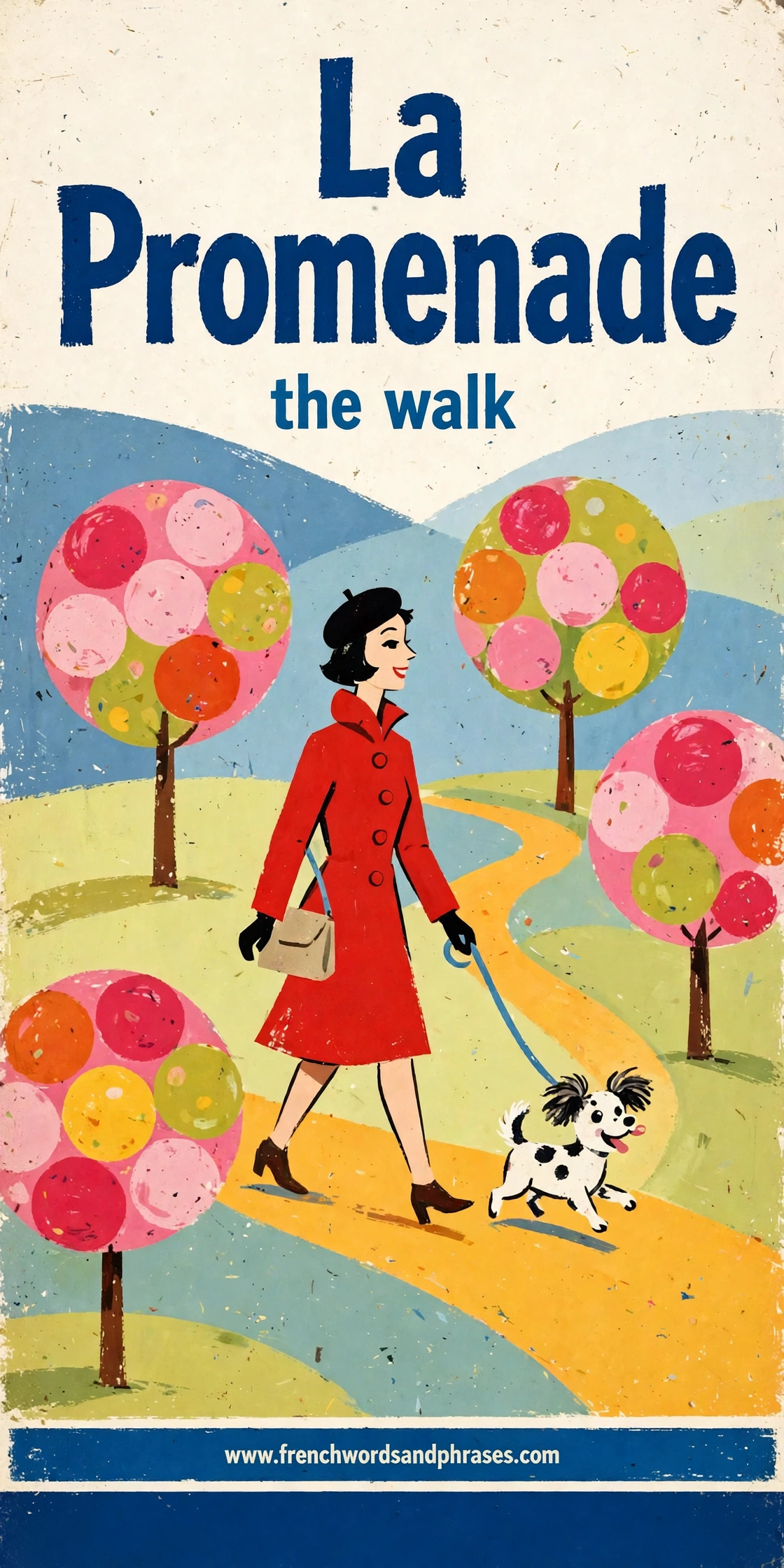
La promenade means a walk, a stroll.
After lunch, the whole family puts on its coats. Not to go anywhere in particular — just out: along the river, under the trees, slowly, talking. Nobody calls it exercise. In French it is simply la promenade.
In this guide, you’ll learn what promenade means in English, how to use it with its articles, how to form its plural, and how it appears in everyday French. Explore French examples, English translations, and practice quizzes.
Understanding the French Noun Promenade
Promenade is a feminine French noun. It is learned together with its article: la promenade, une promenade. It comes from the verb se promener, to go for a walk — and the word names both the walk itself and, in many towns, the wide path built for walking on.
It means a walk, a stroll — a walk taken for pleasure, not to get somewhere: faire une promenade, to go for a walk. The word also names the place: along the sea or a river, la promenade is the broad paved walk where everyone strolls — Nice’s famous Promenade des Anglais is exactly that.
Gender: Feminine
Definite article: la — la promenade (the walk)
Indefinite article: une — une promenade (a walk)
Plural: les promenades
English equivalents: A walk, a stroll; also the promenade itself — the walkway by the sea.
One important usage detail: a promenade is never a journey and never a commute. You fais une promenade — you make a walk — purely for the pleasure of it, and you come back to where you started. For walking as transport, French uses la marche or simply à pied, on foot. And the verb is reflexive: se promener, to take oneself for a walk.
Experience the Word
Promenade is more than a walk. It is a French institution — the slow hour after the meal, the Sunday circuit of the park, the evening turn along the harbour when the whole town seems to be out.
Imagine the seafront at six in the evening: grandparents on the benches, children on bicycles, couples arm in arm, nobody in a hurry, the sea doing the talking. Everyone is doing nothing, together, beautifully.
You have not just stretched your legs. You have taken part in la promenade — the town walking with itself.
How to Use Promenade in French: Complete Guide
Let’s explore how promenade works in French, beginning with its articles.
Promenade with the Definite Article (La, Les)
Used for the walk everyone knows — the Sunday one, the one after lunch.
| Number | French |
|---|---|
| Singular | la promenade |
| Plural | les promenades |
Example
La promenade du dimanche est une tradition dans la famille.
The Sunday walk is a tradition in the family.
Promenade with the Indefinite Article (Une, Des)
Used for a walk in general — the one you are suggesting, the one the dog is waiting for.
| Number | French |
|---|---|
| Singular | une promenade |
| Plural | des promenades |
Example
On fait une promenade après le déjeuner ?
Shall we go for a walk after lunch?
Where to Take a Promenade
By the sea, along the river, in the forest — the classic scenery of the French stroll.
| French | In English |
|---|---|
| au bord de la mer | by the sea |
| le long de la rivière | along the river |
| dans le parc | in the park |
| en forêt | in the forest |
| dans le village | through the village |
| sur la plage | on the beach |
Example
Nous faisons une promenade le long de la rivière.
We are going for a walk along the river.
Quick Quiz 1
What is the Promenade des Anglais?
Reveal the answer
The famous seafront walkway of Nice — the promenade as a place, not just a walk.
La Promenade des Anglais longe la mer à Nice.
The Promenade des Anglais runs along the sea in Nice.
The Plural of Promenade
Promenade adds an -s in the plural — les promenades, the walks of a whole summer.
| Number | French |
|---|---|
| Singular | la promenade |
| Plural | les promenades |
Example
Les promenades du soir sont agréables en été.
Evening walks are pleasant in summer.
Promenade with Possessive Adjectives (Ma, Ta, Sa…)
Possessives agree with the noun, not with the owner — and promenade is feminine, so it takes ma, ta, sa.
| Owner | French |
|---|---|
| my | ma promenade |
| your (tu) | ta promenade |
| his / her | sa promenade |
| our | notre promenade |
| your (vous) | votre promenade |
| their | leur promenade |
Example
Ma promenade préférée longe le canal.
My favourite walk runs along the canal.
Quick Quiz 2
Complete the sentence:
______ promenade quotidienne lui fait du bien. (Her)
Reveal the answer
Sa
Sa promenade quotidienne lui fait du bien.
Her daily walk does her good.
Promenade with Demonstrative Adjectives (Cette, Ces)
Used to point: this walk here, those walks there.
| Number | French |
|---|---|
| Singular | cette promenade |
| Plural | ces promenades |
Example
Cette promenade dure environ une heure.
This walk takes about an hour.
Promenade with Adjectives
Adjectives agree with promenade, feminine — longue, quotidienne, agréable.
| Adjective | With Promenade |
|---|---|
| longue (long) | une longue promenade |
| quotidienne (daily) | une promenade quotidienne |
| agréable (pleasant) | une promenade agréable |
| matinale (morning) | une promenade matinale |
| digestive (after-meal) | une promenade digestive |
Example
Après le repas, une promenade digestive fait du bien.
After the meal, a digestive stroll does you good.
Quick Quiz 3
Complete the sentence:
C’est une promenade très ______. (pleasant)
Reveal the answer
agréable
C’est une promenade très agréable.
It’s a very pleasant walk.
Everyday Expressions with Promenade
Dogs, boats and bicycles — the promenade phrases of daily life.
| Expression | In English |
|---|---|
| faire une promenade | to go for a walk |
| promener le chien | to walk the dog |
| une promenade en bateau | a boat trip |
| une promenade à vélo | a bike ride |
| une promenade digestive | an after-dinner stroll |
| aller en promenade | to go out walking |
Example
Chaque soir, il promène le chien dans le quartier.
Every evening, he walks the dog around the neighbourhood.
Words from the Same Family as Promenade
Walking, paths and slow pleasures — the words that travel with promenade.
| French | In English |
|---|---|
| se promener | to go for a walk |
| la marche | walking, a walk |
| marcher | to walk |
| la balade | a stroll, an outing |
| le sentier | the path, the trail |
| flâner | to stroll, to wander |
Example
On se promène le long du sentier, sans se presser.
We stroll along the path, without hurrying.
Quick Quiz 4
Your friend suggests: « On fait une promenade jusqu’au bureau ? » What is odd about that?
Reveal the answer
A promenade is for pleasure, not for getting somewhere — a walk to the office is a trajet, not a promenade.
On fait une promenade dans le parc, pas jusqu’au bureau !
We go for a walk in the park, not to the office!
Promenade in Everyday French: Real-Life Examples
Now that you know the word, let’s see how promenade appears in everyday French.
Example 1 — After lunch
Après le déjeuner, nous faisons une petite promenade.
After lunch, we go for a little walk.
Example 2 — With the dog
Elle promène le chien matin et soir.
She walks the dog morning and evening.
Example 3 — By the sea
La promenade le long de la plage est magnifique au coucher du soleil.
The walk along the beach is magnificent at sunset.
Example 4 — Sunday ritual
Le dimanche, la promenade en famille est sacrée.
On Sundays, the family walk is sacred.
Example 5 — Suggesting a break
On fait une promenade pour prendre l’air ?
Shall we go for a walk to get some fresh air?
Example 6 — In the forest
Cette promenade en forêt dure deux heures.
This walk in the forest takes two hours.
Beyond Translation: The Meaning of Promenade
The promenade is built into the French landscape: towns paved their seafronts and riverbanks for it, and gave the walkways the same name as the walk. To promenade was once to be seen — the evening hour when the town displayed itself to itself — and something of that gentle theatre survives in every Sunday stroll.
To say promenade is to walk for the pleasure of walking.
It evokes coats after lunch and dogs on leads, benches facing the sea, the slow circuit of the village square — movement with no destination, which is exactly the point.
How to Remember the French Noun Promenade
Remember it this way: Promenade is the walk — feminine, a stroll for pleasure, and also the walkway where the town does its strolling.
- You suggest it — on fait une promenade après le repas ?
- You keep it for pleasure — la promenade ne va nulle part, elle revient.
- You walk the dog — promener le chien, matin et soir.
The key idea is la promenade goes nowhere — on purpose.
Test Your Knowledge of Promenade
Let’s see how much you’ve learned. Try answering these questions before revealing the answers.
Question 1
Is promenade masculine or feminine?
Reveal the answer
Feminine — la promenade, une promenade.
Question 2
How do you say to go for a walk in French?
Reveal the answer
Faire une promenade — or the verb se promener.
Question 3
Translate: We go for a walk along the river.
Reveal the answer
Nous faisons une promenade le long de la rivière.
Question 4
What is une promenade digestive?
Reveal the answer
An after-dinner stroll — the gentle walk that helps the meal go down.
Question 5
Complete the sentence:
Elle fait ______ promenade avec son chien. (her)
Reveal the answer
sa
Elle fait sa promenade avec son chien.
She takes her walk with her dog.
Your Final Challenge
Can You Use It?
How would you say this in French?
“After dinner, we go for a walk by the sea.”
Reveal the answer
Après le dîner, nous faisons une promenade au bord de la mer.
After dinner, we go for a walk by the sea.
A little French. A little curiosity. A richer everyday life.
LEARN FRENCH ONE WORD AT A TIME