A French Word to Live By
Translate Tante to English
/tɑ̃t/
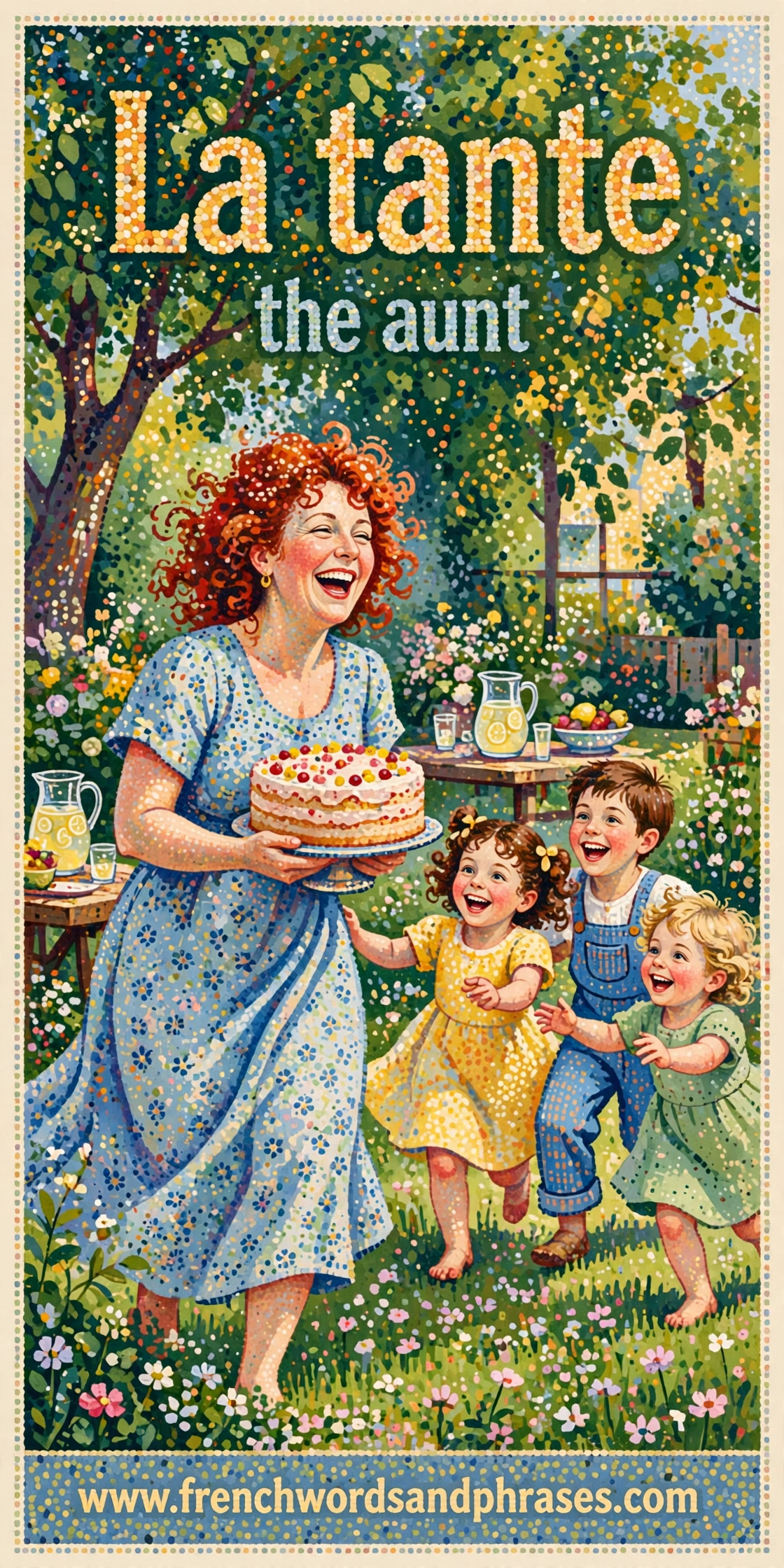
La tante means the aunt.
She arrives with a cake, news of cousins, and the kind of honesty only she is allowed: la tante, the aunt — the parent’s sister, the family’s second mother and first confidante, the relative children run to when the parents have said no.
In this guide, you’ll learn what tante means in English, how to use it with its articles, how to form its plural, and how it appears in everyday French. Explore French examples, English translations, and practice quizzes.
Understanding the French Noun Tante
Tante is a feminine French noun, learned with its article: la tante, une tante. It comes from the Latin amita, the father’s sister — a word children have been softening for two thousand years. Its plural is regular: les tantes. In many families she is called tata, the affectionate name, and by marriage she may be une tante par alliance, an aunt by marriage.
It means aunt — the sister of one’s father or mother, or the wife of an uncle: ma tante habite à Bordeaux, my aunt lives in Bordeaux. French also lends the word to close family friends: a beloved older friend of the parents may be called tante by the children, an honourary rank. One step up: la grand-tante, the great-aunt.
Gender: Feminine — la tante
Definite article: la — la tante (the aunt)
Indefinite article: une — une tante (an aunt)
Plural: les tantes — regular, with a simple -s
Spelling note: from Latin amita, the paternal aunt — the t is pronounced
Family name: tata — the affectionate name children use
English equivalents: The aunt.
Tante is the word for speaking of an aunt; to her face, children and many adults say tata, and grown nieces and nephews often keep the name for life. In conversation, ma tante is unambiguous — French does not need to ask which side: the mother’s sister and the father’s sister are both tante, with the story supplying the rest.
Experience the Word
Tante is the family’s open door — the house where the rules bend, the confidences are kept, and the cake is bigger.
Imagine the summer train journey to la tante in the country: the platform gets nearer, and with it the smell of her kitchen, the cousin in the doorway, and three weeks in which a child is somebody’s favourite person in the world.
You have not just named a relative. You have named childhood’s second home — la tante, the aunt, the family’s beloved accomplice.
How to Use Tante in French: Complete Guide
Let’s explore how tante works in French, beginning with its articles — la tante, une tante, ma tante.
Tante with the Definite Article (La, Les)
Used for a specific aunt — yours, theirs, the one arriving Sunday.
| Form | French |
|---|---|
| Feminine singular | la tante |
| Plural | les tantes |
Example
La tante arrive dimanche avec un gâteau.
The aunt is arriving on Sunday with a cake.
Tante with the Indefinite Article (Une, Des)
Used for an aunt in general — any family’s tata.
| Form | French |
|---|---|
| Feminine singular | une tante |
| Plural | des tantes |
Example
C’est une tante merveilleuse, toujours joyeuse.
She is a wonderful aunt, always cheerful.
Tante with Quantities (Une, Deux, Beaucoup de…)
Aunts are counted across the family tree — by birth, by marriage, by love.
| Quantity | French |
|---|---|
| one aunt | une tante |
| two aunts | deux tantes |
| both aunts | les deux tantes |
| many aunts | beaucoup de tantes |
| every aunt | chaque tante |
Example
J’ai trois tantes et deux oncles.
I have three aunts and two uncles.
Quick Quiz 1
Complete the sentence:
______ tante de Hugo habite à la campagne. (the)
Reveal the answer
La
La tante de Hugo habite à la campagne.
Hugo’s aunt lives in the country — tante is feminine, so la.
The Plural of Tante
Tante takes a regular plural in -s — aunts travel in families.
| Number | French |
|---|---|
| Singular | la tante |
| Plural | les tantes |
Example
Les tantes préparent le repas de famille.
The aunts are preparing the family meal.
Tante with Possessive Adjectives (Ma, Ta, Sa…)
Possessives agree with the noun: tante is feminine, so ma, ta, sa in the singular.
| Owner | French |
|---|---|
| my | ma tante |
| your (tu) | ta tante |
| his / her | sa tante |
| our | notre tante |
| your (vous) | votre tante |
| their | leur tante |
Example
Ma tante m’apprend le piano.
My aunt is teaching me the piano.
Quick Quiz 2
Complete the sentence:
Il passe l’été chez ______ tante, à la mer. (his)
Reveal the answer
sa
Il passe l’été chez sa tante, à la mer.
He spends the summer at his aunt’s, by the sea — sa, because tante is feminine.
Tante with Demonstrative Adjectives (Cette, Ces)
Used to point: cette tante, this aunt — in the story, in the photograph.
| Form | French |
|---|---|
| Feminine singular | cette tante |
| Plural | ces tantes |
Example
Cette tante, à gauche sur la photo, est la sœur de maman.
This aunt, on the left in the photo, is Mum’s sister.
Tante with Adjectives
Adjectives agree with tante — feminine singular: une tante gentille, une vieille tante.
| Adjective | With Tante |
|---|---|
| gentille (kind) | une tante gentille |
| vieille (old) | une vieille tante |
| jeune (young) | une jeune tante |
| drôle (funny) | une tante drôle |
| adorée (beloved) | une tante adorée |
Example
C’est une tante drôle, elle fait rire tous les enfants.
She is a funny aunt, she makes all the children laugh.
Quick Quiz 3
Complete the sentence:
Ma tante est très ______, elle aide tout le monde. (kind)
Reveal the answer
gentille
Ma tante est très gentille, elle aide tout le monde.
My aunt is very kind, she helps everyone — gentille, feminine, to agree with tante.
Everyday Expressions with Tante
Summer houses, confidences and cakes — the tante phrases of daily life.
| Expression | In English |
|---|---|
| ma tante | my aunt |
| une tante par alliance | an aunt by marriage |
| la grand-tante | the great-aunt |
| tata | auntie — the family’s affectionate name |
| chez ma tante | at my aunt’s (house) |
Example
Les enfants passent août chez leur tante.
The children spend August at their aunt’s.
Words from the Same Family as Tante
The family circle — the words that travel with tante.
| French | In English |
|---|---|
| l’oncle | the uncle |
| le neveu | the nephew — what you are to her |
| la nièce | the niece |
| la cousine | the (female) cousin |
| la famille | the family |
Example
La tante garde son neveu le mercredi.
The aunt looks after her nephew on Wednesdays.
Quick Quiz 4
What is la grand-tante?
Reveal the answer
The great-aunt — the aunt of one’s parent.
Ma grand-tante a quatre-vingt-dix ans.
My great-aunt is ninety years old.
Tante in Everyday French: Real-Life Examples
Now that you know the word, let’s see how tante appears in everyday French.
Example 1 — A visit
Nous allons chez ma tante dimanche.
We’re going to my aunt’s on Sunday.
Example 2 — In the country
Ma tante habite dans un petit village.
My aunt lives in a small village.
Example 3 — Learning
Ma tante m’apprend à cuisiner.
My aunt is teaching me to cook.
Example 4 — The family meal
Les tantes préparent le déjeuner de Noël.
The aunts are preparing the Christmas lunch.
Example 5 — A confidence
Elle raconte tout à sa tante.
She tells her aunt everything.
Example 6 — By marriage
C’est ma tante par alliance, la femme de mon oncle.
She’s my aunt by marriage, my uncle’s wife.
Beyond Translation: The Meaning of Tante
Tante descends from the Latin amita, which named specifically the father’s sister — Latin had a whole precision toolkit of aunts that French simplified into one warm word. What French kept, and grew, is the role: la tante is the family’s beloved second authority, close enough for confidences, free enough for fun, and in countless childhoods the first adult who treats a child as a person with a inner life. The affectionate tata, formed in children’s mouths, is the word’s true home address.
To say tante is to name childhood’s accomplice — the family’s open door.
It evokes the summer house, the kept secrets, and the cake that is always, somehow, bigger at her table.
How to Remember the French Noun Tante
Remember it this way: Tante is the aunt — feminine, regular plural tantes, and tata to her face in most families.
- Always feminine — la tante, une tante, ma tante.
- The home name — chez elle, c’est tata ; tante, c’est pour parler d’elle.
- Both sides, one word — la sœur de maman ou de papa, c’est toujours la tante.
The key idea is la tante — the aunt, feminine; tata at home; la grand-tante = the great-aunt.
Test Your Knowledge of Tante
Let’s see how much you’ve learned. Try answering these questions before revealing the answers.
Question 1
Is tante masculine or feminine?
Reveal the answer
Feminine — la tante, une tante.
Question 2
How do you say my aunt?
Reveal the answer
Ma tante.
Question 3
Translate: My aunt lives in Bordeaux.
Reveal the answer
Ma tante habite à Bordeaux.
Question 4
Complete the sentence:
______ tantes arrivent pour Noël. (the)
Reveal the answer
Les
Les tantes arrivent pour Noël.
The aunts are arriving for Christmas.
Question 5
What do children often call their tante?
Reveal the answer
Tata — the affectionate family name.
Your Final Challenge
Can You Use It?
How would you say this in French?
“My aunt is teaching me to cook.”
Reveal the answer
Ma tante m’apprend à cuisiner.
My aunt is teaching me to cook.
A little French. A little curiosity. A richer everyday life.
LEARN FRENCH ONE WORD AT A TIME