A French Word to Live By
Translate Probablement to English
/pʁɔ.ba.blə.mɑ̃/
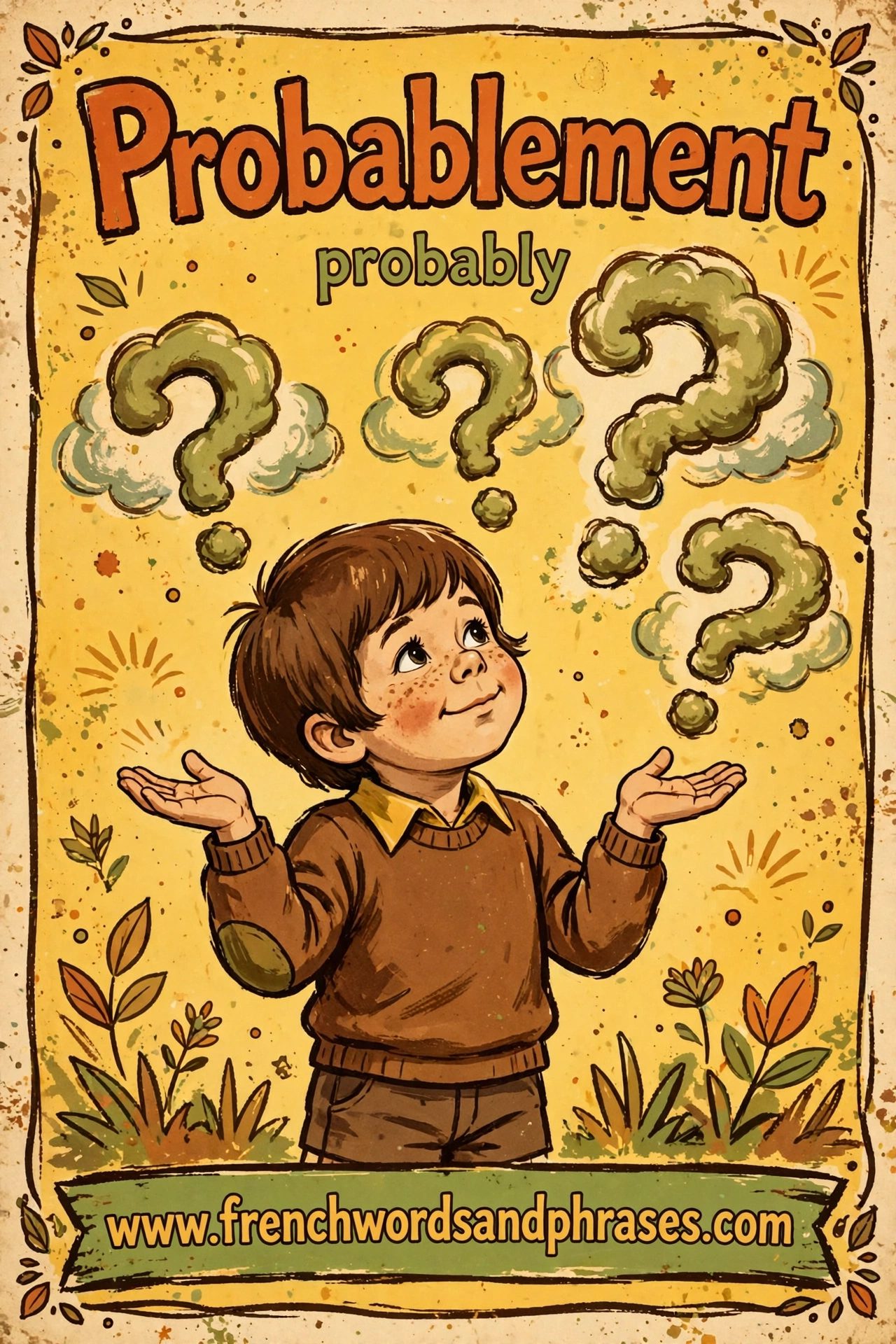
Probablement means probably.
Dark clouds over the harbour, a wind rising off the water, and the fisherman studies the sky before answering: « il va probablement pleuvoir ». It will probably rain. Probablement is the word French uses to lean — not certainty, not a guess in the dark, but a judgement with its weight behind it.
In this guide, you’ll learn what probablement means in English, why it is an adverb and not a conjunction, where it sits in the sentence, and how the frame il est probable que keeps the indicative while il est possible que demands the subjunctive. Explore French examples, English translations, and practice quizzes.
Understanding the French Conjunction Probablement
Probablement is a French adverb of probability — not a conjunction. It weighs a statement: probably, most likely. It sits between peut-être (maybe, a coin toss) and sûrement (surely, near-certainty) on the French scale of confidence.
It means probably. Il viendra probablement demain — he will probably come tomorrow. Notice the French habit: future tense plus probablement, where English spreads the same idea across ‘will probably’.
Type: Adverb — probability and opinion
What follows it: Nothing fixed — it sits inside its clause
Mood after it: No mood of its own — but see the probable/possible pair below
On the confidence scale: Stronger than peut-être, weaker than sûrement
One spoken habit to recognise: in everyday speech you will hear probablement que oui — probably yes — and even probablement que + a clause. It is common but informal; careful writing keeps probablement inside the clause instead.
Experience the Word
Probablement is the forecaster’s word — the honest middle between knowing and hoping.
Imagine a grandmother asked whether the whole family will fit around her table at Christmas. She counts chairs in her head, weighs journeys and weather, and delivers her verdict: « ils viendront probablement tous ».
She has not promised anything. She has weighed the world and reported the balance.
How to Use Probablement in French: Complete Guide
Let’s explore how probablement works in French, beginning with the whole word on one card.
Probablement at a Glance
Before the details, here is the whole word on one card.
The Whole Word on One Card
Meaning, job, pattern and mood — probablement in four lines.
| Point | Probablement |
|---|---|
| Meaning | probably, most likely |
| Job | weighs how likely a statement is |
| What follows | nothing fixed — it sits in its clause |
| Mood | none of its own — the clause stays indicative |
Example
Elle sera probablement en retard.
She will probably be late.
How Probablement Links: It Weighs Rather Than Joins
Probablement joins nothing — it leans on one clause and tilts it towards likelihood. Its favourite partner is the future tense.
| Pattern | Example |
|---|---|
| future + probablement | il pleuvra probablement demain — it will probably rain tomorrow |
| probablement + verb | elle a probablement oublié — she has probably forgotten |
| probablement pas | il ne viendra probablement pas — he probably won’t come |
| at the head of the answer | — Il vient ? — Probablement. — Is he coming? — Probably. |
Example
Nous arriverons probablement vers midi.
We’ll probably arrive around midday.
Quick Quiz 1
Which is more confident — peut-être or probablement?
Reveal the answer
probablement — peut-être is a coin toss, probablement is a weighed judgement.
Il viendra probablement.
He’ll probably come.
The Mood Question: Probable Takes the Indicative, Possible the Subjunctive
Probablement itself governs nothing — but its family hides the most useful mood contrast in French. What is probable is treated as near-fact (indicative); what is merely possible stays in the subjunctive.
| Frame | Mood and example |
|---|---|
| il est probable que + indicative | il est probable qu’il viendra — it’s probable he’ll come |
| il est possible que + subjunctive | il est possible qu’il vienne — it’s possible he may come |
| probablement inside the clause | il viendra probablement — indicative, always |
| il est peu probable que + subjunctive | il est peu probable qu’il vienne — it’s unlikely he’ll come |
Example
Il est probable qu’elle réussira, et elle réussira probablement.
It’s probable she’ll succeed, and she probably will succeed.
Where Probablement Goes: Before the Verb, or Inside It
Probablement sits before the verb, between the auxiliary and the participle, or at the head of the sentence — and probablement pas is its fixed negative form.
| Position | Example |
|---|---|
| Between auxiliary and participle | elle a probablement perdu ses clés — she has probably lost her keys |
| After a simple verb | il viendra probablement — he will probably come |
| Head of the sentence | probablement, il a raison — probably, he’s right |
| Teamed with pas | probablement pas — probably not: il ne viendra probablement pas |
Example
Le train aura probablement du retard.
The train will probably be delayed.
Quick Quiz 2
« Il est probable qu’il ___ » — vient or vienne?
Reveal the answer
vient — probable treats the event as near-fact and takes the indicative (vienne belongs to il est possible que).
Il est probable qu’il vient demain.
It’s probable he’s coming tomorrow.
Everyday Expressions with Probablement
Short answers, weather forecasts and family predictions — probablement lives where the future is being weighed.
| Expression | In English |
|---|---|
| probablement pas | probably not |
| probablement que oui (spoken) | probably yes |
| très probablement | very probably, in all likelihood |
| le plus probablement | most probably |
| probablement vrai | probably true |
Example
— Tu viens demain ? — Probablement pas, je travaille.
— Are you coming tomorrow? — Probably not, I’m working.
Close Cousins: Probablement, Peut-être, Sans doute, Sûrement
The confidence scale of French, from a shrug to a near-promise. Learn the four steps and you can tune any prediction.
| Word | The difference |
|---|---|
| peut-être | maybe — fifty-fifty; can open a sentence (formal French may invert: peut-être viendra-t-il) |
| probablement | probably — the weighed judgement, likely but not sure |
| sans doute | probably, no doubt — sounds certain, actually means ‘very likely’ |
| sûrement | surely, certainly — the top of the scale |
Example
Peut-être qu’il viendra ; probablement même ; sûrement, s’il promet.
Maybe he’ll come; probably, even; surely, if he promises.
Quick Quiz 3
Sans doute looks like ‘without doubt’ — is it a certainty?
Reveal the answer
Not quite — in everyday French sans doute means ‘probably, very likely’, a step below true certainty.
Il est sans doute fatigué.
He’s probably tired.
Probablement and Its Neighbours
The probability shelf — synonyms above, and the ways French says the opposite below.
| French | In English |
|---|---|
| sans doute | probably, no doubt |
| peut-être | maybe, perhaps |
| sûrement | surely, certainly |
| il est probable que | it’s probable that (+ indicative) |
| aucune chance (spoken) | no chance — the flat opposite |
Example
Sans doute fatigué, probablement affamé — il a sûrement besoin de repos.
Probably tired, likely hungry — he surely needs rest.
Watch Out: The Traps Around Probablement
The traps: the spoken probablement que in formal writing, word order with simple verbs, and the sans doute illusion.
| Trap | The truth |
|---|---|
| probablement que + clause in essays | common in speech, avoided in careful writing — keep probablement inside the clause |
| placing it before a simple verb | French puts it after: il viendra probablement, not il probablement viendra |
| sans doute read as certainty | it means ‘probably’ — for true certainty use sûrement or certainement |
| probably = probable alone | probable is the adjective (un résultat probable); the adverb is probablement |
Example
Un retard est probable ; le train arrivera probablement à midi.
A delay is likely; the train will probably arrive at midday.
Quick Quiz 4
Correct the order: « Il probablement viendra demain. »
Reveal the answer
Il viendra probablement demain — after a simple verb, probablement follows it.
Il viendra probablement demain.
He will probably come tomorrow.
Probablement in Everyday French: Real-Life Examples
Now that you know the word, let’s see how probablement appears in everyday French.
Example 1 — Weather
Il pleuvra probablement ce soir.
It will probably rain this evening.
Example 2 — Plans
Il viendra probablement demain matin.
He will probably come tomorrow morning.
Example 3 — A refusal softened
Je ne pourrai probablement pas venir.
I probably won’t be able to come.
Example 4 — Praise
C’est probablement le meilleur restaurant du quartier.
It’s probably the best restaurant in the neighbourhood.
Example 5 — Travel
Le train aura probablement dix minutes de retard.
The train will probably be ten minutes late.
Example 6 — An explanation
Elle a probablement oublié son téléphone.
She has probably forgotten her phone.
Beyond Translation: The Meaning of Probablement
English says probably for the meaning of probablement — and both descend from the Latin probare, to test and prove. A probable thing, in the old sense, is a thing that can be tested and held up: not certain, but defensible.
Probablement is the adverb of the honest witness — I cannot swear it, but I can stand behind it.
French keeps the whole scale polished and in daily use — peut-être, probablement, sans doute, sûrement — because French conversation loves a calibrated judgement: never claim the whole sky when you have only weighed the clouds.
How to Remember the French Conjunction Probablement
Remember it this way: Probablement is the weighed judgement — stronger than maybe, humbler than surely.
- You park it after a simple verb or inside a compound one — il viendra probablement, elle a probablement oublié.
- You climb the scale in order — peut-être, probablement, sans doute, sûrement.
- You split the famous pair — il est probable que + indicative, il est possible que + subjunctive.
The key idea is probablement weighs a clause as likely — and probable keeps the indicative.
Test Your Knowledge of Probablement
Let’s see how much you’ve learned. Try answering these questions before revealing the answers.
Question 1
What does probablement mean?
Reveal the answer
Probably / most likely — a weighed judgement, not a certainty.
Question 2
Is probablement a conjunction?
Reveal the answer
No — it is an adverb of probability. It sits inside a clause; it joins nothing.
Question 3
Translate: He will probably arrive tomorrow.
Reveal the answer
Il arrivera probablement demain.
Question 4
Which mood follows il est probable que?
Reveal the answer
The indicative — the event is treated as near-fact. (Il est possible que takes the subjunctive.)
Question 5
Complete the sentence:
Elle a ______ perdu son parapluie.
Reveal the answer
probablement
Elle a probablement perdu son parapluie.
She has probably lost her umbrella.
Your Final Challenge
Can You Use It?
How would you say this in French?
“He will probably arrive tomorrow.”
Reveal the answer
Il arrivera probablement demain.
He will probably arrive tomorrow.
A little French. A little curiosity. A richer everyday life.
LEARN FRENCH ONE WORD AT A TIME