A French Word to Live By
Translate Néanmoins to English
/ne.ɑ̃.mwɛ̃/
Néanmoins means nonetheless.
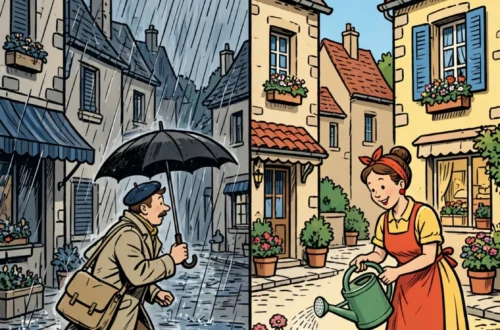
The report is honest about the difficulties: costs are rising, the road ahead is hard. And then the writer turns the page with one formal word: « Néanmoins, le projet avance ». Nonetheless, the project moves forward. Néanmoins is the nevertheless of written French — measured, dressed, and quietly immovable.
In this guide, you’ll learn what néanmoins means in English, why it is honestly a linking adverb rather than a conjunction, why it belongs to formal and written French, and how it differs from its cousins cependant and pourtant. Explore French examples, English translations, and practice quizzes.
Understanding the French Conjunction Néanmoins
Néanmoins is a French linking adverb of concession — honestly an adverb, not a conjunction. It opens or punctuates a clause that concedes the previous point and stands its ground anyway: nonetheless, nevertheless, however. Its home is the written page: essays, reports, formal letters.
It means nonetheless, nevertheless. Il pleut ; néanmoins, nous sortons — it’s raining; nonetheless, we’re going out. The fact before it is fully admitted — and then politely set aside.
Type: Linking adverb — concession
Register: Formal, written — essays, reports, speeches
What follows it: A comma, then a full clause
Mood after it: No mood of its own — the clause is normal
Register is the whole story here: in conversation, French speakers reach for mais, pourtant or quand même. Néanmoins in casual chat sounds like wearing a suit to the beach — correct, but noticeable. Save it for writing, where it shines.
Experience the Word
Néanmoins is the concession of the written word — a bow to the opposing fact, performed without yielding an inch.
Imagine a mayor’s letter to the town: the budget is tight, the works will take longer than promised — « Néanmoins, la bibliothèque ouvrira en septembre ». The difficulties are on the record; so is the decision.
You have not hidden the obstacle. You have acknowledged it in full dress — and proceeded.
How to Use Néanmoins in French: Complete Guide
Let’s explore how néanmoins works in French, beginning with the whole word on one card.
Néanmoins at a Glance
Before the details, here is the whole word on one card.
The Whole Word on One Card
Meaning, job, pattern and mood — néanmoins in four lines.
| Point | Néanmoins |
|---|---|
| Meaning | nonetheless, nevertheless, however |
| Job | concedes a point, then stands firm |
| What follows | a comma, then a clause |
| Mood | none — the clause keeps its normal verb |
Example
Le chemin est long ; néanmoins, nous continuons.
The road is long; nonetheless, we carry on.
How Néanmoins Links: A New Clause That Refuses to Yield
Néanmoins does not weld two clauses together — it opens a fresh clause that answers the previous one: granted, you say — and nevertheless.
| Pattern | Example |
|---|---|
| difficulty ; néanmoins, + firm clause | les prix montent ; néanmoins, la demande reste forte — prices are rising; nonetheless, demand stays strong |
| néanmoins at the head of a sentence | Néanmoins, le projet avance. — Nonetheless, the project is moving forward. |
| néanmoins after the verb | il est néanmoins venu — he came nonetheless |
| néanmoins between auxiliary and participle | elle a néanmoins accepté — she accepted nonetheless |
Example
La tâche est difficile ; néanmoins, elle est possible.
The task is difficult; nonetheless, it is possible.
Quick Quiz 1
Where does néanmoins feel at home — in a text message to a friend, or in a formal report?
Reveal the answer
In a formal report — it is a written, formal word.
Néanmoins, les résultats sont bons.
Nonetheless, the results are good.
The Mood Question: A Formal Word with No Grammar of Its Own
For all its ceremony, néanmoins governs nothing: the clause it introduces is an ordinary statement whose verb keeps its normal tense and mood — the indicative.
| Setting | Example |
|---|---|
| Present | néanmoins, il reste du travail — nonetheless, work remains |
| Past | néanmoins, elle a réussi — nonetheless, she succeeded |
| Future | néanmoins, nous partirons — nonetheless, we shall leave |
| After être | c’est néanmoins vrai — it is nevertheless true |
Example
Il est tard ; néanmoins, la discussion continue.
It is late; nonetheless, the discussion goes on.
Where Néanmoins Goes: The Head of the Clause, or After the Verb
Néanmoins opens its clause followed by a comma, or slips in after the verb — after être, or between the auxiliary and the participle — in flowing written style.
| Position | Example |
|---|---|
| Head of the clause | néanmoins, nous acceptons — nonetheless, we accept |
| After a semicolon | il hésite ; néanmoins, il signe — he hesitates; nonetheless, he signs |
| After the verb être | le plan est néanmoins simple — the plan is nevertheless simple |
| Between auxiliary and participle | ils ont néanmoins décidé de partir — they nevertheless decided to leave |
Example
Le rapport est néanmoins clair sur ce point.
The report is nevertheless clear on this point.
Quick Quiz 2
Which sounds natural in a café conversation: « Néanmoins, je prends un café » or « Mais je prends un café quand même »?
Reveal the answer
The second — néanmoins belongs to writing; speech prefers mais and quand même.
Mais je prends un café quand même.
But I’ll have a coffee anyway.
Everyday Expressions with Néanmoins
Néanmoins has no slang life — its set frames are the furniture of reports, essays and formal letters.
| Expression | In English |
|---|---|
| néanmoins, il faut noter que… | nevertheless, it must be noted that… |
| un effort néanmoins réel | an effort that is nonetheless real |
| il demeure néanmoins que… | it nevertheless remains that… (very formal) |
| néanmoins pas | nevertheless not — il n’est néanmoins pas question de… |
| cela néanmoins | that, nevertheless (written inversion of order) |
Example
Néanmoins, il faut noter que les coûts augmentent.
Nevertheless, it must be noted that costs are rising.
Close Cousins: Néanmoins, Cependant, Pourtant, Toutefois
The formal concession family — four words that all concede and resist, divided by register and by a shade of surprise.
| Word | The difference |
|---|---|
| néanmoins | nonetheless — the most formal; pure written concession |
| cependant | however — neutral written French, the everyday essay word |
| pourtant | yet — written and spoken, often with surprise: et pourtant, elle bouge ! |
| toutefois | however — formal, close to néanmoins, a shade lighter |
Example
Le ciel est gris ; cependant, il ne pleut pas — et pourtant, nous prenons néanmoins un parapluie.
The sky is grey; however, it isn’t raining — and yet we are nevertheless taking an umbrella.
Quick Quiz 3
Which cousin can carry surprise and lives happily in speech — néanmoins or pourtant?
Reveal the answer
pourtant.
Il a peu dormi ; pourtant, il est en forme.
He slept little; yet he’s in good shape.
Néanmoins and Its Neighbours
The concession shelf, formal end — and the consequence words that face the other way.
| French | In English |
|---|---|
| cependant | however, nevertheless |
| pourtant | yet, however |
| toutefois | however, nevertheless |
| malgré tout | in spite of everything |
| par conséquent | consequently — the opposite direction: result, not concession |
Example
Malgré tout, le village résiste ; néanmoins, l’hiver sera dur.
In spite of everything, the village holds out; nonetheless, the winter will be hard.
Watch Out: The Traps Around Néanmoins
The traps are social as much as grammatical: wrong register, wrong spelling, and translating every English ‘nevertheless’ with it.
| Trap | The truth |
|---|---|
| néanmoins in casual speech | it sounds stiff — say mais, pourtant or quand même with friends |
| spelling | one word, with an accent: néanmoins — never néant moins |
| every ‘nevertheless’ translated | French often uses a simple mais where English reaches for the long word |
| expecting a mood change | none follows — the clause after it is a plain statement |
Example
Il est fatigué, mais il continue — written formally: Néanmoins, il continue.
He’s tired, but he carries on — written formally: Nonetheless, he carries on.
Quick Quiz 4
True or false: néanmoins is followed by the subjunctive.
Reveal the answer
False — it governs nothing; the verb stays in the indicative.
Néanmoins, il reste calme.
Nonetheless, he stays calm.
Néanmoins in Everyday French: Real-Life Examples
Now that you know the word, let’s see how néanmoins appears in everyday French.
Example 1 — In a report
Les ventes baissent ; néanmoins, l’entreprise investit.
Sales are falling; nonetheless, the company is investing.
Example 2 — In the news
La route est dangereuse ; néanmoins, elle reste ouverte.
The road is dangerous; nonetheless, it stays open.
Example 3 — In an essay
Le héros est faible ; néanmoins, il triomphe à la fin.
The hero is weak; nonetheless, he triumphs in the end.
Example 4 — In a letter
Je comprends vos raisons ; néanmoins, je refuse.
I understand your reasons; nonetheless, I refuse.
Example 5 — Weather, written style
L’hiver sera froid ; néanmoins, le printemps viendra.
The winter will be cold; nonetheless, spring will come.
Example 6 — A formal email
Le délai est court ; néanmoins, nous livrerons à temps.
The deadline is short; nonetheless, we will deliver on time.
Beyond Translation: The Meaning of Néanmoins
English says nonetheless for the meaning of néanmoins — and the two words are secret sharers: both are built from a negation wrapped around ‘less’ — néant, nothingness, plus moins, less. To say néanmoins is to say: this fact counts for nothing-less — it does not diminish what follows by one degree.
Néanmoins is the dignity of the losing argument, acknowledged and overruled in a single word.
It survives in formal French because some concessions deserve ceremony: the report that admits every difficulty and still recommends the plan is performing, with néanmoins, the oldest move in rhetoric — grant everything, yield nothing.
How to Remember the French Conjunction Néanmoins
Remember it this way: Néanmoins is the concession in a suit — formal, written, and utterly unyielding.
- You save it for writing — néanmoins in a report, quand même in the café.
- You open the clause with it, comma after — néanmoins, nous continuons.
- You spell it as one accented word — né-an-moins, nothing-less.
The key idea is néanmoins concedes in formal writing — nonetheless, with the indicative untouched.
Test Your Knowledge of Néanmoins
Let’s see how much you’ve learned. Try answering these questions before revealing the answers.
Question 1
What does néanmoins mean?
Reveal the answer
Nonetheless / nevertheless — a point is conceded, and the statement stands anyway.
Question 2
Is néanmoins a conjunction?
Reveal the answer
No — it is a linking adverb, and a formal one. It opens a new clause rather than joining clauses.
Question 3
Translate: The road is dangerous; nonetheless, we must go.
Reveal the answer
La route est dangereuse ; néanmoins, nous devons partir.
Question 4
Which cousin of néanmoins is at home in everyday speech?
Reveal the answer
Pourtant — yet. Néanmoins itself belongs to writing.
Question 5
Complete the sentence:
Le prix augmente ; ______, la demande reste forte.
Reveal the answer
néanmoins
Le prix augmente ; néanmoins, la demande reste forte.
The price is rising; nonetheless, demand stays strong.
Your Final Challenge
Can You Use It?
How would you say this in French?
“The road is dangerous; nonetheless, we must go.”
Reveal the answer
La route est dangereuse ; néanmoins, nous devons partir.
The road is dangerous; nonetheless, we must go.
A little French. A little curiosity. A richer everyday life.
LEARN FRENCH ONE WORD AT A TIME