
A French Word to Live By
Translate Préavis to English
/pʁe.a.vis/
Le préavis means the advance notice.
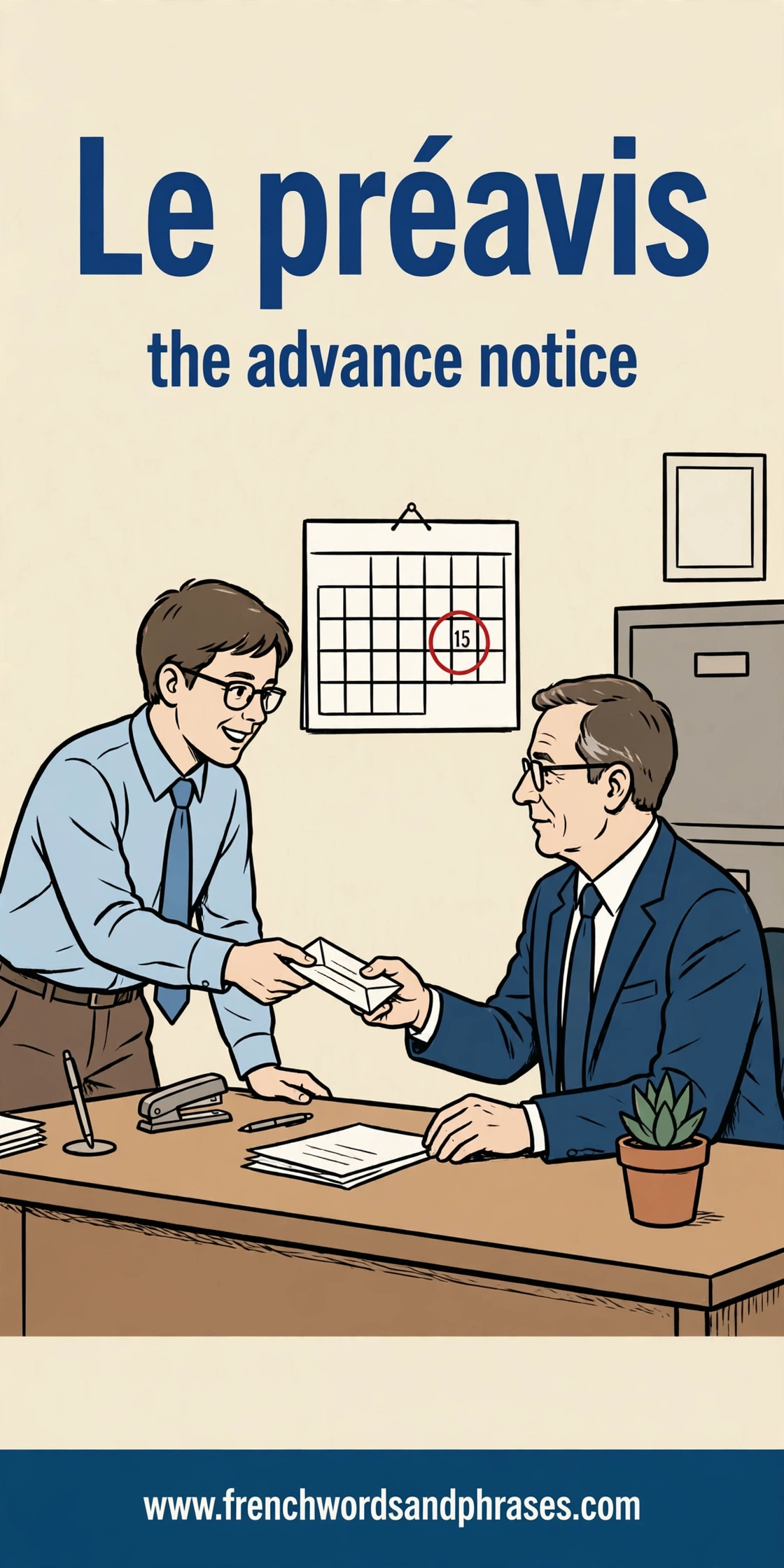
The envelope lands on the manager’s desk on a Monday morning, one page, carefully worded: the employee is leaving, and the clock of the préavis starts ticking — the advance notice, the formal warning period French law wraps around every departure.
In this guide, you’ll learn what préavis means in English, how to use it with its articles, how to form its plural, and how it appears in everyday French. Explore French examples, English translations, and practice quizzes.
Understanding the French Noun Préavis
Préavis is a masculine French noun, learned with its article: le préavis, un préavis. The word is built in plain sight: pré-, before, plus avis, a notice — a notice given before, a warning sent ahead of the event. Note the spelling: it already ends in -s, so singular and plural are written exactly the same, un préavis, des préavis.
It means advance notice — both the act of warning and the period that follows the warning. At work: donner son préavis, to hand in one’s notice, un préavis de démission, a resignation notice period, un préavis de licenciement, the notice period an employer must give before a dismissal. In renting, the tenant gives préavis to the landlord — often three months, sometimes one. Unions announce un préavis de grève, a strike notice. And the sharpest phrase is the negative: sans préavis, without warning, out of the blue.
Gender: Masculine — le préavis
Definite article: le — le préavis (the advance notice)
Indefinite article: un — un préavis (an advance notice)
Plural: les préavis — spelled the same; the word already ends in -s
Key verb: donner — donner son préavis, to hand in one’s notice
The period: le délai de préavis — the notice period itself
English equivalents: The advance notice, the notice period.
Préavis does double duty in a single sentence: il a donné son préavis lundi names the act — he handed in his notice on Monday — while pendant son préavis names the weeks that follow, during his notice period, when he still comes to work while the replacement is found. Do not confuse it with its parent avis: un avis is an opinion or a simple notice; un préavis is always a warning with a deadline attached, a departure announced in advance.
Experience the Word
Préavis is the politest form of goodbye French knows: a departure announced in advance, with dates, signatures and a period of grace for both sides.
Imagine the small office on the last morning of the préavis: the desk already cleared, the plant adopted by a colleague, the handover notes printed in two copies. Three months ago a single envelope started all this — le préavis, the warning that turned a resignation into a ceremony instead of a rupture.
You have not just named a letter. You have named the warning that keeps departures civilised — le préavis, notice given before, never after.
How to Use Préavis in French: Complete Guide
Let’s explore how préavis works in French, beginning with its articles — le préavis, un préavis, donner son préavis.
Préavis with the Definite Article (Le, Les)
Used for a specific notice — the one already given, the one running now.
| Form | French |
|---|---|
| Masculine singular | le préavis |
| Plural | les préavis |
Example
Le préavis de la locataire se termine fin juin.
The tenant’s notice period ends at the end of June.
Préavis with the Indefinite Article (Un, Des)
Used for a notice in general — one formal warning among the warnings of working life.
| Form | French |
|---|---|
| Masculine singular | un préavis |
| Plural | des préavis |
Example
Un préavis de trois mois est exigé pour ce poste.
A notice period of three months is required for this job.
Préavis in Working Life (Donner, Recevoir, Respecter…)
A préavis is handed in, received, served out — the verbs of the formal goodbye.
| Action | French |
|---|---|
| to hand in one’s notice | donner son préavis |
| a notice period of one month | un préavis d’un mois |
| the notice period (the delay) | le délai de préavis |
| a strike notice | un préavis de grève |
| without warning | sans préavis |
Example
Elle a donné son préavis et part à la fin du mois.
She has handed in her notice and leaves at the end of the month.
Quick Quiz 1
Complete the sentence:
______ préavis commence le premier du mois. (the)
Reveal the answer
Le
Le préavis commence le premier du mois.
The notice period begins on the first of the month — préavis is masculine, so le.
The Plural of Préavis
Préavis already ends in -s, so the plural is spelled exactly like the singular — only the article changes.
| Number | French |
|---|---|
| Singular | le préavis |
| Plural | les préavis |
Example
Les préavis de grève se multiplient dans les transports.
Strike notices are multiplying in transport.
Préavis with Possessive Adjectives (Mon, Ton, Son…)
Possessives agree with the noun: préavis is masculine, so mon, ton, son in the singular — son préavis is the classic phrase, one’s own notice to serve out.
| Owner | French |
|---|---|
| my | mon préavis |
| your (tu) | ton préavis |
| his / her | son préavis |
| our | notre préavis |
| your (vous) | votre préavis |
| their | leur préavis |
Example
Pendant son préavis, il forme son remplaçant.
During his notice period, he is training his replacement.
Quick Quiz 2
Complete the sentence:
Elle a donné ______ préavis hier matin. (her)
Reveal the answer
son
Elle a donné son préavis hier matin.
She handed in her notice yesterday morning — son, because préavis is masculine.
Préavis with Demonstrative Adjectives (Ce, Ces)
Used to point: ce préavis, this notice — the one on the desk, the one under discussion.
| Form | French |
|---|---|
| Masculine singular | ce préavis |
| Plural | ces préavis |
Example
Ce préavis de licenciement a surpris tout le service.
This dismissal notice surprised the whole department.
Préavis with Adjectives
Adjectives agree with préavis — masculine singular: un long préavis, le préavis légal.
| Adjective | With Préavis |
|---|---|
| légal (legal, statutory) | le préavis légal |
| long (long) | un long préavis |
| court (short) | un court préavis |
| obligatoire (compulsory) | un préavis obligatoire |
| raisonnable (reasonable) | un préavis raisonnable |
Example
Le préavis légal est d’un mois pour ce type de contrat.
The statutory notice period is one month for this type of contract.
Quick Quiz 3
Complete the sentence:
Son employeur exige un préavis ______. (compulsory)
Reveal the answer
obligatoire
Son employeur exige un préavis obligatoire.
His employer requires a compulsory notice period — obligatoire, masculine, to agree with préavis.
Everyday Expressions with Préavis
Offices, leases and picket lines — the préavis phrases of daily life.
| Expression | In English |
|---|---|
| donner son préavis | to hand in one’s notice |
| un préavis de grève | a strike notice |
| sans préavis | without warning, without notice |
| le délai de préavis | the notice period |
| respecter le préavis | to observe the notice period |
Example
Le syndicat a déposé un préavis de grève pour lundi.
The union has filed a strike notice for Monday.
Words from the Same Family as Préavis
Warnings, resignations and departures — the words that travel with préavis.
| French | In English |
|---|---|
| prévenir | to warn, to notify |
| un avis | an opinion; a notice (the parent word) |
| la démission | the resignation |
| licencier | to dismiss, to make redundant |
| un avertissement | a warning |
Example
Sa démission prendra effet à la fin de son préavis.
Her resignation will take effect at the end of her notice period.
Quick Quiz 4
What does donner son préavis mean?
Reveal the answer
To hand in one’s notice — to formally announce, in advance, that you are leaving a job or a tenancy.
Il a donné son préavis pour se rapprocher de sa famille.
He handed in his notice to move closer to his family.
Préavis in Everyday French: Real-Life Examples
Now that you know the word, let’s see how préavis appears in everyday French.
Example 1 — Resigning
Elle a donné son préavis hier.
She handed in her notice yesterday.
Example 2 — Renting
Le locataire doit donner un préavis de trois mois.
The tenant must give three months’ notice.
Example 3 — Serving it out
Pendant son préavis, elle termine ses dossiers.
During her notice period, she is finishing her files.
Example 4 — A strike
Les cheminots ont déposé un préavis de grève.
The railway workers have filed a strike notice.
Example 5 — No warning
Il est parti sans préavis, du jour au lendemain.
He left without warning, from one day to the next.
Example 6 — The law
Le préavis légal protège les deux parties.
The statutory notice period protects both parties.
Beyond Translation: The Meaning of Préavis
Préavis is French bureaucracy at its most human: a whole philosophy of departure compressed into pré- plus avis, the notice that comes before. Where English “handing in your notice” can sound abrupt, the French word insists on the interval — the délai — in which the leaver trains a replacement, the landlord finds a tenant, the office absorbs the shock. It governs resignations, dismissals, tenancies and even strikes, because a préavis de grève is also a courtesy of a kind: the country is warned before the trains stop. And its dark twin, sans préavis, without warning, names everything the word exists to prevent.
To say préavis is to announce the ending before it arrives.
It evokes the dated letter, the registered envelope and the calendar with the last day circled — the paperwork of a civilised goodbye.
How to Remember the French Noun Préavis
Remember it this way: Préavis is the advance notice — the warning with a deadline: le préavis, donner son préavis.
- Always masculine — le préavis, un préavis, ce préavis; the spelling never changes, plural les préavis.
- The golden verb — donner son préavis, to hand in one’s notice (job or tenancy).
- The sharp opposite — sans préavis, without warning.
The key idea is le préavis — the advance notice, masculine; donner son préavis = to hand in one’s notice.
Test Your Knowledge of Préavis
Let’s see how much you’ve learned. Try answering these questions before revealing the answers.
Question 1
Is préavis masculine or feminine?
Reveal the answer
Masculine — le préavis, un préavis.
Question 2
How do you say to hand in one’s notice?
Reveal the answer
Donner son préavis.
Question 3
Translate: She handed in her notice yesterday.
Reveal the answer
Elle a donné son préavis hier.
Question 4
What does sans préavis mean?
Reveal the answer
Without warning — with no advance notice at all.
Question 5
Complete the sentence:
______ préavis de grève couvre la journée de lundi. (the)
Reveal the answer
Le
Le préavis de grève couvre la journée de lundi.
The strike notice covers the day on Monday — le, because préavis is masculine.
Your Final Challenge
Can You Use It?
How would you say this in French?
“She handed in her notice yesterday.”
Reveal the answer
Elle a donné son préavis hier.
She handed in her notice yesterday.
A little French. A little curiosity. A richer everyday life.
LEARN FRENCH ONE WORD AT A TIME




