A French Word to Live By
How to Conjugate Pousser in French
/pu.se/
Pousser means to push, to grow.
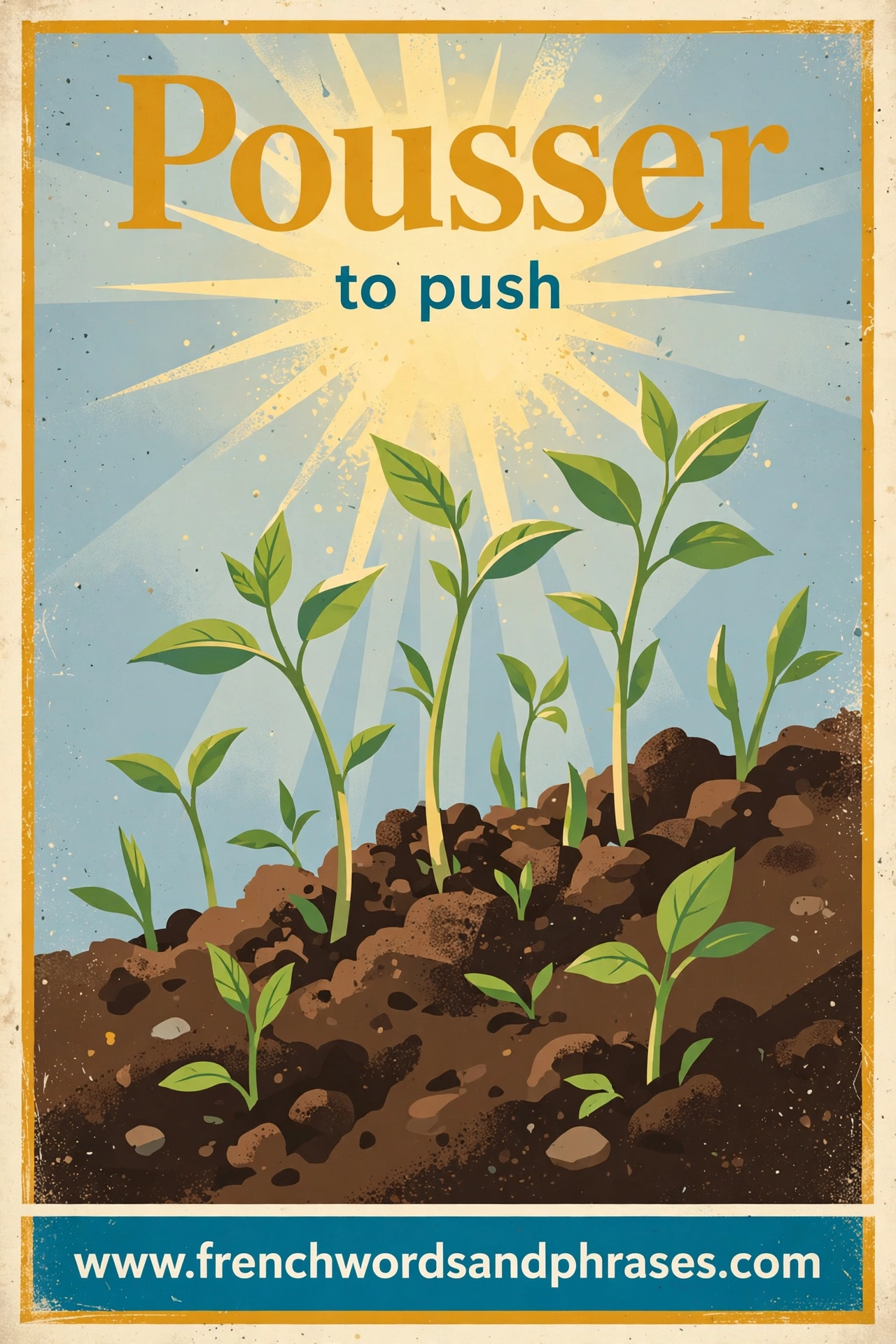
A heavy door that finally gives way, a child on a swing, a green shoot breaking through the soil in spring — to push, and to grow, is pousser.
In this guide, you’ll learn how to conjugate pousser in all the major French tenses and moods. Explore complete conjugation tables, French examples, English translations, and practice quizzes.
Understanding the French Verb Pousser
Pousser is a regular French verb belonging to the first group of verbs, those ending in -er.
It means to push, to grow. It is commonly used for pushing something or someone — pousser une porte, or the cry in pousser un cri — and also for plants growing, as in les fleurs poussent au printemps.
Verb classification: First group (-er)
Auxiliary verb: Avoir
Past participle: poussé
Present participle: poussant
English equivalents: To push, to grow.
One important spelling detail: the double s is kept in every form — je pousse, nous poussions, ils poussèrent — so that the s always keeps its soft sound.
Experience the Word
Pousser is more than using your strength. It is effort meeting resistance — and, in the garden, it is life quietly doing the same thing.
Imagine the first warm day of spring. Under the dark soil, a tiny green shoot pushes through, reaching for the light without making a sound.
It did not ask permission. It simply grew.
How to Conjugate Pousser: Complete French Conjugation Guide
Let’s explore every major conjugation of pousser, beginning with the indicative mood.
How to Conjugate Pousser in the Indicative Mood
The indicative mood is used to express facts, observations, actions, and events.
How to Conjugate Pousser in the Present Tense (Présent)
Used for actions happening now, habitual actions, and general truths.
| Subject | Conjugation |
|---|---|
| je | pousse |
| tu | pousses |
| il / elle | pousse |
| nous | poussons |
| vous | poussez |
| ils / elles | poussent |
Example
Il pousse la brouette dans le jardin.
He pushes the wheelbarrow in the garden.
Quick Quiz 1
Complete the sentence:
Nous ______ la porte ensemble.
Reveal the answer
poussons
Nous poussons la porte ensemble.
We push the door together.
How to Conjugate Pousser in the Passé Composé
Used for completed actions in the past. Pousser takes the auxiliary verb avoir.
| Subject | Conjugation |
|---|---|
| j’ | ai poussé |
| tu | as poussé |
| il / elle | a poussé |
| nous | avons poussé |
| vous | avez poussé |
| ils / elles | ont poussé |
Example
J’ai poussé la voiture jusqu’au garage.
I pushed the car to the garage.
How to Conjugate Pousser in the Imparfait (Imperfect Tense)
Used for habitual past actions, descriptions, and ongoing situations in the past.
| Subject | Conjugation |
|---|---|
| je | poussais |
| tu | poussais |
| il / elle | poussait |
| nous | poussions |
| vous | poussiez |
| ils / elles | poussaient |
Example
Quand il était jeune, il poussait son frère sur la balançoire.
When he was young, he pushed his brother on the swing.
Quick Quiz 2
Choose the correct form:
When we were children, we used to push our brother on the swing.
Quand nous étions enfants, nous ______ notre frère sur la balançoire.
Reveal the answer
poussions
Quand nous étions enfants, nous poussions notre frère sur la balançoire.
How to Conjugate Pousser in the Plus-que-parfait
Used to describe an action that had already been completed before another past event.
| Subject | Conjugation |
|---|---|
| j’ | avais poussé |
| tu | avais poussé |
| il / elle | avait poussé |
| nous | avions poussé |
| vous | aviez poussé |
| ils / elles | avaient poussé |
Example
J’avais déjà poussé la table contre le mur avant qu’il n’arrive.
I had already pushed the table against the wall before he arrived.
How to Conjugate Pousser in the Passé Simple
Primarily used in formal writing, literature, and historical narratives. It is rarely used in everyday conversation.
| Subject | Conjugation |
|---|---|
| je | poussai |
| tu | poussas |
| il / elle | poussa |
| nous | poussâmes |
| vous | poussâtes |
| ils / elles | poussèrent |
Example
Il poussa la porte et entra.
He pushed the door and went in.
How to Conjugate Pousser in the Passé Antérieur
A literary tense used to express an action completed immediately before another past action, generally in the passé simple.
| Subject | Conjugation |
|---|---|
| j’ | eus poussé |
| tu | eus poussé |
| il / elle | eut poussé |
| nous | eûmes poussé |
| vous | eûtes poussé |
| ils / elles | eurent poussé |
Example
Dès qu’il eut poussé le bateau à l’eau, il sauta dedans.
As soon as he had pushed the boat into the water, he jumped in.
How to Conjugate Pousser in the Future Tense (Futur Simple)
Used to describe actions that will take place in the future.
| Subject | Conjugation |
|---|---|
| je | pousserai |
| tu | pousseras |
| il / elle | poussera |
| nous | pousserons |
| vous | pousserez |
| ils / elles | pousseront |
Example
Demain, nous pousserons la voiture ensemble.
Tomorrow, we will push the car together.
How to Conjugate Pousser in the Futur Antérieur (Future Perfect)
Used for an action that will have been completed before a particular point in the future.
| Subject | Conjugation |
|---|---|
| j’ | aurai poussé |
| tu | auras poussé |
| il / elle | aura poussé |
| nous | aurons poussé |
| vous | aurez poussé |
| ils / elles | auront poussé |
Example
Au printemps, les roses auront déjà poussé.
By spring, the roses will already have grown.
How to Conjugate Pousser in the Near Future (Futur Proche)
Used to describe something that is going to happen soon. Formed with aller + infinitive.
| Subject | Conjugation |
|---|---|
| je | vais pousser |
| tu | vas pousser |
| il / elle | va pousser |
| nous | allons pousser |
| vous | allez pousser |
| ils / elles | vont pousser |
Example
Je vais pousser la porte dès ce soir.
I am going to push the door open this evening.
How to Conjugate Pousser in the Conditional Mood
The conditional mood expresses what would happen under certain circumstances. It is also frequently used to make polite requests or express wishes.
How to Conjugate Pousser in the Present Conditional
| Subject | Conjugation |
|---|---|
| je | pousserais |
| tu | pousserais |
| il / elle | pousserait |
| nous | pousserions |
| vous | pousseriez |
| ils / elles | pousseraient |
Example
Je pousserais la voiture si je pouvais.
I would push the car if I could.
How to Conjugate Pousser in the Past Conditional
| Subject | Conjugation |
|---|---|
| j’ | aurais poussé |
| tu | aurais poussé |
| il / elle | aurait poussé |
| nous | aurions poussé |
| vous | auriez poussé |
| ils / elles | auraient poussé |
Example
J’aurais poussé plus fort si j’avais su.
I would have pushed harder if I had known.
Pousser in the Literary Past Conditional Form
This less common literary form uses the imperfect subjunctive of avoir.
| Subject | Conjugation |
|---|---|
| j’ | eusse poussé |
| tu | eusses poussé |
| il / elle | eût poussé |
| nous | eussions poussé |
| vous | eussiez poussé |
| ils / elles | eussent poussé |
Example
Il eût poussé la porte s’il avait pu.
He would have pushed the door if he had been able to.
How to Conjugate Pousser in the Subjunctive Mood
The subjunctive is used to express wishes, emotions, doubts, necessity, and uncertainty. It frequently follows expressions such as il faut que (it is necessary that) or bien que (although).
How to Conjugate Pousser in the Present Subjunctive
| Subject | Conjugation |
|---|---|
| que je | pousse |
| que tu | pousses |
| qu’il / qu’elle | pousse |
| que nous | poussions |
| que vous | poussiez |
| qu’ils / qu’elles | poussent |
Example
Il faut que je pousse cette boîte dans le grenier.
I need to push this box into the attic.
Quick Quiz 3
Complete the sentence using the subjunctive:
Il faut que nous ______ plus fort.
Reveal the answer
poussions
Il faut que nous poussions plus fort.
We need to push harder.
How to Conjugate Pousser in the Imperfect Subjunctive
A literary tense, rarely encountered in modern spoken French.
| Subject | Conjugation |
|---|---|
| que je | poussasse |
| que tu | poussasses |
| qu’il / qu’elle | poussât |
| que nous | poussassions |
| que vous | poussassiez |
| qu’ils / qu’elles | poussassent |
Example
Il souhaitait qu’elle poussât la brouette à sa place.
He wished that she would push the wheelbarrow in his place.
How to Conjugate Pousser in the Pluperfect Subjunctive
A literary construction used to express an action completed before another past action.
| Subject | Conjugation |
|---|---|
| que j’ | eusse poussé |
| que tu | eusses poussé |
| qu’il / qu’elle | eût poussé |
| que nous | eussions poussé |
| que vous | eussiez poussé |
| qu’ils / qu’elles | eussent poussé |
Example
Il regrettait que nous eussions poussé la porte si fort.
He regretted that we had pushed the door so hard.
How to Conjugate Pousser in the Past Subjunctive
| Subject | Conjugation |
|---|---|
| que j’ | aie poussé |
| que tu | aies poussé |
| qu’il / qu’elle | ait poussé |
| que nous | ayons poussé |
| que vous | ayez poussé |
| qu’ils / qu’elles | aient poussé |
Example
Je suis heureux que les roses aient poussé cette année.
I am happy that the roses grew this year.
How to Conjugate Pousser in the Imperative
The imperative is used to give commands, instructions, invitations, or suggestions. Subject pronouns are omitted.
How to Conjugate Pousser in the Present Imperative
| Person | Conjugation |
|---|---|
| (tu) | pousse |
| (nous) | poussons |
| (vous) | poussez |
Example
Pousse la porte, ne tarde pas !
Push the door, don’t delay!
Quick Quiz 4
How would you say Push the door! (tu form)?
Reveal the answer
Pousse la porte !
French Participles of Pousser
Participles are verb forms that can be used in compound tenses and other grammatical constructions.
Present Participle of Pousser
poussant
En poussant doucement, il a ouvert la vieille porte.
By pushing gently, he opened the old door.
Past Participle of Pousser
poussé
Nous avons poussé la table pour aider nos voisins.
We pushed the table to help our neighbours.
Pousser in Everyday French: Real-Life Examples
Now that you know the conjugations, let’s see how pousser appears in everyday French.
Example 1 — Present
Nous poussons toujours la porte doucement.
We always push the door gently.
Example 2 — Passé composé
Elle a poussé un cri de joie.
She let out a cry of joy.
Example 3 — Imparfait
Au printemps, les fleurs poussaient partout.
In spring, the flowers grew everywhere.
Example 4 — Future
Ils pousseront le meuble contre le mur demain.
They will push the piece of furniture against the wall tomorrow.
Example 5 — Conditional
Je pousserais la porte à ta place si je pouvais.
I would push the door in your place if I could.
Example 6 — Subjunctive
Bien que nous poussions fort, la porte ne bouge pas.
Although we push hard, the door doesn’t move.
Beyond Translation: The Meaning of Pousser
English separates what French joins in pousser: to push with your hands, and to grow, as plants and hair do. The link is effort — both push their way forward, one against a door, the other against the soil.
Growth is a quiet push.
To pousser is to press forward, gently or with all your strength. It evokes spring gardens, opening doors, and never standing still.
How to Remember the French Verb Pousser
Remember it this way: Pousser is about pressing forward — with your hands, or out of the soil.
- You lean against a heavy old door — tu pousses.
- A child swings higher and higher — tu pousses la balançoire.
- Spring comes and the tulips appear — elles poussent dans le jardin.
The key idea is pressing forward — with your hands, or out of the soil.
Test Your Knowledge of Pousser
Let’s see how much you’ve learned. Try answering these questions before revealing the answers.
Question 1
What auxiliary verb is used with pousser in compound tenses?
Reveal the answer
Avoir
Question 2
How do you say I will push in French?
Reveal the answer
Je pousserai.
Question 3
Translate: We pushed the table to help our neighbours.
Reveal the answer
Nous avons poussé la table pour aider nos voisins.
Question 4
What is the present participle of pousser?
Reveal the answer
Poussant.
Question 5
Complete the sentence:
Si nous étions plus forts, nous ______ la voiture.
Reveal the answer
pousserions
Si nous étions plus forts, nous pousserions la voiture.
If we were stronger, we would push the car.
Your Final Challenge
Can You Use It?
How would you say this in French?
“In spring, I want to see the roses grow in my garden.”
Reveal the answer
Au printemps, je veux voir les roses pousser dans mon jardin.
In spring, I want to see the roses grow in my garden.
A little French. A little curiosity. A richer everyday life.
LEARN FRENCH ONE WORD AT A TIME