A French Word to Live By
Translate Poule to English
/pul/
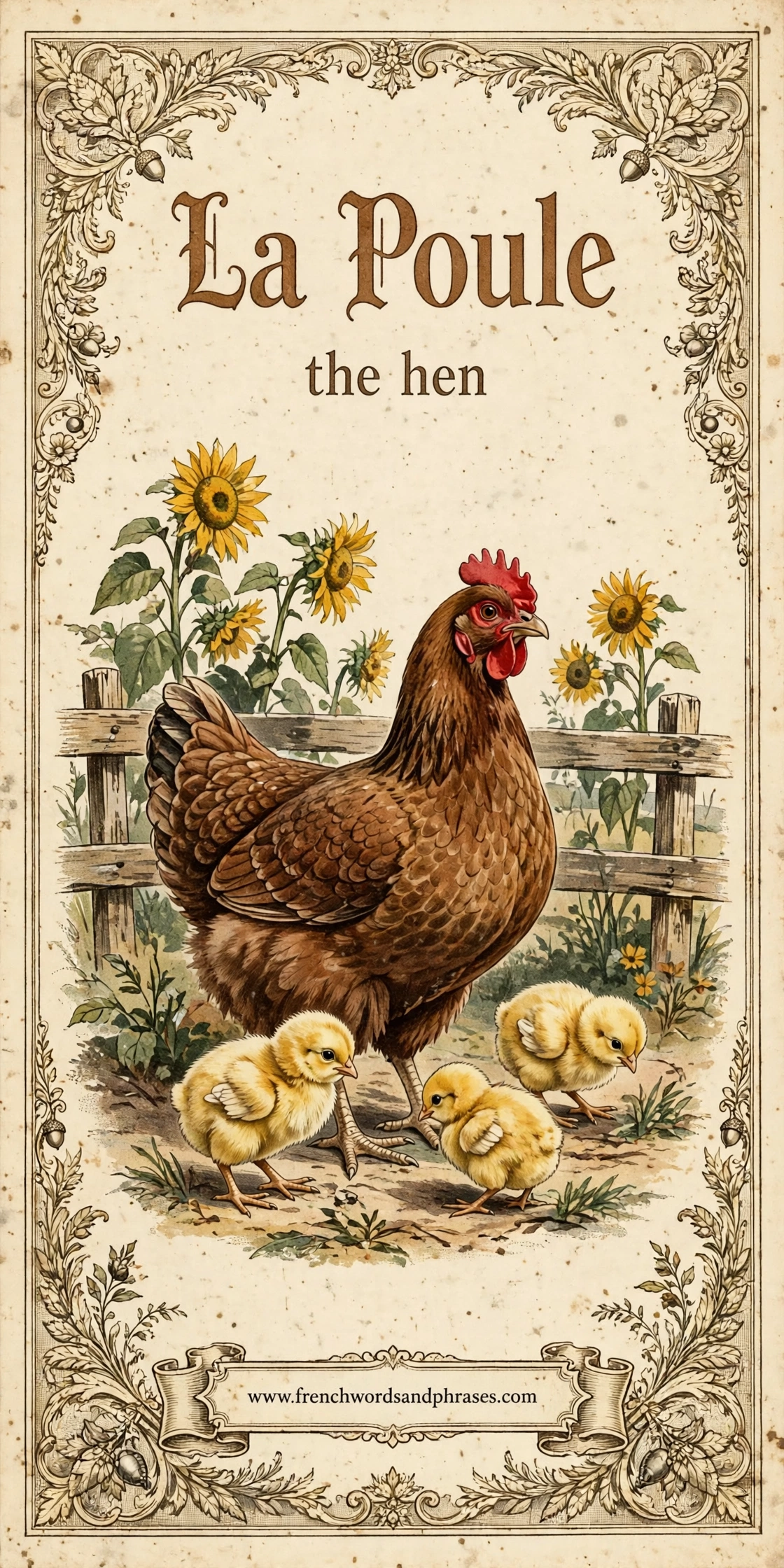
La poule means the hen.
Dawn in the farmyard: the gate of the henhouse creaks open and out they pour, clucking, scratching, arguing over a grain of wheat — and at their head, proud as a queen, la poule.
In this guide, you’ll learn what poule means in English, how to use it with its articles, how to form its plural, and how it appears in everyday French. Explore French examples, English translations, and practice quizzes.
Understanding the French Noun Poule
Poule is a feminine French noun. It is learned together with its article: la poule, une poule. The family is neatly divided: le coq is the cockerel, la poule is the hen, and their children are les poussins, the chicks. Grown for the table, the same bird becomes le poulet — chicken.
It means the hen — the female chicken of the farmyard, layer of eggs and mother of chicks: une poule pondeuse (a laying hen), la poule couve ses œufs (the hen is sitting on her eggs). She scratches in le poulailler (the henhouse), and France loves her so much that a king promised one in every pot: la poule au pot, the boiled chicken that became a national dish.
Gender: Feminine — la poule, une poule
Plural: les poules
The family: le coq (the cockerel), la poule (the hen), le poussin (the chick)
On the table: le poulet is the chicken you eat; la poule au pot is the boiled hen of Henri IV’s promise
The working hen: une poule pondeuse — a laying hen
English equivalents: The hen.
One important usage detail: the poule runs a whole farmyard of idioms. La chair de poule is goosebumps — literally hen’s flesh. Se lever avec les poules is to get up at dawn, with the hens. And the golden warning: tuer la poule aux œufs d’or, to kill the hen that lays the golden eggs — to destroy a source of riches by greed.
Experience the Word
Poule is more than a farm bird. She is the alarm clock of the countryside before alarm clocks, the provider of breakfast, and the heroine of a royal promise that every French schoolchild still learns.
Imagine the Sunday farmyard: the hens scratching under the apple tree, the coq on the fence post, and a child gathering warm eggs in the skirt of her dress.
You have not just met a bird. You have met la poule — the hen who promised France a Sunday dinner.
How to Use Poule in French: Complete Guide
Let’s explore how poule works in French, beginning with its articles — then we will rise with her, gather her eggs and mind the golden one.
Poule with the Definite Article (La, Les)
Used for the hen everyone knows — la poule, the one in the yard.
| Form | French |
|---|---|
| Feminine singular | la poule |
| Plural | les poules |
Example
La poule gratte la terre à la recherche de vers.
The hen is scratching the earth looking for worms.
Poule with the Indefinite Article (Une, Des)
Used for a hen in general — une poule, des poules.
| Form | French |
|---|---|
| Feminine singular | une poule |
| Plural | des poules |
Example
Une poule rousse traverse la cour en courant.
A red hen runs across the yard.
Poule and Her Numbers (Une poule, des œufs…)
Hens are counted with their eggs, their chicks and their flock — French gathers them with de.
| Expression | French |
|---|---|
| a laying hen | une poule pondeuse |
| a hen and her chicks | une poule et ses poussins |
| a dozen eggs from the hens | une douzaine d’œufs des poules |
| a flock of hens | un groupe de poules |
| goosebumps | la chair de poule |
Example
La poule pondeuse donne un œuf presque tous les jours.
The laying hen gives an egg almost every day.
Quick Quiz 1
Complete the sentence:
______ poule couve ses œufs dans le poulailler. (The)
Reveal the answer
La
La poule couve ses œufs dans le poulailler.
The hen is sitting on her eggs in the henhouse.
The Plural of Poule
Poule adds an -s in the plural — les poules, the whole flock.
| Number | French |
|---|---|
| Singular | la poule |
| Plural | les poules |
Example
Les poules rentrent au poulailler dès que le soir tombe.
The hens go back into the henhouse as soon as evening falls.
Poule with Possessive Adjectives (Ma, Ta, Sa…)
Possessives agree with the noun: poule is feminine, so it takes ma, ta, sa.
| Owner | French |
|---|---|
| my | ma poule |
| your (tu) | ta poule |
| his / her | sa poule |
| our | notre poule |
| your (vous) | votre poule |
| their | leur poule |
Example
Ma poule préférée s’appelle Cocotte, elle me suit partout.
My favourite hen is called Cocotte, she follows me everywhere.
Quick Quiz 2
Complete the sentence:
______ poules donnent de beaux œufs frais. (Our)
Reveal the answer
Nos
Nos poules donnent de beaux œufs frais.
Our hens give beautiful fresh eggs — nos, because poules is plural.
Poule with Demonstrative Adjectives (Cette, Ces)
Used to point: cette poule, this hen here.
| Form | French |
|---|---|
| Feminine singular | cette poule |
| Plural | ces poules |
Example
Cette poule est la meilleure pondeuse de la ferme.
This hen is the best layer on the farm.
Poule with Adjectives
Adjectives agree with poule, feminine: rousse, blanche, grosse.
| Adjective | With Poule |
|---|---|
| rousse (red, russet) | une poule rousse |
| blanche (white) | une poule blanche |
| grosse (big, fat) | une grosse poule |
| jeune (young) | une jeune poule |
| vieille (old) | une vieille poule |
Example
Une grosse poule blanche surveille ses poussins dans la cour.
A big white hen is watching over her chicks in the yard.
Quick Quiz 3
Complete the sentence:
C’est une poule très ______. (big)
Reveal the answer
grosse
C’est une poule très grosse.
It is a very big hen — grosse, with the feminine ending.
Everyday Expressions with Poule
Golden eggs, goosebumps and early mornings — the poule phrases of daily life.
| Expression | In English |
|---|---|
| la chair de poule | goosebumps (literally: hen’s flesh) |
| se lever avec les poules | to get up at dawn (literally: to rise with the hens) |
| tuer la poule aux œufs d’or | to kill the goose that lays the golden eggs |
| la poule au pot | boiled chicken — the dish of Henri IV’s promise |
| quand les poules auront des dents | when pigs fly (literally: when hens have teeth) |
Example
Ce film d’horreur m’a donné la chair de poule du début à la fin.
That horror film gave me goosebumps from start to finish.
Words from the Same Family as Poule
Farmyards, eggs and Sunday dinners — the words that travel with poule.
| French | In English |
|---|---|
| le coq | the cockerel, the rooster |
| le poussin | the chick |
| l’œuf | the egg |
| le poulailler | the henhouse |
| le poulet | the chicken (as food) |
| la plume | the feather |
Example
Le coq chante dès l’aube, bien avant les poules.
The cockerel crows from dawn, well before the hens.
Quick Quiz 4
What is la chair de poule?
Reveal the answer
Goosebumps — literally hen’s flesh, the skin that prickles with cold or fear.
Ce bruit étrange m’a donné la chair de poule.
That strange noise gave me goosebumps.
Poule in Everyday French: Real-Life Examples
Now that you know the word, let’s see how poule appears in everyday French.
Example 1 — In the farmyard
Les poules grattent la terre sous le pommier.
The hens are scratching the earth under the apple tree.
Example 2 — Gathering eggs
Elle ramasse les œufs des poules tous les matins.
She collects the hens’ eggs every morning.
Example 3 — An early start
Le fermier se lève avec les poules, vers cinq heures.
The farmer gets up with the hens, around five o’clock.
Example 4 — A shiver
Ce vent froid me donne la chair de poule.
This cold wind gives me goosebumps.
Example 5 — Sunday dinner
Dimanche, grand-mère sert la poule au pot à toute la famille.
On Sunday, grandmother serves boiled chicken to the whole family.
Example 6 — A greedy mistake
En vendant sa boutique, il a tué la poule aux œufs d’or.
By selling his shop, he killed the goose that lays the golden eggs.
Beyond Translation: The Meaning of Poule
The poule is written into France’s founding menu: Henri IV, the beloved king of the 1600s, wished that every labourer might have une poule au pot — a hen in the pot — every Sunday, and the phrase still means a country at peace with full plates. The hen went on laying for the language itself: golden eggs for the greedy, teeth for the impossible, goosebumps for the frightened.
To say poule is to name the bird that fed France and furnished its idioms.
It evokes the dawn farmyard and the warm egg in the child’s hand, the royal promise and the Sunday pot — humble, generous and impossible to imagine France without.
How to Remember the French Noun Poule
Remember it this way: Poule is the hen — feminine, la poule; her husband is le coq, her children les poussins, and her dinner-table name is le poulet.
- You see her in the yard — la poule, une poule rousse.
- You shiver — la chair de poule sur les bras.
- You rise early — se lever avec les poules, à l’aube.
The key idea is la poule — the hen of the golden eggs and the Sunday pot.
Test Your Knowledge of Poule
Let’s see how much you’ve learned. Try answering these questions before revealing the answers.
Question 1
Is poule masculine or feminine?
Reveal the answer
Feminine — la poule, une poule.
Question 2
What is le coq?
Reveal the answer
The cockerel, the rooster — the male of the farmyard, partner of la poule.
Question 3
Translate: The hen lays an egg.
Reveal the answer
La poule pond un œuf.
Question 4
What did Henri IV promise every French family?
Reveal the answer
La poule au pot — a hen in the pot every Sunday, the famous symbol of a well-fed kingdom.
Question 5
Complete the sentence:
______ poule est rousse et très grosse. (This)
Reveal the answer
Cette
Cette poule est rousse et très grosse.
This hen is red and very big.
Your Final Challenge
Can You Use It?
How would you say this in French?
“The hens scratch in the farmyard all morning.”
Reveal the answer
Les poules grattent dans la cour de la ferme toute la matinée.
The hens scratch in the farmyard all morning.
A little French. A little curiosity. A richer everyday life.
LEARN FRENCH ONE WORD AT A TIME