
A French Word to Live By
Translate Poisson to English
/pwa.sɔ̃/
Le poisson means the fish.
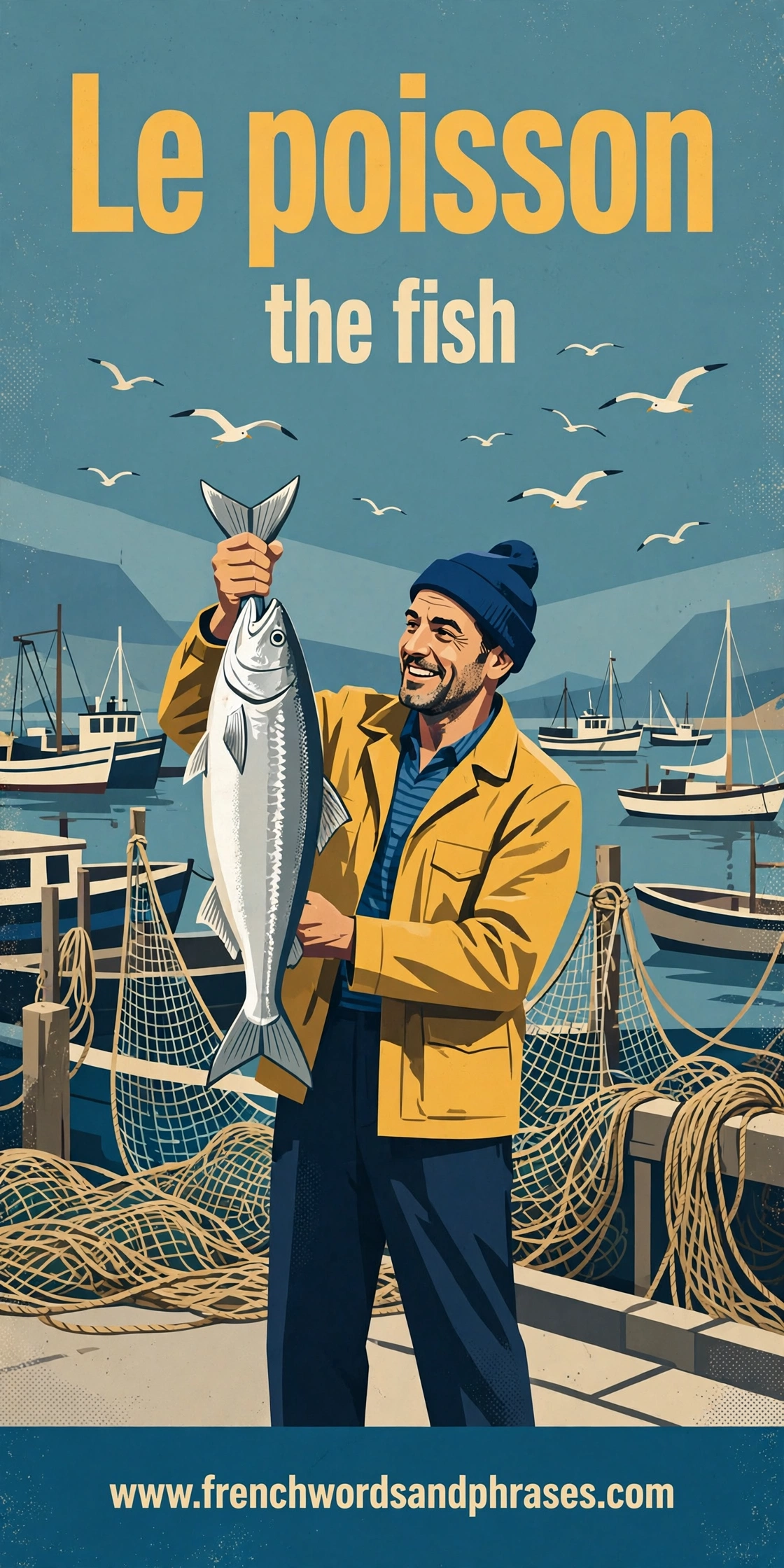
At dawn the harbour is silver: boats unloading, gulls shouting, and crates of shining fish sliding across the wet stones. « Le poisson est frais ce matin ! » calls the fishmonger. Poisson is the noun of the fish — the animal in the water, and the dish on the plate, under one slippery word.
In this guide, you’ll learn what poisson means in English, how to use it with its articles, how to form its plural, and how it appears in everyday French. Explore French examples, English translations, and practice quizzes.
Understanding the French Noun Poisson
Poisson is a masculine French noun, learned with its article: le poisson, un poisson. It descends from the Latin piscis, worn smooth by centuries of harbours. French uses the one word for the living animal and for fish as food — the context, and the plate, do the sorting.
It means the fish: un poisson rouge, a goldfish (literally a red fish), pêcher un poisson, to catch a fish, manger du poisson, to eat fish. Its most famous costume is paper: le poisson d’avril, the April fish — the paper fish pinned secretly on a back on the first of April, the French April Fool. And the fish of character is le poisson in its element: être comme un poisson dans l’eau, to be in one’s element, like a fish in water.
Gender: Masculine — le poisson
Definite article: le — le poisson (the fish)
Indefinite article: un — un poisson (a fish)
Plural: les poissons — the fish; also the sign Pisces
Key phrase: le poisson d’avril — the April fish (April Fool’s prank)
Close neighbour: pêcher — to fish, to catch; un pêcheur — a fisherman
English equivalents: The fish.
Fish as food takes the partitive: manger du poisson, to eat (some) fish — never count it when it is dinner. Counted, un poisson is one animal: trois poissons rouges, three goldfish. And the spelling hides a trap for English eyes: poisson (fish) against poison (the same word in English dress) — one s too few in French would be fatal at the chemist’s: le poison is the poison.
Experience the Word
Poisson is the noun of silver mornings — the word that smells of harbours, ice and salt.
Imagine the child with his first goldfish in a jar, carried home like treasure from the fair: un poisson rouge, a whole ocean of responsibility in a litre of water. Every French childhood seems to hold one, and the word poisson is its name.
You have not just named an animal. You have named the oldest food and the oldest symbol of the sea — le poisson, the fish.
How to Use Poisson in French: Complete Guide
Let’s explore how poisson works in French, beginning with its articles — le poisson, un poisson, du poisson.
Poisson with the Definite Article (Le, Les)
Used for the specific fish — the one in the net, the one on the stall.
| Form | French |
|---|---|
| Masculine singular | le poisson |
| Plural | les poissons |
Example
Le poisson du marché est très frais.
The fish at the market is very fresh.
Poisson with the Indefinite Article (Un, Des)
Used for a fish in general — one animal among the river’s many.
| Form | French |
|---|---|
| Masculine singular | un poisson |
| Plural | des poissons |
Example
Un poisson énorme a sauté hors de l’eau.
An enormous fish leapt out of the water.
Poisson Counted and Poisson Eaten: Un vs Du
The same word, two grammars: counted, poisson is an animal; served, it is a mass and takes du.
| Use | French |
|---|---|
| one animal | un poisson — a fish |
| several animals | trois poissons rouges — three goldfish |
| fish as food | du poisson — (some) fish, for dinner |
| a fish dish | un plat de poisson — a fish dish |
| no fish (in a negative) | pas de poisson — no fish |
Example
Le vendredi, nous mangeons du poisson.
On Fridays, we eat fish.
Quick Quiz 1
Complete the sentence:
______ poisson d’avril ! Tu as un papier dans le dos. (the — the April fish)
Reveal the answer
Le
Le poisson d’avril !
April Fool! (literally: the April fish!) — poisson is masculine, so le.
The Plural of Poisson
Poisson takes a regular plural in -s — and the plural doubles as a sign of the zodiac: les Poissons, Pisces.
| Number | French |
|---|---|
| Singular | le poisson |
| Plural | les poissons |
Example
Les poissons du lac sont protégés.
The fish in the lake are protected.
Poisson with Possessive Adjectives (Mon, Ton, Son…)
Possessives agree with the noun: poisson is masculine, so mon, ton, son in the singular.
| Owner | French |
|---|---|
| my | mon poisson |
| your (tu) | ton poisson |
| his / her | son poisson |
| our | notre poisson |
| your (vous) | votre poisson |
| their | leur poisson |
Example
Mon poisson rouge s’appelle Némo.
My goldfish is called Nemo.
Quick Quiz 2
Complete the sentence:
Elle a nourri ______ poisson ce matin. (her)
Reveal the answer
son
Elle a nourri son poisson ce matin.
She fed her fish this morning — son, because poisson is masculine.
Poisson with Demonstrative Adjectives (Ce, Ces)
Used to point: ce poisson, this fish — usually the one wriggling in the bucket.
| Form | French |
|---|---|
| Masculine singular | ce poisson |
| Plural | ces poissons |
Example
Ce poisson est trop petit, remets-le à l’eau.
This fish is too small, put it back in the water.
Poisson with Adjectives
Adjectives agree with poisson — masculine singular: un poisson frais, un gros poisson.
| Adjective | With Poisson |
|---|---|
| frais (fresh) | un poisson frais |
| rouge (red) | un poisson rouge — a goldfish |
| gros (big) | un gros poisson |
| petit (small) | un petit poisson |
| délicieux (delicious) | un poisson délicieux |
Example
Le chat regarde le poisson rouge dans son bocal.
The cat watches the goldfish in its bowl.
Quick Quiz 3
Complete the sentence:
C’est un poisson très ______. (fresh)
Reveal the answer
frais
C’est un poisson très frais.
It is a very fresh fish — frais, masculine, to agree with poisson (and frais does not change in the masculine plural either).
Everyday Expressions with Poisson
Harbours, Aprils and elements — the poisson phrases of daily life.
| Expression | In English |
|---|---|
| le poisson d’avril | the April fish — the April Fool’s prank |
| un poisson rouge | a goldfish |
| être comme un poisson dans l’eau | to be in one’s element (like a fish in water) |
| la queue du poisson | the fish’s tail — and the end of a story that trails off |
| noyer le poisson | to muddy the waters, to dodge the issue |
Example
Dans son nouvel atelier, il est comme un poisson dans l’eau.
In his new workshop, he is in his element.
Words from the Same Family as Poisson
Nets and rivers — the words that travel with poisson.
| French | In English |
|---|---|
| pêcher | to fish, to catch (the verb) |
| un pêcheur | a fisherman |
| une poissonnerie | a fishmonger’s shop |
| un filet | a net — and a fillet, at the table |
| la mer | the sea — where the poisson comes from |
Example
Le pêcheur vend son poisson à la poissonnerie.
The fisherman sells his fish at the fishmonger’s.
Quick Quiz 4
What is un poisson rouge?
Reveal the answer
A goldfish — literally a red fish, the classic pet of French childhoods.
Son poisson rouge nage dans un grand bocal.
Her goldfish swims in a big bowl.
Poisson in Everyday French: Real-Life Examples
Now that you know the word, let’s see how poisson appears in everyday French.
Example 1 — The market
Le poisson est frais ce matin, madame.
The fish is fresh this morning, madam.
Example 2 — Dinner
Le vendredi, on mange du poisson.
On Fridays, we eat fish.
Example 3 — A pet
Mon poisson rouge a cinq ans.
My goldfish is five years old.
Example 4 — April
Poisson d’avril ! Regarde ton dos !
April Fool! Look at your back!
Example 5 — Fishing
Le pêcheur a pris trois poissons.
The fisherman caught three fish.
Example 6 — Element
Sur scène, elle est comme un poisson dans l’eau.
On stage, she is in her element.
Beyond Translation: The Meaning of Poisson
Poisson is the Latin piscis after a thousand years of French weather — the same root that gives English Pisces and piscine. The word carries the whole harbour in it: the boats, the ice, the Friday dinner, and the paper fish of the first of April, France’s gentlest joke, pinned on a stranger’s back with love.
To say poisson is to smell salt and hear gulls.
And French trusts it with character too: to be comme un poisson dans l’eau is the happiest verdict the language can give — a creature exactly where it belongs.
How to Remember the French Noun Poisson
Remember it this way: Poisson is the fish — masculine: le poisson; counted it is an animal, served it takes du, and in April it is made of paper.
- Always masculine — le poisson, un poisson, mon poisson.
- The two grammars — trois poissons rouges (animals) but du poisson (dinner).
- The spelling trap — poisson with two s is the fish; the poison is the same word as in English, and dangerous.
The key idea is le poisson — the fish, masculine; un poisson rouge = a goldfish; du poisson = fish (food); poisson d’avril = April Fool.
Test Your Knowledge of Poisson
Let’s see how much you’ve learned. Try answering these questions before revealing the answers.
Question 1
Is poisson masculine or feminine?
Reveal the answer
Masculine — le poisson, un poisson.
Question 2
How do you say « a goldfish »?
Reveal the answer
Un poisson rouge — literally, a red fish.
Question 3
Translate: On Fridays, we eat fish.
Reveal the answer
Le vendredi, nous mangeons du poisson.
Question 4
What is le poisson d’avril?
Reveal the answer
The April fish — the paper fish pinned on a back on April the first: the French April Fool’s prank.
Question 5
Complete the sentence:
______ poissons du lac sont protégés. (the)
Reveal the answer
Les
Les poissons du lac sont protégés.
The fish in the lake are protected.
Your Final Challenge
Can You Use It?
How would you say this in French?
“On Fridays, we eat fish.”
Reveal the answer
Le vendredi, nous mangeons du poisson.
On Fridays, we eat fish.
A little French. A little curiosity. A richer everyday life.
LEARN FRENCH ONE WORD AT A TIME




