
Translate Pneu to English
/pnø/
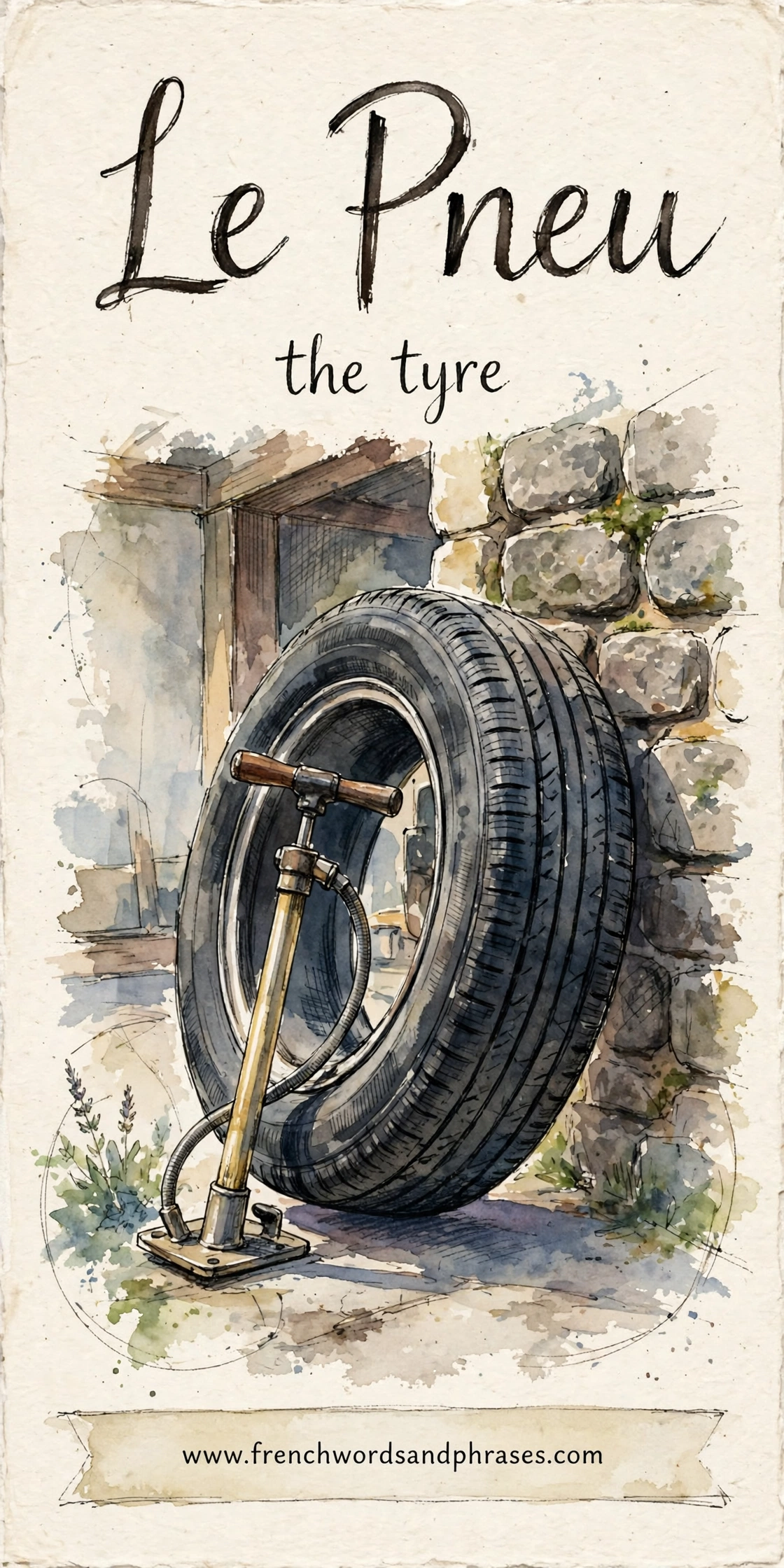
Le pneu means the tyre.
A sharp hiss on a quiet road, the steering suddenly heavy, and the driver sighing the sentence every French motorist learns young — « j’ai crevé »: le pneu, the tyre, has given up.
In this guide, you’ll learn what pneu means in English, how to use it with its articles, how to form its plural, and how it appears in everyday French. Explore French examples, English translations, and practice quizzes.
Understanding the French Noun Pneu
Pneu is a masculine French noun. It is learned together with its article: le pneu, un pneu. It is the short everyday form of le pneumatique — the rubber tyre that wraps the wheel, la roue, and meets the road.
It means the tyre — the black ring of rubber that grips the road in rain, snow and summer heat. French drivers check la pression des pneus, fit des pneus neige in winter, and dread the day one of them is crevé — punctured, flat, finished.
Gender: Masculine
Definite article: le — le pneu (the tyre)
Indefinite article: un — un pneu (a tyre)
Plural: les pneus
English equivalents: The tyre. Pneu is the everyday short form of le pneumatique.
One important usage detail: the verb of the flat tyre is crever — to burst. J’ai crevé means I have got a puncture, and the result is un pneu crevé, a flat tyre. Do not confuse it with the wheel: the pneu bursts, but it is the whole roue that you change at the roadside.
Experience the Word
Pneu is more than rubber. It is the only part of the car that actually touches France — four hand-sized patches of grip between you and the road.
Imagine the first snow of the year in the mountains: the pneus neige fitted the night before, the car climbing calmly past neighbours spinning their summer tyres on the slope.
You have not just changed tyres. You have shaken hands with the road, four times over.
How to Use Pneu in French: Complete Guide
Let’s explore how pneu works in French, beginning with its articles.
Pneu with the Definite Article (Le, Les)
Used for the tyre everyone in the conversation knows — the one that is flat, the one at the front.
| Number | French |
|---|---|
| Singular | le pneu |
| Plural | les pneus |
Le pneu avant est à plat, il faut le changer.
The front tyre is flat, it must be changed.
Pneu with the Indefinite Article (Un, Des)
Used for a tyre in general — the new one bought, the winter ones fitted.
| Number | French |
|---|---|
| Singular | un pneu |
| Plural | des pneus |
Il achète un pneu neuf pour la roue de secours.
He buys a new tyre for the spare wheel.
The Pneu and the Road
Pressure, punctures and winter grip — the words that travel with pneu.
| French | In English |
|---|---|
| la pression des pneus | tyre pressure |
| gonfler les pneus | to inflate the tyres |
| un pneu crevé | a punctured, flat tyre |
| les pneus neige | winter tyres, snow tyres |
| la chambre à air | the inner tube |
| le garagiste | the mechanic |
Vérifie la pression des pneus avant le long trajet.
Check the tyre pressure before the long journey.
What does « j’ai crevé » mean at the side of the road?
Reveal the answer
I have got a puncture. Crever is to burst — the pneu is crevé, flat and finished.
Il a crevé sur l’autoroute, près de la sortie.
He got a puncture on the motorway, near the exit.
The Plural of Pneu
Pneu adds an -s in the plural — les pneus, sold and fitted in pairs.
| Number | French |
|---|---|
| Singular | le pneu |
| Plural | les pneus |
Les pneus doivent être changés par paires.
Tyres must be changed in pairs.
Pneu with Possessive Adjectives (Mon, Ton, Son…)
Possessives agree with the noun, not with the owner — and pneu is masculine, so it takes mon, ton, son.
| Owner | French |
|---|---|
| my | mon pneu |
| your (tu) | ton pneu |
| his / her | son pneu |
| our | notre pneu |
| your (vous) | votre pneu |
| their | leur pneu |
Son pneu arrière est usé jusqu’à la corde.
His rear tyre is worn down to the cord.
Complete the sentence:
Gonfle ______ pneus avant de partir. (your)
Reveal the answer
tes
Gonfle tes pneus avant de partir.
Inflate your tyres before leaving — plural, so tes, not ton.
Pneu with Demonstrative Adjectives (Ce, Ces)
Used to point: this tyre here, those tyres there.
| Number | French |
|---|---|
| Singular | ce pneu |
| Plural | ces pneus |
Ce pneu est lisse, il ne passera pas le contrôle.
This tyre is bald, it will not pass the inspection.
Pneu with Adjectives
Adjectives agree with pneu, masculine — crevé, neuf, usé.
| Adjective | With Pneu |
|---|---|
| crevé (punctured, flat) | un pneu crevé |
| neuf (new) | un pneu neuf |
| usé (worn) | un pneu usé |
| gonflé (inflated) | un pneu gonflé |
| lisse (bald, smooth) | un pneu lisse |
Un pneu lisse sous la pluie, c’est l’accident qui attend.
A bald tyre in the rain is an accident waiting to happen.
Complete the sentence:
En hiver, nous mettons des pneus ______. (snow)
Reveal the answer
neige
En hiver, nous mettons des pneus neige.
In winter, we fit snow tyres.
Everyday Expressions with Pneu
Bursting, inflating and gripping — the pneu phrases of daily life.
| Expression | In English |
|---|---|
| un pneu crevé | a flat tyre, a puncture |
| crever | to get a puncture, to burst |
| gonfler les pneus | to inflate the tyres |
| vérifier la pression | to check the pressure |
| les pneus neige | winter tyres |
| un pneu lisse | a bald tyre |
Elle a crevé deux fois cet hiver, toujours le même pneu.
She has had two punctures this winter, always the same tyre.
Words from the Same Family as Pneu
Wheels, air and grip — the words that travel with pneu.
| French | In English |
|---|---|
| le pneumatique | the tyre (full, formal form) |
| la roue | the wheel |
| la jante | the wheel rim |
| gonfler | to inflate, to pump up |
| la pompe | the pump |
| la route | the road |
La pompe de la station gonfle les pneus en une minute.
The station pump inflates the tyres in a minute.
The mechanic says: « Ce pneu est lisse. » Is he complimenting it?
Reveal the answer
No — lisse here means bald. The tread has worn smooth, and the tyre must be replaced.
Un pneu lisse ne tient pas la route sous la pluie.
A bald tyre does not grip the road in the rain.
Pneu in Everyday French: Real-Life Examples
Now that you know the word, let’s see how pneu appears in everyday French.
Attention, le pneu avant est crevé.
Careful, the front tyre is flat.
Vérifie la pression des pneus, s’il te plaît.
Check the tyre pressure, please.
En novembre, il met ses pneus neige.
In November, he fits his winter tyres.
Les deux pneus avant sont usés, il faut les changer.
Both front tyres are worn, they must be changed.
Gonfle les pneus à la station avant l’autoroute.
Inflate the tyres at the station before the motorway.
Trois pneus crevés en un mois, quelle série !
Three punctures in one month, what a run of luck!
See le pneu in a story: The Car: French Vocabulary (La Voiture) — a family road trip.
Beyond Translation: The Meaning of Pneu
France is a country that drives — to the village, to the coast, to the mountains — and the pneu is where every one of those journeys meets the ground. The law even follows the seasons: in the mountain departments, pneus neige are compulsory in winter, a rule written by the snow itself.
To say pneu is to talk about grip — the thin black line between the car and the road.
It evokes the hiss of the puncture, the pump at the petrol station, and the quiet confidence of new rubber on a wet road.
How to Remember the French Noun Pneu
Remember it this way: Pneu is the tyre — masculine, with le and un, the rubber ring on the roue that bursts, grips and wears smooth.
- You burst it — un pneu crevé, and « j’ai crevé » on the telephone.
- You pump it — gonfler les pneus, and check la pression.
- You winter it — les pneus neige when the snow comes.
The key idea is le pneu that grips — le pneu crevé that stops you.
Test Your Knowledge of Pneu
Let’s see how much you’ve learned. Try answering these questions before revealing the answers.
Is pneu masculine or feminine?
Reveal the answer
Masculine — le pneu, un pneu.
What does un pneu crevé mean?
Reveal the answer
A flat, punctured tyre — crever is to burst.
Translate: Careful, the front tyre is flat.
Reveal the answer
Attention, le pneu avant est crevé.
What are les pneus neige?
Reveal the answer
Winter tyres — fitted for snow and ice, compulsory in the mountains in winter.
Complete the sentence:
Il gonfle ______ pneus avant le départ.
Reveal the answer
les
Il gonfle les pneus avant le départ.
He inflates the tyres before leaving.
Can You Use It?
How would you say this in French?
“Careful, the front tyre is flat.”
Reveal the answer
Attention, le pneu avant est crevé.
Careful, the front tyre is flat.
LEARN FRENCH ONE WORD AT A TIME




