A French Word to Live By
Translate Plat to English
/pla/
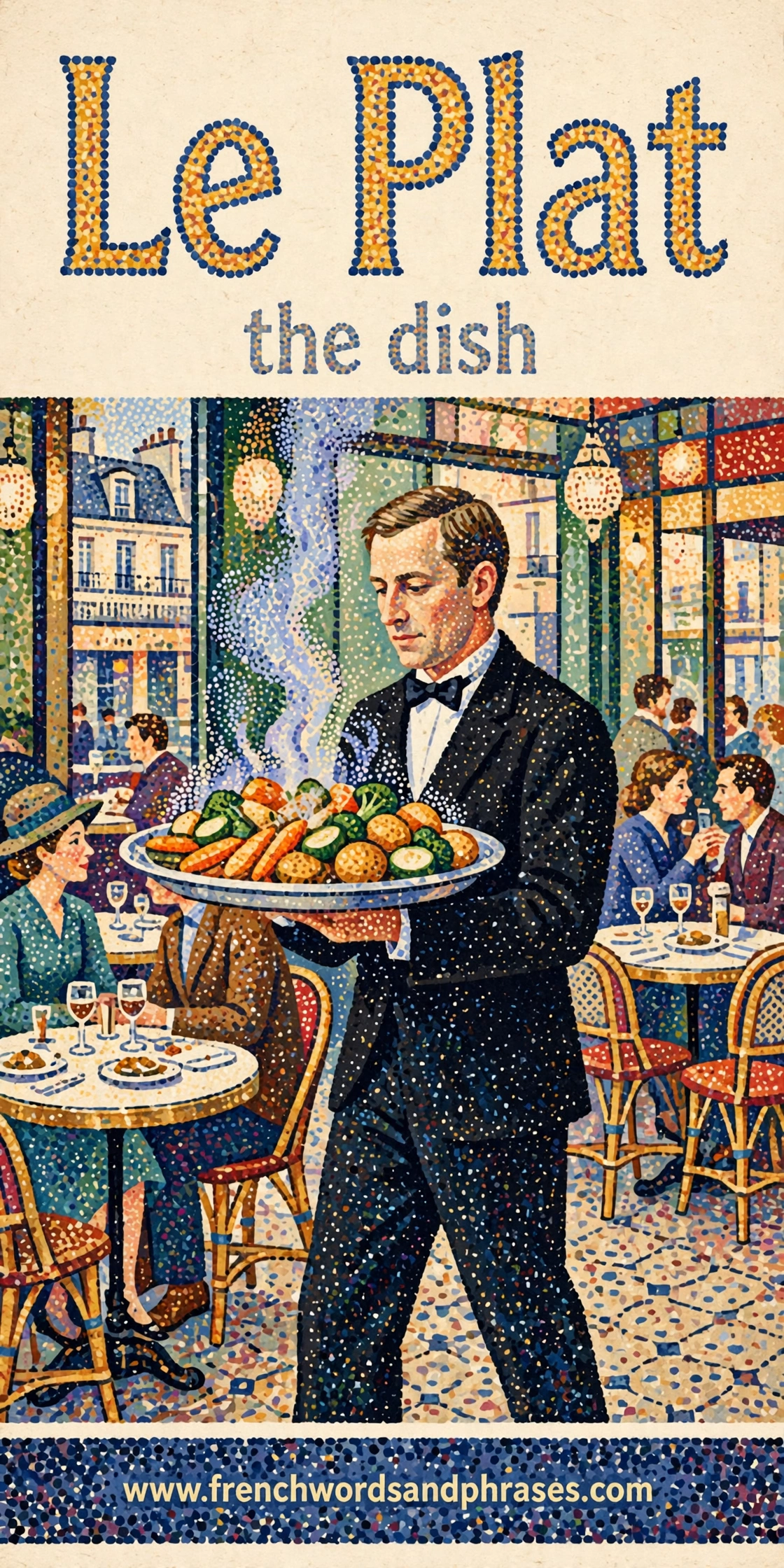
Le plat means the dish.
Sunday lunch at grandmother’s: she comes in from the kitchen carrying something heavy with both hands, steam rising, everyone sitting up straighter. « Attention, c’est chaud ! » Here comes le plat.
In this guide, you’ll learn what plat means in English, how to use it with its articles, how to form its plural, and how it appears in everyday French. Explore French examples, English translations, and practice quizzes.
Understanding the French Noun Plat
Plat is a masculine French noun. It is learned together with its article: le plat, un plat. The same word is also an adjective meaning flat — un plat is the dish on the table, while à plat means flat, or flat-out exhausted. Context, as always, does the sorting.
It means the dish — in both of the word’s delicious senses. A plat is the serving dish itself, the wide plate the food arrives in: un plat en porcelaine, le plat de service. And it is the course of the meal: le plat principal (the main course), le plat du jour (the dish of the day), un plat en sauce (a dish in sauce). At a French table, le plat is the heart of the meal.
Gender: Masculine — le plat, un plat
Plural: les plats
Two senses in one: the serving dish itself, and the course it carries — le plat du jour is both
The menu ladder: l’entrée (starter), le plat principal (main course), le fromage, le dessert
Same word, adjective: plat also means flat: un terrain plat, and à plat — flat, deflated, worn out
English equivalents: The dish; the course, the main course.
One important usage detail: French keeps the container and the course in one word, so le plat du jour is the dish of the day in every sense. And beware the most famous plat idiom of all — mettre les pieds dans le plat, to put your feet in the dish, means to blunder in and say the awkward thing everyone was avoiding. A faux pas you can hear.
Experience the Word
Plat is more than crockery. In France the plat is the centre of the table and the centre of the meal — the thing everyone waits for, leans over and compliments the cook about.
Imagine the bistro at noon: the waiter calls out the plat du jour, chalk squeaks on the little blackboard, and half the room orders it without even looking at the menu.
You have not just eaten a course. You have shared le plat — the dish that turns lunch into an occasion.
How to Use Plat in French: Complete Guide
Let’s explore how plat works in French, beginning with its articles — then we will order it, serve it and, carefully, not put our feet in it.
Plat with the Definite Article (Le, Les)
Used for the dish everyone at the table knows — le plat, the one coming out of the kitchen now.
| Form | French |
|---|---|
| Masculine singular | le plat |
| Plural | les plats |
Example
Le plat arrive enfin, encore fumant, au milieu de la table.
The dish finally arrives, still steaming, in the middle of the table.
Plat with the Indefinite Article (Un, Des)
Used for a dish in general — un plat, des plats.
| Form | French |
|---|---|
| Masculine singular | un plat |
| Plural | des plats |
Example
Elle prépare un plat délicieux pour ses invités ce soir.
She is preparing a delicious dish for her guests this evening.
Plat at the Table: Portions and Helpings (Du plat…)
When plat means the food itself, French helps itself with the partitive — du plat, some of the dish.
| Expression | French |
|---|---|
| some of the dish of the day | du plat du jour |
| a dish of pasta | un plat de pâtes |
| a large serving dish | un grand plat |
| a dish for the whole family | un plat pour toute la famille |
| to have a second helping of the dish | reprendre du plat |
Example
Tu reprendras bien un peu du plat de grand-mère ?
You’ll have a little more of grandmother’s dish, won’t you?
Quick Quiz 1
Complete the sentence:
______ plat du jour est un bœuf bourguignon. (The)
Reveal the answer
Le
Le plat du jour est un bœuf bourguignon.
The dish of the day is a beef bourguignon.
The Plural of Plat
Plat adds an -s in the plural — les plats, a whole menu of them.
| Number | French |
|---|---|
| Singular | le plat |
| Plural | les plats |
Example
Ce restaurant propose des plats traditionnels de toute la France.
This restaurant offers traditional dishes from all over France.
Plat with Possessive Adjectives (Mon, Ton, Son…)
Possessives agree with the noun: plat is masculine, so it takes mon, ton, son.
| Owner | French |
|---|---|
| my | mon plat |
| your (tu) | ton plat |
| his / her | son plat |
| our | notre plat |
| your (vous) | votre plat |
| their | leur plat |
Example
Mon plat préféré, c’est le bœuf bourguignon de ma mère.
My favourite dish is my mother’s beef bourguignon.
Quick Quiz 2
Complete the sentence:
______ plat est encore au four, patience ! (Our)
Reveal the answer
Notre
Notre plat est encore au four, patience !
Our dish is still in the oven, patience!
Plat with Demonstrative Adjectives (Ce, Ces)
Used to point at the dish in front of you: ce plat, ces plats.
| Form | French |
|---|---|
| Masculine singular | ce plat |
| Plural | ces plats |
Example
Ce plat sent merveilleusement bon, qu’est-ce que c’est ?
This dish smells wonderful, what is it?
Plat with Adjectives
Adjectives agree with plat, masculine: délicieux, chaud, traditionnel.
| Adjective | With Plat |
|---|---|
| délicieux (delicious) | un plat délicieux |
| chaud (hot) | un plat chaud |
| traditionnel (traditional) | un plat traditionnel |
| principal (main) | le plat principal |
| nouveau (new) | un nouveau plat |
Example
Le plat principal sera suivi d’un fromage affiné et d’un dessert.
The main course will be followed by a matured cheese and a dessert.
Quick Quiz 3
Complete the sentence:
C’est un plat très ______. (delicious)
Reveal the answer
délicieux
C’est un plat très délicieux.
It is a very delicious dish.
Everyday Expressions with Plat
Menus, blunders and flat batteries — the plat phrases of daily life.
| Expression | In English |
|---|---|
| le plat du jour | the dish of the day |
| le plat principal | the main course |
| mettre les pieds dans le plat | to put your foot in it (literally: to put your feet in the dish) |
| le plat de résistance | the main dish, the star of the meal |
| à plat | flat; flat-out tired; flat (battery) |
Example
Il a mis les pieds dans le plat en parlant du cadeau surprise.
He put his foot in it by talking about the surprise present.
Words from the Same Family as Plat
Trays, courses and tables — the words that travel with plat.
| French | In English |
|---|---|
| le plateau | the tray; the plateau |
| l’assiette | the plate (for one person) |
| l’entrée | the starter |
| le menu | the menu; the set meal |
| le four | the oven |
| servir | to serve |
Example
Elle apporte les fromages sur un plateau en bois.
She brings the cheeses in on a wooden tray.
Quick Quiz 4
What does mettre les pieds dans le plat mean?
Reveal the answer
To put your foot in it — to blunder in and say exactly the awkward thing.
Il met toujours les pieds dans le plat aux repas de famille.
He always puts his foot in it at family meals.
Plat in Everyday French: Real-Life Examples
Now that you know the word, let’s see how plat appears in everyday French.
Example 1 — At the bistro
Le plat du jour, s’il vous plaît, avec un verre de rouge.
The dish of the day, please, with a glass of red.
Example 2 — In the kitchen
Ce plat mijote doucement depuis deux heures.
This dish has been simmering gently for two hours.
Example 3 — A compliment
Ton plat est délicieux, tu me donneras la recette ?
Your dish is delicious, will you give me the recipe?
Example 4 — A blunder
Il a mis les pieds dans le plat devant tout le monde.
He put his foot in it in front of everyone.
Example 5 — A flat battery
Mon téléphone est à plat, je dois le recharger.
My phone is flat, I need to recharge it.
Example 6 — Serving up
Elle pose le plat au centre de la table, sous les applaudissements.
She puts the dish in the centre of the table, to applause.
Beyond Translation: The Meaning of Plat
The plat is where French cooking becomes French theatre: the dish carried in with both hands, set down in the middle, admired before it is touched. Around it the whole grammar of the meal arranges itself — entrée before, fromage after, and the plat de résistance holding the centre like a leading actor. No wonder the language’s great social blunder is staged in it: to put your feet dans le plat is to trample the centrepiece itself.
To say plat is to name the heart of the French meal — and its most famous faux pas.
It evokes the steaming bœuf bourguignon, the chalked plat du jour outside the bistro, and the silence of a table just before the first spoonful.
How to Remember the French Noun Plat
Remember it this way: Plat is the dish — masculine, le plat, one word for the serving dish and the course it carries.
- You order it — le plat du jour, s’il vous plaît.
- You serve it — le plat principal, au centre de la table.
- You blunder — mettre les pieds dans le plat, devant tout le monde.
The key idea is le plat — the dish, the course, and the blunder.
Test Your Knowledge of Plat
Let’s see how much you’ve learned. Try answering these questions before revealing the answers.
Question 1
Is plat masculine or feminine?
Reveal the answer
Masculine — le plat, un plat.
Question 2
What is le plat du jour?
Reveal the answer
The dish of the day — the special course the chef proposes today.
Question 3
Translate: The main course is delicious.
Reveal the answer
Le plat principal est délicieux.
Question 4
What does à plat mean for a phone?
Reveal the answer
Flat — the battery is dead: mon téléphone est à plat.
Question 5
Complete the sentence:
______ plat sent très bon. (This)
Reveal the answer
Ce
Ce plat sent très bon.
This dish smells very good.
Your Final Challenge
Can You Use It?
How would you say this in French?
“The dish of the day is a delicious stew.”
Reveal the answer
Le plat du jour est un ragoût délicieux.
The dish of the day is a delicious stew.
A little French. A little curiosity. A richer everyday life.
LEARN FRENCH ONE WORD AT A TIME