A French Word to Live By
Translate Peur to English
/pœʁ/
La peur means fear.
The cinema goes dark, the music turns slow and strange, and the whole row of friends grips the armrests at the same moment. Nobody screams — but everybody feels it: la peur.
In this guide, you’ll learn what peur means in English, how to use it with its articles, how to form its plural, and how it appears in everyday French. Explore French examples, English translations, and practice quizzes.
Understanding the French Noun Peur
Peur is a feminine French noun. It is learned together with its article: la peur, une peur. It is an abstract noun naming the feeling of fear, and it lives inside one of the most useful verb phrases in French: avoir peur, to be afraid — literally, to have fear.
It means fear — the feeling that rises before danger, real or imagined: la peur du noir (the fear of the dark), la peur de tomber (the fear of falling). French most often uses it with avoir: j’ai peur, I am afraid. With de and a noun or an infinitive, it says exactly what frightens you: avoir peur des chiens, to be afraid of dogs.
Gender: Feminine
Definite article: la — la peur (the fear)
Indefinite article: une — une peur (a fear)
Plural: les peurs (one’s fears)
English equivalents: Fear, fright; une peur bleue — a terrible fright.
One important usage detail: French does not say « je suis peur » — fear is something you have, not something you are: j’ai peur. And note the little trap in the other direction: de peur de means for fear of, and de peur que introduces a feared event — il parle doucement de peur de réveiller le bébé, he speaks softly for fear of waking the baby.
Experience the Word
Peur is more than a feeling in a horror film. It is the oldest alarm bell we own — the racing heart on the cliff path, the cold hands before the exam results.
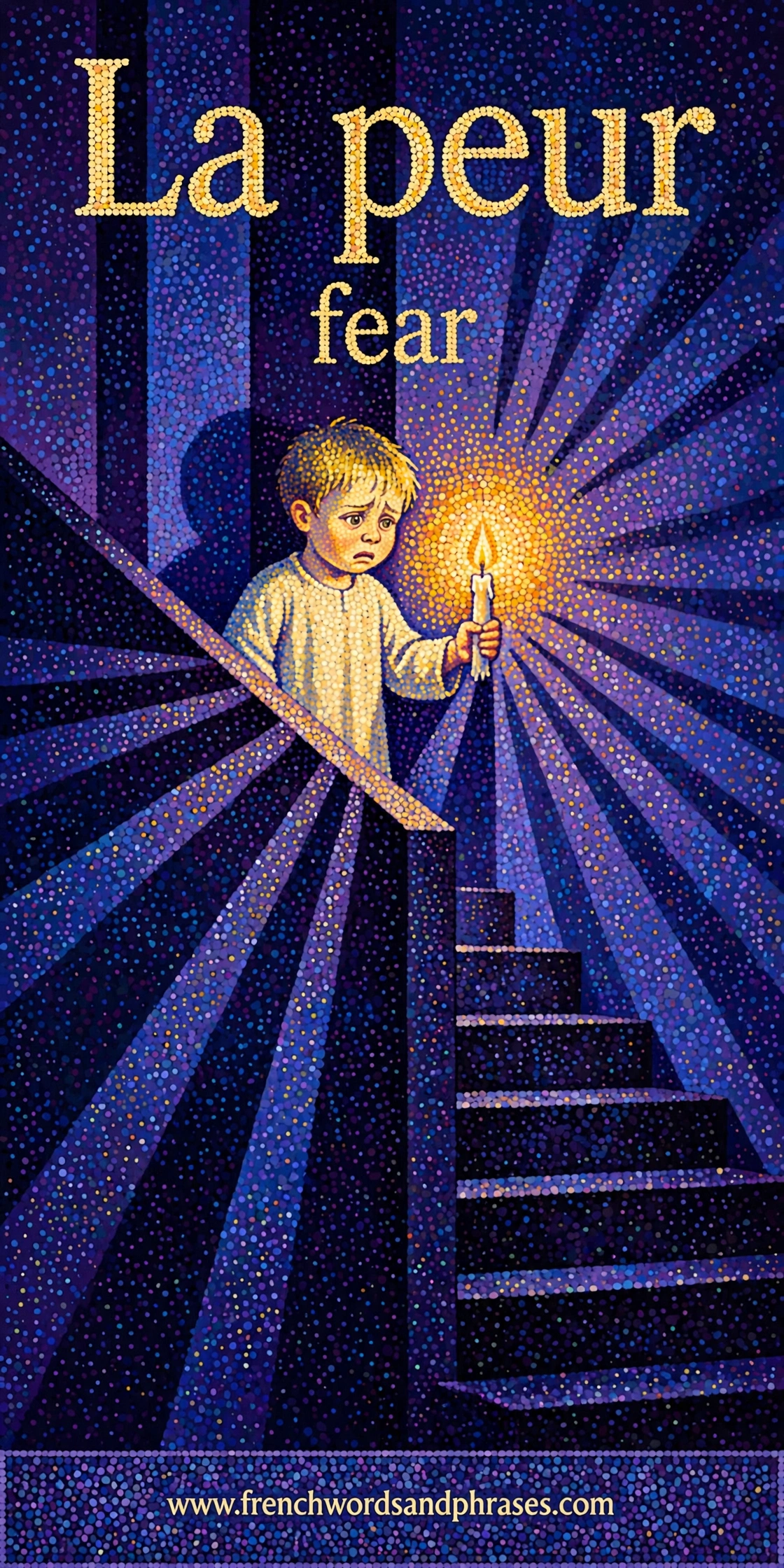
Imagine a child at the top of the big slide, frozen, knuckles white on the rails. Her father does not laugh; he climbs up beside her and waits. Two minutes later she slides down shouting — and the fear has become a story she tells proudly.
You have not just been frightened. You have crossed la peur — and come out bigger on the other side.
How to Use Peur in French: Complete Guide
Let’s explore how peur works in French, beginning with its articles.
Peur with the Definite Article (La, Les)
Used for the fear everyone in the conversation knows — the one being felt right now.
| Number | French |
|---|---|
| Singular | la peur |
| Plural | les peurs |
Example
La peur se lisait sur tous les visages.
Fear could be read on every face.
Peur with the Indefinite Article (Une, Des)
Used for one particular fear — une peur soudaine, a sudden fear.
| Number | French |
|---|---|
| Singular | une peur |
| Plural | des peurs |
Example
Une peur soudaine l’a saisi devant la porte fermée.
A sudden fear seized him in front of the closed door.
Peur with the Partitive Article (De la)
With verbs of feeling, peur often arrives with de la — some fear, mixed into the moment.
| Quantity | French |
|---|---|
| some | de la peur |
| a lot of | beaucoup de peur |
| a little | un peu de peur |
| no more | plus de peur |
| no, none | pas de peur |
Example
Elle a ressenti un peu de peur avant de monter sur scène.
She felt a little fear before going on stage.
Quick Quiz 1
How do you say ‘I am afraid’ in French?
Reveal the answer
J’ai peur — fear is something you have in French: avoir peur.
J’ai peur des orages depuis mon enfance.
I have been afraid of storms since my childhood.
The Plural of Peur
Peur adds an -s in the plural — les peurs — and the plural is common when we list someone’s particular fears.
| Number | French |
|---|---|
| Singular | la peur |
| Plural | les peurs |
Example
Il a vaincu ses peurs une à une.
He conquered his fears one by one.
Peur with Possessive Adjectives (Ma, Ta, Sa…)
Possessives agree with the noun, not with the owner — and peur is feminine, so it takes ma, ta, sa.
| Owner | French |
|---|---|
| my | ma peur |
| your (tu) | ta peur |
| his / her | sa peur |
| our | notre peur |
| your (vous) | votre peur |
| their | leur peur |
Example
Elle a caché sa peur derrière un sourire.
She hid her fear behind a smile.
Quick Quiz 2
Complete the sentence:
Il a enfin avoué ______ peur des hauteurs. (his)
Reveal the answer
sa
Il a enfin avoué sa peur des hauteurs.
He finally admitted his fear of heights.
Peur with Demonstrative Adjectives (Cette, Ces)
Used to point: this fear here, those fears there.
| Number | French |
|---|---|
| Singular | cette peur |
| Plural | ces peurs |
Example
Cette peur de l’eau l’empêche d’apprendre à nager.
This fear of water stops him from learning to swim.
Peur with Adjectives
Adjectives agree with peur, feminine — grande, soudaine, bleue in the famous expression une peur bleue.
| Adjective | With Peur |
|---|---|
| grande (great) | une grande peur |
| soudaine (sudden) | une peur soudaine |
| bleue (terrible, in the set phrase) | une peur bleue |
| irrationnelle (irrational) | une peur irrationnelle |
| constante (constant) | une peur constante |
Example
Le tonnerre m’a fait une peur bleue.
The thunder gave me a terrible fright.
Quick Quiz 3
Complete the sentence:
Le bruit soudain m’a fait une peur ______. (terrible)
Reveal the answer
bleue
Le bruit soudain m’a fait une peur bleue.
The sudden noise gave me a terrible fright.
Everyday Expressions with Peur
Afraid, frightening and reassuring — the peur phrases of daily life.
| Expression | In English |
|---|---|
| avoir peur de | to be afraid of |
| faire peur à quelqu’un | to frighten someone |
| mourir de peur | to be scared to death |
| de peur de / de peur que | for fear of / for fear that |
| n’aie pas peur | don’t be afraid |
| plus de peur que de mal | more fright than harm |
Example
N’aie pas peur, le chien est très gentil.
Don’t be afraid, the dog is very gentle.
Words from the Same Family as Peur
Fear and its neighbours — the words that travel with peur.
| French | In English |
|---|---|
| effrayant | frightening |
| la frayeur | fright, dread |
| craindre | to fear, to dread |
| inquiet / inquiète | worried |
| le courage | courage — fear’s great opponent |
| rassurer | to reassure |
Example
Ce bruit effrayant nous a donné une grande frayeur.
That frightening noise gave us a great fright.
Quick Quiz 4
Your little brother fell off his bike and only scratched his knee. Which expression sums up the evening?
Reveal the answer
Plus de peur que de mal — more fright than harm: the scare was worse than the injury.
Il est tombé, mais c’est plus de peur que de mal.
He fell, but it was more fright than harm.
Peur in Everyday French: Real-Life Examples
Now that you know the word, let’s see how peur appears in everyday French.
Example 1 — At the cinema
Ce film d’horreur m’a fait une peur terrible.
That horror film gave me a terrible fright.
Example 2 — A child at night
Mon fils a peur du noir depuis l’âge de trois ans.
My son has been afraid of the dark since he was three.
Example 3 — Before the exam
Elle a peur de rater son examen de conduite.
She is afraid of failing her driving test.
Example 4 — Reassuring a friend
N’aie pas peur, je reste avec toi jusqu’au bout.
Don’t be afraid, I’ll stay with you to the end.
Example 5 — At the dentist
Beaucoup de gens ont peur du dentiste, c’est normal.
Many people are afraid of the dentist, it’s normal.
Example 6 — Good news after all
L’accident n’a fait que des dégâts légers : plus de peur que de mal.
The accident only did slight damage: more fright than harm.
Beyond Translation: The Meaning of Peur
French treats fear as a possession — something you have, carry, and can set down. J’ai peur, tu as peur: the grammar itself suggests that fear is a load, not an identity, and loads can be put down again. The language even grades it gently: un peu de peur, une peur bleue, mourir de peur.
To say peur is to hold the feeling in your hand — where it can be looked at, and let go.
It evokes the child at the top of the slide, the white knuckles on the cliff path, and the old reassurance that has closed a thousand French evenings: plus de peur que de mal.
How to Remember the French Noun Peur
Remember it this way: Peur is fear — feminine, and above all a word you use with avoir: j’ai peur, I am afraid.
- You have it — j’ai peur, never « je suis peur ».
- You name it — avoir peur de plus the thing that frightens you.
- You grade it — un peu de peur, une peur bleue, mourir de peur.
The key idea is la peur is something you have — and can put down.
Test Your Knowledge of Peur
Let’s see how much you’ve learned. Try answering these questions before revealing the answers.
Question 1
Is peur masculine or feminine?
Reveal the answer
Feminine — la peur, une peur.
Question 2
How do you say ‘She is afraid of spiders’ in French?
Reveal the answer
Elle a peur des araignées.
Question 3
Translate: Don’t be afraid, it’s only a mouse.
Reveal the answer
N’aie pas peur, ce n’est qu’une souris.
Question 4
What does ‘plus de peur que de mal’ mean?
Reveal the answer
More fright than harm — the scare was worse than the damage.
Question 5
Complete the sentence:
Les enfants ont ______ des orages.
Reveal the answer
peur
Les enfants ont peur des orages.
The children are afraid of storms.
Your Final Challenge
Can You Use It?
How would you say this in French?
“The children are afraid of the dark.”
Reveal the answer
Les enfants ont peur du noir.
The children are afraid of the dark.
A little French. A little curiosity. A richer everyday life.
LEARN FRENCH ONE WORD AT A TIME