A French Word to Live By
Translate Petit déjeuner to English
/pə.ti de.ʒœ.ne/
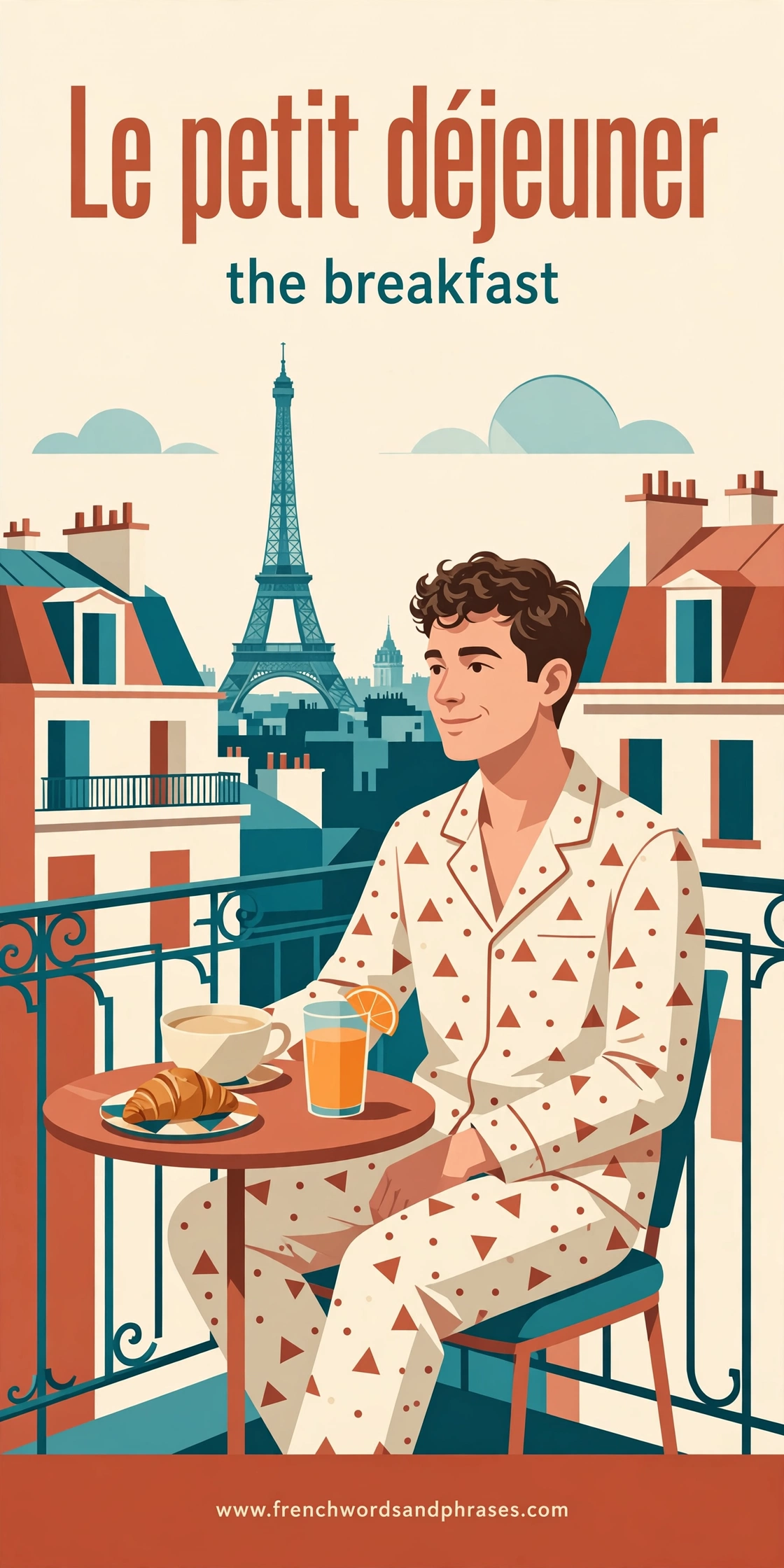
Le petit déjeuner means the breakfast.
Morning light, the smell of coffee and warm croissants, a bowl rather than a cup on the table. The first meal of the French day has a name that tells a story: le petit déjeuner.
In this guide, you’ll learn what petit déjeuner means in English, how to use it with its articles, how to form its plural, and how it appears in everyday French. Explore French examples, English translations, and practice quizzes.
Understanding the French Noun Petit déjeuner
Petit déjeuner is a masculine French compound noun: petit (little) plus déjeuner (lunch, a meal). It is learned with its article: le petit déjeuner, un petit déjeuner. It is written without a hyphen — petit stays an ordinary adjective in front of the noun.
It means breakfast — literally the « little lunch », because déjeuner is the midday meal and breakfast is its smaller morning brother. The logic is hidden in déjeuner itself: to break the fast. A classic French petit déjeuner is light — un croissant, une tartine (bread with butter and jam), and un café au lait in a bowl.
Gender: Masculine
Composition: petit (little) + déjeuner (lunch, meal) — the little lunch that breaks the fast
Definite article: le — le petit déjeuner (the breakfast, breakfast)
Indefinite article: un — un petit déjeuner (a breakfast)
Plural: les petits déjeuners — both words take the plural
English equivalents: Breakfast; the breakfast.
One important usage detail: déjeuner alone is lunch, the midday meal — the petit is what moves it to the morning. And the verb is a gift: prendre le petit déjeuner, to have breakfast, is the sentence every French morning begins with.
Experience the Word
Petit déjeuner is more than a meal. It is the day’s gentle opening ceremony — coffee steaming, the tartine buttered in silence, the radio murmuring the news.
Imagine the little Paris café at eight: a croissant, a bowl of café au lait, the newspaper folded beside the plate, and the whole city still soft at the edges.
You have not just eaten. You have begun — le jour commence en douceur.
How to Use Petit déjeuner in French: Complete Guide
Let’s explore how petit déjeuner works in French, beginning with its articles — and watch the little lunch that starts the day.
Petit déjeuner with the Definite Article (Le, Les)
Used for breakfast as a daily institution — le petit déjeuner is served from seven to ten.
| Form | French |
|---|---|
| Masculine singular | le petit déjeuner |
| Plural | les petits déjeuners |
Example
Le petit déjeuner est servi dans la salle à manger.
Breakfast is served in the dining room.
Petit déjeuner with the Indefinite Article (Un, Des)
Used for a breakfast in particular — un petit déjeuner copieux, a hearty breakfast.
| Form | French |
|---|---|
| Masculine singular | un petit déjeuner |
| Plural | des petits déjeuners |
Example
L’hôtel propose un petit déjeuner délicieux.
The hotel offers a delicious breakfast.
At the Table: Words of the Petit déjeuner
Croissants, bowls and jam — the vocabulary that surrounds the petit déjeuner.
| French | In English |
|---|---|
| le croissant | the croissant |
| la tartine | the slice of bread with butter and jam |
| le café au lait | the white coffee |
| la confiture | the jam |
| le bol | the bowl |
| le jus d’orange | the orange juice |
Example
Au petit déjeuner, elle mange une tartine et boit un café au lait.
At breakfast, she eats a tartine and drinks a white coffee.
Quick Quiz 1
Complete the sentence:
Nous prenons ______ à sept heures tous les matins.
Reveal the answer
le petit déjeuner
Nous prenons le petit déjeuner à sept heures tous les matins.
We have breakfast at seven o’clock every morning.
The Plural of Petit déjeuner
Both words take the -s: des petits déjeuners.
| Number | French |
|---|---|
| Singular | le petit déjeuner / un petit déjeuner |
| Plural | les petits déjeuners / des petits déjeuners |
Example
Les petits déjeuners de cet hôtel sont célèbres.
This hotel’s breakfasts are famous.
Petit déjeuner with Possessive Adjectives (Mon, Ton, Son…)
Possessives agree with the noun: petit déjeuner is masculine, so it takes mon, ton, son.
| Owner | French |
|---|---|
| my | mon petit déjeuner |
| your (tu) | ton petit déjeuner |
| his / her | son petit déjeuner |
| our | notre petit déjeuner |
| your (vous) | votre petit déjeuner |
| their | leur petit déjeuner |
Example
Mon petit déjeuner préféré, c’est un croissant et un chocolat chaud.
My favourite breakfast is a croissant and a hot chocolate.
Quick Quiz 2
Complete the sentence:
______ petit déjeuner est prêt, à table ! (Your, tu)
Reveal the answer
Ton
Ton petit déjeuner est prêt, à table !
Your breakfast is ready — come to the table!
Petit déjeuner with Demonstrative Adjectives (Ce, Ces)
Used to point at the table: ce petit déjeuner, this spread here.
| Form | French |
|---|---|
| Masculine singular | ce petit déjeuner |
| Plural | ces petits déjeuners |
Example
Ce petit déjeuner a l’air délicieux.
This breakfast looks delicious.
Petit déjeuner with Adjectives
Adjectives agree with déjeuner as masculine: un petit déjeuner copieux, un petit déjeuner complet.
| Adjective | With Petit déjeuner |
|---|---|
| copieux (hearty) | un petit déjeuner copieux |
| complet (full, complete) | un petit déjeuner complet |
| léger (light) | un petit déjeuner léger |
| délicieux (delicious) | un petit déjeuner délicieux |
| traditionnel (traditional) | un petit déjeuner traditionnel |
Example
Après la randonnée, un petit déjeuner copieux nous attend.
After the hike, a hearty breakfast awaits us.
Quick Quiz 3
Complete the sentence:
______ petit déjeuner est inclus dans le prix. (This)
Reveal the answer
Ce
Ce petit déjeuner est inclus dans le prix.
This breakfast is included in the price.
Everyday Expressions with Petit déjeuner
Mornings and hotels — the petit déjeuner phrases of daily life.
| Expression | In English |
|---|---|
| prendre le petit déjeuner | to have breakfast |
| préparer le petit déjeuner | to make breakfast |
| le petit déjeuner au lit | breakfast in bed |
| petit déjeuner inclus | breakfast included |
| l’heure du petit déjeuner | breakfast time |
Example
Elle prépare le petit déjeuner pour toute la famille.
She is making breakfast for the whole family.
Words from the Same Family as Petit déjeuner
Meals of the day — the words that travel with petit déjeuner.
| French | In English |
|---|---|
| déjeuner | to have lunch; lunch |
| le déjeuner | lunch |
| le dîner | dinner |
| le goûter | the afternoon snack |
| le repas | the meal |
| le matin | the morning |
Example
Le petit déjeuner ouvre la journée, le déjeuner la partage en deux.
Breakfast opens the day; lunch divides it in two.
Quick Quiz 4
What is le déjeuner, without petit?
Reveal the answer
Lunch — the midday meal; petit is what makes the déjeuner a breakfast.
Le déjeuner est à midi et demi.
Lunch is at half past twelve.
Petit déjeuner in Everyday French: Real-Life Examples
Now that you know the word, let’s see how petit déjeuner appears in everyday French.
Example 1 — In the morning
Je prends mon petit déjeuner à sept heures.
I have my breakfast at seven o’clock.
Example 2 — At a hotel
Le petit déjeuner est inclus dans le prix de la chambre.
Breakfast is included in the price of the room.
Example 3 — A treat
Dimanche, nous prenons le petit déjeuner au lit.
On Sunday, we have breakfast in bed.
Example 4 — Cooking
Il prépare un petit déjeuner copieux pour ses amis.
He is making a hearty breakfast for his friends.
Example 5 — Asking
À quelle heure est le petit déjeuner ?
What time is breakfast?
Example 6 — Skipping
Elle part sans petit déjeuner, elle est en retard.
She leaves without breakfast; she is late.
Beyond Translation: The Meaning of Petit déjeuner
Petit déjeuner hides a whole philosophy of eating: déjeuner comes from breaking the fast, so breakfast is the little break-fast, lunch the big one. The French petit déjeuner itself is famously modest beside its English cousin — no fry-up, just the croissant, the tartine and the bowl of coffee — a lightness the name announces honestly: it is petit, and proud of it.
To say petit déjeuner is to start the day gently, the French way.
It evokes the café bowl and the buttered tartine, the hotel tray and the Sunday lie-in — the smallest meal with the warmest welcome.
How to Remember the French Noun Petit déjeuner
Remember it this way: Petit déjeuner is breakfast — the little déjeuner, the small meal that breaks the night’s fast.
- You picture the morning — petit, parce qu’il est léger.
- You start the day — prendre le petit déjeuner à sept heures.
- You separate the meals — le déjeuner, c’est à midi.
The key idea is petit + déjeuner — the little lunch of the morning.
Test Your Knowledge of Petit déjeuner
Let’s see how much you’ve learned. Try answering these questions before revealing the answers.
Question 1
Why is breakfast called petit déjeuner?
Reveal the answer
It is the little lunch — déjeuner (lunch) means breaking the fast, and breakfast is its smaller morning version.
Question 2
What is le déjeuner on its own?
Reveal the answer
Lunch — the midday meal; only with petit does it become breakfast.
Question 3
Translate: We have breakfast at eight o’clock.
Reveal the answer
Nous prenons le petit déjeuner à huit heures.
Question 4
What is une tartine?
Reveal the answer
A slice of bread with butter and jam — the classic companion of the petit déjeuner.
Question 5
Complete the sentence:
______ petit déjeuner est servi à sept heures. (The)
Reveal the answer
Le
Le petit déjeuner est servi à sept heures.
Breakfast is served at seven o’clock.
Your Final Challenge
Can You Use It?
How would you say this in French?
“Breakfast is served at seven o’clock.”
Reveal the answer
Le petit déjeuner est servi à sept heures.
Breakfast is served at seven o’clock.
A little French. A little curiosity. A richer everyday life.
LEARN FRENCH ONE WORD AT A TIME