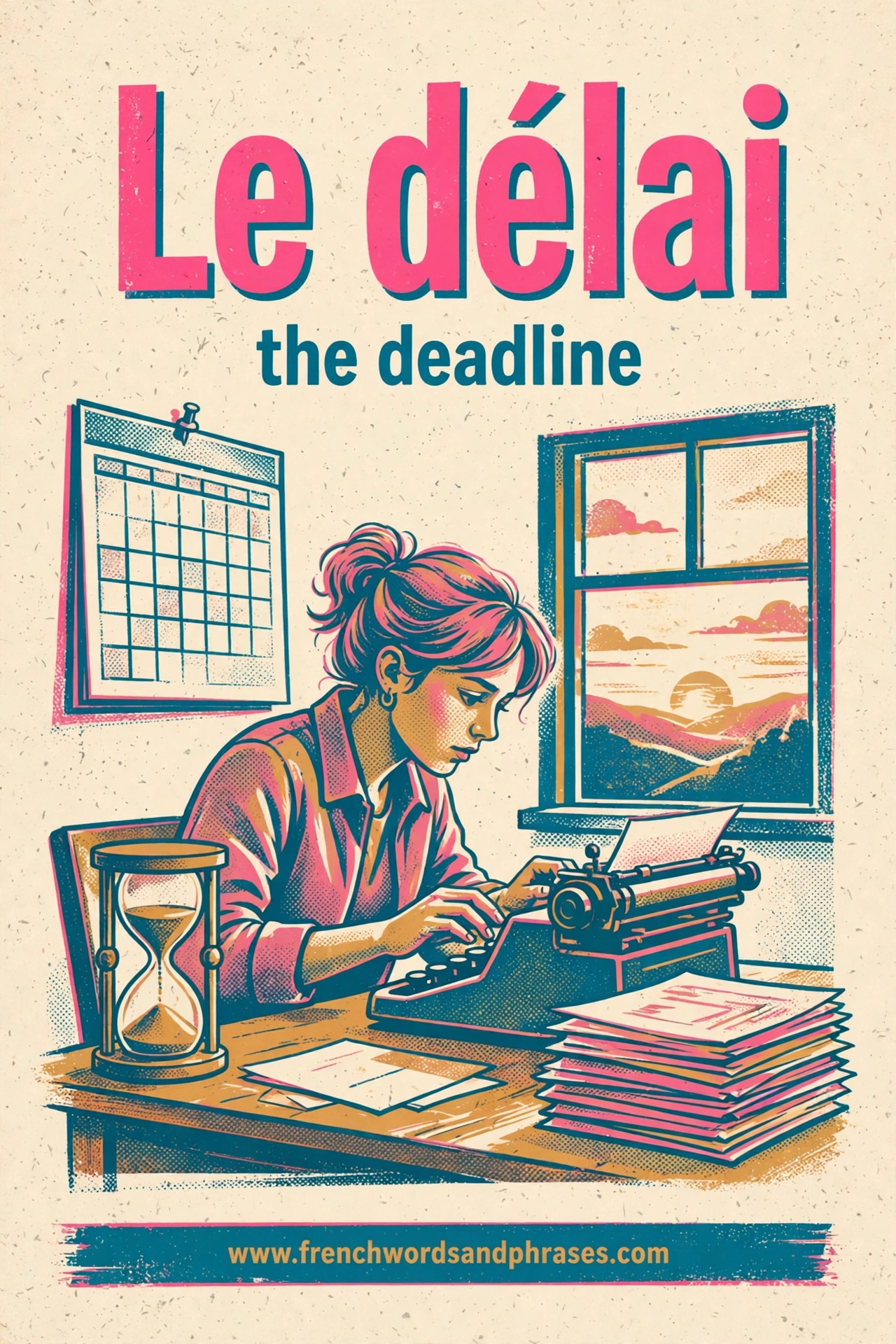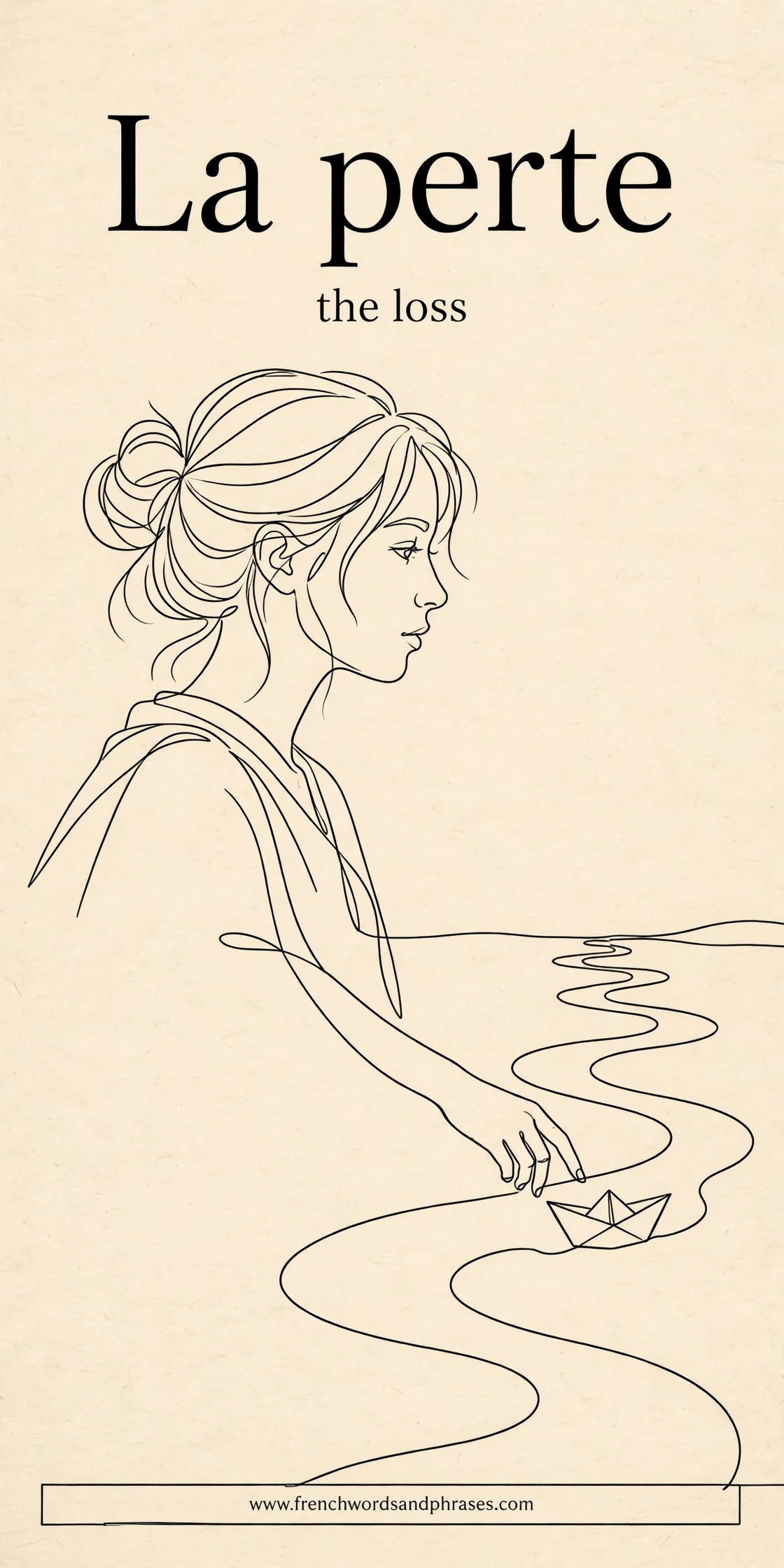
A French Word to Live By
Translate Perte to English
/pɛʁt/
La perte means the loss.
The little shop at the end of the street closes its shutters for the last time. On the door, a handwritten note thanks the customers of forty years. The whole street feels it — la perte d’un commerce, d’un lieu, d’une habitude.
In this guide, you’ll learn what perte means in English, how to use it with its articles, how to form its plural, and how it appears in everyday French. Explore French examples, English translations, and practice quizzes.
Understanding the French Noun Perte
Perte is a feminine French noun, learned with its article: la perte, une perte. It is the noun that belongs to the verb perdre (to lose): where English says « I lost it », French builds the loss itself with perte.
It means the loss — of an object, of money, of time, of a person. A company announces une perte de deux millions (a loss of two million), a dieter celebrates une perte de poids (weight loss), and the saddest sense of all is the loss of someone dear: la perte d’un proche. Its opposite, the gain, is le gain — and profit in business is le bénéfice.
Gender: Feminine
Definite article: la — la perte (the loss)
Indefinite article: une — une perte (a loss)
Plural: les pertes
Word origin: The noun of perdre, to lose — je perds, nous perdons
English equivalents: The loss; a loss.
One important usage detail: French loves the phrase à perte and en pure perte — in vain, for nothing: « Travailler en pure perte », to work for nothing. And when something is lost for good, beyond recovery, French says perdu — but the official, countable side of losing, in accounts and in hearts, is always la perte.
Experience the Word
Perte is more than an accounting line. It ranges from the trivial — la perte d’un parapluie — to the deepest word in the language of grief: la perte d’un être cher, the loss of a loved one, for which French keeps its gentlest formulas of sympathy.
Imagine the accountant closing the year’s books, the red figure at the bottom — and, in another house, a family keeping a chair at the table for someone who will not return.
You have not just mislaid something. You have measured an absence — petite ou immense, small or immense.
How to Use Perte in French: Complete Guide
Let’s explore how perte works in French, beginning with its articles.
Perte with the Definite Article (La, Les)
Used for the loss everyone in the conversation knows — the one in the accounts, the one in the family.
| Form | French |
|---|---|
| Singular | la perte |
| Plural | les pertes |
Example
La perte de l’entreprise atteint deux millions d’euros.
The company’s loss reaches two million euros.
Perte with the Indefinite Article (Une, Des)
Used for a loss in general — une perte, any loss at all.
| Form | French |
|---|---|
| Singular | une perte |
| Plural | des pertes |
Example
C’est une perte de temps, ce travail ne sert à rien.
It is a waste of time; this work is useless.
Kinds of Perte: Words Around the Loss
Money, weight and time — the vocabulary that surrounds the perte.
| French | In English |
|---|---|
| la perte de poids | weight loss |
| la perte de temps | the waste of time |
| les pertes financières | financial losses |
| la perte d’un proche | the loss of a loved one, a bereavement |
| perdre | to lose |
| le gain | the gain (the opposite) |
Example
Sa perte de poids est régulière depuis janvier.
His weight loss has been steady since January.
Quick Quiz 1
Complete the sentence:
Attendre ici est une ______ de temps.
Reveal the answer
perte
Attendre ici est une perte de temps.
Waiting here is a waste of time.
The Plural of Perte
Perte adds an -s in the plural — les pertes, the losses of a year or a battle.
| Number | French |
|---|---|
| Singular | la perte |
| Plural | les pertes |
Example
Les pertes de la société diminuent cette année.
The company’s losses are falling this year.
Perte with Possessive Adjectives (Ma, Ta, Sa…)
Possessives agree with the noun: perte is feminine, so it takes ma, ta, sa in the singular.
| Owner | French |
|---|---|
| my | ma perte |
| your (tu) | ta perte |
| his / her | sa perte |
| our | notre perte |
| your (vous) | votre perte |
| their | leur perte |
Example
Leur perte est immense, toute la famille est en deuil.
Their loss is immense; the whole family is in mourning.
Quick Quiz 2
Complete the sentence:
______ perte de mémoire inquiète le médecin. (His)
Reveal the answer
Sa
Sa perte de mémoire inquiète le médecin.
His memory loss worries the doctor — sa, because perte is feminine.
Perte with Demonstrative Adjectives (Cette, Ces)
Used to point: cette perte, this loss — this one here.
| Form | French |
|---|---|
| Singular | cette perte |
| Plural | ces pertes |
Example
Cette perte va coûter cher à l’entreprise.
This loss is going to cost the company dearly.
Perte with Adjectives
Adjectives agree with perte: feminine forms, lourde and sèche take their endings.
| Adjective | With Perte |
|---|---|
| lourde (heavy) | une perte lourde |
| sèche (net, outright) | une perte sèche |
| financière (financial) | une perte financière |
| énorme (enormous) | une perte énorme |
| douloureuse (painful) | une perte douloureuse |
Example
Le magasin a subi une perte sèche cette année.
The shop made an outright loss this year.
Quick Quiz 3
Complete the sentence:
C’est une perte très ______ pour le village. (painful)
Reveal the answer
douloureuse
C’est une perte très douloureuse pour le village.
It is a very painful loss for the village — douloureuse, the feminine form.
Everyday Expressions with Perte
Accounts, diets and grief — the perte phrases of daily life.
| Expression | In English |
|---|---|
| une perte de temps | a waste of time |
| une perte de poids | weight loss |
| en pure perte | in vain, for nothing |
| à perte | at a loss (selling below cost) |
| la perte d’un proche | a bereavement |
| subir une perte | to suffer, to incur a loss |
Example
Il a travaillé toute la journée en pure perte.
He worked all day in vain.
Words from the Same Family as Perte
Losing, finding and gaining — the words that travel with perte.
| French | In English |
|---|---|
| perdre | to lose |
| perdu | lost |
| le gain | the gain |
| le bénéfice | the profit |
| retrouver | to find again |
| le deuil | mourning, bereavement |
Example
Après la perte de son chien, il l’a retrouvé à la fourrière.
After losing his dog, he found it again at the pound.
Quick Quiz 4
What does « en pure perte » mean?
Reveal the answer
In vain, for nothing — effort spent with no result at all.
Ces réparations sont faites en pure perte.
These repairs are being done in vain.
Perte in Everyday French: Real-Life Examples
Now that you know the word, let’s see how perte appears in everyday French.
Example 1 — In business
La société annonce une perte au premier trimestre.
The company announces a loss in the first quarter.
Example 2 — At the doctor’s
Sa perte de poids est un bon signe.
His weight loss is a good sign.
Example 3 — Wasted effort
Ne refais pas ce trajet, c’est une perte de temps.
Don’t make that journey again, it’s a waste of time.
Example 4 — In the family
La perte de leur grand-père les a beaucoup touchés.
The loss of their grandfather affected them deeply.
Example 5 — At the market
Le marchand vend ses légumes à perte en fin de journée.
The stallholder sells his vegetables at a loss at the end of the day.
Example 6 — Memory
Elle remarque une petite perte de mémoire chez son père.
She notices a slight memory loss in her father.
Beyond Translation: The Meaning of Perte
Perte covers the whole scale of French loss, from the umbrella left on the train to the empty chair at Christmas. The language handles both with the same word but never the same tone: the accounts speak of pertes sèches, outright losses, while the letters of sympathy speak of votre perte with a gentleness that English borrows word for word — « I am sorry for your loss ».
To say perte is to name the empty space something leaves behind.
It evokes the red figure in the ledger and the silence in the house — one word for everything that is no longer there.
How to Remember the French Noun Perte
Remember it this way: Perte is the loss — the noun built on perdre, to lose — from a waste of time to the loss of a loved one.
- You lose money — une perte, une perte financière.
- You waste the afternoon — une perte de temps, en pure perte.
- You lose weight gladly — une perte de poids, régulière et saine.
The key idea is la perte — what perdre leaves behind.
Test Your Knowledge of Perte
Let’s see how much you’ve learned. Try answering these questions before revealing the answers.
Question 1
What does la perte mean in English?
Reveal the answer
The loss — of money, of time, of weight, or of a loved one.
Question 2
Which verb does perte belong to?
Reveal the answer
Perdre — to lose: je perds, tu perds, nous perdons.
Question 3
Translate: It is a waste of time.
Reveal the answer
C’est une perte de temps.
Question 4
What does « une perte de poids » mean?
Reveal the answer
Weight loss — la perte de poids est régulière, the weight loss is steady.
Question 5
Complete the sentence:
L’entreprise a subi une ______ importante cette année.
Reveal the answer
perte
L’entreprise a subi une perte importante cette année.
The company suffered a significant loss this year.
Your Final Challenge
Can You Use It?
How would you say this in French?
“The loss of the shop saddens the whole street.”
Reveal the answer
La perte du magasin attriste toute la rue.
The loss of the shop saddens the whole street.
A little French. A little curiosity. A richer everyday life.
LEARN FRENCH ONE WORD AT A TIME