A French Word to Live By
How to Conjugate Permettre in French
/pɛʁ.mɛtʁ/
Permettre means to permit, to allow.
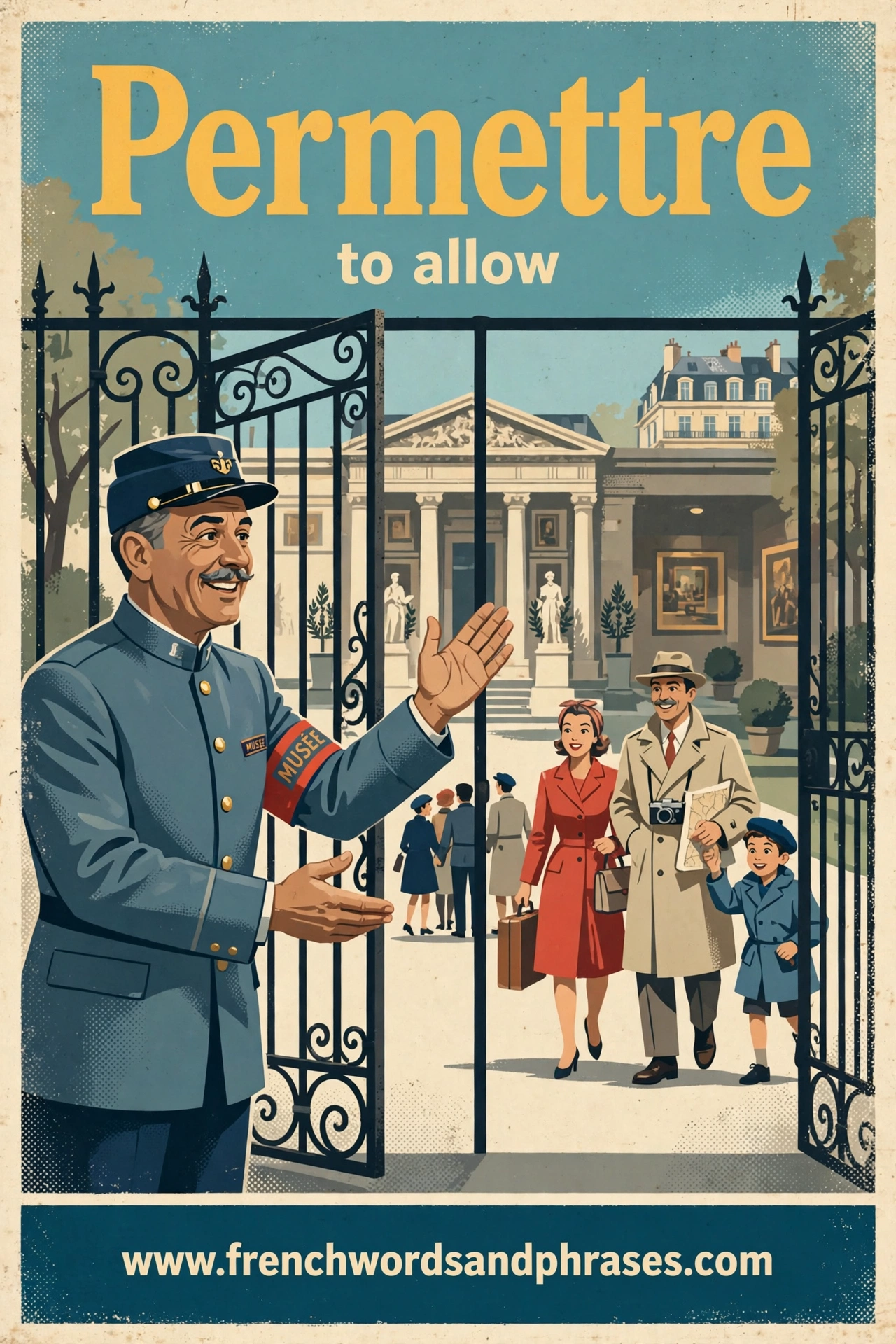
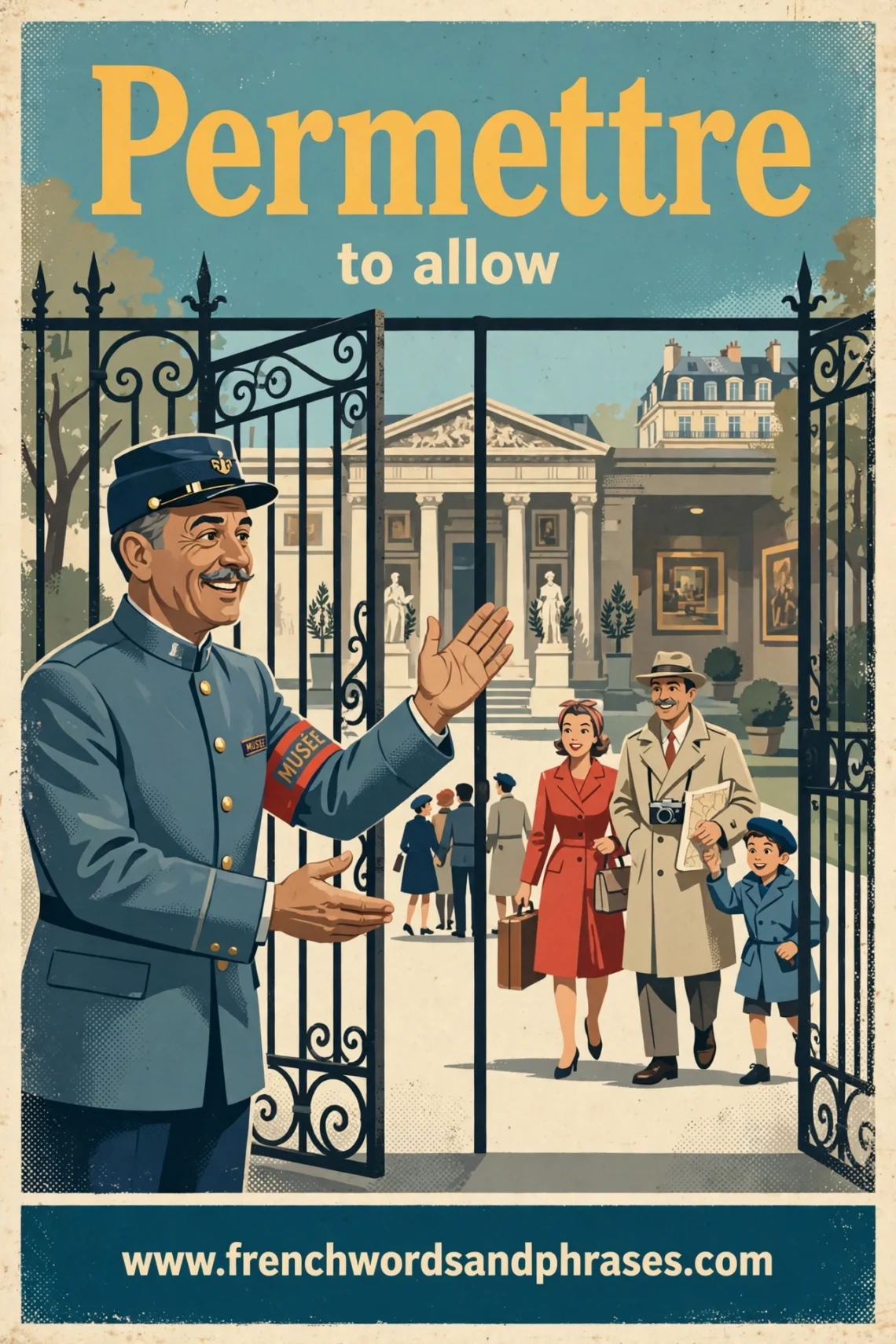
A door opens, a rule bends, someone finally says yes — when you give somebody the green light to do something, that is permettre.
In this guide, you’ll learn how to conjugate permettre in all the major French tenses and moods. Explore complete conjugation tables, French examples, English translations, and practice quizzes.
Understanding the French Verb Permettre
Permettre is an irregular French verb belonging to the third group of verbs, those ending in -re.
It means to permit, to allow. It is commonly used for giving permission, and also for making something possible, as in ce passeport vous permet de voyager, this passport allows you to travel.
Verb classification: Third group (irregular -re verb)
Auxiliary verb: Avoir
Past participle: permis
Present participle: permettant
English equivalents: To permit, to allow.
One important spelling detail: permettre is conjugated exactly like mettre — a single t in the singular present — je permets, il permet — and a double tt in the plural — nous permettons.
Experience the Word
Permettre is more than saying yes. It is removing an obstacle, opening a gate, and letting someone move forward.
Imagine a teenager asking to stay out late for the first time. Her parents look at each other, smile, and say yes.
You have not just agreed. You have allowed it.
How to Conjugate Permettre: Complete French Conjugation Guide
Let’s explore every major conjugation of permettre, beginning with the indicative mood.
How to Conjugate Permettre in the Indicative Mood
The indicative mood is used to express facts, observations, actions, and events.
How to Conjugate Permettre in the Present Tense (Présent)
Used for actions happening now, habitual actions, and general truths.
| Subject | Conjugation |
|---|---|
| je | permets |
| tu | permets |
| il / elle | permet |
| nous | permettons |
| vous | permettez |
| ils / elles | permettent |
Example
Le professeur permet aux élèves de sortir.
The teacher allows the pupils to go out.
Quick Quiz 1
Complete the sentence:
Mes parents me ______ de sortir le samedi.
Reveal the answer
permettent
Mes parents me permettent de sortir le samedi.
My parents let me go out on Saturdays.
How to Conjugate Permettre in the Passé Composé
Used for completed actions in the past. Permettre takes the auxiliary verb avoir.
| Subject | Conjugation |
|---|---|
| j’ | ai permis |
| tu | as permis |
| il / elle | a permis |
| nous | avons permis |
| vous | avez permis |
| ils / elles | ont permis |
Example
J’ai permis à mon fils de partir.
I allowed my son to leave.
How to Conjugate Permettre in the Imparfait (Imperfect Tense)
Used for habitual past actions, descriptions, and ongoing situations in the past.
| Subject | Conjugation |
|---|---|
| je | permettais |
| tu | permettais |
| il / elle | permettait |
| nous | permettions |
| vous | permettiez |
| ils / elles | permettaient |
Example
Quand elle était enfant, ses parents lui permettaient de jouer dehors.
When she was a child, her parents allowed her to play outside.
Quick Quiz 2
Choose the correct form:
Before, phones were not allowed at school.
Avant, on ne ______ pas les téléphones à l’école.
Reveal the answer
permettait
Avant, on ne permettait pas les téléphones à l’école.
How to Conjugate Permettre in the Plus-que-parfait
Used to describe an action that had already been completed before another past event.
| Subject | Conjugation |
|---|---|
| j’ | avais permis |
| tu | avais permis |
| il / elle | avait permis |
| nous | avions permis |
| vous | aviez permis |
| ils / elles | avaient permis |
Example
Nous avions permis aux invités d’entrer avant qu’il n’arrive.
We had allowed the guests to come in before he arrived.
How to Conjugate Permettre in the Passé Simple
Primarily used in formal writing, literature, and historical narratives. It is rarely used in everyday conversation.
| Subject | Conjugation |
|---|---|
| je | permis |
| tu | permis |
| il / elle | permit |
| nous | permîmes |
| vous | permîtes |
| ils / elles | permirent |
Example
Le roi permit au prisonnier de partir.
The king allowed the prisoner to leave.
How to Conjugate Permettre in the Passé Antérieur
A literary tense used to express an action completed immediately before another past action, generally in the passé simple.
| Subject | Conjugation |
|---|---|
| j’ | eus permis |
| tu | eus permis |
| il / elle | eut permis |
| nous | eûmes permis |
| vous | eûtes permis |
| ils / elles | eurent permis |
Example
Dès qu’il eut permis aux enfants de sortir, la maison devint calme.
As soon as he had allowed the children to go out, the house became quiet.
How to Conjugate Permettre in the Future Tense (Futur Simple)
Used to describe actions that will take place in the future.
| Subject | Conjugation |
|---|---|
| je | permettrai |
| tu | permettras |
| il / elle | permettra |
| nous | permettrons |
| vous | permettrez |
| ils / elles | permettront |
Example
Demain, nous permettrons aux enfants de veiller.
Tomorrow, we will allow the children to stay up late.
How to Conjugate Permettre in the Futur Antérieur (Future Perfect)
Used for an action that will have been completed before a particular point in the future.
| Subject | Conjugation |
|---|---|
| j’ | aurai permis |
| tu | auras permis |
| il / elle | aura permis |
| nous | aurons permis |
| vous | aurez permis |
| ils / elles | auront permis |
Example
À midi, j’aurai déjà permis aux élèves de sortir.
By noon, I will already have allowed the pupils to leave.
How to Conjugate Permettre in the Near Future (Futur Proche)
Used to describe something that is going to happen soon. Formed with aller + infinitive.
| Subject | Conjugation |
|---|---|
| je | vais permettre |
| tu | vas permettre |
| il / elle | va permettre |
| nous | allons permettre |
| vous | allez permettre |
| ils / elles | vont permettre |
Example
Je vais permettre à ma fille de conduire.
I am going to allow my daughter to drive.
How to Conjugate Permettre in the Conditional Mood
The conditional mood expresses what would happen under certain circumstances. It is also frequently used to make polite requests or express wishes.
How to Conjugate Permettre in the Present Conditional
| Subject | Conjugation |
|---|---|
| je | permettrais |
| tu | permettrais |
| il / elle | permettrait |
| nous | permettrions |
| vous | permettriez |
| ils / elles | permettraient |
Example
Je permettrais tout si je pouvais.
I would allow anything if I could.
How to Conjugate Permettre in the Past Conditional
| Subject | Conjugation |
|---|---|
| j’ | aurais permis |
| tu | aurais permis |
| il / elle | aurait permis |
| nous | aurions permis |
| vous | auriez permis |
| ils / elles | auraient permis |
Example
J’aurais permis plus tôt si j’avais su.
I would have allowed it earlier if I had known.
Permettre in the Literary Past Conditional Form
This less common literary form uses the imperfect subjunctive of avoir.
| Subject | Conjugation |
|---|---|
| j’ | eusse permis |
| tu | eusses permis |
| il / elle | eût permis |
| nous | eussions permis |
| vous | eussiez permis |
| ils / elles | eussent permis |
Example
Il eût permis le départ s’il avait pu.
He would have allowed the departure if he had been able to.
How to Conjugate Permettre in the Subjunctive Mood
The subjunctive is used to express wishes, emotions, doubts, necessity, and uncertainty. It frequently follows expressions such as il faut que (it is necessary that) or bien que (although).
How to Conjugate Permettre in the Present Subjunctive
| Subject | Conjugation |
|---|---|
| que je | permette |
| que tu | permettes |
| qu’il / qu’elle | permette |
| que nous | permettions |
| que vous | permettiez |
| qu’ils / qu’elles | permettent |
Example
Il faut que je permette à tout le monde d’entrer.
I need to let everyone in.
Quick Quiz 3
Complete the sentence using the subjunctive:
Il faut que nous ______ aux enfants de jouer.
Reveal the answer
permettions
Il faut que nous permettions aux enfants de jouer.
We must let the children play.
How to Conjugate Permettre in the Imperfect Subjunctive
A literary tense, rarely encountered in modern spoken French.
| Subject | Conjugation |
|---|---|
| que je | permisse |
| que tu | permisses |
| qu’il / qu’elle | permît |
| que nous | permissions |
| que vous | permissiez |
| qu’ils / qu’elles | permissent |
Example
Il souhaitait qu’elle permît à son fils de partir.
He wished that she would allow her son to leave.
How to Conjugate Permettre in the Pluperfect Subjunctive
A literary construction used to express an action completed before another past action.
| Subject | Conjugation |
|---|---|
| que j’ | eusse permis |
| que tu | eusses permis |
| qu’il / qu’elle | eût permis |
| que nous | eussions permis |
| que vous | eussiez permis |
| qu’ils / qu’elles | eussent permis |
Example
Il regrettait que nous eussions permis cela.
He regretted that we had allowed that.
How to Conjugate Permettre in the Past Subjunctive
| Subject | Conjugation |
|---|---|
| que j’ | aie permis |
| que tu | aies permis |
| qu’il / qu’elle | ait permis |
| que nous | ayons permis |
| que vous | ayez permis |
| qu’ils / qu’elles | aient permis |
Example
Je suis heureux que tu aies permis à ta sœur de venir.
I am happy that you allowed your sister to come.
How to Conjugate Permettre in the Imperative
The imperative is used to give commands, instructions, invitations, or suggestions. Subject pronouns are omitted.
How to Conjugate Permettre in the Present Imperative
| Person | Conjugation |
|---|---|
| (tu) | permets |
| (nous) | permettons |
| (vous) | permettez |
Example
Permets-moi de t’aider !
Let me help you!
Quick Quiz 4
How would you say Let me help you! (tu form)?
Reveal the answer
Permets-moi de t’aider !
French Participles of Permettre
Participles are verb forms that can be used in compound tenses and other grammatical constructions.
Present Participle of Permettre
permettant
En permettant aux enfants de choisir, il leur a donné confiance.
By allowing the children to choose, he gave them confidence.
Past Participle of Permettre
permis
Nous avons permis à nos voisins d’utiliser le jardin.
We allowed our neighbours to use the garden.
Permettre in Everyday French: Real-Life Examples
Now that you know the conjugations, let’s see how permettre appears in everyday French.
Example 1 — Present
Mes parents me permettent de sortir le samedi.
My parents let me go out on Saturdays.
Example 2 — Passé composé
Le gardien a permis aux visiteurs d’entrer.
The guard allowed the visitors to come in.
Example 3 — Imparfait
Avant, on ne permettait pas les téléphones à l’école.
Before, phones were not allowed at school.
Example 4 — Future
Ce billet vous permettra de voyager partout.
This ticket will allow you to travel everywhere.
Example 5 — Conditional
Je te permettrais de conduire si tu avais ton permis.
I would let you drive if you had your licence.
Example 6 — Subjunctive
Il faut que nous permettions aux enfants de jouer.
We must let the children play.
Beyond Translation: The Meaning of Permettre
English uses permit and allow for the meaning of permettre. But the French word also covers what things make possible — a key permits you to open a door, a salary permits you to dream.
Permission is freedom, granted.
To permettre is to open a door that was closed. It evokes the parent’s yes, the guard lifting the barrier, and every obstacle quietly removed.
How to Remember the French Verb Permettre
Remember it this way: Permettre is about opening a closed door.
- Your parents say yes to the party — ils te permettent de sortir.
- This ticket lets you travel — ce billet te permet de voyager.
- You let a friend use your car — tu lui permets de conduire.
The key idea is opening a closed door.
Test Your Knowledge of Permettre
Let’s see how much you’ve learned. Try answering these questions before revealing the answers.
Question 1
What auxiliary verb is used with permettre in compound tenses?
Reveal the answer
Avoir
Question 2
How do you say I will allow in French?
Reveal the answer
Je permettrai.
Question 3
Translate: We allowed our neighbours to use the garden.
Reveal the answer
Nous avons permis à nos voisins d’utiliser le jardin.
Question 4
What is the present participle of permettre?
Reveal the answer
Permettant.
Question 5
Complete the sentence:
Si je pouvais, je ______ tout.
Reveal the answer
permettrais
Si je pouvais, je permettrais tout.
If I could, I would allow anything.
Your Final Challenge
Can You Use It?
How would you say this in French?
“Tomorrow, I will let my children stay up a little later.”
Reveal the answer
Demain, je permettrai à mes enfants de veiller un peu plus tard.
Tomorrow, I will let my children stay up a little later.
A little French. A little curiosity. A richer everyday life.
LEARN FRENCH ONE WORD AT A TIME