A French Word to Live By
Translate Peigne to English
/pɛɲ/
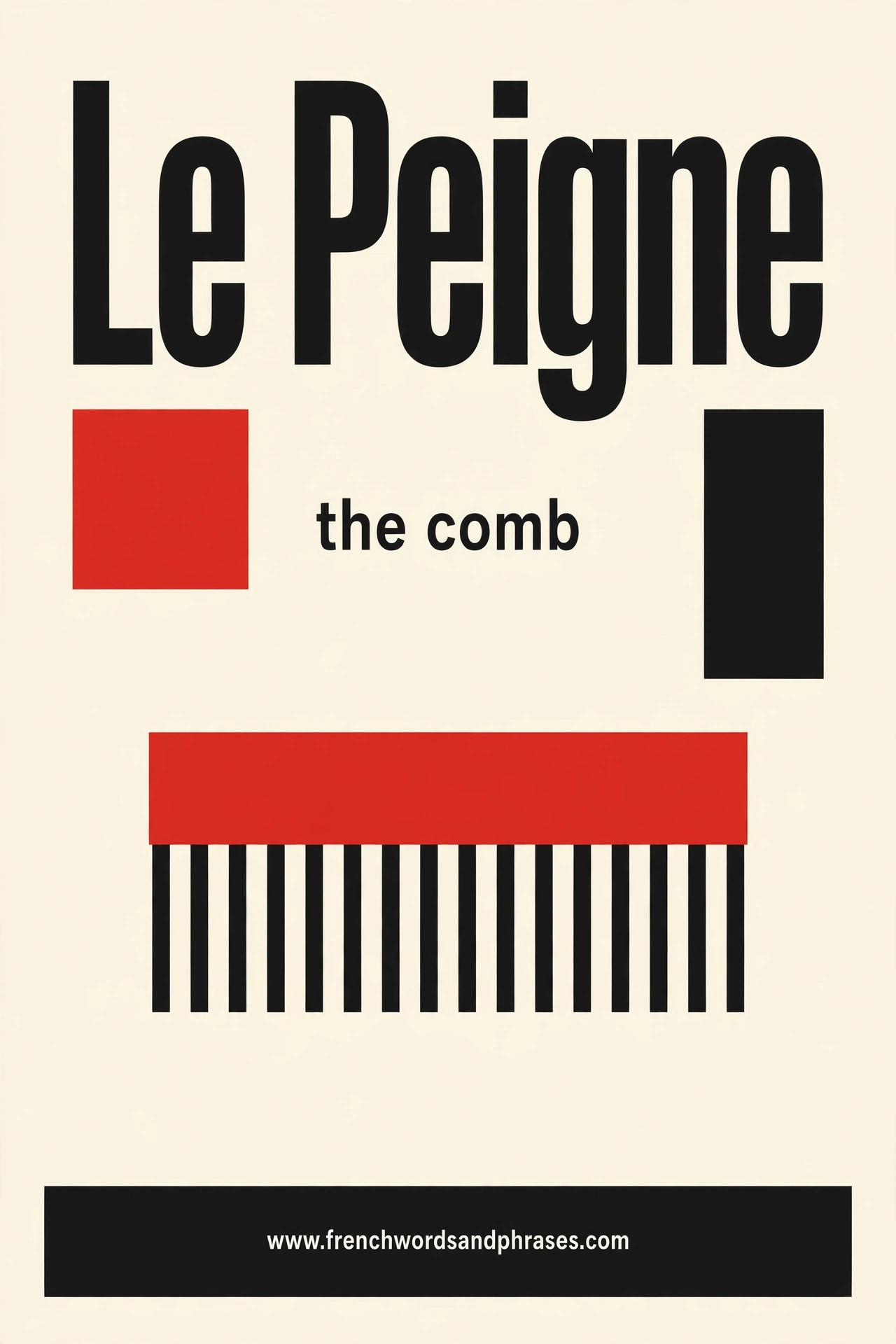
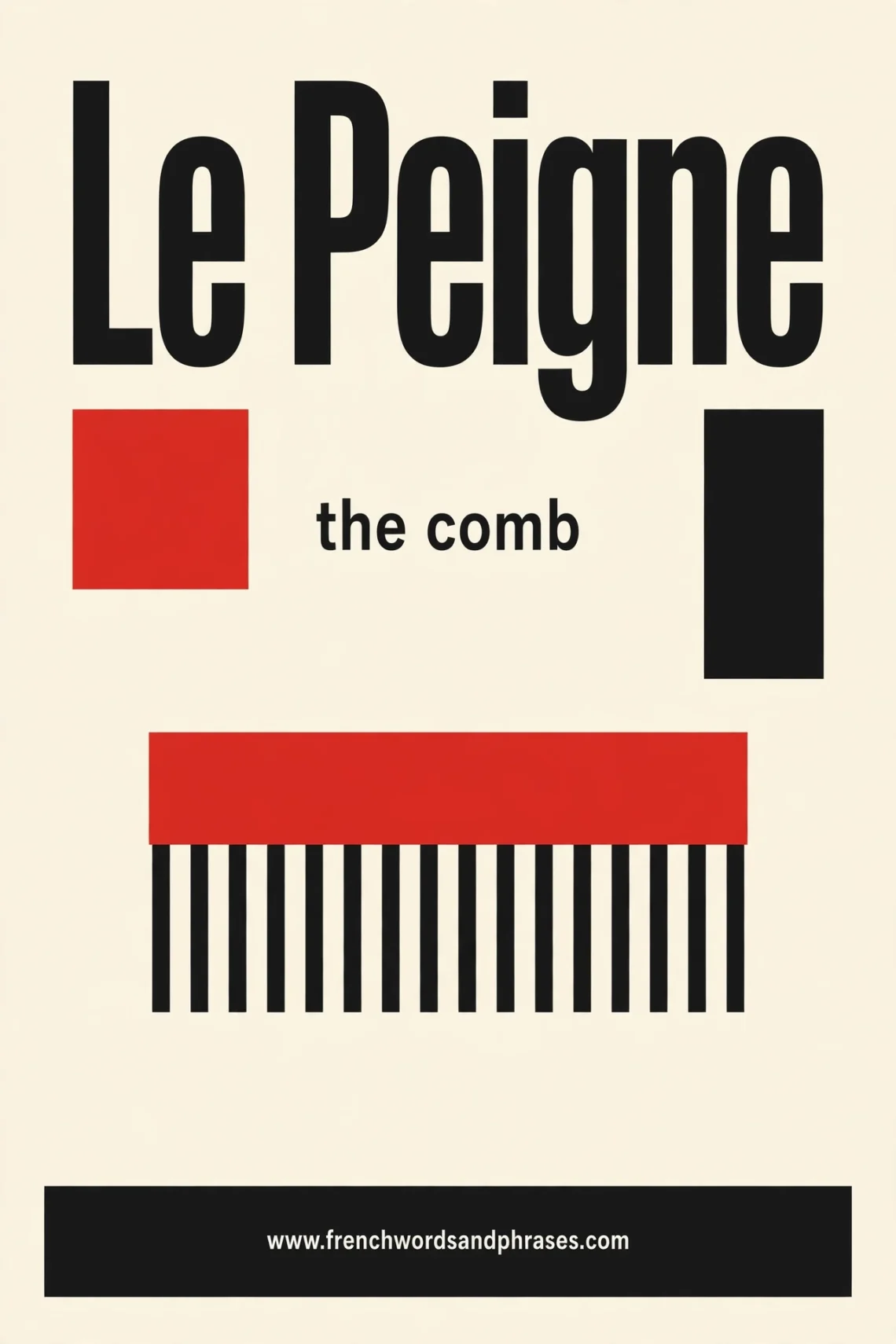
Le peigne means a comb.
Morning, mirror, hair standing in every direction. One flat little tool with teeth passes through the chaos a few times, and order returns. In French, that humble rescuer is le peigne.
In this guide, you’ll learn what peigne means in English, how to use it with its articles, how to form its plural, and how it appears in everyday French. Explore French examples, English translations, and practice quizzes.
Understanding the French Noun Peigne
Peigne is a masculine French noun. It is learned together with its article: le peigne, un peigne. It comes from the verb peigner, to comb — se peigner, to comb one’s own hair. Its teeth can be fine or wide, and the word also serves in the famous expression un coup de peigne, a quick comb-through.
It means a comb — the flat, toothed tool used to tidy and untangle hair: passer un coup de peigne (to run a comb through one’s hair), un peigne à dents fines (a fine-toothed comb). Do not mix it up with la brosse, the brush: the peigne has teeth in a single row, the brosse has bristles in a block.
Gender: Masculine
Definite article: le — le peigne (the comb)
Indefinite article: un — un peigne (a comb)
Plural: les peignes
English equivalents: A comb.
One important usage detail: French splits what English sometimes merges. A comb is un peigne, a brush is une brosse — different tools, different words, different genders. And when you comb your own hair, the verb turns reflexive: je me peigne, I comb my hair, never « je peigne mes cheveux » in everyday speech.
Experience the Word
Peigne is more than a tool. It is the last touch before the door — the thirty seconds in front of the mirror that turn ‘just woke up’ into ‘ready’.
Imagine a father before a school photo, kneeling in front of his daughter, peigne in hand, negotiating with one rebellious lock. The whole tenderness of the morning is in that small, patient gesture.
You have not just tidied your hair. You have given yourself un coup de peigne — the smallest ceremony of the day.
How to Use Peigne in French: Complete Guide
Let’s explore how peigne works in French, beginning with its articles.
Peigne with the Definite Article (Le, Les)
Used for the comb everyone knows — yours, the one by the mirror.
| Number | French |
|---|---|
| Singular | le peigne |
| Plural | les peignes |
Example
Le peigne est sur le bord du lavabo.
The comb is on the edge of the sink.
Peigne with the Indefinite Article (Un, Des)
Used for a comb in general — the one in the shop, the spare in the drawer.
| Number | French |
|---|---|
| Singular | un peigne |
| Plural | des peignes |
Example
Il a toujours un peigne dans sa poche.
He always has a comb in his pocket.
Kinds of Peignes
Fine teeth, wide teeth, pocket size — the combs of the French bathroom drawer.
| French | In English |
|---|---|
| un peigne à dents fines | a fine-toothed comb |
| un peigne à dents larges | a wide-toothed comb |
| un peigne de poche | a pocket comb |
| un peigne en bois | a wooden comb |
| un peigne démêloir | a detangling comb |
| un peigne fin | a fine comb |
Example
Pour les cheveux bouclés, prends un peigne à dents larges.
For curly hair, take a wide-toothed comb.
Quick Quiz 1
What is un coup de peigne?
Reveal the answer
A quick comb-through — one pass of the comb to tidy up.
Passe-toi un coup de peigne avant la photo.
Give your hair a quick comb before the photo.
The Plural of Peigne
Peigne adds an -s in the plural — les peignes, the combs of a whole family.
| Number | French |
|---|---|
| Singular | le peigne |
| Plural | les peignes |
Example
Les peignes des enfants sont rangés par couleur.
The children’s combs are sorted by colour.
Peigne with Possessive Adjectives (Mon, Ton, Son…)
Possessives agree with the noun, not with the owner — and peigne is masculine, so it takes mon, ton, son.
| Owner | French |
|---|---|
| my | mon peigne |
| your (tu) | ton peigne |
| his / her | son peigne |
| our | notre peigne |
| your (vous) | votre peigne |
| their | leur peigne |
Example
Mon peigne a perdu deux dents.
My comb has lost two teeth.
Quick Quiz 2
Complete the sentence:
______ peigne à elle est rose. (Her)
Reveal the answer
Son
Son peigne à elle est rose.
Her comb is pink — son, because peigne is masculine, whoever owns it.
Peigne with Demonstrative Adjectives (Ce, Ces)
Used to point: this comb here, those combs there.
| Number | French |
|---|---|
| Singular | ce peigne |
| Plural | ces peignes |
Example
Ce peigne démêle sans tirer.
This comb detangles without pulling.
Peigne with Adjectives
Adjectives agree with peigne, masculine — fin, large, neuf.
| Adjective | With Peigne |
|---|---|
| fin (fine) | un peigne fin |
| large (wide) | un peigne large |
| neuf (new) | un peigne neuf |
| petit (small) | un petit peigne |
| cassé (broken) | un peigne cassé |
Example
Il cherche un peigne fin pour la raie.
He is looking for a fine comb for the parting.
Quick Quiz 3
Complete the sentence:
Elle démêle ses cheveux avec un peigne ______. (wide-toothed — à dents larges)
Reveal the answer
à dents larges
Elle démêle ses cheveux avec un peigne à dents larges.
She detangles her hair with a wide-toothed comb.
Everyday Expressions with Peigne
Quick touches, tangles and tidy hair — the peigne phrases of daily life.
| Expression | In English |
|---|---|
| passer un coup de peigne | to run a comb through one’s hair |
| se peigner | to comb one’s hair |
| démêler les cheveux | to detangle one’s hair |
| un peigne dans la poche | a comb in one’s pocket |
| la raie sur le côté | a side parting |
| se regarder dans le miroir | to look at oneself in the mirror |
Example
Avant de sortir, il se peigne devant la glace.
Before going out, he combs his hair in front of the mirror.
Words from the Same Family as Peigne
Combing, hair and mirrors — the words that travel with peigne.
| French | In English |
|---|---|
| peigner | to comb |
| les cheveux | hair (on the head) |
| la brosse à cheveux | the hairbrush |
| le miroir | the mirror |
| démêler | to untangle, to detangle |
| la dent | the tooth — also a comb’s tooth |
Example
Entre le peigne et la brosse, elle choisit le peigne pour démêler.
Between the comb and the brush, she chooses the comb for detangling.
Quick Quiz 4
Your friend grabs a brush and says: « Je me peigne. » What is wrong?
Reveal the answer
The tool and the verb do not match — se peigner goes with un peigne; with a brush, it is se brosser.
Avec un peigne, on se peigne ; avec une brosse, on se brosse.
With a comb, you comb; with a brush, you brush.
Peigne in Everyday French: Real-Life Examples
Now that you know the word, let’s see how peigne appears in everyday French.
Example 1 — Before the photo
Passe-toi un coup de peigne, la photo est dans cinq minutes.
Give your hair a quick comb, the photo is in five minutes.
Example 2 — Pocket comb
Mon grand-père gardait toujours un peigne dans sa poche.
My grandfather always kept a comb in his pocket.
Example 3 — Curly hair
Avec ses boucles, elle utilise un peigne à dents larges.
With her curls, she uses a wide-toothed comb.
Example 4 — Lost and found
Qui a pris mon peigne ? Il était sur le lavabo.
Who took my comb? It was on the sink.
Example 5 — At the hairdresser’s
Le coiffeur passe le peigne, puis prend les ciseaux.
The hairdresser runs the comb through, then picks up the scissors.
Example 6 — Morning mirror
Chaque matin, le même rituel : le peigne, puis le café.
Every morning, the same ritual: the comb, then coffee.
Beyond Translation: The Meaning of Peigne
The peigne is one of humanity’s oldest tools — combs carved from bone and wood have been found in graves thousands of years old, because tidying hair is as old as vanity and tenderness themselves. French keeps the word busy: the teeth of the comb are dents, like the teeth in your mouth, and a mountain ridge with sharp peaks can even be called a peigne by geologists. Small word, long history.
To say peigne is to take thirty seconds for yourself.
It evokes mirrors and morning light, a father’s patience before a school photo, the quiet click of order returning to a head of hair.
How to Remember the French Noun Peigne
Remember it this way: Peigne is the comb — masculine, with teeth in a single row, and its verb is se peigner.
- You pass it quickly — un coup de peigne avant de sortir.
- You split the tools — le peigne a des dents, la brosse a des poils.
- You comb yourself — je me peigne devant le miroir.
The key idea is le peigne — teeth in a row, order in seconds.
Test Your Knowledge of Peigne
Let’s see how much you’ve learned. Try answering these questions before revealing the answers.
Question 1
Is peigne masculine or feminine?
Reveal the answer
Masculine — le peigne, un peigne.
Question 2
How do you say to comb one’s hair in French?
Reveal the answer
Se peigner — a reflexive verb: je me peigne.
Question 3
Translate: He always has a comb in his pocket.
Reveal the answer
Il a toujours un peigne dans sa poche.
Question 4
What is un peigne démêloir?
Reveal the answer
A detangling comb — wide teeth made to undo knots without pulling.
Question 5
Complete the sentence:
Elle cherche ______ peigne à dents fines. (her)
Reveal the answer
son
Elle cherche son peigne à dents fines.
She is looking for her fine-toothed comb.
Your Final Challenge
Can You Use It?
How would you say this in French?
“Before the photo, he runs a comb through his hair.”
Reveal the answer
Avant la photo, il se passe un coup de peigne.
Before the photo, he runs a comb through his hair.
A little French. A little curiosity. A richer everyday life.
LEARN FRENCH ONE WORD AT A TIME