A French Word to Live By
Translate Pays to English
/pɛ.i/
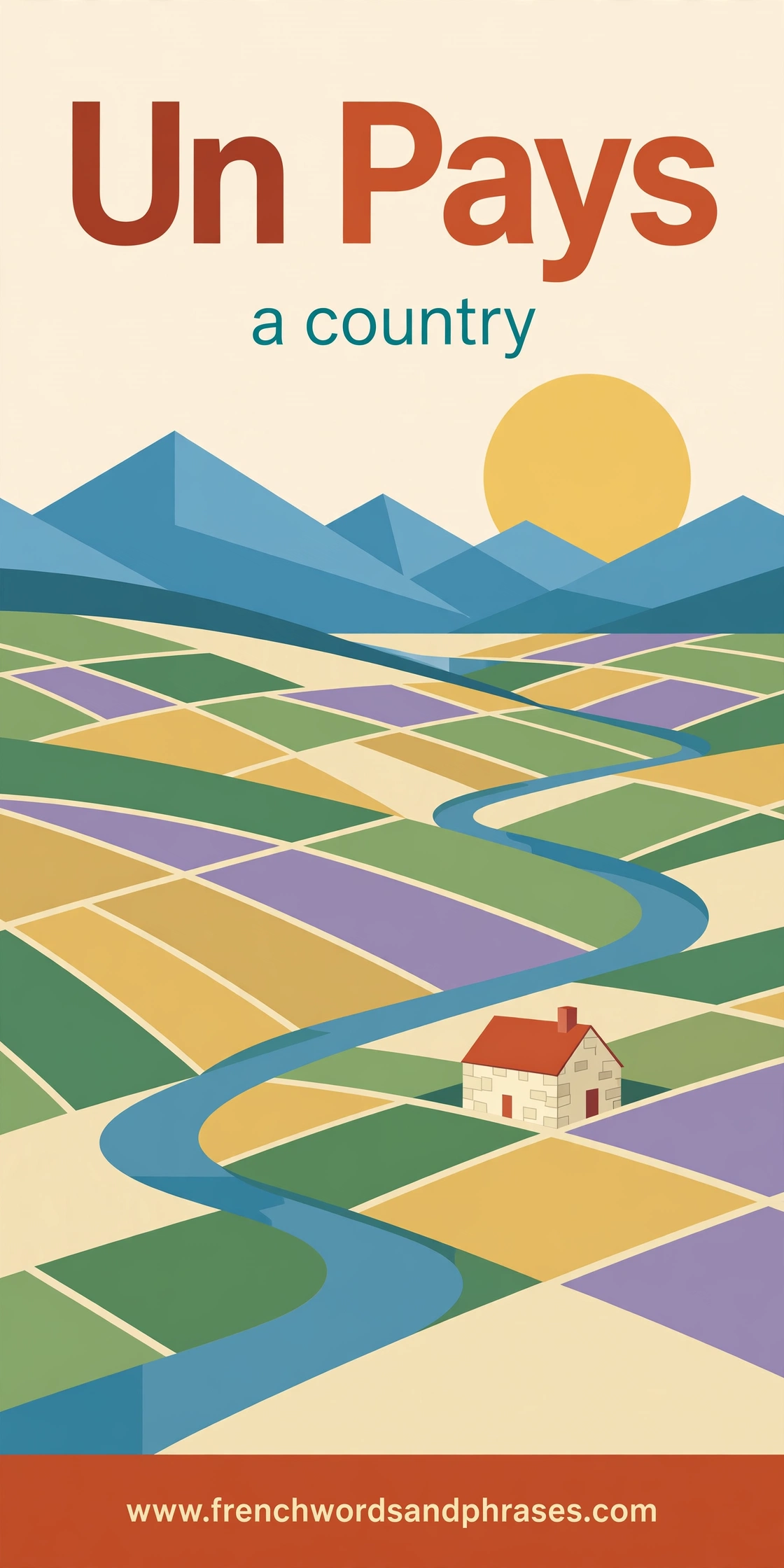
Un pays means a country.
The ferry turns toward the coast and the passengers crowd the rail, watching a grey line of cliffs become fields, roofs, a church tower. For the ones coming home, that line has a name — le pays.
In this guide, you’ll learn what pays means in English, how to use it with its articles, how to form its plural, and how it appears in everyday French. Explore French examples, English translations, and practice quizzes.
Understanding the French Noun Pays
Pays is a masculine French noun. Like every French noun, it has a gender, and it is learned together with its article: un pays.
It means a country. It is the country on the map, with its borders and its capital — and it is also home: mon pays, the place you come from, the place you miss when you are far away. From the same root comes paysage, the landscape — the country as you see it.
Gender: Masculine
Definite article: le — le pays (the country)
Indefinite article: un — un pays (a country)
Plural: les pays — spelled exactly the same; pays never changes
English equivalents: A country.
One spelling gift: pays never changes. Un pays, deux pays, les pays — the word is identical in the singular and the plural, and only the article tells you which you have. Note also that au pays, with nothing added, simply means back home.
Experience the Word
Pays is more than borders on a map. It is the smell of the rain at home, the accent you grew up with, the landscape your eyes expect.
Imagine a sailor months from home, standing on deck at dawn. A coastline appears through the mist — not his yet, but close enough to make his heart beat faster.
You have not just crossed a frontier. You have come back to your pays.
How to Use Pays in French: Complete Guide
Let’s explore how pays works in French, beginning with its articles.
Pays and Its Articles
French nouns are almost never used alone. The small word in front of the noun — the article — does a great deal of work.
Pays with the Definite Article (Le, Les)
Used for a particular country, or the country both speakers know — this one, ours.
| Number | French |
|---|---|
| Singular | le pays |
| Plural | les pays |
Example
Le pays est en fête aujourd’hui.
The country is celebrating today.
Pays with the Indefinite Article (Un, Des)
Used to present a country: one country among all the others.
| Number | French |
|---|---|
| Singular | un pays |
| Plural | des pays |
Example
Le Canada est un pays immense.
Canada is a huge country.
Pays with Quantities (De after Quantities)
Pays is a count noun — you count countries one by one, and after quantities French uses de.
| Meaning | French |
|---|---|
| many countries | beaucoup de pays |
| few countries | peu de pays |
| three countries | trois pays |
Example
Il a visité beaucoup de pays.
He has visited many countries.
Quick Quiz 1
Complete the sentence:
Elle rêve de visiter un ______ nordique.
Reveal the answer
pays
Elle rêve de visiter un pays nordique.
She dreams of visiting a Nordic country.
The Plural of Pays
Here is the gift: pays does not change. Singular and plural are spelled exactly the same — only the article changes.
| Number | French |
|---|---|
| Singular | le pays |
| Plural | les pays |
Example
Les pays voisins signent un accord.
The neighbouring countries are signing an agreement.
Pays with Possessive Adjectives (Mon, Ton, Son…)
Possessives agree with the noun — pays is masculine, so it takes mon, ton, son. Mon pays is the most emotional form of all: my homeland.
| Owner | French |
|---|---|
| my | mon pays |
| your (tu) | ton pays |
| his / her | son pays |
| our | notre pays |
| your (vous) | votre pays |
| their | leur pays |
Example
La France est mon pays natal.
France is my native country.
Quick Quiz 2
True or false: the plural of pays is payses.
Reveal the answer
False — pays never changes: un pays, des pays.
Il a visité vingt pays.
He has visited twenty countries.
Pays with Demonstrative Adjectives (Ce, Ces)
Used to point: this country here, those countries there.
| Number | French |
|---|---|
| Singular | ce pays |
| Plural | ces pays |
Example
Ce pays me manque.
I miss this country.
Pays with Adjectives
Adjectives agree with pays and almost all follow it — un pays lointain, un pays voisin.
| Adjective | With Pays |
|---|---|
| lointain (faraway) | un pays lointain |
| étranger (foreign) | un pays étranger |
| natal (native, home) | mon pays natal |
| riche (rich) | un pays riche |
| pauvre (poor) | un pays pauvre |
| voisin (neighbouring) | un pays voisin |
Example
C’est un pays lointain et mystérieux.
It is a faraway, mysterious country.
Quick Quiz 3
Complete the sentence:
La France est mon pays ______.
Reveal the answer
natal
La France est mon pays natal.
France is my native country.
Everyday Expressions with Pays
Pays is the traveller’s word and the exile’s word at once.
| Expression | In English |
|---|---|
| le pays natal | the home country, the native land |
| un pays étranger | a foreign country |
| rentrer au pays | to go back home (to your own country) |
| le pays d’accueil | the host country |
| quitter son pays | to leave your country |
| un pays en voie de développement | a developing country |
Example
Après dix ans à l’étranger, elle rentre au pays.
After ten years abroad, she is coming home.
Words from the Same Family as Pays
Learn these together and the whole map makes sense.
| French | In English |
|---|---|
| le paysage | the landscape |
| un paysan | a farmer |
| un compatriote | a fellow citizen |
| la patrie | the homeland |
| une frontière | a border |
| la capitale | the capital |
Example
Le paysage change à chaque saison.
The landscape changes with every season.
Quick Quiz 4
What does rentrer au pays mean?
Reveal the answer
To go back home (to your own country)
Elle rentre au pays en août.
She is going back home in August.
Pays in Everyday French: Real-Life Examples
Now that you know the word, let’s see how pays appears in everyday French.
Example 1 — A country of islands
Le Japon est un pays d’îles.
Japan is a country of islands.
Example 2 — Home country
La France est mon pays natal.
France is my home country.
Example 3 — Counting travels
Il a visité vingt pays.
He has visited twenty countries.
Example 4 — Going home
Après dix ans à l’étranger, elle rentre au pays.
After ten years abroad, she is going back home.
Example 5 — A question
Quel est le plus grand pays du monde ?
What is the biggest country in the world?
Example 6 — Neighbours
Les pays voisins se ressemblent.
Neighbouring countries resemble each other.
Beyond Translation: The Meaning of Pays
English says country for the meaning of pays — a state, a territory. The French word is warmer: a pays is a homeland before it is a border, the ground your childhood stands on.
To say mon pays is to say where you belong.
It evokes the landscape — le paysage, the country you can see — the accent of home, and the emigrant’s suitcase, packed for years with the plan of rentrer au pays, going back.
How to Remember the French Noun Pays
Remember it this way: Pays is a country that never changes its spelling — and at heart, it is home.
- You point at the map — le Canada est un grand pays.
- You count your travels — j’ai visité vingt pays.
- You come home — elle rentre au pays.
The key idea is un pays, des pays — the word stays the same, only the article moves.
Test Your Knowledge of Pays
Let’s see how much you’ve learned. Try answering these questions before revealing the answers.
Question 1
Is pays masculine or feminine?
Reveal the answer
Masculine — le pays, un pays.
Question 2
What is special about the plural of pays?
Reveal the answer
It never changes — un pays, des pays.
Question 3
Translate: Canada is a huge country.
Reveal the answer
Le Canada est un pays immense.
Question 4
What does mon pays natal mean?
Reveal the answer
My native country, my homeland.
Question 5
Complete the sentence:
Après dix ans à l’étranger, elle rentre au ______.
Reveal the answer
pays
Après dix ans à l’étranger, elle rentre au pays.
After ten years abroad, she is going back home.
Your Final Challenge
Can You Use It?
How would you say this in French?
“She wants to discover a faraway country.”
Reveal the answer
Elle veut découvrir un pays lointain.
She wants to discover a faraway country.
A little French. A little curiosity. A richer everyday life.
LEARN FRENCH ONE WORD AT A TIME