A French Word to Live By
How to Conjugate Paver in French
/pa.ve/
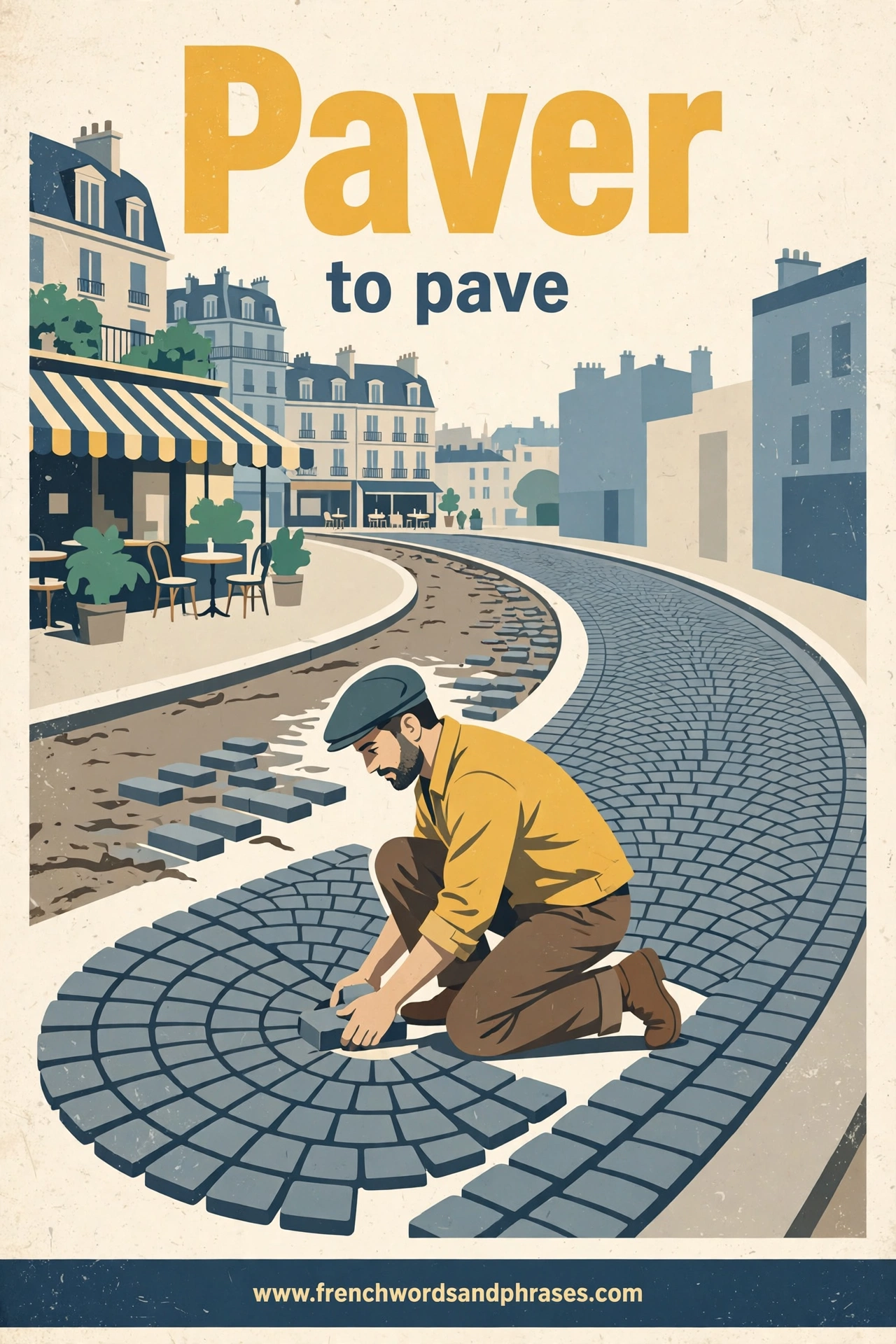
Paver means to pave — to cover a street, a square or a courtyard with stones, the verb that built the cobbled streets of old Paris.
Workers kneeling in a Paris street, setting granite blocks one by one into the sand; a courtyard in Provence turning from dust to stone — paver is the craftsman’s verb of the paved city, stone by stone, square by square.
In this guide, you’ll learn how to conjugate paver in all the major French tenses and moods. Explore complete conjugation tables, French examples, English translations, and practice quizzes.
Understanding the French Verb Paver
Paver is a regular French verb belonging to the first group of verbs, those ending in-er.
It means to pave. It is commonly used by town councils and builders for streets, squares, courtyards and terraces, and it echoes through French history: the pavés of Paris were torn up as weapons and barricades in every revolution, and the spring classic Paris–Roubaix is still raced over them, which is why cyclists simply call them les pavés.
Verb classification: First group (-er)
Auxiliary verb: Avoir
Past participle: pavé
Present participle: pavant
English equivalents: To pave, to cobble; paver une rue — to pave a street; les pavés — cobblestones, paving stones; un pavé dans la mare — a bombshell, a remark that splashes everyone (literally a paving stone in the pond); l’enfer est pavé de bonnes intentions — the road to hell is paved with good intentions.
One important detail: paver is a perfectly regular -er verb — je pave, nous pavons, ils pavent — and its family is everywhere in French life: un pavé is one paving stone (and, by shape, a thick book or a slab of meat), le pavé is the paved street itself, and battre le pavé is to pound the pavement. The famous proverb travels with the verb: l’enfer est pavé de bonnes intentions — hell is paved with good intentions — the past participle doing the work.
Experience the Word
Paver is the verb of the stone city — patient, heavy work that turns mud and dust into streets that last for centuries.
Imagine a small square in an old town at dawn. The workers are already kneeling, each with a hammer, tapping granite blocks into a bed of sand — tap, tap, tap — and by evening the dust of a thousand years has become a street your grandchildren will walk on.
Nothing here is fast. It is paved — pavé — stone by stone, for good.
How to Conjugate Paver: Complete French Conjugation Guide
Let’s explore every major conjugation of paver, beginning with the indicative mood.
How to Conjugate Paver in the Indicative Mood
The indicative mood is used to express facts, observations, actions, and events.
How to Conjugate Paver in the Present Tense (Présent)
Used for actions happening now, habitual actions, and general truths.
| Subject | Conjugation |
|---|---|
| je | pave |
| tu | paves |
| il / elle | pave |
| nous | pavons |
| vous | pavez |
| ils / elles | pavent |
Example
Les ouvriers pavent la cour de l’école.
The workers are paving the school courtyard.
Quick Quiz 1
Complete the sentence:
Nous ______ la terrasse ce week-end.
Reveal the answer
pavons
Nous pavons la terrasse ce week-end.
We are paving the terrace this weekend.
How to Conjugate Paver in the Passé Composé
Used for completed actions in the past. Paver takes the auxiliary verb avoir.
| Subject | Conjugation |
|---|---|
| j’ | ai pavé |
| tu | as pavé |
| il / elle | a pavé |
| nous | avons pavé |
| vous | avez pavé |
| ils / elles | ont pavé |
Example
La mairie a pavé la place du marché.
The town council has paved the market square.
How to Conjugate Paver in the Imparfait (Imperfect Tense)
Used for habitual past actions, descriptions, and ongoing situations in the past.
| Subject | Conjugation |
|---|---|
| je | pavais |
| tu | pavais |
| il / elle | pavait |
| nous | pavions |
| vous | paviez |
| ils / elles | pavaient |
Example
Autrefois, on pavait les rues de gros blocs de granit.
In the old days, streets were paved with big granite blocks.
Quick Quiz 2
Choose the correct form:
The Romans paved the roads.
Les Romains ______ les voies. (ont pavé / sont pavés)
Reveal the answer
ont pavé
Les Romains ont pavé les voies.
Paver takes avoir.
How to Conjugate Paver in the Plus-que-parfait
Used to describe an action that had already been completed before another past event.
| Subject | Conjugation |
|---|---|
| j’ | avais pavé |
| tu | avais pavé |
| il / elle | avait pavé |
| nous | avions pavé |
| vous | aviez pavé |
| ils / elles | avaient pavé |
Example
Ils avaient pavé le chemin avant l’hiver.
They had paved the path before winter.
How to Conjugate Paver in the Passé Simple
Primarily used in formal writing, literature, and historical narratives. It is rarely used in everyday conversation.
| Subject | Conjugation |
|---|---|
| je | pavai |
| tu | pavas |
| il / elle | pava |
| nous | pavâmes |
| vous | pavâtes |
| ils / elles | pavèrent |
Example
Les Romains pavèrent les voies de la province.
The Romans paved the roads of the province.
How to Conjugate Paver in the Passé Antérieur
A literary tense used to express an action completed immediately before another past action, generally in the passé simple.
| Subject | Conjugation |
|---|---|
| j’ | eus pavé |
| tu | eus pavé |
| il / elle | eut pavé |
| nous | eûmes pavé |
| vous | eûtes pavé |
| ils / elles | eurent pavé |
Example
Quand on eut pavé la cour, les enfants purent enfin jouer dehors.
When the courtyard had been paved, the children could finally play outside.
How to Conjugate Paver in the Future Tense (Futur Simple)
Used to describe actions that will take place in the future.
| Subject | Conjugation |
|---|---|
| je | paverai |
| tu | paveras |
| il / elle | pavera |
| nous | paverons |
| vous | paverez |
| ils / elles | paveront |
Example
L’entreprise pavera le trottoir au printemps.
The firm will pave the pavement in spring.
How to Conjugate Paver in the Futur Antérieur (Future Perfect)
Used for an action that will have been completed before a particular point in the future.
| Subject | Conjugation |
|---|---|
| j’ | aurai pavé |
| tu | auras pavé |
| il / elle | aura pavé |
| nous | aurons pavé |
| vous | aurez pavé |
| ils / elles | auront pavé |
Example
À la fin du mois, ils auront pavé toute la rue.
By the end of the month, they will have paved the whole street.
How to Conjugate Paver in the Near Future (Futur Proche)
Used to describe something that is going to happen soon. Formed with aller + infinitive.
| Subject | Conjugation |
|---|---|
| je | vais paver |
| tu | vas paver |
| il / elle | va paver |
| nous | allons paver |
| vous | allez paver |
| ils / elles | vont paver |
Example
On va paver la terrasse ce week-end.
We are going to pave the terrace this weekend.
How to Conjugate Paver in the Conditional Mood
The conditional mood expresses what would happen under certain circumstances. It is also frequently used to make polite requests or express wishes.
How to Conjugate Paver in the Present Conditional
| Subject | Conjugation |
|---|---|
| je | paverais |
| tu | paverais |
| il / elle | paverait |
| nous | paverions |
| vous | paveriez |
| ils / elles | paveraient |
Example
Avec plus de budget, la ville paverait toutes les ruelles.
With a bigger budget, the town would pave all the little lanes.
How to Conjugate Paver in the Past Conditional
| Subject | Conjugation |
|---|---|
| j’ | aurais pavé |
| tu | aurais pavé |
| il / elle | aurait pavé |
| nous | aurions pavé |
| vous | auriez pavé |
| ils / elles | auraient pavé |
Example
Ils auraient pavé la place sans la tempête.
They would have paved the square if not for the storm.
Paver in the Literary Past Conditional Form
This less common literary form uses the imperfect subjunctive of avoir.
| Subject | Conjugation |
|---|---|
| j’ | eusse pavé |
| tu | eusses pavé |
| il / elle | eût pavé |
| nous | eussions pavé |
| vous | eussiez pavé |
| ils / elles | eussent pavé |
Example
On eût pavé la cour d’or pour sa venue.
They would have paved the courtyard with gold for her coming.
How to Conjugate Paver in the Subjunctive Mood
The subjunctive is used to express wishes, emotions, doubts, necessity, and uncertainty. It frequently follows expressions such as il faut que (it is necessary that) or bien que (although).
How to Conjugate Paver in the Present Subjunctive
| Subject | Conjugation |
|---|---|
| que je | pave |
| que tu | paves |
| qu’il / qu’elle | pave |
| que nous | pavions |
| que vous | paviez |
| qu’ils / qu’elles | pavent |
Example
Il faut que la mairie pave cette rue avant l’hiver.
The council must pave this street before winter.
Quick Quiz 3
Complete the sentence using the subjunctive:
Il faut que vous ______ l’allée avant l’hiver.
Reveal the answer
paviez
Il faut que vous paviez l’allée avant l’hiver.
You must pave the drive before winter.
How to Conjugate Paver in the Imperfect Subjunctive
A literary tense, rarely encountered in modern spoken French.
| Subject | Conjugation |
|---|---|
| que je | pavasse |
| que tu | pavasses |
| qu’il / qu’elle | pavât |
| que nous | pavassions |
| que vous | pavassiez |
| qu’ils / qu’elles | pavassent |
Example
Le maire voulait que l’on pavât la place en une semaine.
The mayor wanted the square paved within a week.
How to Conjugate Paver in the Pluperfect Subjunctive
A literary construction used to express an action completed before another past action.
| Subject | Conjugation |
|---|---|
| que j’ | eusse pavé |
| que tu | eusses pavé |
| qu’il / qu’elle | eût pavé |
| que nous | eussions pavé |
| que vous | eussiez pavé |
| qu’ils / qu’elles | eussent pavé |
Example
On admirait qu’ils eussent pavé la voie en un seul été.
People admired that they had paved the road in a single summer.
How to Conjugate Paver in the Past Subjunctive
| Subject | Conjugation |
|---|---|
| que j’ | aie pavé |
| que tu | aies pavé |
| qu’il / qu’elle | ait pavé |
| que nous | ayons pavé |
| que vous | ayez pavé |
| qu’ils / qu’elles | aient pavé |
Example
Je suis content qu’ils aient pavé le chemin de l’école.
I am glad they paved the path to the school.
How to Conjugate Paver in the Imperative
The imperative is used to give commands, instructions, invitations, or suggestions. Subject pronouns are omitted.
How to Conjugate Paver in the Present Imperative
| Person | Conjugation |
|---|---|
| (tu) | pave |
| (nous) | pavons |
| (vous) | pavez |
Example
Pavez l’allée avec les anciens pavés !
Pave the drive with the old cobblestones!
Quick Quiz 4
How would you say Pave the drive (tu form)?
Reveal the answer
Pave l’allée !
French Participles of Paver
Participles are verb forms that can be used in compound tenses and other grammatical constructions.
Present Participle of Paver
pavant
En pavant la cour, ils ont découvert un vieux puits.
While paving the courtyard, they discovered an old well.
Past Participle of Paver
pavé
Pavée de pierres anciennes, la ruelle attire les photographes.
Paved with old stones, the little lane attracts photographers.
Paver in Everyday French: Real-Life Examples
Now that you know the conjugations, let’s see how paver appears in everyday French.
Example 1 — Present
Les ouvriers pavent la cour.
The workers are paving the courtyard.
Example 2 — Passé composé
La mairie a pavé la place.
The council has paved the square.
Example 3 — Imparfait
On pavait les rues de granit.
Streets were paved with granite.
Example 4 — Future
Ils paveront toute la rue.
They will pave the whole street.
Example 5 — Conditional
La ville paverait les ruelles avec plus d’argent.
The town would pave the lanes with more money.
Example 6 — Imperative
Pavez l’allée !
Pave the drive!
Beyond Translation: The Meaning of Paver
English pave comes from the same Latin pavire, to ram down earth — but French kept the stones visible: un pavé is at once a cobblestone, a paving slab, and any thick heavy block.
Stones remember what streets forget.
The pavés of Paris were dug up for barricades in 1830, 1848, 1871 and 1968 — sous les pavés, la plage !, beneath the paving stones, the beach, said the students of May 68 — and the proverb promises that even hell needed a good paver: l’enfer est pavé de bonnes intentions.
How to Remember the French Verb Paver
Remember it this way: Paver is about granite blocks, tapped into sand, street by street.
- Un pavé is one stone; paver is setting the stones; le pavé is the finished street.
- The proverb carries the participle: l’enfer est pavé de bonnes intentions.
- Regular -er: je pave, nous pavons, past participle pavé.
The key idea is granite blocks, tapped into sand, street by street.
Test Your Knowledge of Paver
Let’s see how much you’ve learned. Try answering these questions before revealing the answers.
Question 1
What is a pavé?
Reveal the answer
A paving stone, a cobblestone — and le pavé is the paved street itself.
Question 2
How do you say The council has paved the square in French?
Reveal the answer
La mairie a pavé la place.
Question 3
Translate: The road to hell is paved with good intentions.
Reveal the answer
L’enfer est pavé de bonnes intentions.
Question 4
What is the past participle of paver?
Reveal the answer
Pavé — agreeing: pavée, pavés, pavées.
Question 5
Complete the sentence:
Il faut que la mairie ______ cette rue avant l’hiver.
Reveal the answer
pave
Il faut que la mairie pave cette rue avant l’hiver.
The council must pave this street before winter.
Your Final Challenge
Can You Use It?
How would you say this in French?
They pave the square stone by stone, and the village finds its heart again.
Reveal the answer
Ils pavent la place pierre à pierre, et le village retrouve son cœur.
They pave the square stone by stone, and the village finds its heart again.
A little French. A little curiosity. A richer everyday life.
LEARN FRENCH ONE WORD AT A TIME