A French Word to Live By
How to Conjugate Lécher in French
/le.ʃe/
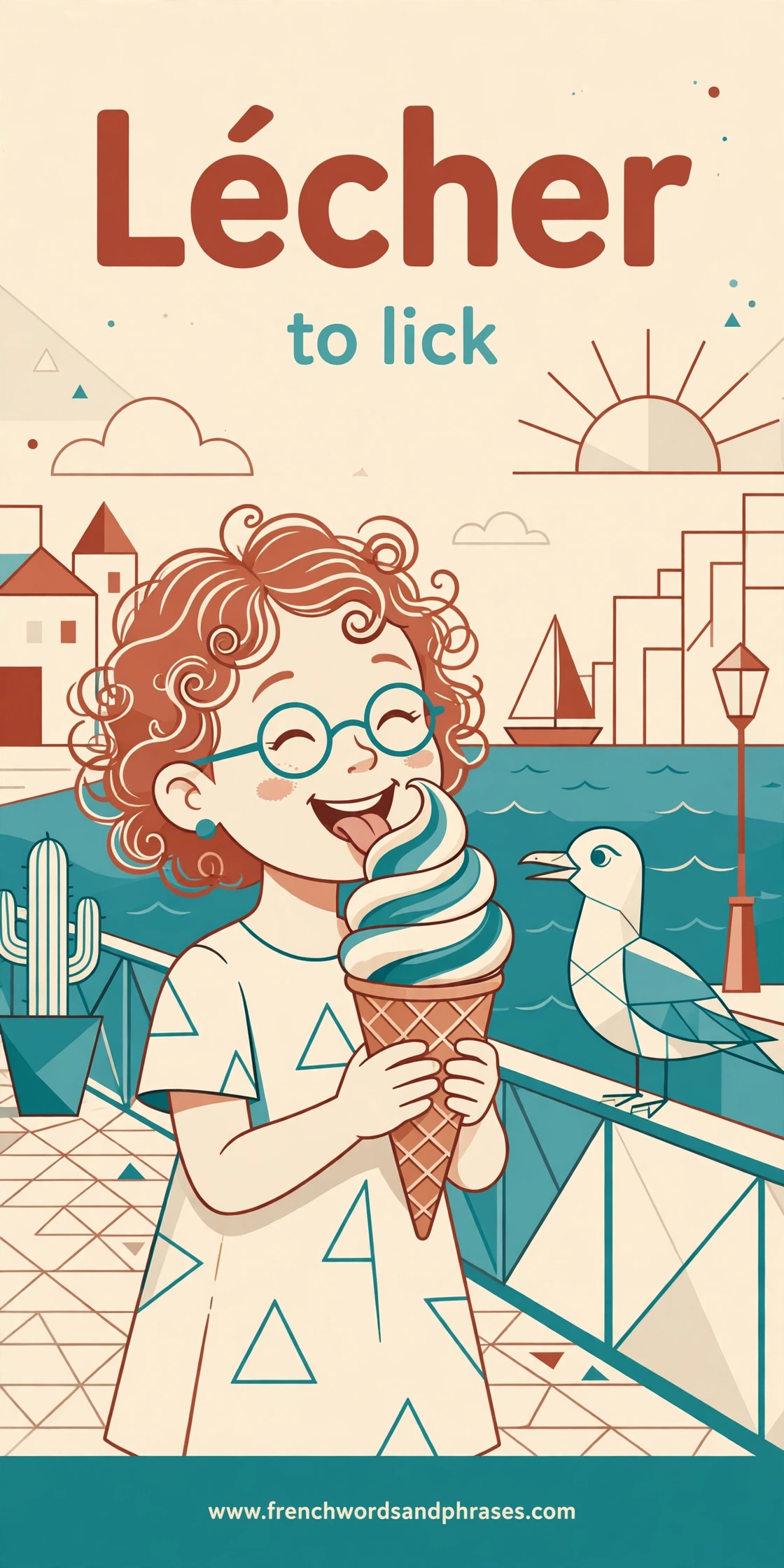
Lécher means to lick — to pass the tongue over something, from a dog greeting its master to flames licking a wall.
A dog licking the hand that feeds it, a child licking an ice cream before it melts, a bootlicker licking the boss’s boots in hope of promotion — lécher is the verb of the tongue: affection, appetite, and flattery, all in one stroke.
In this guide, you’ll learn how to conjugate lécher in all the major French tenses and moods. Explore complete conjugation tables, French examples, English translations, and practice quizzes.
Understanding the French Verb Lécher
Lécher is a regular French verb belonging to the first group of verbs, those ending in-er.
It means to lick. It is commonly used for animals and eating (dogs, cats, ice creams, stamps, envelopes), in the reflexive se lécher for animals grooming themselves and people licking their lips, and figuratively for flames and waves brushing a surface — and, in office French, for the flatterer who lèche les bottes of his superiors.
Verb classification: First group (-er)
Auxiliary verb: Avoir
Past participle: léché
Present participle: léchant
English equivalents: To lick; lécher les bottes de quelqu’un — to lick someone’s boots, to suck up to them; se lécher les babines — to lick one’s lips (in anticipation); lécher les vitrines — to go window-shopping (literally to lick the shop windows); à s’en lécher les doigts — finger-licking good.
One important detail: lécher is a céder-type verb — the é of the stem opens to è wherever the next syllable is mute: je lèche, tu lèches, il lèche, ils lèchent, and through the whole future and conditional: je lècherai, je lècherais. The é survives wherever the ending is sounded: nous léchons, vous léchez, je léchais, en léchant. The subjunctive splits along the same line: que je lèche, but que nous léchions. And its figurative career is glorious: flames lèchent a wall, waves lèchent the shore, and the ambitious lèchent les bottes — lick the boots — of the powerful.
Experience the Word
Lécher is the verb of the tongue at work — tasting, greeting, grooming, and, in human ambition, flattering.
Imagine a farm dog at the gate. His master comes home after a long day; before the key is even in the lock, the dog is there, tail turning like a propeller, léchant the hand that opens the gate — one lick that says everything words cannot.
No speech, no ceremony. He has greeted — léché — the hand he loves.
How to Conjugate Lécher: Complete French Conjugation Guide
Let’s explore every major conjugation of lécher, beginning with the indicative mood.
How to Conjugate Lécher in the Indicative Mood
The indicative mood is used to express facts, observations, actions, and events.
How to Conjugate Lécher in the Present Tense (Présent)
Used for actions happening now, habitual actions, and general truths.
| Subject | Conjugation |
|---|---|
| je | lèche |
| tu | lèches |
| il / elle | lèche |
| nous | léchons |
| vous | léchez |
| ils / elles | lèchent |
Example
Le chien lèche la main de son maître.
The dog licks his master’s hand.
Quick Quiz 1
Complete the sentence:
Nous ______ les timbres avant de les coller.
Reveal the answer
léchons
Nous léchons les timbres avant de les coller.
We lick the stamps before sticking them down.
How to Conjugate Lécher in the Passé Composé
Used for completed actions in the past. Lécher takes the auxiliary verb avoir.
| Subject | Conjugation |
|---|---|
| j’ | ai léché |
| tu | as léché |
| il / elle | a léché |
| nous | avons léché |
| vous | avez léché |
| ils / elles | ont léché |
Example
Elle a léché le dos du timbre avant de le coller.
She licked the back of the stamp before sticking it down.
How to Conjugate Lécher in the Imparfait (Imperfect Tense)
Used for habitual past actions, descriptions, and ongoing situations in the past.
| Subject | Conjugation |
|---|---|
| je | léchais |
| tu | léchais |
| il / elle | léchait |
| nous | léchions |
| vous | léchiez |
| ils / elles | léchaient |
Example
Le veau léchait le sel sur la pierre.
The calf used to lick the salt on the stone.
Quick Quiz 2
Choose the correct form:
He would lick the director’s boots.
Il ______ les bottes du directeur. (lècherait / lécherait)
Reveal the answer
lècherait
Il lècherait les bottes du directeur.
The conditional stem takes è all the way through: je lècherai, je lècherais.
How to Conjugate Lécher in the Plus-que-parfait
Used to describe an action that had already been completed before another past event.
| Subject | Conjugation |
|---|---|
| j’ | avais léché |
| tu | avais léché |
| il / elle | avait léché |
| nous | avions léché |
| vous | aviez léché |
| ils / elles | avaient léché |
Example
Il avait léché toute la crème du couvercle.
He had licked all the cream off the lid.
How to Conjugate Lécher in the Passé Simple
Primarily used in formal writing, literature, and historical narratives. It is rarely used in everyday conversation.
| Subject | Conjugation |
|---|---|
| je | léchai |
| tu | léchas |
| il / elle | lécha |
| nous | léchâmes |
| vous | léchâtes |
| ils / elles | léchèrent |
Example
Le chien lécha l’assiette jusqu’à la dernière miette.
The dog licked the plate down to the last crumb.
How to Conjugate Lécher in the Passé Antérieur
A literary tense used to express an action completed immediately before another past action, generally in the passé simple.
| Subject | Conjugation |
|---|---|
| j’ | eus léché |
| tu | eus léché |
| il / elle | eut léché |
| nous | eûmes léché |
| vous | eûtes léché |
| ils / elles | eurent léché |
Example
Quand le chat eut léché sa gamelle, il s’endormit.
When the cat had licked its bowl, it fell asleep.
How to Conjugate Lécher in the Future Tense (Futur Simple)
Used to describe actions that will take place in the future.
| Subject | Conjugation |
|---|---|
| je | lècherai |
| tu | lècheras |
| il / elle | lèchera |
| nous | lècherons |
| vous | lècherez |
| ils / elles | lècheront |
Example
Le chien lèchera la glace tombée par terre.
The dog will lick up the ice cream that fell on the floor.
How to Conjugate Lécher in the Futur Antérieur (Future Perfect)
Used for an action that will have been completed before a particular point in the future.
| Subject | Conjugation |
|---|---|
| j’ | aurai léché |
| tu | auras léché |
| il / elle | aura léché |
| nous | aurons léché |
| vous | aurez léché |
| ils / elles | auront léché |
Example
À la fin du dessert, les enfants auront léché leurs cuillères.
By the end of dessert, the children will have licked their spoons.
How to Conjugate Lécher in the Near Future (Futur Proche)
Used to describe something that is going to happen soon. Formed with aller + infinitive.
| Subject | Conjugation |
|---|---|
| je | vais lécher |
| tu | vas lécher |
| il / elle | va lécher |
| nous | allons lécher |
| vous | allez lécher |
| ils / elles | vont lécher |
Example
Regarde, le chat va lécher le lait renversé.
Look, the cat is going to lick up the spilt milk.
How to Conjugate Lécher in the Conditional Mood
The conditional mood expresses what would happen under certain circumstances. It is also frequently used to make polite requests or express wishes.
How to Conjugate Lécher in the Present Conditional
| Subject | Conjugation |
|---|---|
| je | lècherais |
| tu | lècherais |
| il / elle | lècherait |
| nous | lècherions |
| vous | lècheriez |
| ils / elles | lècheraient |
Example
Il lècherait les bottes du directeur pour une promotion.
He would lick the director’s boots for a promotion.
How to Conjugate Lécher in the Past Conditional
| Subject | Conjugation |
|---|---|
| j’ | aurais léché |
| tu | aurais léché |
| il / elle | aurait léché |
| nous | aurions léché |
| vous | auriez léché |
| ils / elles | auraient léché |
Example
Sans fierté, elle aurait léché les bottes de ses chefs.
Without pride, she would have licked her bosses’ boots.
Lécher in the Literary Past Conditional Form
This less common literary form uses the imperfect subjunctive of avoir.
| Subject | Conjugation |
|---|---|
| j’ | eusse léché |
| tu | eusses léché |
| il / elle | eût léché |
| nous | eussions léché |
| vous | eussiez léché |
| ils / elles | eussent léché |
Example
Il eût léché les bottes du roi pour un titre.
He would have licked the king’s boots for a title.
How to Conjugate Lécher in the Subjunctive Mood
The subjunctive is used to express wishes, emotions, doubts, necessity, and uncertainty. It frequently follows expressions such as il faut que (it is necessary that) or bien que (although).
How to Conjugate Lécher in the Present Subjunctive
| Subject | Conjugation |
|---|---|
| que je | lèche |
| que tu | lèches |
| qu’il / qu’elle | lèche |
| que nous | léchions |
| que vous | léchiez |
| qu’ils / qu’elles | lèchent |
Example
Je ne veux pas que le chien lèche l’assiette.
I do not want the dog to lick the plate.
Quick Quiz 3
Complete the sentence using the subjunctive:
Je ne veux pas que tu ______ l’assiette.
Reveal the answer
lèches
Je ne veux pas que tu lèches l’assiette.
I do not want you to lick the plate.
How to Conjugate Lécher in the Imperfect Subjunctive
A literary tense, rarely encountered in modern spoken French.
| Subject | Conjugation |
|---|---|
| que je | léchasse |
| que tu | léchasses |
| qu’il / qu’elle | léchât |
| que nous | léchassions |
| que vous | léchassiez |
| qu’ils / qu’elles | léchassent |
Example
La mère surveillait l’enfant de peur qu’il ne léchât le poteau gelé.
The mother watched the child for fear he would lick the frozen pole.
How to Conjugate Lécher in the Pluperfect Subjunctive
A literary construction used to express an action completed before another past action.
| Subject | Conjugation |
|---|---|
| que j’ | eusse léché |
| que tu | eusses léché |
| qu’il / qu’elle | eût léché |
| que nous | eussions léché |
| que vous | eussiez léché |
| qu’ils / qu’elles | eussent léché |
Example
On riait qu’il eût léché le pot de miel en cachette.
People laughed that he had licked the honey pot in secret.
How to Conjugate Lécher in the Past Subjunctive
| Subject | Conjugation |
|---|---|
| que j’ | aie léché |
| que tu | aies léché |
| qu’il / qu’elle | ait léché |
| que nous | ayons léché |
| que vous | ayez léché |
| qu’ils / qu’elles | aient léché |
Example
Je suis étonné qu’il ait léché ses doigts en public.
I am amazed he licked his fingers in public.
How to Conjugate Lécher in the Imperative
The imperative is used to give commands, instructions, invitations, or suggestions. Subject pronouns are omitted.
How to Conjugate Lécher in the Present Imperative
| Person | Conjugation |
|---|---|
| (tu) | lèche |
| (nous) | léchons |
| (vous) | léchez |
Example
Lèche ta cuillère et dis-moi si c’est bon !
Lick your spoon and tell me if it is good!
Quick Quiz 4
How would you say Lick your spoon (tu form)?
Reveal the answer
Lèche ta cuillère !
French Participles of Lécher
Participles are verb forms that can be used in compound tenses and other grammatical constructions.
Present Participle of Lécher
léchant
En léchant la vitrine du pâtissier, l’enfant rêve de gâteaux.
Licking the cake shop window, the child dreams of cakes.
Past Participle of Lécher
léché
Son assiette, léchée jusqu’à briller, n’avait pas besoin d’être lavée.
His plate, licked until it shone, did not need washing.
Lécher in Everyday French: Real-Life Examples
Now that you know the conjugations, let’s see how lécher appears in everyday French.
Example 1 — Present
Le chien lèche la main de son maître.
The dog licks his master’s hand.
Example 2 — Passé composé
Elle a léché le dos du timbre.
She licked the back of the stamp.
Example 3 — Imparfait
Le veau léchait le sel sur la pierre.
The calf used to lick the salt on the stone.
Example 4 — Future
Le chien lèchera la glace tombée.
The dog will lick up the fallen ice cream.
Example 5 — Conditional
Il lècherait les bottes du directeur.
He would lick the director’s boots.
Example 6 — Imperative
Lèche ta cuillère !
Lick your spoon!
Beyond Translation: The Meaning of Lécher
English lick and French lécher both began as tongue words, and both grew the same figurative families: flames lick, waves lick, and flatterers lick boots in both languages.
The tongue is honest about appetite.
French adds two delights of its own: lécher les vitrines, to lick the shop windows — window-shopping with the nose pressed to the glass — and se lécher les babines, to lick one’s chops while waiting for something delicious, said of cats, dogs and dinner guests alike.
How to Remember the French Verb Lécher
Remember it this way: Lécher is about the dog’s tongue — greeting, tasting, and flattering.
- Céder-type spelling: je lèche with è, but nous léchons with é; future je lècherai.
- Lécher les bottes = to suck up to someone; lécher les vitrines = window-shopping.
- Se lécher les babines — to lick your lips in anticipation.
The key idea is the dog’s tongue — greeting, tasting, and flattering.
Test Your Knowledge of Lécher
Let’s see how much you’ve learned. Try answering these questions before revealing the answers.
Question 1
Why does je lèche have a grave accent but nous léchons an acute one?
Reveal the answer
The céder-type rule — é becomes è before a mute syllable (je lèche), and stays é where the ending is sounded (nous léchons).
Question 2
What does lécher les bottes de quelqu’un mean?
Reveal the answer
To lick someone’s boots — to flatter and suck up to them in hope of favour.
Question 3
Translate: The dog licks his master’s hand.
Reveal the answer
Le chien lèche la main de son maître.
Question 4
What is the past participle of lécher?
Reveal the answer
Léché — agreeing: léchée, léchés, léchées.
Question 5
Complete the sentence:
Je ne veux pas que le chien ______ l’assiette.
Reveal the answer
lèche
Je ne veux pas que le chien lèche l’assiette.
I do not want the dog to lick the plate.
Your Final Challenge
Can You Use It?
How would you say this in French?
The dog licks his master’s hand, and all is forgiven.
Reveal the answer
Le chien lèche la main de son maître, et tout est pardonné.
The dog licks his master’s hand, and all is forgiven.
A little French. A little curiosity. A richer everyday life.
LEARN FRENCH ONE WORD AT A TIME