
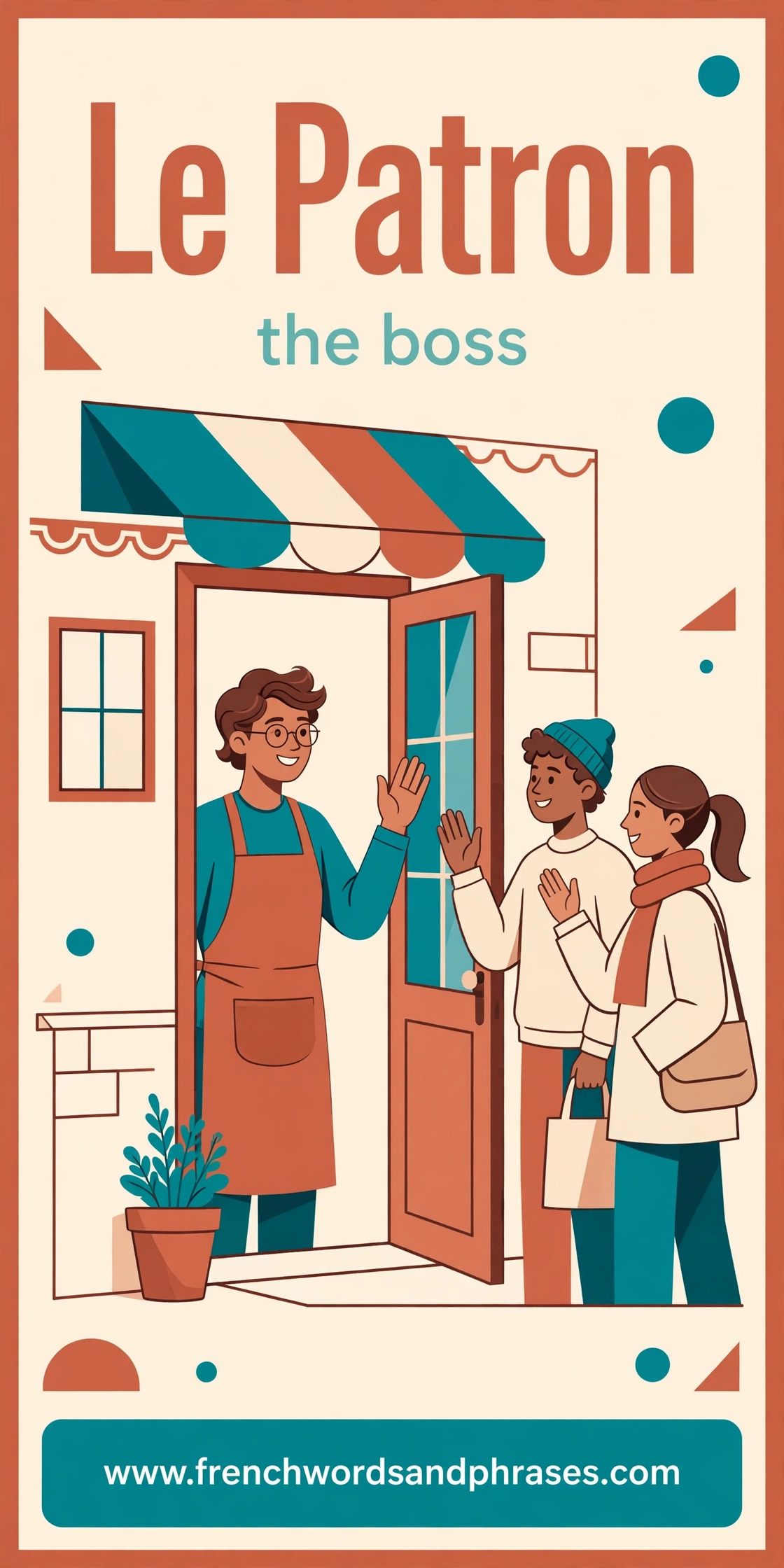
A French Word to Live By
Translate Patron to English
/pa.tʁɔ̃/
Le Patron means a boss.
Every workshop, café and little company in France has one person whose name answers every question — the one who decides, who pays, who protects. C’est le patron.
In this guide, you’ll learn what patron means in English, how to use it with its articles, how to form its plural, and how it appears in everyday French. Explore French examples, English translations, and practice quizzes.
Understanding the French Noun Patron
Patron is a masculine French noun. Like every French noun, it has a gender, and it is learned together with its article: le patron.
It means a boss — the owner of a business, the person in charge. In a café or a little shop, le patron is the one whose house it is: he decides, he serves, he answers for everything. A woman in the same role is la patronne.
Gender: Masculine (a woman boss is la patronne)
Definite article: le — le patron (the boss)
Indefinite article: un — un patron (a boss)
Plural: les patrons (the bosses)
English equivalents: A boss; the owner (of a business).
One important usage detail: patron is masculine, and a woman who runs the business is la patronne — never ‘la patron’. In small shops and cafés, le patron often means the owner himself, the man of the house; in a big company, people say le grand patron for the chief at the very top.
Experience the Word
Patron is more than a boss. In the old French sense he is the protector of the house — the one whose name is on the door and whose word settles every question.
Imagine a café in Marseille at seven in the morning. Le patron polishes the counter, greets each regular by name, and remembers exactly how everyone takes their coffee. The café is his; but in a way, he belongs to it too.
You have not just met the manager. You have met le patron — the soul of the house.
How to Use Patron in French: Complete Guide
Let’s explore how patron works in French, beginning with its articles.
Patron with the Definite Article (Le, Les)
Used for the boss himself — in most workplaces there is only one le patron.
| Number | French |
|---|---|
| Singular | le patron |
| Plural | les patrons |
Example
Le patron arrive à neuf heures.
The boss arrives at nine o’clock.
Patron with the Indefinite Article (Un, Des)
Used when you describe the man himself: un patron exigeant, a demanding boss.
| Number | French |
|---|---|
| Singular | un patron |
| Plural | des patrons |
Example
C’est un patron exigeant.
He is a demanding boss.
Le Patron at Work
Around the patron, a little court of phrases gathers. These are the ones you will hear at work.
| French | In English |
|---|---|
| parler au patron | to speak to the boss |
| le bureau du patron | the boss’s office |
| la patronne | the (female) boss |
| un bon patron | a good boss |
| chez le patron | at the boss’s place |
| les patrons | the bosses, the owners |
Example
Je dois parler au patron demain.
I have to speak to the boss tomorrow.
Quick Quiz 1
Complete the sentence:
Je dois parler ______ patron demain.
Reveal the answer
au
Je dois parler au patron demain.
I have to speak to the boss tomorrow.
The Plural of Patron
Like most French nouns, patron simply adds an -s in the plural — a letter you see but do not hear.
| Number | French |
|---|---|
| Singular | le patron |
| Plural | les patrons |
Example
Les patrons de la région se réunissent.
The business owners of the region are meeting.
Patron with Possessive Adjectives (Mon, Ton, Son…)
Possessives agree with the noun, not with the owner — and patron is masculine, so it takes mon, ton, son.
| Owner | French |
|---|---|
| my | mon patron |
| your (tu) | ton patron |
| his / her | son patron |
| our | notre patron |
| your (vous) | votre patron |
| their | leur patron |
Example
Ton patron est sympa ?
Is your boss nice?
Quick Quiz 2
Complete the sentence:
______ patron arrive à neuf heures. (My)
Reveal the answer
Mon
Mon patron arrive à neuf heures.
My boss arrives at nine o’clock.
Patron with Demonstrative Adjectives (Ce, Ces)
Used to point: this boss here, those bosses there.
| Number | French |
|---|---|
| Singular | ce patron |
| Plural | ces patrons |
Example
Ce patron écoute ses employés.
This boss listens to his employees.
Patron with Adjectives
Ancien (former), nouveau and grand come before patron — le grand patron is the top boss — while gentil and sévère follow it.
| Adjective | With Patron |
|---|---|
| nouveau (new) | un nouveau patron |
| grand (top — le grand patron) | le grand patron |
| ancien (former) | un ancien patron |
| jeune (young) | un jeune patron |
| gentil (kind) | un patron gentil |
| sévère (strict) | un patron sévère |
Example
Mon ancien patron était très sévère.
My former boss was very strict.
Quick Quiz 3
Complete the sentence:
Mon ______ patron était très sévère. (former)
Reveal the answer
ancien
Mon ancien patron était très sévère.
My former boss was very strict. (Ancien meaning ‘former’ comes before the noun.)
Everyday Expressions with Patron
Around every patron, a small world of phrases turns — about power, protection and being your own master.
| Expression | In English |
|---|---|
| être son propre patron | to be your own boss |
| le grand patron | the big boss |
| la patronne | the (female) boss |
| le patron de l’entreprise | the head of the company |
| la fête patronale | the village festival (patron saint’s day) |
| un saint patron | a patron saint |
Example
Elle rêve d’être son propre patron.
She dreams of being her own boss.
Words from the Same Family as Patron
Around the patron stands the whole company — learn the family together.
| French | In English |
|---|---|
| la patronne | the (female) boss |
| un employé / une employée | an employee |
| un directeur / une directrice | a manager, a director |
| une entreprise | a company, a business |
| un chef | a boss, a head, a chef |
| le patronat | the employers, management (as a body) |
Example
L’entreprise compte vingt employés.
The company has twenty employees.
Quick Quiz 4
What does être son propre patron mean?
Reveal the answer
To be your own boss
Elle veut être son propre patron.
She wants to be her own boss.
Patron in Everyday French: Real-Life Examples
Now that you know the word, let’s see how patron appears in everyday French.
Example 1 — A kind boss
Notre patron nous laisse partir tôt le vendredi.
Our boss lets us leave early on Fridays.
Example 2 — Asking the boss
Je vais demander au patron demain matin.
I’m going to ask the boss tomorrow morning.
Example 3 — Your own boss
Il veut être son propre patron.
He wants to be his own boss.
Example 4 — The big boss
Le grand patron visite l’usine aujourd’hui.
The big boss is visiting the factory today.
Example 5 — The owner welcomes us
Le patron de l’hôtel nous a accueillis.
The owner of the hotel welcomed us.
Example 6 — A female boss
La patronne de la boulangerie est très gentille.
The owner of the bakery is very kind.
Beyond Translation: The Meaning of Patron
English boss is blunt; patron remembers Rome. It comes from patronus, the protector — the powerful man who watched over his clients. The French patron keeps something of that old role: in a café, a workshop, a little company, he is not only the one who gives orders, but the one who answers for the house.
Le patron protects, decides, and stands behind his people.
The word reaches further still: every village has its saint patron and its fête patronale, and le Patron watches over the biggest house of all in many a French joke. To work pour un bon patron — for a good boss — is still, in France, a kind of luck.
How to Remember the French Noun Patron
Remember it this way: Patron is the boss with an old Roman heart — the protector of the house — masculine; a woman boss is la patronne.
- You need a day off — tu demandes au patron.
- Your friend opens her own café — elle est sa propre patronne.
- The owner greets you by name — c’est le patron de la maison.
The key idea is mon patron for my boss, la patronne for a woman boss, son propre patron for your own boss.
Test Your Knowledge of Patron
Let’s see how much you’ve learned. Try answering these questions before revealing the answers.
Question 1
Is patron masculine or feminine? And what do you call a woman boss?
Reveal the answer
Masculine — le patron. A woman boss is la patronne.
Question 2
How do you say my boss in French?
Reveal the answer
Mon patron.
Question 3
Translate: The boss is very kind.
Reveal the answer
Le patron est très gentil.
Question 4
What does le grand patron mean?
Reveal the answer
The big boss.
Question 5
Complete the sentence:
Il veut être son ______ patron.
Reveal the answer
propre
Il veut être son propre patron.
He wants to be his own boss.
Your Final Challenge
Can You Use It?
How would you say this in French?
“Tomorrow, I am going to ask the boss for a day off.”
Reveal the answer
Demain, je vais demander un jour de congé au patron.
Tomorrow, I am going to ask the boss for a day off.
A little French. A little curiosity. A richer everyday life.
LEARN FRENCH ONE WORD AT A TIME




