A French Word to Live By
How to Conjugate Mettre in French
Pronunciation: /mɛtʁ/
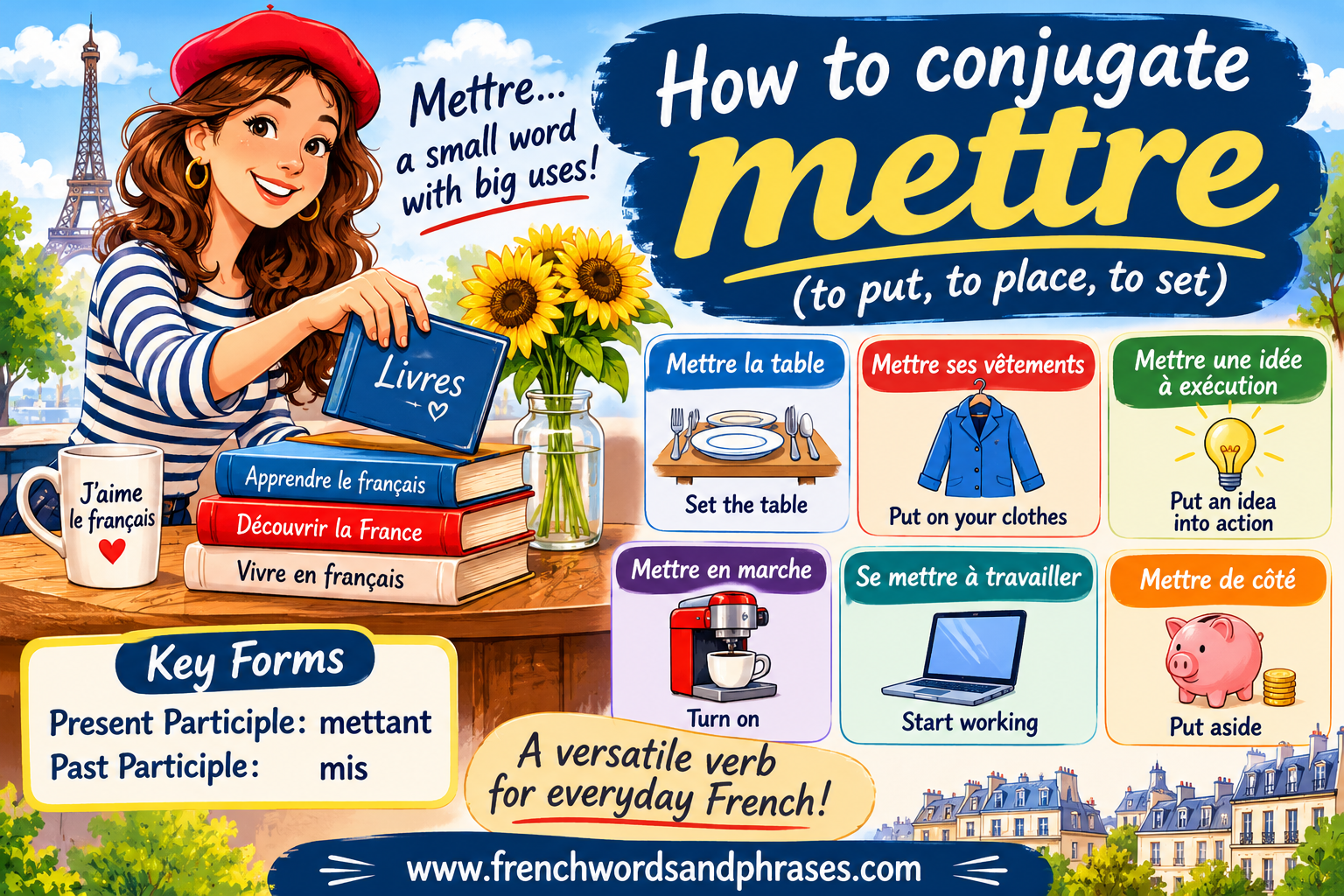
Mettre means “to put,” “to place,” or “to set” in French. It is also used in many everyday expressions, including putting on clothes, setting the table, turning something on, and taking time to do something.
Some French verbs quietly do a lot of work. Mettre is one of them. Whether you are putting a book on a shelf, setting the table for dinner, or getting ready to go out, this versatile verb appears in countless everyday situations. Learning to use it will give you another useful building block for expressing yourself naturally in French.
This guide walks you through the conjugation of mettre in every major French tense and mood. You will find complete tables, practical examples, pronunciation support, and short quizzes to help you remember each form.
Understanding the French Verb Mettre
Mettre is an irregular third-group French verb ending in -re. Unlike regular -re verbs, its spelling changes in several tenses, so its conjugations need to be learned individually.
- Infinitive: mettre
- Meaning: to put, to place, to set, to put on
- Verb group: Third group (irregular -re verb)
- Auxiliary verb: avoir
- Past participle: mis
- Present participle: mettant
Important Spelling Changes
One of the most noticeable features of mettre is the change in its stem. In the present tense, the singular forms use met-, while the plural forms use mett-:
- je mets
- tu mets
- il met / elle met
- nous mettons
- vous mettez
- ils mettent / elles mettent
The double t also appears in the imperfect and present subjunctive. In the future and conditional, the stem becomes mettr-, as in je mettrai and je mettrais.
Mettre and Its Past Participle
The past participle of mettre is mis. All compound tenses use the auxiliary verb avoir:
- J’ai mis le livre sur la table. — I put the book on the table.
- Nous avons mis nos manteaux. — We put on our coats.
When mettre is conjugated with avoir, the past participle does not normally agree with the subject. However, it agrees with a preceding direct object when grammar requires it:
Les chaussures que j’ai mises.
The shoes that I put on.
Here, mises agrees with les chaussures, which appears before the verb.
Common Uses of Mettre
Mettre is much more flexible than the English verb “to put.” Here are some common expressions:
- mettre quelque chose sur la table — to put something on the table
- mettre ses vêtements — to put on one’s clothes
- mettre la table — to set the table
- mettre la télévision — to turn on the television
- mettre du temps — to take time
- se mettre à travailler — to start working
- mettre en place — to put in place, to set up
Notice that se mettre à + infinitive is a particularly useful expression. It means to begin or start doing something.
Experience the Word
Imagine arriving home after a long day. You put your keys on the table, take off your coat, and turn on the radio. In French, mettre helps describe each of these small actions:
Je mets mes clés sur la table et je mets la radio.
I put my keys on the table and turn on the radio.
One little verb, several everyday actions. That is the usefulness of mettre.
How to Conjugate Mettre: Complete French Conjugation Guide
Indicatif
The indicative mood is used to talk about facts, events, habits, and actions that are presented as real. Mettre has several irregular forms, so pay attention to its changing stems as you work through the tenses.
How to Conjugate Mettre in the Présent (Present Tense)
The present tense describes actions happening now, regular habits, and general facts. Notice the single t in the singular forms and the double tt in the plural forms.
| Subject | Conjugation |
|---|---|
| je | mets |
| tu | mets |
| il / elle | met |
| nous | mettons |
| vous | mettez |
| ils / elles | mettent |
Je mets mon téléphone dans mon sac.
I put my phone in my bag.
The present tense is especially useful for describing routines and everyday actions.
Quick Quiz: Mettre in the Present
Which is the correct way to say “We put the books on the shelf”?
Show the answer
Nous mettons les livres sur l’étagère.
The correct form is mettons, with a double t.
How to Conjugate Mettre in the Passé Composé (Past Perfective)
The passé composé describes completed actions in the past. It is formed with the present tense of avoir followed by the past participle mis.
| Subject | Conjugation |
|---|---|
| j’ | ai mis |
| tu | as mis |
| il / elle | a mis |
| nous | avons mis |
| vous | avez mis |
| ils / elles | ont mis |
Elle a mis ses lunettes avant de lire.
She put on her glasses before reading.
Remember that mettre uses avoir in compound tenses. The past participle is mis, not a regular -re ending.
How to Conjugate Mettre in the Imparfait (Imperfect Tense)
The imparfait describes ongoing or repeated actions in the past. It is often used for habits, background details, and situations that continued over time.
| Subject | Conjugation |
|---|---|
| je | mettais |
| tu | mettais |
| il / elle | mettait |
| nous | mettions |
| vous | mettiez |
| ils / elles | mettaient |
Quand j’étais petit, je mettais toujours mes jouets dans cette boîte.
When I was little, I always put my toys in this box.
The imperfect uses the stem mett-, with the familiar imperfect endings.
Quick Quiz: Mettre in the Imparfait
Complete the sentence: “They used to put the chairs outside.”
Show the answer
Ils mettaient les chaises dehors.
The imperfect form for ils and elles is mettaient.
How to Conjugate Mettre in the Plus-que-parfait (Pluperfect Tense)
The plus-que-parfait describes an action that had already happened before another past action. It is formed with the imperfect tense of avoir and the past participle mis.
| Subject | Conjugation |
|---|---|
| j’ | avais mis |
| tu | avais mis |
| il / elle | avait mis |
| nous | avions mis |
| vous | aviez mis |
| ils / elles | avaient mis |
J’avais déjà mis la table quand les invités sont arrivés.
I had already set the table when the guests arrived.
The action of setting the table happened before the guests arrived.
How to Conjugate Mettre in the Passé Simple (Simple Past Tense)
The passé simple is mainly found in literature, historical writing, and formal narratives. It describes completed actions in the past and is rarely used in everyday conversation.
| Subject | Conjugation |
|---|---|
| je | mis |
| tu | mis |
| il / elle | mit |
| nous | mîmes |
| vous | mîtes |
| ils / elles | mirent |
Il mit la lettre dans une enveloppe.
He put the letter in an envelope.
These forms are irregular and are worth recognizing when reading French literature.
How to Conjugate Mettre in the Passé Antérieur (Past Anterior Tense)
The passé antérieur is a literary tense used to describe an action completed immediately before another past action, often in a narrative. It is formed with the passé simple of avoir and the past participle mis.
| Subject | Conjugation |
|---|---|
| j’ | eus mis |
| tu | eus mis |
| il / elle | eut mis |
| nous | eûmes mis |
| vous | eûtes mis |
| ils / elles | eurent mis |
Lorsqu’il eut mis son manteau, il sortit.
When he had put on his coat, he went out.
This tense is primarily useful for understanding written French rather than for everyday conversation.
How to Conjugate Mettre in the Futur Simple (Simple Future Tense)
The futur simple describes actions that will happen in the future. Mettre uses the irregular future stem mettr-.
| Subject | Conjugation |
|---|---|
| je | mettrai |
| tu | mettras |
| il / elle | mettra |
| nous | mettrons |
| vous | mettrez |
| ils / elles | mettront |
Demain, je mettrai cette chemise bleue.
Tomorrow, I will wear this blue shirt.
Remember the double t in the future stem: mettr-.
Quick Quiz: Mettre in the Future
How would you say “She will put the flowers in the vase”?
Show the answer
Elle mettra les fleurs dans le vase.
The future form for elle is mettra.
How to Conjugate Mettre in the Futur Antérieur (Future Perfect Tense)
The futur antérieur describes an action that will have been completed before a particular point in the future. It is formed with the future tense of avoir and the past participle mis.
| Subject | Conjugation |
|---|---|
| j’ | aurai mis |
| tu | auras mis |
| il / elle | aura mis |
| nous | aurons mis |
| vous | aurez mis |
| ils / elles | auront mis |
À midi, nous aurons mis toutes les chaises en place.
By noon, we will have put all the chairs in place.
The futur antérieur emphasizes that the action will be finished before a future deadline or event.
How to Conjugate Mettre in the Futur Proche (Near Future Tense)
The futur proche describes something that is going to happen soon or is planned for the near future. It is formed with the present tense of aller followed by the infinitive mettre.
| Subject | Conjugation |
|---|---|
| je | vais mettre |
| tu | vas mettre |
| il / elle | va mettre |
| nous | allons mettre |
| vous | allez mettre |
| ils / elles | vont mettre |
Je vais mettre la table avant le dîner.
I am going to set the table before dinner.
This is one of the most common ways to talk about the future in everyday French.
Conditionnel
The conditional mood expresses what would happen under certain circumstances. It is also used to make polite requests and soften statements.
How to Conjugate Mettre in the Conditionnel Présent (Present Conditional)
The present conditional is formed using the future stem mettr- with the imperfect endings. It often translates as “would put” or “would place.”
| Subject | Conjugation |
|---|---|
| je | mettrais |
| tu | mettrais |
| il / elle | mettrait |
| nous | mettrions |
| vous | mettriez |
| ils / elles | mettraient |
Je mettrais les fleurs près de la fenêtre.
I would put the flowers near the window.
The conditional is also useful in polite requests:
Vous pourriez mettre la musique un peu moins fort ?
Could you turn the music down a little?
How to Conjugate Mettre in the Conditionnel Passé (Past Conditional)
The past conditional describes what would have happened under different circumstances. It is formed with the conditional present of avoir and the past participle mis.
| Subject | Conjugation |
|---|---|
| j’ | aurais mis |
| tu | aurais mis |
| il / elle | aurait mis |
| nous | aurions mis |
| vous | auriez mis |
| ils / elles | auraient mis |
J’aurais mis mon manteau si j’avais su qu’il ferait froid.
I would have put on my coat if I had known it would be cold.
How to Conjugate Mettre in the Conditionnel Passé – Alternative Form
This literary alternative uses the imperfect subjunctive of avoir followed by the past participle mis. It is rare in modern spoken French but may appear in formal or older literary writing.
| Subject | Conjugation |
|---|---|
| j’ | eusse mis |
| tu | eusses mis |
| il / elle | eût mis |
| nous | eussions mis |
| vous | eussiez mis |
| ils / elles | eussent mis |
Il eût mis la table plus tôt s’il avait eu le temps.
He would have set the table earlier if he had had time.
Subjonctif
The subjunctive mood expresses wishes, doubts, emotions, necessity, and possibilities. It often appears after expressions such as il faut que, je veux que, and bien que.
How to Conjugate Mettre in the Subjonctif Présent (Present Subjunctive)
The present subjunctive is used when the action is uncertain, desired, necessary, or emotionally significant. Notice the double t in the singular and third-person plural forms.
| Subject | Conjugation |
|---|---|
| que je | mette |
| que tu | mettes |
| qu’il / qu’elle | mette |
| que nous | mettions |
| que vous | mettiez |
| qu’ils / qu’elles | mettent |
Il faut que tu mettes tes affaires dans ta chambre.
You must put your things in your room.
The expression il faut que is commonly followed by the subjunctive.
How to Conjugate Mettre in the Subjonctif Imparfait (Imperfect Subjunctive)
The imperfect subjunctive is a literary tense that is now rarely used in everyday French. It is mainly encountered in older literature and formal writing.
| Subject | Conjugation |
|---|---|
| que je | misse |
| que tu | misses |
| qu’il / qu’elle | mît |
| que nous | missions |
| que vous | missiez |
| qu’ils / qu’elles | missent |
Il souhaitait que je misse la lettre sur son bureau.
He wished that I would put the letter on his desk.
How to Conjugate Mettre in the Subjonctif Plus-que-parfait (Pluperfect Subjunctive)
The pluperfect subjunctive is another literary tense. It describes an action that had been completed before another past action in a context requiring the subjunctive.
| Subject | Conjugation |
|---|---|
| que j’ | eusse mis |
| que tu | eusses mis |
| qu’il / qu’elle | eût mis |
| que nous | eussions mis |
| que vous | eussiez mis |
| qu’ils / qu’elles | eussent mis |
Il regrettait que nous eussions mis les documents au mauvais endroit.
He regretted that we had put the documents in the wrong place.
How to Conjugate Mettre in the Subjonctif Passé (Past Subjunctive)
The past subjunctive describes a completed action in a context that calls for the subjunctive. It is formed with the present subjunctive of avoir and the past participle mis.
| Subject | Conjugation |
|---|---|
| que j’ | aie mis |
| que tu | aies mis |
| qu’il / qu’elle | ait mis |
| que nous | ayons mis |
| que vous | ayez mis |
| qu’ils / qu’elles | aient mis |
Je suis content que tu aies mis la table.
I’m glad that you set the table.
Impératif
The imperative mood is used to give commands, instructions, advice, or invitations. Mettre has three imperative forms: tu, nous, and vous. The subject pronoun is omitted.
How to Conjugate Mettre in the Impératif Présent (Present Imperative)
| Subject | Conjugation |
|---|---|
| (tu) | mets |
| (nous) | mettons |
| (vous) | mettez |
Mets ton téléphone dans ta poche !
Put your phone in your pocket!
Use mets when speaking informally to one person, mettons when suggesting that you do something together, and mettez when addressing several people or speaking formally.
Quick Quiz: Mettre in the Imperative
How would you tell a friend to “Put your coat on”?
Show the answer
Mets ton manteau !
The informal singular imperative is mets.
French Participles: Mettre
Participles are important verb forms used in compound tenses and other grammatical constructions. Mettre has an irregular past participle: mis.
Present Participle
The present participle of mettre is mettant. It can describe an action in progress or appear in certain constructions.
En mettant les livres sur l’étagère, elle a fait tomber un vase.
While putting the books on the shelf, she knocked over a vase.
Past Participle
The past participle is mis. It is used with avoir to form compound tenses and can also function as an adjective. When agreement is required, its forms are:
- mis — masculine singular
- mis — masculine plural
- mise — feminine singular
- mises — feminine plural
Les assiettes sont mises sur la table.
The plates are placed on the table.
In this example, mises agrees with the feminine plural noun assiettes.
Mettre in Everyday French: Six Useful Examples
Here are six examples showing how mettre works in different tenses and everyday situations.
1. Present — A simple action
Je mets mes clés près de la porte.
I put my keys near the door.
2. Passé composé — Something completed
Nous avons mis les valises dans la voiture.
We put the suitcases in the car.
3. Imparfait — A past habit
Elle mettait toujours du sucre dans son café.
She always used to put sugar in her coffee.
4. Futur simple — A future action
Tu mettras la table ce soir.
You will set the table tonight.
5. Conditionnel présent — A hypothetical choice
Je mettrais cette photo dans le salon.
I would put this photo in the living room.
6. Subjonctif présent — A necessary action
Il faut que nous mettions tout en ordre.
We need to put everything in order.
Beyond Translation: The Many Uses of Mettre
Learning mettre is about more than memorizing the equivalent of “to put.” French speakers use it in a wide range of expressions, and recognizing these combinations will make your French sound more natural.
- mettre la table — to set the table
- mettre le couvert — to lay the table
- mettre ses chaussures — to put on one’s shoes
- mettre la musique — to turn on or put on music
- mettre au point — to develop, finalize, or fine-tune
- mettre en marche — to start or switch on
- mettre en question — to call into question
- mettre de côté — to put aside or save
- mettre du temps — to take time
- se mettre à rire — to burst out laughing
Mettre vs. Poser
Both mettre and poser can describe placing something somewhere, but they are not always interchangeable.
Mettre is the broader verb. It can mean to put, place, set, wear, or turn on, depending on the context.
Poser often emphasizes physically placing or setting an object down on a surface.
Je mets mes affaires dans le sac.
I put my things in the bag.
Je pose mon livre sur la table.
I put my book down on the table.
As you encounter more French, you will begin to recognize which verb sounds most natural in each situation.
How to Remember the Conjugation of Mettre
Because mettre is irregular, it helps to remember its most important stems rather than trying to apply the rules for regular -re verbs.
- Present singular: met- — je mets, tu mets, il met
- Present plural: mett- — nous mettons, vous mettez, ils mettent
- Imperfect: mett- — je mettais, nous mettions
- Future and conditional: mettr- — je mettrai, je mettrais
- Past participle: mis — j’ai mis
- Present participle: mettant
Try saying these forms aloud in groups. The changing stems become easier to recognize when you hear them as well as read them.
One final memory trick: the past participle mis is short, but it appears throughout the compound tenses. Once you know it, you already have an important part of several conjugations mastered.
Test Your Knowledge: Mettre
Let’s see how well you have learned to conjugate mettre. Try answering each question before revealing the answer.
Question 1
Which is the correct present-tense form for nous?
Show the answer
Nous mettons.
Question 2
What is the past participle of mettre?
Show the answer
Mis.
Question 3
Complete the sentence: “Tomorrow, they will put the bags in the car.”
Show the answer
Demain, ils mettront les sacs dans la voiture.
Question 4
Which auxiliary verb is used to form the passé composé of mettre?
Show the answer
Avoir. For example: j’ai mis.
Question 5
How do you say “I would put” in French?
Show the answer
Je mettrais.
Your Final Challenge
Translate this sentence into French:
“We put on our coats and went outside.”
Reveal the translation
Nous avons mis nos manteaux et nous sommes sortis.
We put on our coats and went outside.
Notice that mettre uses avoir in the passé composé: avons mis. The verb sortir here uses être because it describes going out.
A little French. A little curiosity. A richer everyday life.
LEARN FRENCH ONE WORD AT A TIME