A French Word to Live By
Translate Pas to English
/pɑ/
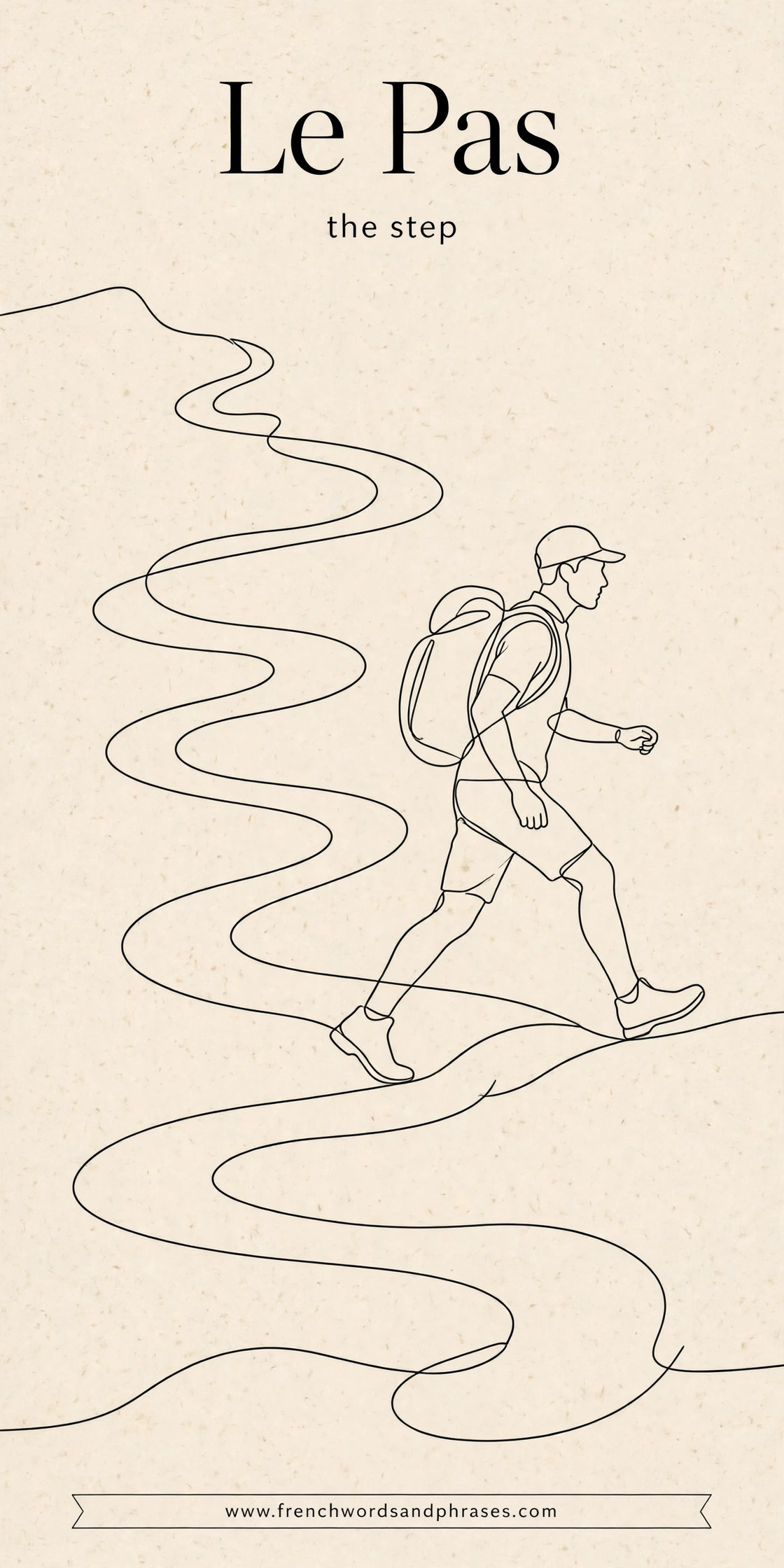
Le Pas means the step.
The old man crosses the village square slowly, counting under his breath — un pas, deux pas — measuring the distance to the bakery the way he has done every morning for forty years: pas à pas.
In this guide, you’ll learn what pas means in English, how to use it with its articles, how to form its plural, and how it appears in everyday French. Explore French examples, English translations, and practice quizzes.
Understanding the French Noun Pas
Pas is a masculine French noun, learned with its article: le pas, un pas. It means the step you take when walking — and it keeps its spelling in the plural: les pas, with no extra letters. Do not confuse it with its famous homonym, the little negative word pas in ne… pas: same sound, different job.
It means the step — one movement of the foot when you walk, and by extension your pace and your footstep: entendre des pas, to hear footsteps. French measures life in pas: à deux pas means a stone’s throw away, faire les cent pas is to pace up and down, and un pas de géant is a giant leap forward.
Gender: Masculine
Definite article: le — le pas (the step)
Indefinite article: un — un pas (a step)
Plural: les pas — the spelling never changes
The sound: des pas — footsteps
Not to confuse: ne… pas — the negative word, a different pas
One important usage detail: the plural of pas is written exactly like the singular — un pas, deux pas, mille pas. And when someone walks towards you in the dark, what you hear first is des pas: pas also means the footsteps themselves.
Experience the Word
Pas is more than a unit of walking. It is the smallest measure of a journey — every road, every pilgrimage, every escape begins with exactly one of them.
Imagine the corridor at night: a child listens, heart beating, to the slow pas of a parent coming to check on her — the most reassuring sound in the world.
You have not just moved a foot. You have begun — le premier pas, celui qui compte le plus.
How to Use Pas in French: Complete Guide
Let’s explore how pas works in French, beginning with its articles — a masculine word whose plural hides in plain sight.
Pas with the Definite Article (Le, Les)
Used for the step in question — the first step, the last step, the steps on the stairs.
| Form | French |
|---|---|
| Masculine singular | le pas |
| Plural | les pas |
Example
Le premier pas est toujours le plus difficile.
The first step is always the hardest.
Pas with the Indefinite Article (Un, Des)
Used for a step in general — un pas forward, des pas in the corridor.
| Form | French |
|---|---|
| Masculine singular | un pas |
| Plural | des pas |
Example
Elle fait un pas en avant et sourit à la classe.
She takes a step forward and smiles at the class.
Pas with the Partitive and Quantities (Des, Mille pas…)
Steps are made to be counted, so French counts them by the hundred and measures distance with them.
| Quantity | French |
|---|---|
| some steps | des pas |
| a hundred steps | cent pas |
| ten thousand steps | dix mille pas |
| a few steps away | à quelques pas |
| two steps away (very near) | à deux pas |
Example
L’hôtel se trouve à deux pas de la gare.
The hotel is a stone’s throw from the station.
Quick Quiz 1
Complete the sentence:
On entend ______ pas dans l’escalier. (some)
Reveal the answer
des
On entend des pas dans l’escalier.
We can hear footsteps on the stairs — des pas, plural, spelled just like the singular.
The Plural of Pas
Pas is invariable: the written form never changes — un pas, les pas, cent pas.
| Number | French |
|---|---|
| Singular | le pas |
| Plural | les pas |
Example
Ses pas résonnent dans la rue silencieuse.
His footsteps echo in the silent street.
Pas with Possessive Adjectives (Mon, Ton, Son…)
Possessives agree with the noun: pas is masculine, so it takes mon, ton, son in the singular.
| Owner | French |
|---|---|
| my | mon pas |
| your (tu) | ton pas |
| his / her | son pas |
| our | nos pas |
| your (vous) | vos pas |
| their | leurs pas |
Example
Elle marche sur mes pas dans la neige fraîche.
She walks in my footsteps in the fresh snow.
Quick Quiz 2
Complete the sentence:
L’enfant suit ______ pas de son père sur la plage. (his / the)
Reveal the answer
les
L’enfant suit les pas de son père sur la plage.
The child follows his father’s footsteps on the beach — les pas, the steps in question.
Pas with Demonstrative Adjectives (Ce, Ces)
Used to point: ce pas, this step — the decisive one.
| Form | French |
|---|---|
| Masculine singular | ce pas |
| Plural | ces pas |
Example
Ce pas de danse demande beaucoup de pratique.
This dance step takes a lot of practice.
Pas with Adjectives
Adjectives agree with pas and stay masculine: grand, petit, rapide.
| Adjective | With Pas |
|---|---|
| grand (big) | un grand pas |
| petit (small) | un petit pas |
| rapide (quick) | un pas rapide |
| lent (slow) | un pas lent |
| premier (first) | le premier pas |
Example
D’un grand pas, il traverse la cour en quelques secondes.
With long strides, he crosses the yard in a few seconds.
Quick Quiz 3
Complete the sentence:
Le bébé fait ses premiers ______ tout seul. (steps)
Reveal the answer
pas
Le bébé fait ses premiers pas tout seul.
The baby is taking his first steps all by himself — pas, with no extra -s: the word never changes.
Everyday Expressions with Pas
Pacing, tiptoeing and giant leaps — the pas phrases of daily life.
| Expression | In English |
|---|---|
| faire les cent pas | to pace up and down |
| pas à pas | step by step |
| à deux pas | a stone’s throw away, very near |
| un pas de géant | a giant leap forward |
| marcher à pas de loup | to walk silently, on tiptoe |
| le pas de la porte | the doorstep |
| un faux pas | a misstep, a blunder |
Example
Il fait les cent pas devant la salle d’attente.
He is pacing up and down in front of the waiting room.
Words from the Same Family as Pas
Passing, passages and overtaking — the words that travel with pas.
| French | In English |
|---|---|
| passer | to pass, to go by |
| le passage | the passage, the crossing |
| dépasser | to overtake, to go beyond |
| le passant | the passer-by |
| la passerelle | the footbridge |
| repasser | to pass again; to iron |
Example
Les passants traversent au passage piéton.
The pedestrians are crossing at the zebra crossing.
Quick Quiz 4
What does faire les cent pas mean?
Reveal the answer
To pace up and down — to walk the same stretch over and over while waiting.
Elle fait les cent pas devant l’hôpital depuis une heure.
She has been pacing up and down outside the hospital for an hour.
Pas in Everyday French: Real-Life Examples
Now that you know the word, let’s see how pas appears in everyday French.
Example 1 — Giving directions
La boulangerie est à deux pas d’ici, sur la gauche.
The bakery is a stone’s throw from here, on the left.
Example 2 — Waiting nervously
Il fait les cent pas dans le couloir depuis ce matin.
He has been pacing up and down the corridor since this morning.
Example 3 — A baby’s triumph
Regarde, le bébé fait ses premiers pas !
Look, the baby is taking his first steps!
Example 4 — Learning slowly
Nous avançons pas à pas, sans nous presser.
We are moving forward step by step, without hurrying.
Example 5 — In the snow
Leurs pas dessinent un chemin dans la neige.
Their footsteps draw a path in the snow.
Example 6 — A big breakthrough
Cette découverte est un pas de géant pour la médecine.
This discovery is a giant leap forward for medicine.
Beyond Translation: The Meaning of Pas
French trusts the pas to measure everything that matters: distance (à deux pas), progress (pas à pas), courage (le premier pas) and even dance — un pas de deux. The little word carries the philosophy that nothing great happens all at once: cathedrals, languages and journeys are all built one honest step at a time.
To say pas is to name the unit of every journey.
It evokes footsteps in snow and in corridors, babies standing for the first time, and Neil Armstrong’s famous line, which French renders with this very word: un petit pas pour l’homme.
How to Remember the French Noun Pas
Remember it this way: Pas is the step — masculine, le pas, and invariable in the plural; à deux pas means just round the corner.
- You take a step — un pas, le premier pas, un grand pas.
- You count them — des pas, cent pas, dix mille pas, sans changer le mot.
- You wait and pace — faire les cent pas, pas à pas.
The key idea is le pas — plural les pas, the spelling never changes.
Test Your Knowledge of Pas
Let’s see how much you’ve learned. Try answering these questions before revealing the answers.
Question 1
Is pas masculine or feminine?
Reveal the answer
Masculine — le pas, un pas.
Question 2
What is special about the plural of pas?
Reveal the answer
It never changes — un pas, deux pas, les pas: the written form is identical.
Question 3
Translate: The station is very near.
Reveal the answer
La gare est à deux pas. — literally, two steps away.
Question 4
What is the difference between le pas and the pas in « je ne sais pas »?
Reveal the answer
Le pas is the noun, a step; the other pas is a negative word with no meaning of its own — it simply helps ne say « not ».
Question 5
Complete the sentence:
Elle avance ______ à ______, lentement mais sûrement.
Reveal the answer
pas, pas
Elle avance pas à pas, lentement mais sûrement.
She is advancing step by step, slowly but surely.
Your Final Challenge
Can You Use It?
How would you say this in French?
“The child takes his first steps towards his mother.”
Reveal the answer
L’enfant fait ses premiers pas vers sa mère.
The child takes his first steps towards his mother.
A little French. A little curiosity. A richer everyday life.
LEARN FRENCH ONE WORD AT A TIME