A French Word to Live By
Translate Parking to English
/paʁ.kiŋ/
Le parking means the parking lot, the car park.
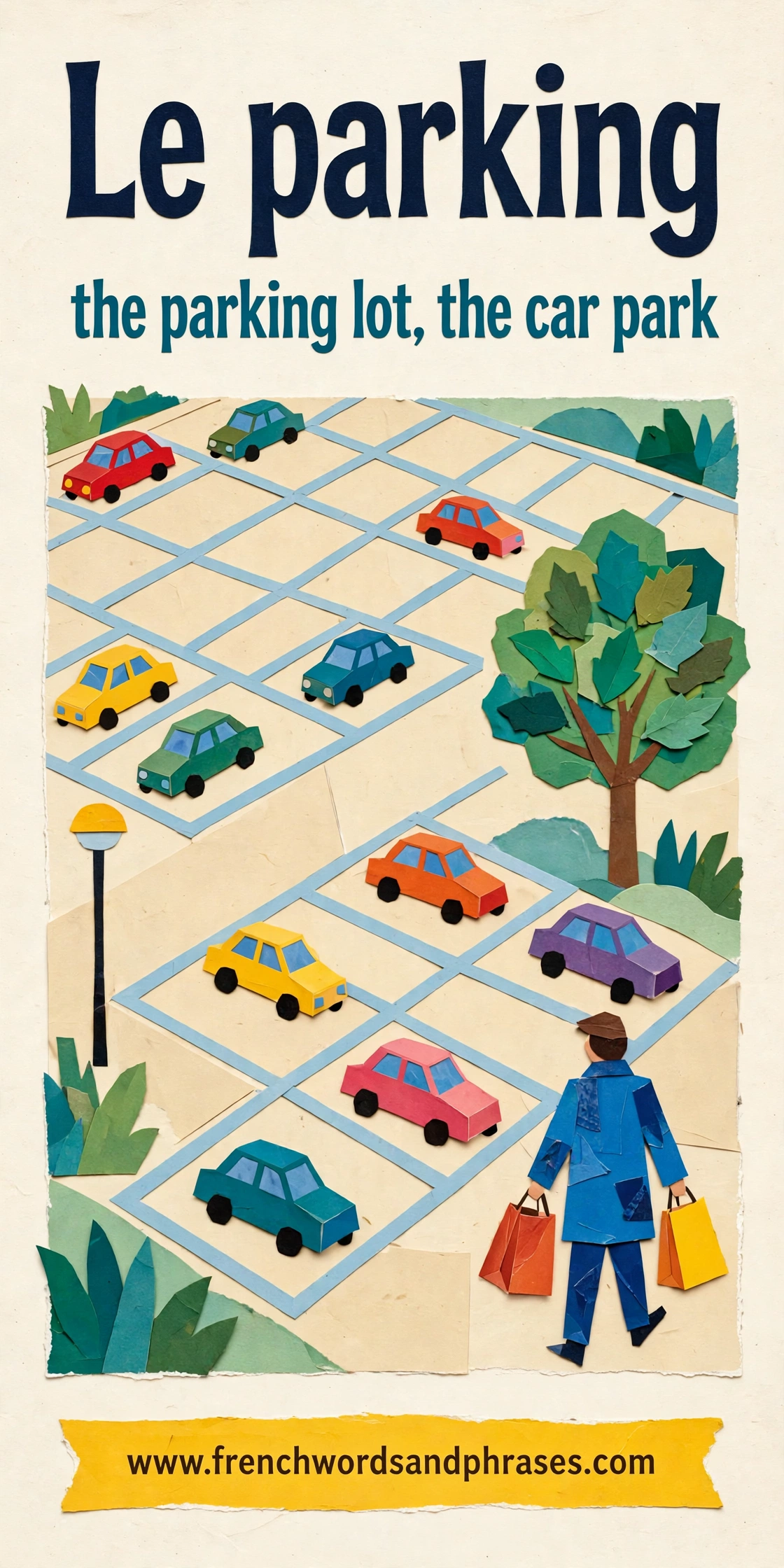
Rows of cars under the supermarket lights, a ticket in the windscreen and the eternal hunt for a space: le parking, the car park — the modern traveller’s first and last battle in every French town.
In this guide, you’ll learn what parking means in English, how to use it with its articles, how to form its plural, and how it appears in everyday French. Explore French examples, English translations, and practice quizzes.
Understanding the French Noun Parking
Parking is a masculine French noun, learned with its article: le parking, un parking. It is an English loanword that French adopted for the place — where English “parking” names the action, French le parking names the ground itself. The car left there is garée, from se garer, to park, and its exact spot is une place de parking.
It means a car park, a parking lot — a place where cars are parked: le parking du supermarché, the supermarket car park, un parking souterrain, an underground car park, un parking gratuit, free parking. Town centres hide theirs underground, signed with the white P on blue. Around the word: se garer, to park, une place, a space — il n’y a plus de place, there are no spaces left — and le ticket de parking you take at the barrier.
Gender: Masculine — le parking
Definite article: le — le parking (the car park)
Indefinite article: un — un parking (a car park)
Plural: les parkings — regular, with a simple -s
Spelling note: an English loanword — but in French it names the place, not the action
The space itself: une place de parking — and se garer is to park the car
English equivalents: The car park, the parking lot.
The classic learner’s trap lives here: to park is se garer, never “faire du parking”. You leave the car au parking or dans un parking souterrain, and you look for une place. On the street, paid parking is le stationnement payant, watched over by l’horodateur, the parking meter — and the fine for forgetting is une amende, called in everyday French une prune or un PV.
Experience the Word
Parking is the unglamorous threshold of every outing: the circling, the squeeze between two cars, the small triumph of a space near the door.
Imagine the parking under the town square on market day — cars prowling in slow spirals, a space opening like a gift, and the whole choreography of a town arriving at once.
You have not just named a concrete field. You have named the journey’s ground floor — le parking, the car park, where every trip by car begins and ends.
How to Use Parking in French: Complete Guide
Let’s explore how parking works in French, beginning with its articles — le parking, un parking, se garer au parking.
Parking with the Definite Article (Le, Les)
Used for a specific car park — the one under the square, the one at the station.
| Form | French |
|---|---|
| Masculine singular | le parking |
| Plural | les parkings |
Example
Le parking se trouve sous la place du marché.
The car park is under the market square.
Parking with the Indefinite Article (Un, Des)
Used for a car park in general — any field of painted lines.
| Form | French |
|---|---|
| Masculine singular | un parking |
| Plural | des parkings |
Example
Il y a un parking juste derrière la gare.
There is a car park just behind the station.
Kinds of Parking (Souterrain, Gratuit, Payant…)
Underground, free or guarded — the car park’s varieties.
| Kind | French |
|---|---|
| an underground car park | un parking souterrain |
| a free car park | un parking gratuit |
| a paid car park | un parking payant |
| a supermarket car park | le parking du supermarché |
| a park-and-ride | un parking relais |
Example
Le parking relais est gratuit avec un ticket de tram.
The park-and-ride is free with a tram ticket.
Quick Quiz 1
Complete the sentence:
______ parking de l’hôpital est complet. (the)
Reveal the answer
Le
Le parking de l’hôpital est complet.
The hospital car park is full — parking is masculine, so le.
The Plural of Parking
Parking takes a regular plural in -s — big towns signpost a dozen of them.
| Number | French |
|---|---|
| Singular | le parking |
| Plural | les parkings |
Example
Les parkings du centre sont payants.
The car parks in the centre are paid.
Parking with Possessive Adjectives (Mon, Ton, Son…)
Possessives agree with the noun: parking is masculine, so mon, ton, son in the singular.
| Owner | French |
|---|---|
| my | mon parking |
| your (tu) | ton parking |
| his / her | son parking |
| our | notre parking |
| your (vous) | votre parking |
| their | leur parking |
Example
Mon parking habituel est celui de la gare.
My usual car park is the station one.
Quick Quiz 2
Complete the sentence:
Elle a laissé sa voiture dans ______ parking souterrain. (her)
Reveal the answer
son
Elle a laissé sa voiture dans son parking souterrain.
She left her car in her underground car park — son, because parking is masculine.
Parking with Demonstrative Adjectives (Ce, Ces)
Used to point: ce parking, this car park — this one, by the entrance.
| Form | French |
|---|---|
| Masculine singular | ce parking |
| Plural | ces parkings |
Example
Ce parking est réservé aux clients.
This car park is reserved for customers.
Parking with Adjectives
Adjectives agree with parking — masculine singular: un parking souterrain, un parking complet.
| Adjective | With Parking |
|---|---|
| souterrain (underground) | un parking souterrain |
| gratuit (free) | un parking gratuit |
| complet (full) | un parking complet |
| grand (large) | un grand parking |
| payant (paid) | un parking payant |
Example
Un parking gratuit près du centre, c’est rare.
A free car park near the centre is rare.
Quick Quiz 3
Complete the sentence:
C’est un parking ______, il faut descendre deux étages. (underground)
Reveal the answer
souterrain
C’est un parking souterrain, il faut descendre deux étages.
It’s an underground car park, you go down two floors — souterrain, masculine, to agree with parking.
Everyday Expressions with Parking
Spaces, tickets and barriers — the parking phrases of daily life.
| Expression | In English |
|---|---|
| se garer | to park (oneself, one’s car) |
| une place de parking | a parking space |
| un parking souterrain | an underground car park |
| il n’y a plus de place | there are no spaces left |
| le ticket de parking | the parking ticket (for the barrier) |
Example
Je me gare toujours au même parking.
I always park in the same car park.
Words from the Same Family as Parking
Cars and streets — the words that travel with parking.
| French | In English |
|---|---|
| se garer | to park (the verb) |
| une place | a space; also a square |
| une voiture | a car |
| l’horodateur | the parking meter |
| le stationnement | parking (the action, the rules) |
Example
Le stationnement est interdit devant l’école.
Parking is forbidden in front of the school.
Quick Quiz 4
How do you say to park in French?
Reveal the answer
Se garer — never “faire du parking”; le parking is the place, not the action.
Je me gare près de l’entrée.
I’ll park near the entrance.
Parking in Everyday French: Real-Life Examples
Now that you know the word, let’s see how parking appears in everyday French.
Example 1 — Arriving
Le parking est à côté du supermarché.
The car park is next to the supermarket.
Example 2 — Full
Le parking est complet, cherchons une place dans la rue.
The car park is full, let’s look for a space in the street.
Example 3 — Underground
Descends au parking souterrain, niveau moins deux.
Go down to the underground car park, level minus two.
Example 4 — The ticket
Garde le ticket de parking pour la sortie.
Keep the parking ticket for the exit.
Example 5 — Free
Ce parking est gratuit le dimanche.
This car park is free on Sundays.
Example 6 — Remembering
Je ne me souviens plus où je me suis garé.
I can’t remember where I parked any more.
Beyond Translation: The Meaning of Parking
The parking is the monument the car age hid underground: French towns, unwilling to scar their beautiful squares, dug their car parks beneath them — you park under the market place, under the cathedral square, and surface by a staircase into the Middle Ages. The borrowed word arrived with the thing itself in the post-war years, and French, practical as ever, kept the place and invented its own verb for the act: se garer, from the old word for shelter — the same root as la gare.
To say parking is to name the car’s hidden harbour.
It evokes the barrier rising, the ticket in the windscreen and the hunt for a place — the ground floor of every journey.
How to Remember the French Noun Parking
Remember it this way: Parking is the car park — masculine: le parking. But to park is se garer — the word names the place, not the action.
- Always masculine — le parking, un parking, mon parking.
- The trap — se garer is to park; le parking is only the place.
- The space — une place de parking; full is complet.
The key idea is le parking — the car park, masculine; se garer = to park.
Test Your Knowledge of Parking
Let’s see how much you’ve learned. Try answering these questions before revealing the answers.
Question 1
Is parking masculine or feminine?
Reveal the answer
Masculine — le parking, un parking.
Question 2
How do you say to park (a car)?
Reveal the answer
Se garer.
Question 3
Translate: The car park is under the market square.
Reveal the answer
Le parking se trouve sous la place du marché.
Question 4
What is une place de parking?
Reveal the answer
A parking space — one marked bay for one car.
Question 5
Complete the sentence:
______ parkings du centre sont payants. (the)
Reveal the answer
Les
Les parkings du centre sont payants.
The car parks in the centre are paid.
Your Final Challenge
Can You Use It?
How would you say this in French?
“The car park is under the market square.”
Reveal the answer
Le parking se trouve sous la place du marché.
The car park is under the market square.
A little French. A little curiosity. A richer everyday life.
LEARN FRENCH ONE WORD AT A TIME