How to Conjugate Parafer in French
/pa.ʁa.fe/
Parafer means to initial, to sign — to put your small signature, your paraphe, at the bottom of each page of a document.
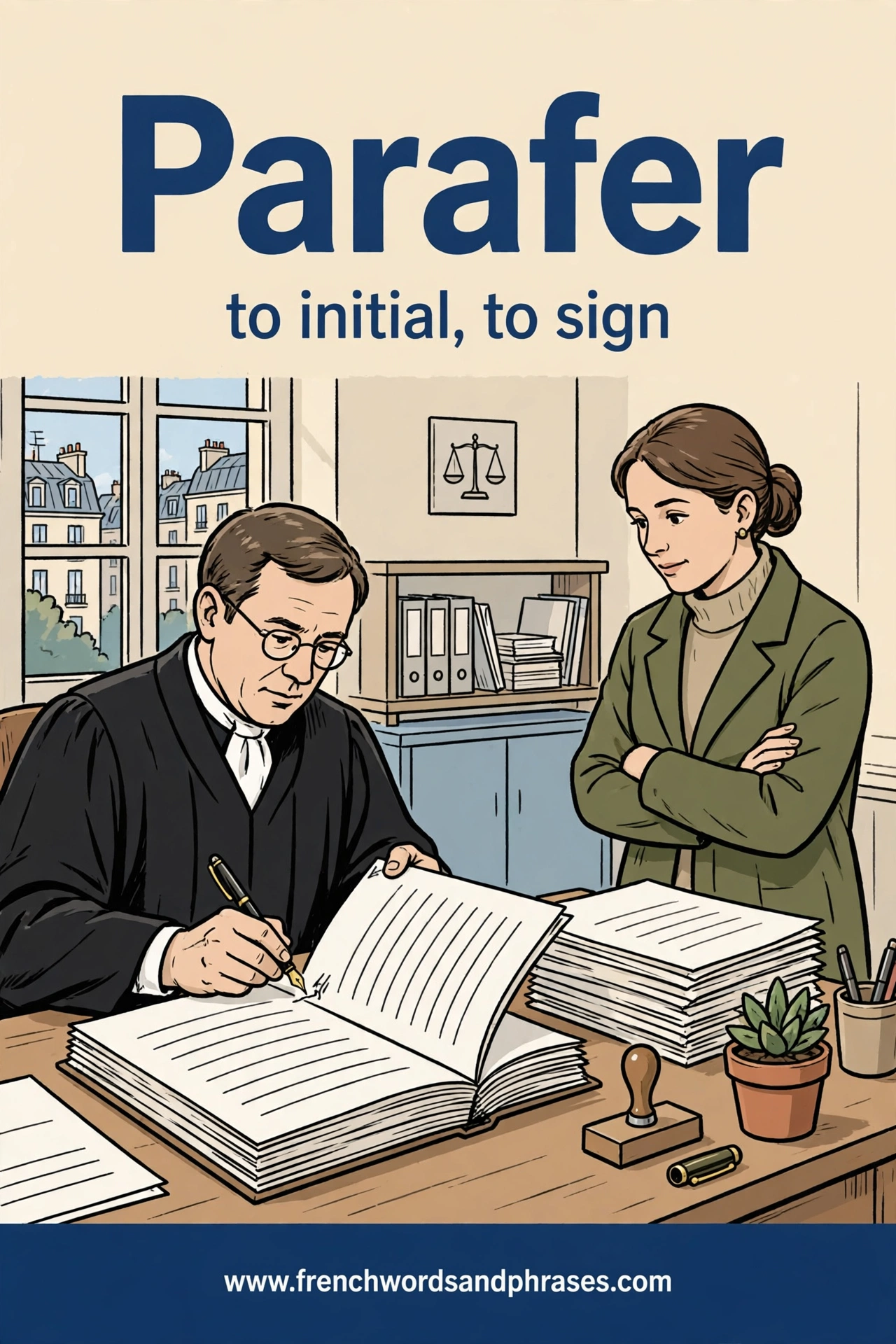
A notary’s office, a contract forty pages thick, and a pen moving from page to page leaving two quick letters in every corner — parafer is the verb of the initial: the small, quick signature that says you have read and approved every page.
In this guide, you’ll learn how to conjugate parafer in all the major French tenses and moods. Explore complete conjugation tables, French examples, English translations, and practice quizzes.
Understanding the French Verb Parafer
Parafer is a regular French verb belonging to the first group of verbs, those ending in -er.
It means to initial, to sign. It belongs to the world of notaries, lawyers and administration — deeds, contracts, official reports. Where signer is one full signature at the end, parafer is the initials on every page: slower, safer, and very French in its love of stamped, initialled paperwork.
Verb classification: First group (-er)
Auxiliary verb: Avoir
Past participle: parafé
Present participle: parafant
English equivalents: To initial, to sign off page by page; parafer un contrat — to initial a contract; parafer chaque page — to initial every page; un paraphe — one’s initials, a flourish of the pen; le paraphe du notaire — the notary’s initials.
One important detail: parafer is the older spelling-variant of parapher — the two verbs are twins, both regular -er verbs meaning to initial a document page by page, and modern French uses parapher far more often. The word inside both is un paraphe: the flourish or initials a person writes instead of a full signature. To parafer un acte is to go through it page by page, initialling each one so that no page can later be swapped.
Experience the Word
Parafer is the verb of careful paperwork — a signature is a promise, but initials on forty pages are a promise repeated forty times.
Imagine the sale of a house in a French notary’s study. The deed is a small book. Before anyone signs the last page, the notary turns the pages one by one — parafez ici, et ici, et ici — until every corner carries the buyer’s two letters and no page can ever be changed.
Nothing is signed yet, officially. But every page has been initialled — parafé — and the document is already sealed against doubt.
How to Conjugate Parafer: Complete French Conjugation Guide
Let’s explore every major conjugation of parafer, beginning with the indicative mood.
How to Conjugate Parafer in the Indicative Mood
The indicative mood is used to express facts, observations, actions, and events.
How to Conjugate Parafer in the Present Tense (Présent)
Used for actions happening now, habitual actions, and general truths.
| Subject | Conjugation |
|---|---|
| je | parafe |
| tu | parafes |
| il / elle | parafe |
| nous | parafons |
| vous | parafez |
| ils / elles | parafent |
Le notaire parafe chaque page de l’acte.
The notary initials every page of the deed.
Complete the sentence:
Nous ______ chaque page de l’acte.
Reveal the answer
parafons
Nous parafons chaque page de l’acte.
We initial every page of the deed.
How to Conjugate Parafer in the Passé Composé
Used for completed actions in the past. Parafer takes the auxiliary verb avoir.
| Subject | Conjugation |
|---|---|
| j’ | ai parafé |
| tu | as parafé |
| il / elle | a parafé |
| nous | avons parafé |
| vous | avez parafé |
| ils / elles | ont parafé |
Elle a parafé le contrat ce matin.
She initialled the contract this morning.
How to Conjugate Parafer in the Imparfait (Imperfect Tense)
Used for habitual past actions, descriptions, and ongoing situations in the past.
| Subject | Conjugation |
|---|---|
| je | parafais |
| tu | parafais |
| il / elle | parafait |
| nous | parafions |
| vous | parafiez |
| ils / elles | parafaient |
Le greffier parafait les registres tous les soirs.
The clerk used to initial the registers every evening.
Choose the correct form:
She initialled the contract.
Elle ______ le contrat. (a parafé / est parafé)
Reveal the answer
a parafé
Elle a parafé le contrat.
Parafer takes avoir.
How to Conjugate Parafer in the Plus-que-parfait
Used to describe an action that had already been completed before another past event.
| Subject | Conjugation |
|---|---|
| j’ | avais parafé |
| tu | avais parafé |
| il / elle | avait parafé |
| nous | avions parafé |
| vous | aviez parafé |
| ils / elles | avaient parafé |
Ils avaient parafé toutes les pages avant l’arrivée du directeur.
They had initialled all the pages before the director arrived.
How to Conjugate Parafer in the Passé Simple
Primarily used in formal writing, literature, and historical narratives. It is rarely used in everyday conversation.
| Subject | Conjugation |
|---|---|
| je | parafai |
| tu | parafas |
| il / elle | parafa |
| nous | parafâmes |
| vous | parafâtes |
| ils / elles | parafèrent |
Le ministre parafa le document sans le relire.
The minister initialled the document without rereading it.
How to Conjugate Parafer in the Passé Antérieur
A literary tense used to express an action completed immediately before another past action, generally in the passé simple.
| Subject | Conjugation |
|---|---|
| j’ | eus parafé |
| tu | eus parafé |
| il / elle | eut parafé |
| nous | eûmes parafé |
| vous | eûtes parafé |
| ils / elles | eurent parafé |
Quand il eut parafé la dernière page, il posa son stylo.
When he had initialled the last page, he put down his pen.
How to Conjugate Parafer in the Future Tense (Futur Simple)
Used to describe actions that will take place in the future.
| Subject | Conjugation |
|---|---|
| je | paraferai |
| tu | paraferas |
| il / elle | parafera |
| nous | paraferons |
| vous | paraferez |
| ils / elles | paraferont |
Vous paraferez chaque page, puis vous signerez.
You will initial every page, then you will sign.
How to Conjugate Parafer in the Futur Antérieur (Future Perfect)
Used for an action that will have been completed before a particular point in the future.
| Subject | Conjugation |
|---|---|
| j’ | aurai parafé |
| tu | auras parafé |
| il / elle | aura parafé |
| nous | aurons parafé |
| vous | aurez parafé |
| ils / elles | auront parafé |
À dix heures, elle aura parafé tout le dossier.
By ten o’clock, she will have initialled the whole file.
How to Conjugate Parafer in the Near Future (Futur Proche)
Used to describe something that is going to happen soon. Formed with aller + infinitive.
| Subject | Conjugation |
|---|---|
| je | vais parafer |
| tu | vas parafer |
| il / elle | va parafer |
| nous | allons parafer |
| vous | allez parafer |
| ils / elles | vont parafer |
Je vais parafer ces pages tout de suite.
I am going to initial these pages right away.
How to Conjugate Parafer in the Conditional Mood
The conditional mood expresses what would happen under certain circumstances. It is also frequently used to make polite requests or express wishes.
How to Conjugate Parafer in the Present Conditional
| Subject | Conjugation |
|---|---|
| je | paraferais |
| tu | paraferais |
| il / elle | paraferait |
| nous | paraferions |
| vous | paraferiez |
| ils / elles | paraferaient |
Sans son accord, je ne paraferais pas ce texte.
Without his agreement, I would not initial this text.
How to Conjugate Parafer in the Past Conditional
| Subject | Conjugation |
|---|---|
| j’ | aurais parafé |
| tu | aurais parafé |
| il / elle | aurait parafé |
| nous | aurions parafé |
| vous | auriez parafé |
| ils / elles | auraient parafé |
Il aurait parafé l’acte si le prix avait été juste.
He would have initialled the deed if the price had been fair.
Parafer in the Literary Past Conditional Form
This less common literary form uses the imperfect subjunctive of avoir.
| Subject | Conjugation |
|---|---|
| j’ | eusse parafé |
| tu | eusses parafé |
| il / elle | eût parafé |
| nous | eussions parafé |
| vous | eussiez parafé |
| ils / elles | eussent parafé |
Le roi eût parafé le traité de sa propre main.
The king would have initialled the treaty with his own hand.
How to Conjugate Parafer in the Subjunctive Mood
The subjunctive is used to express wishes, emotions, doubts, necessity, and uncertainty. It frequently follows expressions such as il faut que (it is necessary that) or bien que (although).
How to Conjugate Parafer in the Present Subjunctive
| Subject | Conjugation |
|---|---|
| que je | parafe |
| que tu | parafes |
| qu’il / qu’elle | parafe |
| que nous | parafions |
| que vous | parafiez |
| qu’ils / qu’elles | parafent |
Il faut que vous parafiez chaque page du contrat.
You must initial every page of the contract.
Complete the sentence using the subjunctive:
Il faut que tu ______ cette page aussi.
Reveal the answer
parafes
Il faut que tu parafes cette page aussi.
You must initial this page too.
How to Conjugate Parafer in the Imperfect Subjunctive
A literary tense, rarely encountered in modern spoken French.
| Subject | Conjugation |
|---|---|
| que je | parafasse |
| que tu | parafasses |
| qu’il / qu’elle | parafât |
| que nous | parafassions |
| que vous | parafassiez |
| qu’ils / qu’elles | parafassent |
Le notaire exigeait que l’acheteur parafât l’acte entier.
The notary required the buyer to initial the entire deed.
How to Conjugate Parafer in the Pluperfect Subjunctive
A literary construction used to express an action completed before another past action.
| Subject | Conjugation |
|---|---|
| que j’ | eusse parafé |
| que tu | eusses parafé |
| qu’il / qu’elle | eût parafé |
| que nous | eussions parafé |
| que vous | eussiez parafé |
| qu’ils / qu’elles | eussent parafé |
On vérifia qu’ils eussent parafé toutes les pages.
They checked that they had initialled all the pages.
How to Conjugate Parafer in the Past Subjunctive
| Subject | Conjugation |
|---|---|
| que j’ | aie parafé |
| que tu | aies parafé |
| qu’il / qu’elle | ait parafé |
| que nous | ayons parafé |
| que vous | ayez parafé |
| qu’ils / qu’elles | aient parafé |
Je suis content que tu aies parafé le document.
I am glad you initialled the document.
How to Conjugate Parafer in the Imperative
The imperative is used to give commands, instructions, invitations, or suggestions. Subject pronouns are omitted.
How to Conjugate Parafer in the Present Imperative
| Person | Conjugation |
|---|---|
| (tu) | parafe |
| (nous) | parafons |
| (vous) | parafez |
Parafez ici, en bas de chaque page !
Initial here, at the bottom of each page!
How would you say Initial here (tu form)?
Reveal the answer
Parafe ici !
French Participles of Parafer
Participles are verb forms that can be used in compound tenses and other grammatical constructions.
Present Participle of Parafer
parafant
En parafant chaque page, elle vérifiait les chiffres.
While initialling every page, she was checking the figures.
Past Participle of Parafer
parafé
Parafé par le notaire, l’acte devint officiel.
Initialled by the notary, the deed became official.
Parafer in Everyday French: Real-Life Examples
Now that you know the conjugations, let’s see how parafer appears in everyday French.
Le notaire parafe chaque page.
The notary initials every page.
Elle a parafé le contrat.
She initialled the contract.
Le greffier parafait les registres.
The clerk used to initial the registers.
Vous paraferez chaque page.
You will initial every page.
Je ne paraferais pas ce texte sans le lire.
I would not initial this text without reading it.
Parafez en bas de la page !
Initial at the bottom of the page!
Beyond Translation: The Meaning of Parafer
The paraphe behind parafer began life as the Greek word for a marginal mark beside a paragraph — a scribe’s sign in the margin.
From margin mark to legal safeguard.
That is why initialling is serious business in France: a page without its paraphe can be challenged, swapped or denied, and a whole house sale can turn on two small letters in a corner.
How to Remember the French Verb Parafer
Remember it this way: Parafer is about the notary’s pen leaving two letters in every corner.
- Parafer = parapher: twins meaning to initial — parapher is the one you will meet most often today.
- Think of the paraphe: two quick letters in the corner of every page, not one signature at the end.
- Regular -er: je parafe, nous parafons, past participle parafé.
The key idea is the notary’s pen leaving two letters in every corner.
Test Your Knowledge of Parafer
Let’s see how much you’ve learned. Try answering these questions before revealing the answers.
What is the difference between signer and parafer?
Reveal the answer
Signer is one full signature, usually at the end; parafer is to initial every page.
How do you say The notary initials every page in French?
Reveal the answer
Le notaire parafe chaque page.
Translate: She initialled the contract this morning.
Reveal the answer
Elle a parafé le contrat ce matin.
What is the past participle of parafer?
Reveal the answer
Parafé.
Complete the sentence:
Il faut que vous ______ chaque page du contrat.
Reveal the answer
parafiez
Il faut que vous parafiez chaque page du contrat.
You must initial every page of the contract.
Can You Use It?
How would you say this in French?
The notary initials the last page, and the house changes hands in silence.
Reveal the answer
Le notaire parafe la dernière page, et la maison change de mains en silence.
The notary initials the last page, and the house changes hands in silence.
LEARN FRENCH ONE WORD AT A TIME