How to Conjugate Parader in French
/pa.ʁa.de/
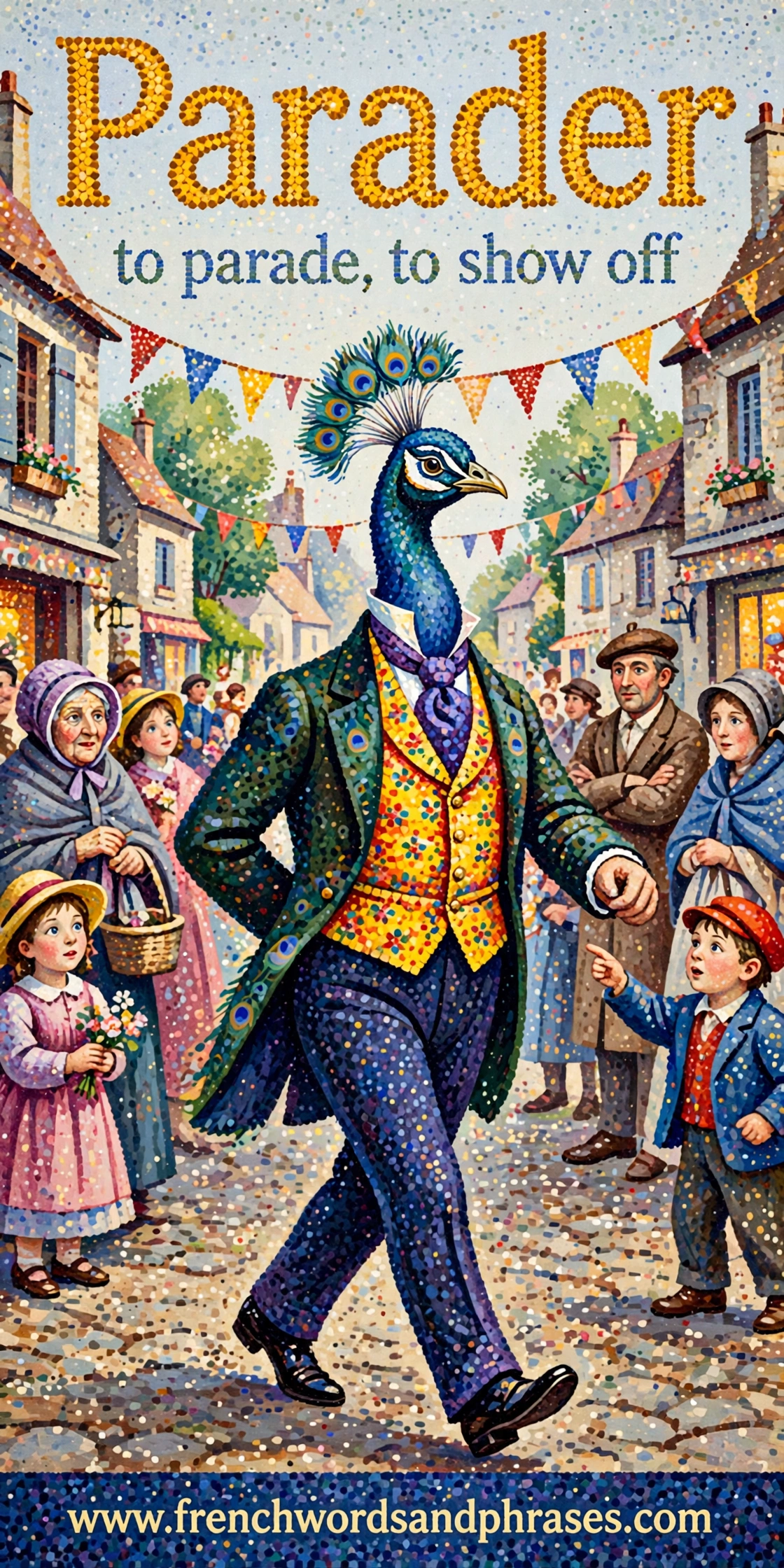
Parader means to parade, to show off — to march or strut in public so that everyone can admire you.
Trumpets on the Champs-Élysées, soldiers in step under the July sun, a peacock opening its tail in the farmyard — parader is the verb of display: marching, strutting and showing off in front of an audience that is meant to look.
In this guide, you’ll learn how to conjugate parader in all the major French tenses and moods. Explore complete conjugation tables, French examples, English translations, and practice quizzes.
Understanding the French Verb Parader
Parader is a regular French verb belonging to the first group of verbs, those ending in -er.
It means to parade, to show off. It is commonly used for military parades and official ceremonies, for animals displaying themselves — le paon parade, the peacock struts and displays — and, with a smile or a sneer, for anyone exhibiting a new car, a new partner or a new title a little too visibly.
Verb classification: First group (-er)
Auxiliary verb: Avoir
Past participle: paradé
Present participle: paradant
English equivalents: To parade, to march past, to show off, to strut; parader sur les Champs-Élysées — to parade down the Champs-Élysées; parader avec sa nouvelle voiture — to show off with one’s new car; parader devant les caméras — to parade in front of the cameras; le défilé du 14 juillet — the Bastille Day parade.
One important detail: parader is a perfectly regular -er verb — je parade, nous paradons, ils paradent — and its trap is one of tone, not spelling. About soldiers and ceremonies it is neutral, even proud: the troops paradent on Bastille Day. About a person, it usually carries a raised eyebrow: il parade avec sa montre en or means he is showing off, flaunting it. It is often followed by devant (the audience) or avec (the thing being flaunted).
Experience the Word
Parader is the verb of being seen — nobody parades alone in a cellar; it needs a street, a crowd and a touch of vanity.
Imagine the morning of the 14th of July. The avenue is closed, the flags are out, and the regiment comes down the hill in perfect step, boots striking together, while a small boy on his father’s shoulders waves at every single soldier — ils paradent, and the whole town has turned out to watch.
The soldiers are not going anywhere in particular. They are parading — paradant — so that France can see them.
How to Conjugate Parader: Complete French Conjugation Guide
Let’s explore every major conjugation of parader, beginning with the indicative mood.
How to Conjugate Parader in the Indicative Mood
The indicative mood is used to express facts, observations, actions, and events.
How to Conjugate Parader in the Present Tense (Présent)
Used for actions happening now, habitual actions, and general truths.
| Subject | Conjugation |
|---|---|
| je | parade |
| tu | parades |
| il / elle | parade |
| nous | paradons |
| vous | paradez |
| ils / elles | paradent |
Les soldats paradent sur les Champs-Élysées le 14 juillet.
The soldiers parade down the Champs-Élysées on the 14th of July.
Complete the sentence:
Nous ______ sur la place du village.
Reveal the answer
paradons
Nous paradons sur la place du village.
We are parading on the village square.
How to Conjugate Parader in the Passé Composé
Used for completed actions in the past. Parader takes the auxiliary verb avoir.
| Subject | Conjugation |
|---|---|
| j’ | ai paradé |
| tu | as paradé |
| il / elle | a paradé |
| nous | avons paradé |
| vous | avez paradé |
| ils / elles | ont paradé |
Il a paradé toute la soirée avec sa médaille.
He showed off all evening with his medal.
How to Conjugate Parader in the Imparfait (Imperfect Tense)
Used for habitual past actions, descriptions, and ongoing situations in the past.
| Subject | Conjugation |
|---|---|
| je | paradais |
| tu | paradais |
| il / elle | paradait |
| nous | paradions |
| vous | paradiez |
| ils / elles | paradaient |
Le paon paradait dans la cour de la ferme.
The peacock used to strut about in the farmyard.
Choose the correct form:
He showed off with his medal.
Il ______ avec sa médaille. (a paradé / est paradé)
Reveal the answer
a paradé
Il a paradé avec sa médaille.
Parader takes avoir.
How to Conjugate Parader in the Plus-que-parfait
Used to describe an action that had already been completed before another past event.
| Subject | Conjugation |
|---|---|
| j’ | avais paradé |
| tu | avais paradé |
| il / elle | avait paradé |
| nous | avions paradé |
| vous | aviez paradé |
| ils / elles | avaient paradé |
Elle avait paradé devant les photographes avant le scandale.
She had paraded in front of the photographers before the scandal.
How to Conjugate Parader in the Passé Simple
Primarily used in formal writing, literature, and historical narratives. It is rarely used in everyday conversation.
| Subject | Conjugation |
|---|---|
| je | paradai |
| tu | paradas |
| il / elle | parada |
| nous | paradâmes |
| vous | paradâtes |
| ils / elles | paradèrent |
La garde parada devant le palais sous les applaudissements.
The guard paraded before the palace to applause.
How to Conjugate Parader in the Passé Antérieur
A literary tense used to express an action completed immediately before another past action, generally in the passé simple.
| Subject | Conjugation |
|---|---|
| j’ | eus paradé |
| tu | eus paradé |
| il / elle | eut paradé |
| nous | eûmes paradé |
| vous | eûtes paradé |
| ils / elles | eurent paradé |
Quand les troupes eurent paradé, la fête commença.
When the troops had paraded past, the festivities began.
How to Conjugate Parader in the Future Tense (Futur Simple)
Used to describe actions that will take place in the future.
| Subject | Conjugation |
|---|---|
| je | paraderai |
| tu | paraderas |
| il / elle | paradera |
| nous | paraderons |
| vous | paraderez |
| ils / elles | paraderont |
Demain, les pompiers paraderont dans les rues du village.
Tomorrow, the firefighters will parade through the streets of the village.
How to Conjugate Parader in the Futur Antérieur (Future Perfect)
Used for an action that will have been completed before a particular point in the future.
| Subject | Conjugation |
|---|---|
| j’ | aurai paradé |
| tu | auras paradé |
| il / elle | aura paradé |
| nous | aurons paradé |
| vous | aurez paradé |
| ils / elles | auront paradé |
À midi, le régiment aura paradé devant le président.
By noon, the regiment will have paraded before the president.
How to Conjugate Parader in the Near Future (Futur Proche)
Used to describe something that is going to happen soon. Formed with aller + infinitive.
| Subject | Conjugation |
|---|---|
| je | vais parader |
| tu | vas parader |
| il / elle | va parader |
| nous | allons parader |
| vous | allez parader |
| ils / elles | vont parader |
Regarde-le, il va parader avec sa nouvelle moto !
Look at him, he is going to show off with his new motorbike!
How to Conjugate Parader in the Conditional Mood
The conditional mood expresses what would happen under certain circumstances. It is also frequently used to make polite requests or express wishes.
How to Conjugate Parader in the Present Conditional
| Subject | Conjugation |
|---|---|
| je | paraderais |
| tu | paraderais |
| il / elle | paraderait |
| nous | paraderions |
| vous | paraderiez |
| ils / elles | paraderaient |
Sans public, il paraderait quand même.
Even without an audience, he would still show off.
How to Conjugate Parader in the Past Conditional
| Subject | Conjugation |
|---|---|
| j’ | aurais paradé |
| tu | aurais paradé |
| il / elle | aurait paradé |
| nous | aurions paradé |
| vous | auriez paradé |
| ils / elles | auraient paradé |
Elle aurait paradé devant les caméras si elle avait gagné.
She would have paraded in front of the cameras if she had won.
Parader in the Literary Past Conditional Form
This less common literary form uses the imperfect subjunctive of avoir.
| Subject | Conjugation |
|---|---|
| j’ | eusse paradé |
| tu | eusses paradé |
| il / elle | eût paradé |
| nous | eussions paradé |
| vous | eussiez paradé |
| ils / elles | eussent paradé |
Il eût paradé sur la place du village au retour de la guerre.
He would have paraded on the village square on his return from the war.
How to Conjugate Parader in the Subjunctive Mood
The subjunctive is used to express wishes, emotions, doubts, necessity, and uncertainty. It frequently follows expressions such as il faut que (it is necessary that) or bien que (although).
How to Conjugate Parader in the Present Subjunctive
| Subject | Conjugation |
|---|---|
| que je | parade |
| que tu | parades |
| qu’il / qu’elle | parade |
| que nous | paradions |
| que vous | paradiez |
| qu’ils / qu’elles | paradent |
Je ne veux pas qu’il parade avec ma voiture.
I do not want him showing off with my car.
Complete the sentence using the subjunctive:
Je ne veux pas que tu ______ devant les caméras.
Reveal the answer
parades
Je ne veux pas que tu parades devant les caméras.
I do not want you parading in front of the cameras.
How to Conjugate Parader in the Imperfect Subjunctive
A literary tense, rarely encountered in modern spoken French.
| Subject | Conjugation |
|---|---|
| que je | paradasse |
| que tu | paradasses |
| qu’il / qu’elle | paradât |
| que nous | paradassions |
| que vous | paradassiez |
| qu’ils / qu’elles | paradassent |
On craignait qu’elle paradât devant les journalistes.
People feared she might parade in front of the journalists.
How to Conjugate Parader in the Pluperfect Subjunctive
A literary construction used to express an action completed before another past action.
| Subject | Conjugation |
|---|---|
| que j’ | eusse paradé |
| que tu | eusses paradé |
| qu’il / qu’elle | eût paradé |
| que nous | eussions paradé |
| que vous | eussiez paradé |
| qu’ils / qu’elles | eussent paradé |
On racontait qu’ils eussent paradé dans la capitale après la victoire.
People said they had paraded in the capital after the victory.
How to Conjugate Parader in the Past Subjunctive
| Subject | Conjugation |
|---|---|
| que j’ | aie paradé |
| que tu | aies paradé |
| qu’il / qu’elle | ait paradé |
| que nous | ayons paradé |
| que vous | ayez paradé |
| qu’ils / qu’elles | aient paradé |
Je suis étonné qu’il ait paradé ainsi devant tout le monde.
I am amazed he showed off like that in front of everyone.
How to Conjugate Parader in the Imperative
The imperative is used to give commands, instructions, invitations, or suggestions. Subject pronouns are omitted.
How to Conjugate Parader in the Present Imperative
| Person | Conjugation |
|---|---|
| (tu) | parade |
| (nous) | paradons |
| (vous) | paradez |
Ne parade pas avec ce trophée, reste modeste !
Do not show off with that trophy, stay modest!
How would you say Do not show off like that (tu form)?
Reveal the answer
Ne parade pas comme ça !
French Participles of Parader
Participles are verb forms that can be used in compound tenses and other grammatical constructions.
Present Participle of Parader
paradant
En paradant devant les caméras, il a oublié son discours.
While parading in front of the cameras, he forgot his speech.
Past Participle of Parader
paradé
Paradé de rue en rue, le champion a fini épuisé.
Paraded from street to street, the champion ended up exhausted.
Parader in Everyday French: Real-Life Examples
Now that you know the conjugations, let’s see how parader appears in everyday French.
Les soldats paradent le 14 juillet.
The soldiers parade on the 14th of July.
Il a paradé avec sa nouvelle voiture.
He showed off with his new car.
Le paon paradait dans la cour.
The peacock used to strut in the yard.
Les pompiers paraderont demain.
The firefighters will parade tomorrow.
Elle paraderait devant les caméras.
She would parade in front of the cameras.
Ne parade pas ainsi !
Do not show off like that!
Beyond Translation: The Meaning of Parader
English parade is the same word borrowed back — French borrowed it from Spanish and Italian display culture, then English borrowed the parade.
But French parader keeps the sideways look.
Where English to parade is mostly about marching, parader slides easily into vanity: parader avec son diplôme is not marching at all — it is waving the diploma under everyone’s nose.
How to Remember the French Verb Parader
Remember it this way: Parader is about soldiers on the avenue — and the neighbour strutting with his new car.
- Two faces: soldiers parade proudly, people parader with a new car — and that second face means showing off.
- Its favourite partners: devant (the audience) and avec (the thing flaunted).
- Regular -er: je parade, nous paradons, past participle paradé.
The key idea is soldiers on the avenue — and the neighbour strutting with his new car.
Test Your Knowledge of Parader
Let’s see how much you’ve learned. Try answering these questions before revealing the answers.
What is the difference between les soldats paradent and il parade avec sa voiture?
Reveal the answer
Tone — the soldiers are marching on parade; the man is showing off, flaunting his car.
How do you say The soldiers parade on the 14th of July in French?
Reveal the answer
Les soldats paradent le 14 juillet.
Translate: He showed off all evening with his medal.
Reveal the answer
Il a paradé toute la soirée avec sa médaille.
What is the past participle of parader?
Reveal the answer
Paradé.
Complete the sentence:
Je ne veux pas qu’il ______ avec ma voiture.
Reveal the answer
parade
Je ne veux pas qu’il parade avec ma voiture.
I do not want him showing off with my car.
Can You Use It?
How would you say this in French?
On the 14th of July, the soldiers parade beneath the flags, and even the pigeons watch.
Reveal the answer
Le 14 juillet, les soldats paradent sous les drapeaux, et même les pigeons regardent.
On the 14th of July, the soldiers parade beneath the flags, and even the pigeons watch.
LEARN FRENCH ONE WORD AT A TIME