
A French Word to Live By
Translate Paprika to English
/pa.pʁi.ka/
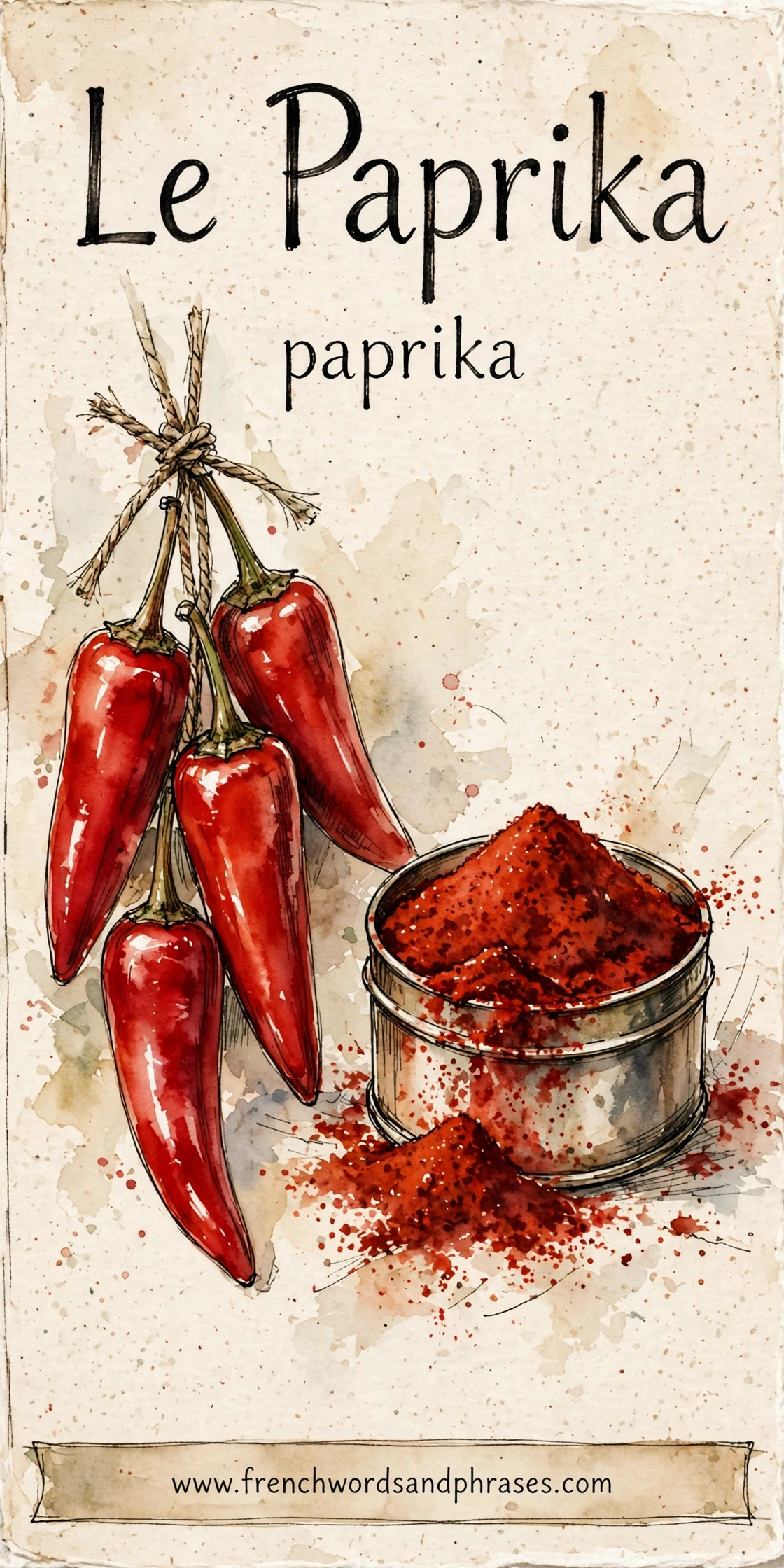
Le paprika means paprika.
At the market stall, little heaps of red powder glow in the sun like tiny brick-dust mountains — le paprika, paprika, the spice that paints a dish red before you even taste it.
In this guide, you’ll learn what paprika means in English, how to use it with its articles, how to form its plural, and how it appears in everyday French. Explore French examples, English translations, and practice quizzes.
Understanding the French Noun Paprika
Paprika is a masculine French noun. It is learned together with its article: le paprika, du paprika. It names the powder ground from dried red peppers, sweet in its gentle form — le paprika doux — or smoky and fiery in its strong ones.
It means paprika — the brick-red powder of Hungary’s goulasch, of Spanish chorizo and smoked pimentón, dusted over eggs, potatoes and chicken. Paprika is as much a colour as a flavour: a spoonful turns a pale stew deep red, and a pinch on top of a dish is the cook’s signature.
Gender: Masculine
Definite article: le — le paprika (paprika)
Indefinite article: un — du paprika (some paprika)
Plural: les paprikas (the varieties of paprika)
English equivalents: Paprika; le paprika fumé — smoked paprika.
One important usage detail: paprika comes in a family, and French names each member — le paprika doux is the sweet, gentle one, le paprika fumé is smoked, and le paprika fort bites back. Recipes rarely say just paprika; they say which one. Choose the wrong brother and your gentle stew becomes a fire alarm.
Experience the Word
Paprika is more than a spice. It is a pot of red paint for the kitchen — the powder that turns an ordinary stew into something that looks like a celebration.
Imagine the spoon tipping over the pot: the pale sauce blushes, then deepens to brick red, and the whole dish suddenly looks as rich as it is about to taste.
You have not just seasoned the stew. You have painted dinner red.
How to Use Paprika in French: Complete Guide
Let’s explore how paprika works in French, beginning with its articles.
Paprika with the Definite Article (Le, Les)
Used for the paprika everyone in the conversation knows — the tin by the stove, the heap at the stall.
| Number | French |
|---|---|
| Singular | le paprika |
| Plural | les paprikas |
Example
Le paprika est dans la boîte rouge, sur l’étagère.
The paprika is in the red tin, on the shelf.
Paprika with the Indefinite Article (Un, Des)
One paprika means one kind of it — sweet, smoked or strong; the powder itself is measured in spoons.
| Number | French |
|---|---|
| Singular | un paprika (a kind of paprika) |
| Plural | des paprikas (kinds of paprika) |
Example
Ce paprika est fumé, il vient d’Espagne.
This paprika is smoked, it comes from Spain.
Paprika with the Partitive Article (Du)
For an amount of paprika — some, a little, a spoonful — French uses du, and quantities follow with de.
| Context | French |
|---|---|
| Some paprika | du paprika |
| A little paprika | un peu de paprika |
| A spoonful of paprika | une cuillère de paprika |
| No paprika | pas de paprika |
Example
Mets une cuillère de paprika dans le goulasch.
Put a spoonful of paprika in the goulash.
Quick Quiz 1
What is le paprika fumé?
Reveal the answer
Smoked paprika — the peppers are dried over wood smoke before grinding, so the powder tastes of the fire as well as the pepper.
Le paprika fumé parfume tout le plat.
Smoked paprika flavours the whole dish.
The Plural of Paprika
The powder stays singular — du paprika — but its varieties line up in the plural: les paprikas, doux, fumé, fort.
| Number | French |
|---|---|
| Singular | le paprika |
| Plural | les paprikas |
Example
Les paprikas d’Espagne et de Hongrie sont célèbres.
The paprikas of Spain and Hungary are famous.
Paprika with Possessive Adjectives (Mon, Ton, Son…)
Possessives agree with the noun, not with the owner — and paprika is masculine, so it takes mon, ton, son.
| Owner | French |
|---|---|
| my | mon paprika |
| your (tu) | ton paprika |
| his / her | son paprika |
| our | notre paprika |
| your (vous) | votre paprika |
| their | leur paprika |
Example
Elle apporte son paprika fumé de son voyage en Espagne.
She brings her smoked paprika back from her trip to Spain.
Quick Quiz 2
Complete the sentence:
______ paprika est doux, pas fort du tout. (My)
Reveal the answer
Mon
Mon paprika est doux, pas fort du tout.
My paprika is sweet, not strong at all.
Paprika with Demonstrative Adjectives (Ce, Ces)
Used to point: this paprika here, these paprikas there.
| Number | French |
|---|---|
| Singular | ce paprika |
| Plural | ces paprikas |
Example
Ce paprika est trop fort pour les enfants.
This paprika is too strong for the children.
Paprika with Adjectives
Adjectives agree with paprika, masculine — doux, fumé, fort.
| Adjective | With Paprika |
|---|---|
| doux (sweet, mild) | du paprika doux |
| fumé (smoked) | du paprika fumé |
| fort (strong, hot) | du paprika fort |
| moulu (ground) | du paprika moulu |
| rouge (red) | du paprika rouge |
Example
Du paprika doux et fumé, voilà le goût de l’Espagne.
Sweet, smoked paprika — that is the taste of Spain.
Quick Quiz 3
Complete the sentence:
Je voudrais du paprika bien ______, pas fort. (mild)
Reveal the answer
doux
Je voudrais du paprika bien doux, pas fort.
I would like really mild paprika, not strong.
Everyday Expressions with Paprika
Goulash, eggs and smoky fires — the paprika phrases of daily life.
| Expression | In English |
|---|---|
| le paprika doux | sweet paprika |
| le paprika fumé | smoked paprika |
| le paprika fort | hot paprika |
| une pincée de paprika | a pinch of paprika |
| des œufs au paprika | eggs with paprika |
| le goulasch au paprika | goulash with paprika |
Example
Une pincée de paprika sur les œufs, c’est joli et bon.
A pinch of paprika on the eggs — pretty and tasty.
Words from the Same Family as Paprika
Peppers, smoke and red powder — the words that travel with paprika.
| French | In English |
|---|---|
| le poivron | the pepper (the vegetable) |
| le piment | the chilli pepper |
| fumer | to smoke |
| la fumée | smoke |
| sécher | to dry |
| le goulasch | goulash |
Example
Le poivron séché et moulu devient le paprika.
The dried, ground pepper becomes paprika.
Quick Quiz 4
The recipe just says « du paprika ». Which one do you reach for, doux or fort?
Reveal the answer
Doux, the sweet one, is the safe default — fort is hot, and fumé changes the whole dish with its smoke. When a recipe says nothing, it means the gentle brother.
Sans précision, prends le paprika doux.
If nothing is specified, take the sweet paprika.
Paprika in Everyday French: Real-Life Examples
Now that you know the word, let’s see how paprika appears in everyday French.
Example 1 — Goulash night
Le goulasch mijote avec beaucoup de paprika doux.
The goulash simmers with plenty of sweet paprika.
Example 2 — At the spice stall
Je voudrais du paprika fumé, s’il vous plaît.
I would like some smoked paprika, please.
Example 3 — Eggs
Elle saupoudre les œufs d’un peu de paprika.
She sprinkles the eggs with a little paprika.
Example 4 — Potatoes
Les pommes de terre au paprika sont croustillantes.
The potatoes with paprika are crispy.
Example 5 — Choosing carefully
Ce paprika est fort, mets-en juste une pincée.
This paprika is hot, put in just a pinch.
Example 6 — Chicken
Le poulet au paprika est le plat du dimanche.
Chicken with paprika is the Sunday dish.
See le paprika in a story: Spices: French Vocabulary (Les Épices) — a cook restocking her spice drawer.
Beyond Translation: The Meaning of Paprika
Paprika is Hungary’s red gold: whole towns dry, string and grind the peppers each autumn, and the goulasch pot is unthinkable without it. Spain smokes its own version over oak fires to make pimentón, the soul of chorizo. France adopted both — the doux for colour, the fumé for depth, the fort for courage.
To say paprika is to paint the pot red.
It evokes the heaps of brick-red powder at the market, the first spoonful blooming in hot oil, and the quiet pride of a stew that finally looks as good as it tastes.
How to Remember the French Noun Paprika
Remember it this way: Paprika is paprika — masculine, with le and du, a family of three brothers: doux, fumé and fort.
- You paint the stew — du paprika dans le goulasch, masculine with le.
- You pick your brother — doux gentle, fumé smoky, fort hot.
- You finish the dish — une pincée de paprika sur les œufs.
The key idea is le paprika doux for colour — le paprika fort with care.
Test Your Knowledge of Paprika
Let’s see how much you’ve learned. Try answering these questions before revealing the answers.
Question 1
Is paprika masculine or feminine?
Reveal the answer
Masculine — le paprika, du paprika.
Question 2
What is le paprika fumé?
Reveal the answer
Smoked paprika — dried over wood smoke before grinding.
Question 3
Translate: She sprinkles the eggs with a little paprika.
Reveal the answer
Elle saupoudre les œufs d’un peu de paprika.
Question 4
Name the three brothers of the paprika family.
Reveal the answer
Doux (sweet), fumé (smoked) and fort (hot).
Question 5
Complete the sentence:
Mets une cuillère ______ paprika dans la sauce.
Reveal the answer
de
Mets une cuillère de paprika dans la sauce.
Put a spoonful of paprika in the sauce.
Your Final Challenge
Can You Use It?
How would you say this in French?
“A spoonful of sweet paprika turns the stew deep red.”
Reveal the answer
Une cuillère de paprika doux rend le ragoût tout rouge.
A spoonful of sweet paprika turns the stew deep red.
A little French. A little curiosity. A richer everyday life.
LEARN FRENCH ONE WORD AT A TIME




