How to Conjugate Papillonner in French
/pa.pi.jɔ.ne/
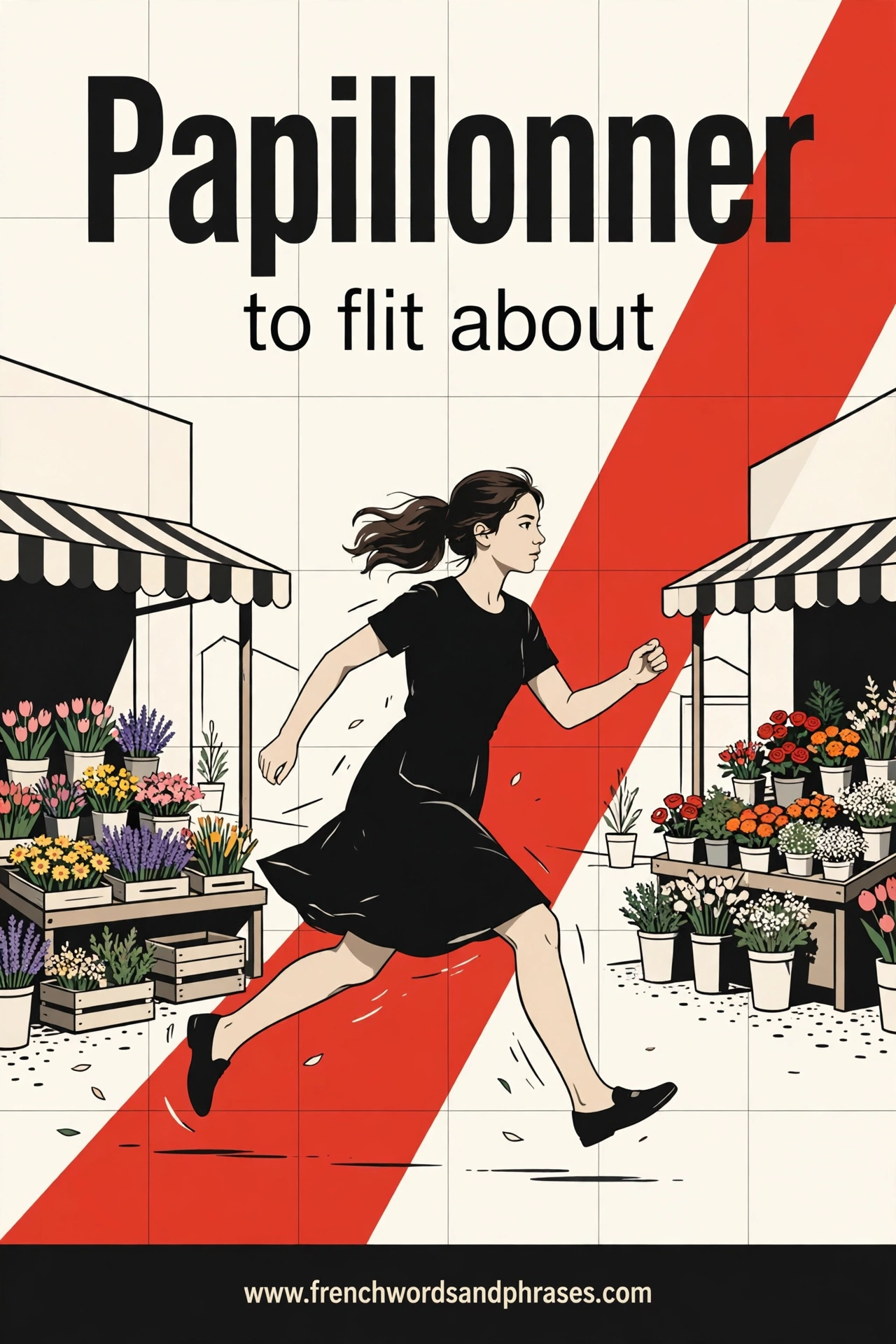
Papillonner means to flit about — to flutter from person to person, stall to stall or subject to subject, never settling anywhere for long.
A guest drifting from conversation to conversation at a garden party, a shopper touching everything at the market and buying nothing, a mind skipping across topics — papillonner is the butterfly verb: beautiful, light, and impossible to pin down.
In this guide, you’ll learn how to conjugate papillonner in all the major French tenses and moods. Explore complete conjugation tables, French examples, English translations, and practice quizzes.
Understanding the French Verb Papillonner
Papillonner is a regular French verb belonging to the first group of verbs, those ending in -er.
It means to flit about. It is used of social butterflies working a room, of shoppers and tourists drifting without a plan, and figuratively of attention and conversation that will not settle: un esprit qui papillonne is a mind that skips from idea to idea. The tone is fond rather than hostile — papillonner is charming, if slightly exasperating.
Verb classification: First group (-er)
Auxiliary verb: Avoir
Past participle: papillonné
Present participle: papillonnant
English equivalents: To flit about, to flutter from one thing to another; papillonner de stand en stand — to flit from stall to stall; papillonner d’un sujet à l’autre — to skip from topic to topic; papillonner en société — to flit about socially; un papillon — a butterfly.
One important detail: papillonner is simply un papillon, a butterfly, turned into a verb, and it is perfectly regular — je papillonne, nous papillonnons, j’ai papillonné — with the double n of papillon kept throughout. Watch what it governs: one flits de one thing à another — papillonner de stand en stand, d’un sujet à l’autre — and the construction carries the whole picture of never landing.
Experience the Word
Papillonner is the verb of the unlandable — always arriving, never staying, gone before the conversation warms up.
Imagine a garden party in June. One guest is everywhere and nowhere: two minutes with the neighbours, a laugh by the buffet, a question to the gardener, and she is off again — elle papillonne, and by midnight she has spoken to forty people and finished no conversation at all.
Nobody minds; that is her charm. She has flitted — papillonné — the whole evening, like her namesake over the flower beds.
How to Conjugate Papillonner: Complete French Conjugation Guide
Let’s explore every major conjugation of papillonner, beginning with the indicative mood.
How to Conjugate Papillonner in the Indicative Mood
The indicative mood is used to express facts, observations, actions, and events.
How to Conjugate Papillonner in the Present Tense (Présent)
Used for actions happening now, habitual actions, and general truths.
| Subject | Conjugation |
|---|---|
| je | papillonne |
| tu | papillonnes |
| il / elle | papillonne |
| nous | papillonnons |
| vous | papillonnez |
| ils / elles | papillonnent |
Elle papillonne de stand en stand au marché.
She flits from stall to stall at the market.
Complete the sentence:
Nous ______ d’un sujet à l’autre sans nous arrêter.
Reveal the answer
papillonnons
Nous papillonnons d’un sujet à l’autre sans nous arrêter.
We flit from one topic to another without stopping.
How to Conjugate Papillonner in the Passé Composé
Used for completed actions in the past. Papillonner takes the auxiliary verb avoir.
| Subject | Conjugation |
|---|---|
| j’ | ai papillonné |
| tu | as papillonné |
| il / elle | a papillonné |
| nous | avons papillonné |
| vous | avez papillonné |
| ils / elles | ont papillonné |
Il a papillonné toute la soirée sans se poser.
He flitted about all evening without settling.
How to Conjugate Papillonner in the Imparfait (Imperfect Tense)
Used for habitual past actions, descriptions, and ongoing situations in the past.
| Subject | Conjugation |
|---|---|
| je | papillonnais |
| tu | papillonnais |
| il / elle | papillonnait |
| nous | papillonnions |
| vous | papillonniez |
| ils / elles | papillonnaient |
Enfant, elle papillonnait d’un livre à l’autre.
As a child, she used to flit from one book to another.
Choose the correct form:
He flitted about all evening.
Il ______ toute la soirée. (a papillonné / est papillonné)
Reveal the answer
a papillonné
Il a papillonné toute la soirée.
Papillonner takes avoir.
How to Conjugate Papillonner in the Plus-que-parfait
Used to describe an action that had already been completed before another past event.
| Subject | Conjugation |
|---|---|
| j’ | avais papillonné |
| tu | avais papillonné |
| il / elle | avait papillonné |
| nous | avions papillonné |
| vous | aviez papillonné |
| ils / elles | avaient papillonné |
Ils avaient papillonné des années avant de choisir un métier.
They had flitted about for years before choosing a trade.
How to Conjugate Papillonner in the Passé Simple
Primarily used in formal writing, literature, and historical narratives. It is rarely used in everyday conversation.
| Subject | Conjugation |
|---|---|
| je | papillonnai |
| tu | papillonnas |
| il / elle | papillonna |
| nous | papillonnâmes |
| vous | papillonnâtes |
| ils / elles | papillonnèrent |
La jeune fille papillonna de groupe en groupe toute la fête.
The girl flitted from group to group all through the party.
How to Conjugate Papillonner in the Passé Antérieur
A literary tense used to express an action completed immediately before another past action, generally in the passé simple.
| Subject | Conjugation |
|---|---|
| j’ | eus papillonné |
| tu | eus papillonné |
| il / elle | eut papillonné |
| nous | eûmes papillonné |
| vous | eûtes papillonné |
| ils / elles | eurent papillonné |
Quand il eut papillonné une heure au marché, il rentra sans rien acheter.
When he had flitted about the market for an hour, he went home without buying anything.
How to Conjugate Papillonner in the Future Tense (Futur Simple)
Used to describe actions that will take place in the future.
| Subject | Conjugation |
|---|---|
| je | papillonnerai |
| tu | papillonneras |
| il / elle | papillonnera |
| nous | papillonnerons |
| vous | papillonnerez |
| ils / elles | papillonneront |
Demain, les touristes papillonneront dans les ruelles de la vieille ville.
Tomorrow, the tourists will flit about the lanes of the old town.
How to Conjugate Papillonner in the Futur Antérieur (Future Perfect)
Used for an action that will have been completed before a particular point in the future.
| Subject | Conjugation |
|---|---|
| j’ | aurai papillonné |
| tu | auras papillonné |
| il / elle | aura papillonné |
| nous | aurons papillonné |
| vous | aurez papillonné |
| ils / elles | auront papillonné |
À la fin de la soirée, elle aura papillonné entre tous les invités.
By the end of the evening, she will have flitted among all the guests.
How to Conjugate Papillonner in the Near Future (Futur Proche)
Used to describe something that is going to happen soon. Formed with aller + infinitive.
| Subject | Conjugation |
|---|---|
| je | vais papillonner |
| tu | vas papillonner |
| il / elle | va papillonner |
| nous | allons papillonner |
| vous | allez papillonner |
| ils / elles | vont papillonner |
Je vais papillonner un peu au salon avant le dîner.
I am going to flit about the fair a little before dinner.
How to Conjugate Papillonner in the Conditional Mood
The conditional mood expresses what would happen under certain circumstances. It is also frequently used to make polite requests or express wishes.
How to Conjugate Papillonner in the Present Conditional
| Subject | Conjugation |
|---|---|
| je | papillonnerais |
| tu | papillonnerais |
| il / elle | papillonnerait |
| nous | papillonnerions |
| vous | papillonneriez |
| ils / elles | papillonneraient |
Sans son agenda, il papillonnerait encore plus.
Without his diary, he would flit about even more.
How to Conjugate Papillonner in the Past Conditional
| Subject | Conjugation |
|---|---|
| j’ | aurais papillonné |
| tu | aurais papillonné |
| il / elle | aurait papillonné |
| nous | aurions papillonné |
| vous | auriez papillonné |
| ils / elles | auraient papillonné |
Elle aurait papillonné moins si la fête avait été plus petite.
She would have flitted about less if the party had been smaller.
Papillonner in the Literary Past Conditional Form
This less common literary form uses the imperfect subjunctive of avoir.
| Subject | Conjugation |
|---|---|
| j’ | eusse papillonné |
| tu | eusses papillonné |
| il / elle | eût papillonné |
| nous | eussions papillonné |
| vous | eussiez papillonné |
| ils / elles | eussent papillonné |
Il eût papillonné toute sa jeunesse sans la rencontre de sa femme.
He would have flitted about his whole youth but for meeting his wife.
How to Conjugate Papillonner in the Subjunctive Mood
The subjunctive is used to express wishes, emotions, doubts, necessity, and uncertainty. It frequently follows expressions such as il faut que (it is necessary that) or bien que (although).
How to Conjugate Papillonner in the Present Subjunctive
| Subject | Conjugation |
|---|---|
| que je | papillonne |
| que tu | papillonnes |
| qu’il / qu’elle | papillonne |
| que nous | papillonnions |
| que vous | papillonniez |
| qu’ils / qu’elles | papillonnent |
Il ne faut pas que tu papillonnes pendant les visites.
You must not flit about during the viewings.
Complete the sentence using the subjunctive:
Je crains qu’elle ______ toute la journée sans rien acheter.
Reveal the answer
papillonne
Je crains qu’elle papillonne toute la journée sans rien acheter.
I fear she will flit about all day without buying anything.
How to Conjugate Papillonner in the Imperfect Subjunctive
A literary tense, rarely encountered in modern spoken French.
| Subject | Conjugation |
|---|---|
| que je | papillonnasse |
| que tu | papillonnasses |
| qu’il / qu’elle | papillonnât |
| que nous | papillonnassions |
| que vous | papillonnassiez |
| qu’ils / qu’elles | papillonnassent |
Je craignais qu’elle papillonnât toute la journée sans rien acheter.
I feared she might flit about all day without buying anything.
How to Conjugate Papillonner in the Pluperfect Subjunctive
A literary construction used to express an action completed before another past action.
| Subject | Conjugation |
|---|---|
| que j’ | eusse papillonné |
| que tu | eusses papillonné |
| qu’il / qu’elle | eût papillonné |
| que nous | eussions papillonné |
| que vous | eussiez papillonné |
| qu’ils / qu’elles | eussent papillonné |
On racontait qu’ils eussent papillonné d’atelier en atelier sans rien apprendre.
People said they had flitted from workshop to workshop without learning anything.
How to Conjugate Papillonner in the Past Subjunctive
| Subject | Conjugation |
|---|---|
| que j’ | aie papillonné |
| que tu | aies papillonné |
| qu’il / qu’elle | ait papillonné |
| que nous | ayons papillonné |
| que vous | ayez papillonné |
| qu’ils / qu’elles | aient papillonné |
Je suis étonné qu’il ait papillonné ainsi toute la soirée.
I am amazed he flitted about like that all evening.
How to Conjugate Papillonner in the Imperative
The imperative is used to give commands, instructions, invitations, or suggestions. Subject pronouns are omitted.
How to Conjugate Papillonner in the Present Imperative
| Person | Conjugation |
|---|---|
| (tu) | papillonne |
| (nous) | papillonnons |
| (vous) | papillonnez |
Ne papillonne pas, choisis un stand et reste-y !
Don’t flit about, choose a stall and stay there!
How would you say Don’t flit about, stay with us (tu form)?
Reveal the answer
Ne papillonne pas, reste avec nous !
French Participles of Papillonner
Participles are verb forms that can be used in compound tenses and other grammatical constructions.
Present Participle of Papillonner
papillonnant
En papillonnant de groupe en groupe, elle a salué tout le monde.
By flitting from group to group, she greeted everyone.
Past Participle of Papillonner
papillonné
Papillonné de conversation en conversation, il n’a rien retenu de la soirée.
Having flitted from conversation to conversation, he remembered nothing of the evening.
Papillonner in Everyday French: Real-Life Examples
Now that you know the conjugations, let’s see how papillonner appears in everyday French.
Elle papillonne de stand en stand.
She flits from stall to stall.
Il a papillonné toute la soirée.
He flitted about all evening.
Elle papillonnait d’un livre à l’autre.
She used to flit from one book to another.
Les touristes papillonneront dans la vieille ville.
The tourists will flit about the old town.
Il papillonnerait encore plus sans son agenda.
He would flit about even more without his diary.
Ne papillonne pas, reste avec nous !
Don’t flit about, stay with us!
Beyond Translation: The Meaning of Papillonner
The butterfly is inside the word: un papillon — itself from Latin papilio — lends French its verb for every charming, unsettled movement.
To move like a butterfly is to settle nowhere.
Papillonner is never quite an insult; the papillon is too pretty for that. The social guest, the browsing shopper and the skipping mind all papillonnent — and the word watches them the way you watch a butterfly, half admiring, half unable to follow.
How to Remember the French Verb Papillonner
Remember it this way: Papillonner is about the butterfly guest — forty conversations, none finished.
- Un papillon is a butterfly — papillonner is to move exactly like one: land, sip, gone.
- It governs de … à: papillonner de stand en stand, d’un sujet à l’autre.
- Regular -er with the butterfly’s double n: je papillonne, nous papillonnons, past participle papillonné.
The key idea is the butterfly guest — forty conversations, none finished.
Test Your Knowledge of Papillonner
Let’s see how much you’ve learned. Try answering these questions before revealing the answers.
Which insect gives papillonner its meaning?
Reveal the answer
The butterfly — un papillon; to papillonner is to flit about like one, never settling.
How do you say She flits from stall to stall in French?
Reveal the answer
Elle papillonne de stand en stand.
Translate: He flitted about all evening.
Reveal the answer
Il a papillonné toute la soirée.
What is the past participle of papillonner?
Reveal the answer
Papillonné.
Complete the sentence:
Il ne faut pas que tu ______ pendant les visites.
Reveal the answer
papillonnes
Il ne faut pas que tu papillonnes pendant les visites.
You must not flit about during the viewings.
Can You Use It?
How would you say this in French?
She flits from stall to stall at the Sunday market, and everyone knows her by her first name.
Reveal the answer
Elle papillonne de stand en stand au marché du dimanche, et tout le monde la connaît par son prénom.
She flits from stall to stall at the Sunday market, and everyone knows her by her first name.
LEARN FRENCH ONE WORD AT A TIME