How to Conjugate Palisser in French
/pa.li.se/
Palisser means to nail up, to train (branches) — to fasten a climbing plant flat against a wall or trellis, branch by branch, until the wall itself blooms.
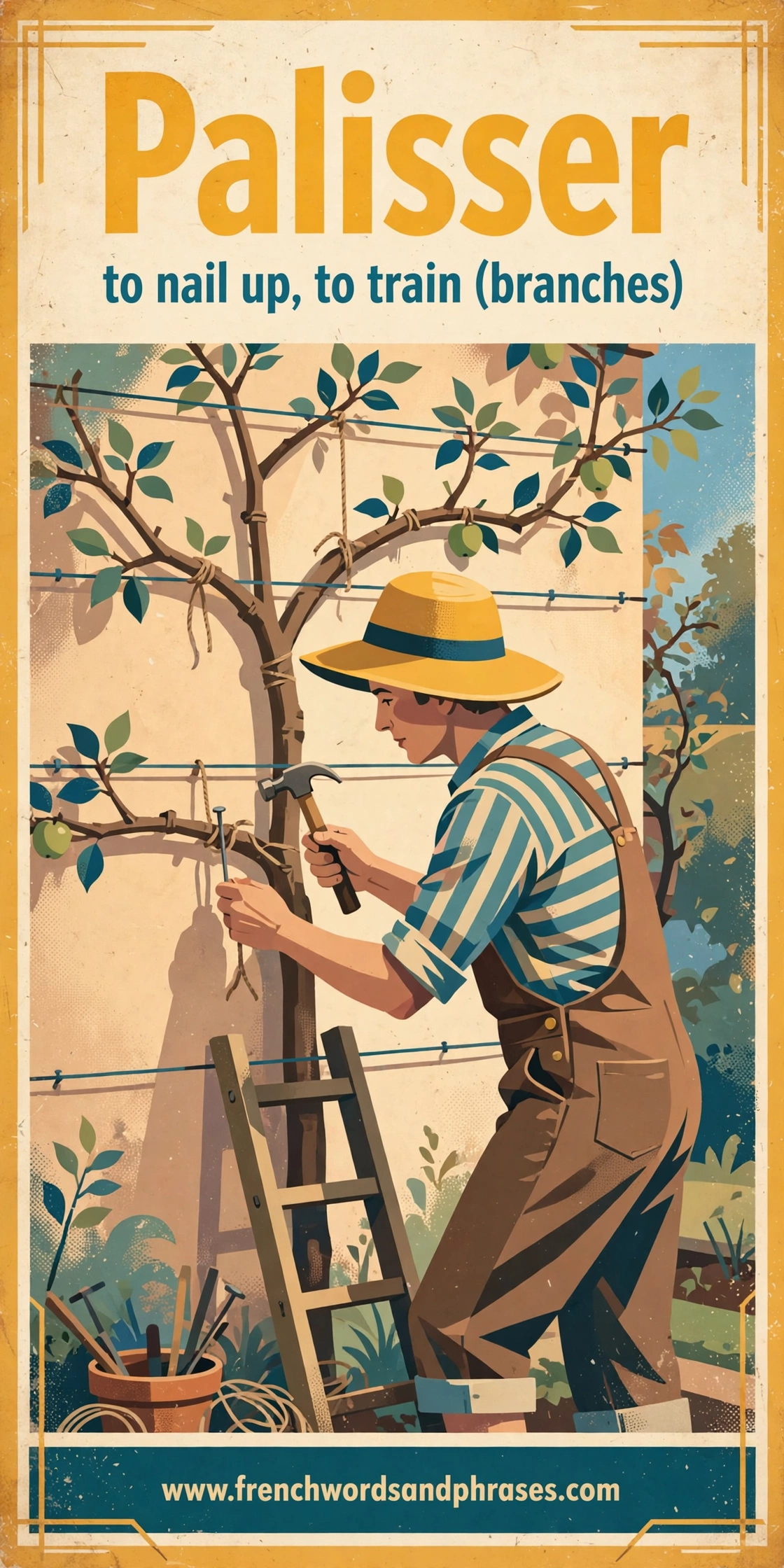
Against a sun-warmed stone wall in Provence, a gardener works along a pear tree spread out like an open fan, tying each branch to its wire with a strip of raffia. Palisser is his verb: to train a tree or vine flat against a support, nailed, tied and persuaded into a living pattern — the espalier, gardening’s most patient art.
In this guide, you’ll learn how to conjugate palisser in all the major French tenses and moods. Explore complete conjugation tables, French examples, English translations, and practice quizzes.
Understanding the French Verb Palisser
Palisser is a regular French verb belonging to the first group of verbs, those ending in -er.
It means to nail up, to train (branches). It belongs to the garden: fruit trees trained flat against walls to catch the sun and save space, vines wired along a trellis, roses and jasmine fastened to a fence. The trained tree is un arbre palissé, the technique is le palissage, and the flat, formal shapes — fans, candelabra, horizontal cordons — are the pride of French kitchen gardens.
Verb classification: First group (-er)
Auxiliary verb: Avoir
Past participle: palissé
Present participle: palissant
English equivalents: To nail up, to train (branches), to espalier; palisser un arbre contre un mur — to train a tree against a wall; palisser une vigne — to train a vine on wires; palisser en espalier — to train as an espalier; un palissage — the training of branches on a support.
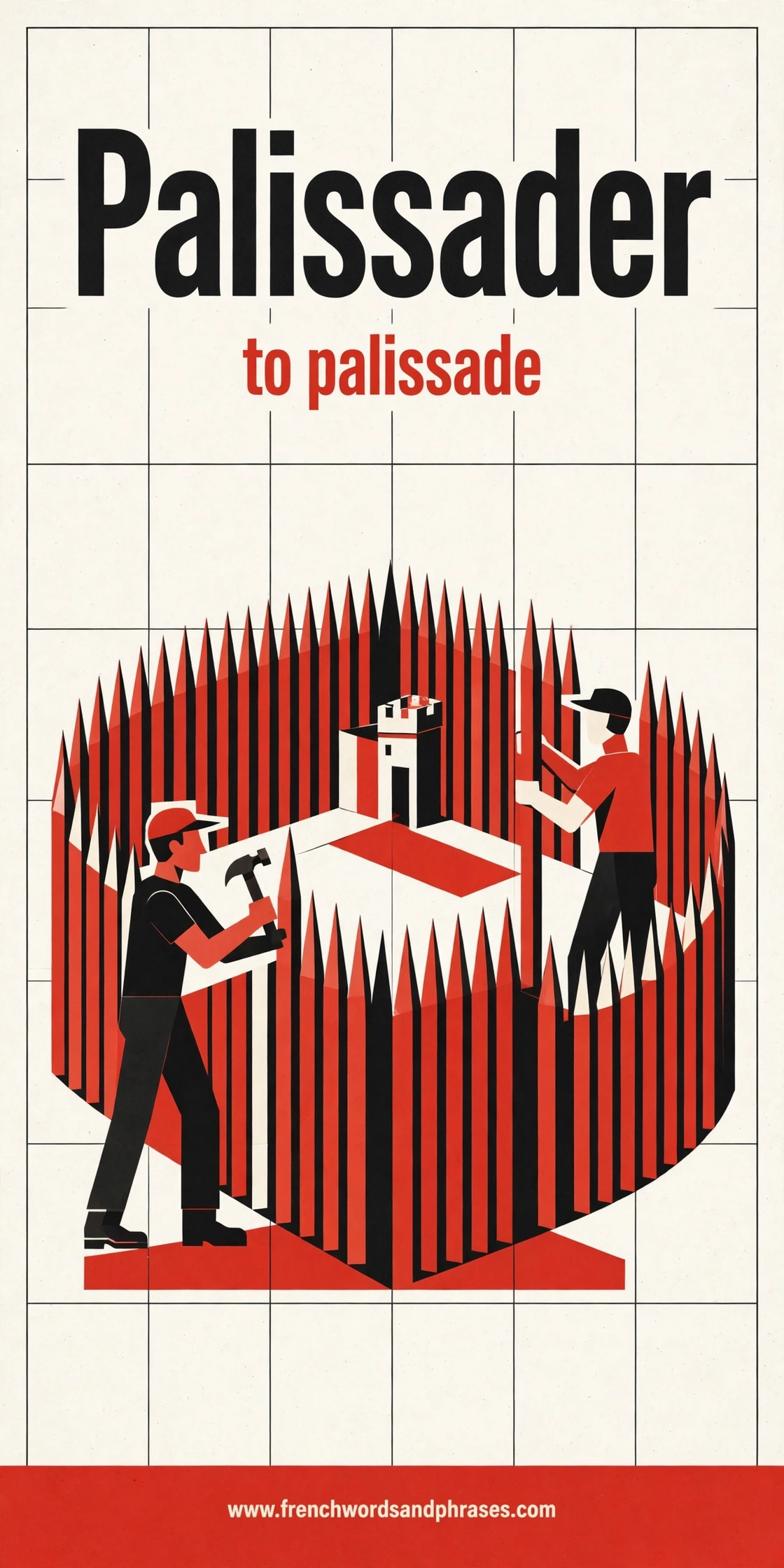
One important detail: palisser has one s where its cousin palissader has two — and the difference is the picture: a palissade is a fence of stakes, while palisser works branch by branch with ties and small nails, from un palis, a stake or paling used as the support. Modern gardeners tie more than they nail — the dictionary’s ‘to nail up’ is the old technique — but the verb covers both. Conjugation is regular: je palisse, nous palissons, past participle palissé.
Experience the Word
Palisser is the verb of gardening as sculpture — a tree persuaded, one tied branch at a time, to grow in two dimensions.
Imagine the walled garden of a Loire château in April. The head gardener moves along a century-old pear tree, flat against the south wall like green calligraphy, untying last year’s raffia, easing a new shoot along its wire, tying it home: il palisse, as his father did, on the same tree, at the same wall.
The tree is not pruned into submission. It has been trained — palissé — into a fan of branches that flowers against the stone.
How to Conjugate Palisser: Complete French Conjugation Guide
Let’s explore every major conjugation of palisser, beginning with the indicative mood.
How to Conjugate Palisser in the Indicative Mood
The indicative mood is used to express facts, observations, actions, and events.
How to Conjugate Palisser in the Present Tense (Présent)
Used for actions happening now, habitual actions, and general truths.
| Subject | Conjugation |
|---|---|
| je | palisse |
| tu | palisses |
| il / elle | palisse |
| nous | palissons |
| vous | palissez |
| ils / elles | palissent |
Le jardinier palisse le poirier contre le mur sud.
The gardener is training the pear tree against the south wall.
Complete the sentence:
Nous ______ la vigne le long de la treille.
Reveal the answer
palissons
Nous palissons la vigne le long de la treille.
We are training the vine along the trellis.
How to Conjugate Palisser in the Passé Composé
Used for completed actions in the past. Palisser takes the auxiliary verb avoir.
| Subject | Conjugation |
|---|---|
| j’ | ai palissé |
| tu | as palissé |
| il / elle | a palissé |
| nous | avons palissé |
| vous | avez palissé |
| ils / elles | ont palissé |
Nous avons palissé la vigne le long de la treille.
We trained the vine along the trellis.
How to Conjugate Palisser in the Imparfait (Imperfect Tense)
Used for habitual past actions, descriptions, and ongoing situations in the past.
| Subject | Conjugation |
|---|---|
| je | palissais |
| tu | palissais |
| il / elle | palissait |
| nous | palissions |
| vous | palissiez |
| ils / elles | palissaient |
Mon grand-père palissait ses rosiers chaque printemps.
My grandfather used to train his rose bushes every spring.
Choose the correct form:
She trained the rose bush.
Elle ______ le rosier. (a palissé / est palissée)
Reveal the answer
a palissé
Elle a palissé le rosier.
Palisser takes avoir.
How to Conjugate Palisser in the Plus-que-parfait
Used to describe an action that had already been completed before another past event.
| Subject | Conjugation |
|---|---|
| j’ | avais palissé |
| tu | avais palissé |
| il / elle | avait palissé |
| nous | avions palissé |
| vous | aviez palissé |
| ils / elles | avaient palissé |
Ils avaient palissé les pommiers avant l’arrivée du gel.
They had trained the apple trees before the frost arrived.
How to Conjugate Palisser in the Passé Simple
Primarily used in formal writing, literature, and historical narratives. It is rarely used in everyday conversation.
| Subject | Conjugation |
|---|---|
| je | palissai |
| tu | palissas |
| il / elle | palissa |
| nous | palissâmes |
| vous | palissâtes |
| ils / elles | palissèrent |
Le jardinier palissa l’arbre entier en une matinée.
The gardener trained the whole tree in one morning.
How to Conjugate Palisser in the Passé Antérieur
A literary tense used to express an action completed immediately before another past action, generally in the passé simple.
| Subject | Conjugation |
|---|---|
| j’ | eus palissé |
| tu | eus palissé |
| il / elle | eut palissé |
| nous | eûmes palissé |
| vous | eûtes palissé |
| ils / elles | eurent palissé |
Quand il eut palissé la dernière branche, il recula pour admirer l’éventail.
When he had trained the last branch, he stepped back to admire the fan.
How to Conjugate Palisser in the Future Tense (Futur Simple)
Used to describe actions that will take place in the future.
| Subject | Conjugation |
|---|---|
| je | palisserai |
| tu | palisseras |
| il / elle | palissera |
| nous | palisserons |
| vous | palisserez |
| ils / elles | palisseront |
Au printemps, nous palisserons le jasmin sur la clôture.
In spring, we will train the jasmine on the fence.
How to Conjugate Palisser in the Futur Antérieur (Future Perfect)
Used for an action that will have been completed before a particular point in the future.
| Subject | Conjugation |
|---|---|
| j’ | aurai palissé |
| tu | auras palissé |
| il / elle | aura palissé |
| nous | aurons palissé |
| vous | aurez palissé |
| ils / elles | auront palissé |
À la fin du mois, tu auras palissé toutes les vignes du rang.
By the end of the month, you will have trained all the vines in the row.
How to Conjugate Palisser in the Near Future (Futur Proche)
Used to describe something that is going to happen soon. Formed with aller + infinitive.
| Subject | Conjugation |
|---|---|
| je | vais palisser |
| tu | vas palisser |
| il / elle | va palisser |
| nous | allons palisser |
| vous | allez palisser |
| ils / elles | vont palisser |
Je vais palisser ce rosier avant qu’il ne s’étale partout.
I am going to train this rose bush before it sprawls everywhere.
How to Conjugate Palisser in the Conditional Mood
The conditional mood expresses what would happen under certain circumstances. It is also frequently used to make polite requests or express wishes.
How to Conjugate Palisser in the Present Conditional
| Subject | Conjugation |
|---|---|
| je | palisserais |
| tu | palisserais |
| il / elle | palisserait |
| nous | palisserions |
| vous | palisseriez |
| ils / elles | palisseraient |
Avec un mur au sud, on palisserait des abricotiers même ici.
With a south-facing wall, one could train apricot trees even here.
How to Conjugate Palisser in the Past Conditional
| Subject | Conjugation |
|---|---|
| j’ | aurais palissé |
| tu | aurais palissé |
| il / elle | aurait palissé |
| nous | aurions palissé |
| vous | auriez palissé |
| ils / elles | auraient palissé |
Elle aurait palissé la glycine si la treille avait tenu.
She would have trained the wisteria if the trellis had held.
Palisser in the Literary Past Conditional Form
This less common literary form uses the imperfect subjunctive of avoir.
| Subject | Conjugation |
|---|---|
| j’ | eusse palissé |
| tu | eusses palissé |
| il / elle | eût palissé |
| nous | eussions palissé |
| vous | eussiez palissé |
| ils / elles | eussent palissé |
Le jardinier eût palissé l’espalier avant l’hiver sans la tempête.
The gardener would have trained the espalier before winter, but for the storm.
How to Conjugate Palisser in the Subjunctive Mood
The subjunctive is used to express wishes, emotions, doubts, necessity, and uncertainty. It frequently follows expressions such as il faut que (it is necessary that) or bien que (although).
How to Conjugate Palisser in the Present Subjunctive
| Subject | Conjugation |
|---|---|
| que je | palisse |
| que tu | palisses |
| qu’il / qu’elle | palisse |
| que nous | palissions |
| que vous | palissiez |
| qu’ils / qu’elles | palissent |
Il faut que tu palisses ces branches avant la montée de la sève.
You must train these branches before the sap rises.
Complete the sentence using the subjunctive:
Il faut que vous ______ le jasmin sur la clôture.
Reveal the answer
palissiez
Il faut que vous palissiez le jasmin sur la clôture.
You must train the jasmine on the fence.
How to Conjugate Palisser in the Imperfect Subjunctive
A literary tense, rarely encountered in modern spoken French.
| Subject | Conjugation |
|---|---|
| que je | palissasse |
| que tu | palissasses |
| qu’il / qu’elle | palissât |
| que nous | palissassions |
| que vous | palissassiez |
| qu’ils / qu’elles | palissassent |
Le maître voulait que l’apprenti palissât le poirier sans aide.
The master wanted the apprentice to train the pear tree unaided.
How to Conjugate Palisser in the Pluperfect Subjunctive
A literary construction used to express an action completed before another past action.
| Subject | Conjugation |
|---|---|
| que j’ | eusse palissé |
| que tu | eusses palissé |
| qu’il / qu’elle | eût palissé |
| que nous | eussions palissé |
| que vous | eussiez palissé |
| qu’ils / qu’elles | eussent palissé |
On admirait qu’il eût palissé un arbre centenaire sans le blesser.
People admired that he had trained a hundred-year-old tree without harming it.
How to Conjugate Palisser in the Past Subjunctive
| Subject | Conjugation |
|---|---|
| que j’ | aie palissé |
| que tu | aies palissé |
| qu’il / qu’elle | ait palissé |
| que nous | ayons palissé |
| que vous | ayez palissé |
| qu’ils / qu’elles | aient palissé |
Je suis content que vous ayez palissé la vigne à temps.
I am glad you trained the vine in time.
How to Conjugate Palisser in the Imperative
The imperative is used to give commands, instructions, invitations, or suggestions. Subject pronouns are omitted.
How to Conjugate Palisser in the Present Imperative
| Person | Conjugation |
|---|---|
| (tu) | palisse |
| (nous) | palissons |
| (vous) | palissez |
Palissons ce jeune arbre tant qu’il est souple !
Let us train this young tree while it is still supple!
How would you say Train this rose bush (tu form)?
Reveal the answer
Palisse ce rosier !
French Participles of Palisser
Participles are verb forms that can be used in compound tenses and other grammatical constructions.
Present Participle of Palisser
palissant
En palissant les branches une à une, on forme l’éventail parfait.
By training the branches one by one, you form the perfect fan.
Past Participle of Palisser
palissé
Palissé contre le mur, le poirier donne des fruits magnifiques.
Trained against the wall, the pear tree bears magnificent fruit.
Palisser in Everyday French: Real-Life Examples
Now that you know the conjugations, let’s see how palisser appears in everyday French.
Le jardinier palisse le poirier contre le mur.
The gardener is training the pear tree against the wall.
Nous avons palissé la vigne.
We trained the vine.
Mon grand-père palissait ses rosiers.
My grandfather used to train his rose bushes.
Nous palisserons le jasmin au printemps.
We will train the jasmine in spring.
On palisserait des abricotiers avec un mur au sud.
One could train apricot trees with a south-facing wall.
Palisse ce rosier avant l’été !
Train this rose bush before summer!
Beyond Translation: The Meaning of Palisser
English has no single verb for this — gardeners say to train or use the French noun itself, espalier, borrowed whole.
Le palissage is gardening’s slow geometry.
A palissé tree gives more fruit in less space, ripens against the wall’s stored heat, and turns a kitchen garden into a gallery — proof that in French gardening, even a pear tree can be taught manners.
How to Remember the French Verb Palisser
Remember it this way: Palisser is about the gardener tying a pear tree into a fan against a sunny wall.
- One s in palisser, two in palissader: ties and branches here, a fence of stakes there.
- The picture is a tree flat against a wall, branches tied along wires — an espalier.
- Regular -er: je palisse, nous palissons, past participle palissé.
The key idea is the gardener tying a pear tree into a fan against a sunny wall.
Test Your Knowledge of Palisser
Let’s see how much you’ve learned. Try answering these questions before revealing the answers.
What does a gardener do when he palisse un arbre?
Reveal the answer
He trains it flat against a wall or trellis, tying or nailing each branch along its support.
How do you say The gardener is training the pear tree against the wall in French?
Reveal the answer
Le jardinier palisse le poirier contre le mur.
Translate: We trained the vine along the trellis.
Reveal the answer
Nous avons palissé la vigne le long de la treille.
What is the past participle of palisser?
Reveal the answer
Palissé — one s, unlike palissadé.
Complete the sentence:
Il faut que tu ______ ces branches avant la sève.
Reveal the answer
palisses
Il faut que tu palisses ces branches avant la sève.
You must train these branches before the sap rises.
Can You Use It?
How would you say this in French?
The gardener trains the old pear tree, and the stone wall begins to flower.
Reveal the answer
Le jardinier palisse le vieux poirier, et le mur de pierre se met à fleurir.
The gardener trains the old pear tree, and the stone wall begins to flower.
LEARN FRENCH ONE WORD AT A TIME