
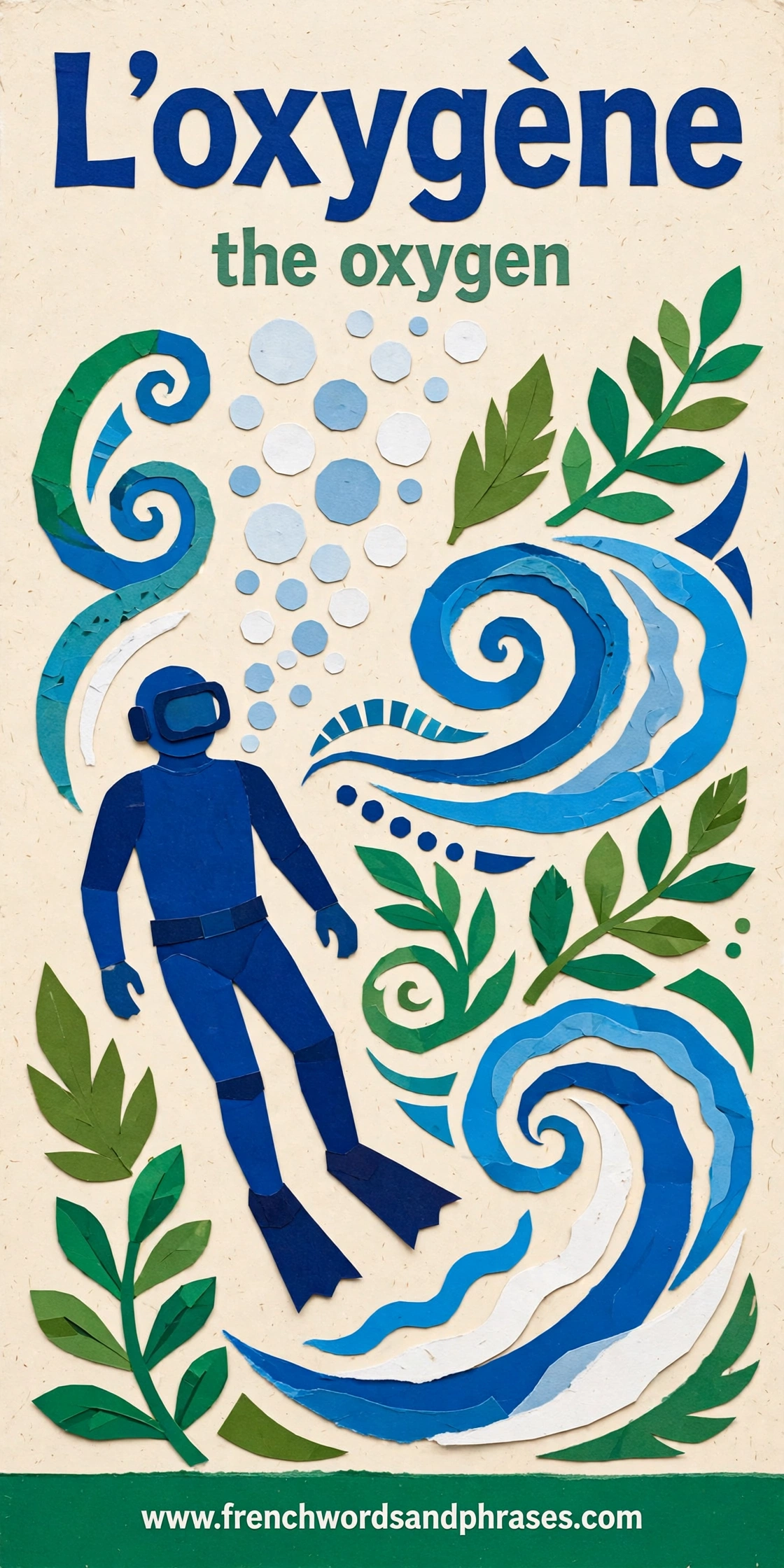
A French Word to Live By
Translate Oxygène to English
/ɔk.si.ʒɛn/
L’Oxygène means oxygen.
You cannot see it, smell it or hold it — yet every breath you have ever taken was a small loan of it: l’oxygène, oxygen, the invisible gas that keeps every fire and every animal on Earth alight.
In this guide, you’ll learn what oxygène means in English, how to use it with its articles, how to form its plural, and how it appears in everyday French. Explore French examples, English translations, and practice quizzes.
Understanding the French Noun Oxygène
Oxygène is a masculine French noun, learned with its article: l’oxygène, with the article melted before the vowel. It was named by the French chemist Lavoisier from Greek words meaning « acid-maker », because he believed — wrongly, as it turned out — that all acids contained it. The name stayed; the mistake is forgiven. Like most substance nouns, it usually has no plural.
It means oxygen — the gas, element O, that makes up a fifth of the air: respirer de l’oxygène, to breathe oxygen, un masque à oxygène, an oxygen mask, une bouteille d’oxygène, an oxygen bottle or tank. In hospital French a patient is sous oxygène, on oxygen. Figuratively, French borrows it for anything that revives: une bouffée d’oxygène, a breath of fresh air, for a person, a budget or a tired government.
Gender: Masculine — l’oxygène
Definite article: l’ — l’oxygène (the oxygen), melted before the vowel
Indefinite / partitive: de l’oxygène — some oxygen; un is rare for a substance
Plural: none in ordinary use — a substance noun
Spelling note: named by Lavoisier from Greek oxys (sharp, acid) + -gène (maker)
Key phrase: une bouffée d’oxygène — a breath of fresh air, literally and figuratively
English equivalents: Oxygen.
Because oxygène is a substance, French measures it with the partitive: de l’oxygène, some oxygen — les plantes produisent de l’oxygène. Divers and patients receive it from une bouteille d’oxygène, and a room that lacks it is a room where l’oxygène manque. The figurative use is everywhere in journalism: donner de l’oxygène à l’économie, to give the economy breathing room.
Experience the Word
Oxygène is the most generous word in the air: the trees make it, the fires eat it, and you are spending it right now, one breath at a time.
Imagine the mountain refuge at dawn, the air thin and bright, each breath a little shorter than the last — up there, l’oxygène stops being invisible and becomes the whole subject of the day.
You have not just named a gas. You have named the condition of being alive — l’oxygène, the breath of the world.
How to Use Oxygène in French: Complete Guide
Let’s explore how oxygène works in French, beginning with its article — l’oxygène, de l’oxygène, une bouffée d’oxygène.
Oxygène with the Definite Article (L’)
Used for oxygen as a whole — the gas in the air around us. The article melts before the vowel.
| Form | French |
|---|---|
| Masculine singular | l’oxygène |
| Plural | — (substance noun, no ordinary plural) |
Example
L’oxygène est indispensable à la vie.
Oxygen is essential to life.
Oxygène with the Partitive (De l’oxygène…)
Substances are measured, not counted: some oxygen, a lot of oxygen, no oxygen.
| Quantity | French |
|---|---|
| some oxygen | de l’oxygène |
| a lot of oxygen | beaucoup d’oxygène |
| pure oxygen | de l’oxygène pur |
| no oxygen | pas d’oxygène |
| enough oxygen | assez d’oxygène |
Example
Les forêts produisent de l’oxygène.
Forests produce oxygen.
Oxygène in Its Containers (Masque, bouteille, bouffée…)
Oxygen reaches people through masks, bottles and breaths — French names them all with d’oxygène.
| Item | French |
|---|---|
| an oxygen mask | un masque à oxygène |
| an oxygen bottle / tank | une bouteille d’oxygène |
| a breath of fresh air | une bouffée d’oxygène |
| on oxygen (hospital) | sous oxygène |
| a lack of oxygen | un manque d’oxygène |
Example
Le plongeur vérifie sa bouteille d’oxygène.
The diver checks his oxygen tank.
Quick Quiz 1
Complete the sentence:
______ oxygène de l’air nous fait vivre. (the)
Reveal the answer
L’
L’oxygène de l’air nous fait vivre.
The oxygen in the air keeps us alive — le melts into l’ before the vowel.
The Plural of Oxygène
Oxygène is a substance noun: it has no ordinary plural. Quantities are expressed with the partitive and containers.
| Number | French |
|---|---|
| Singular | l’oxygène |
| Plural | — (use de l’oxygène, des bouteilles d’oxygène) |
Example
Deux bouteilles d’oxygène suffisent pour la plongée.
Two oxygen tanks are enough for the dive.
Oxygène with Possessive Adjectives (Mon, Ton, Son…)
Possessives agree with the noun: oxygène is masculine, so mon, ton, son in the singular.
| Owner | French |
|---|---|
| my | mon oxygène |
| your (tu) | ton oxygène |
| his / her | son oxygène |
| our | notre oxygène |
| your (vous) | votre oxygène |
| their | leur oxygène |
Example
Le patient garde son oxygène près du lit.
The patient keeps his oxygen by the bed.
Quick Quiz 2
Complete the sentence:
Elle respire mieux avec ______ masque à oxygène. (her)
Reveal the answer
son
Elle respire mieux avec son masque à oxygène.
She breathes better with her oxygen mask — son, because masque is masculine.
Oxygène with Demonstrative Adjectives (Cet, Ces)
Used to point: cet oxygène, this oxygen — cet, because the noun begins with a vowel.
| Form | French |
|---|---|
| Masculine singular | cet oxygène |
| Plural | — (substance noun) |
Example
Cet oxygène pur sert aux expériences du laboratoire.
This pure oxygen is used for the laboratory’s experiments.
Oxygène with Adjectives
Adjectives agree with oxygène — masculine singular: de l’oxygène pur, l’oxygène liquide.
| Adjective | With Oxygène |
|---|---|
| pur (pure) | de l’oxygène pur |
| liquide (liquid) | l’oxygène liquide |
| rare (scarce) | l’oxygène rare |
| vital (vital) | l’oxygène vital |
| frais (fresh, figurative) | une bouffée d’oxygène frais |
Example
En altitude, l’oxygène rare fatigue vite.
At altitude, the scarce oxygen tires you quickly.
Quick Quiz 3
Complete the sentence:
Le laboratoire utilise de l’oxygène ______. (pure)
Reveal the answer
pur
Le laboratoire utilise de l’oxygène pur.
The laboratory uses pure oxygen — pur, masculine, to agree with oxygène.
Everyday Expressions with Oxygène
Hospitals, mountains and metaphors — the oxygène phrases of daily life.
| Expression | In English |
|---|---|
| une bouffée d’oxygène | a breath of fresh air |
| un masque à oxygène | an oxygen mask |
| être sous oxygène | to be on oxygen |
| manquer d’oxygène | to lack oxygen, to run short of breath |
| donner de l’oxygène à | to give breathing room to (figurative) |
Example
Ce voyage a été une vraie bouffée d’oxygène.
That trip was a real breath of fresh air.
Words from the Same Family as Oxygène
Air and breathing — the words that travel with oxygène.
| French | In English |
|---|---|
| l’air | the air |
| respirer | to breathe (the verb) |
| le dioxyde de carbone | carbon dioxide |
| une bouteille | a bottle, a tank |
| les poumons | the lungs |
Example
Les poumons prennent l’oxygène dans l’air.
The lungs take the oxygen from the air.
Quick Quiz 4
What does une bouffée d’oxygène mean, figuratively?
Reveal the answer
A breath of fresh air — relief, revival, room to breathe.
Ses vacances ont été une bouffée d’oxygène.
Her holiday was a breath of fresh air.
Oxygène in Everyday French: Real-Life Examples
Now that you know the word, let’s see how oxygène appears in everyday French.
Example 1 — Breathing
Les plantes produisent de l’oxygène.
Plants produce oxygen.
Example 2 — At the hospital
Le malade est sous oxygène depuis hier.
The patient has been on oxygen since yesterday.
Example 3 — Diving
Vérifie ta bouteille d’oxygène avant de plonger.
Check your oxygen tank before diving.
Example 4 — In the mountains
Ici, l’oxygène est rare, marchons lentement.
Here, oxygen is scarce, let’s walk slowly.
Example 5 — Figurative
Cette nouvelle est une bouffée d’oxygène.
This news is a breath of fresh air.
Example 6 — In class
L’oxygène représente un cinquième de l’air.
Oxygen makes up a fifth of the air.
Beyond Translation: The Meaning of Oxygène
Oxygène is a French invention twice over: Lavoisier isolated the gas and gave it its name in Paris, building it from Greek for « acid-maker » — a theory that proved wrong, since some acids have no oxygen at all. The word survived its own mistake, which is fitting for a word about what keeps things alive. And French went on spending it as a metaphor: governments, football teams and tired marriages are all, in the newspapers, en manque d’oxygène or grateful for une bouffée d’oxygène.
To say oxygène is to name the invisible guest at every fire and every breath.
It evokes thin mountain air, hospital masks, green forests — and every figurative second wind.
How to Remember the French Noun Oxygène
Remember it this way: Oxygène is oxygen — masculine with a melted article: l’oxygène, and the partitive de l’oxygène for the substance.
- Masculine, vowel first — l’oxygène, de l’oxygène, cet oxygène.
- The substance rule — no plural; measure it: beaucoup d’oxygène, une bouteille d’oxygène.
- The metaphor — une bouffée d’oxygène, a breath of fresh air.
The key idea is l’oxygène — the oxygen, masculine; une bouffée d’oxygène = a breath of fresh air.
Test Your Knowledge of Oxygène
Let’s see how much you’ve learned. Try answering these questions before revealing the answers.
Question 1
Is oxygène masculine or feminine?
Reveal the answer
Masculine — l’oxygène, with the article melted before the vowel.
Question 2
How do you say some oxygen?
Reveal the answer
De l’oxygène — the partitive, for a substance.
Question 3
Translate: The diver checks his oxygen tank.
Reveal the answer
Le plongeur vérifie sa bouteille d’oxygène.
Question 4
Who named oxygen, and where?
Reveal the answer
Lavoisier, in France — from Greek words meaning « acid-maker », a theory later proved wrong.
Question 5
Complete the sentence:
En altitude, ______ oxygène se fait rare. (the)
Reveal the answer
l’
En altitude, l’oxygène se fait rare.
At altitude, oxygen becomes scarce.
Your Final Challenge
Can You Use It?
How would you say this in French?
“That trip was a real breath of fresh air.”
Reveal the answer
Ce voyage a été une vraie bouffée d’oxygène.
That trip was a real breath of fresh air.
A little French. A little curiosity. A richer everyday life.
LEARN FRENCH ONE WORD AT A TIME




