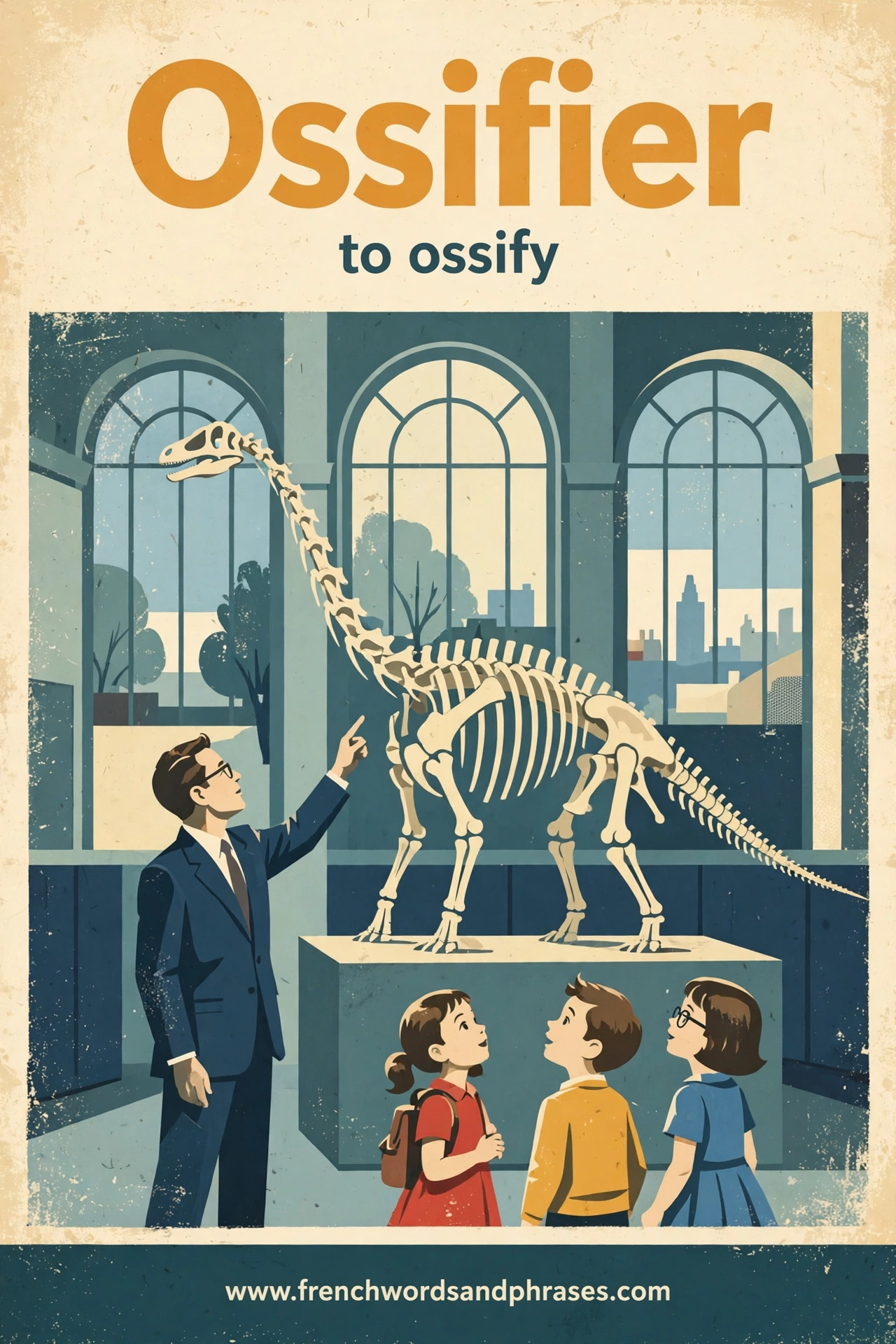
A French Word to Live By
How to Conjugate Ossifier in French
/ɔ.si.fje/
Ossifier means to ossify — to turn into bone, or to become rigid and set in one’s ways.
Cartilage slowly turning to bone in an old joint; a ministry where the same form has been stamped the same way for forty years — ossifier is the verb of living, supple things hardening for good.
In this guide, you’ll learn how to conjugate ossifier in all the major French tenses and moods. Explore complete conjugation tables, French examples, English translations, and practice quizzes.
Understanding the French Verb Ossifier
Ossifier is a regular French verb belonging to the first group of verbs, those ending in -er.
It means to ossify. It is commonly used in medicine for tissue and cartilage turning into bone, and figuratively for administrations, rules, habits and thinking that have hardened and can no longer bend.
Verb classification: First group (-er)
Auxiliary verb: Avoir
Past participle: ossifié
Present participle: ossifiant
English equivalents: To ossify, to turn into bone; s’ossifier — to ossify, to become ossified, to grow rigid; un cartilage qui s’ossifie — cartilage turning to bone; l’ossification — ossification.
One important detail: ossifier is an -ier verb, so the nous forms of the imperfect and the present subjunctive double the i: nous ossifiions, que nous ossifiions. In real life the verb is most often met as s’ossifier, the reflexive — literally, in anatomy, when soft tissue turns to bone, and figuratively when an institution, a habit or a mind grows stiff and stops adapting. The root is Latin os, bone: to ossify is to become bone.
Experience the Word
Ossifier is the verb of things turning to bone — supple tissue, or supple ideas, hardening for good.
Imagine an old office where nothing has changed for thirty years. The same forms, the same stamps, the same answer: « On a toujours fait comme ça. » Nobody decided to harden; the place simply ossified, one unexamined year at a time.
What was once alive and flexible is now rigid. It has ossified — in French, ossifié.
How to Conjugate Ossifier: Complete French Conjugation Guide
Let’s explore every major conjugation of ossifier, beginning with the indicative mood.
How to Conjugate Ossifier in the Indicative Mood
The indicative mood is used to express facts, observations, actions, and events.
How to Conjugate Ossifier in the Present Tense (Présent)
Used for actions happening now, habitual actions, and general truths.
| Subject | Conjugation |
|---|---|
| je | ossifie |
| tu | ossifies |
| il / elle | ossifie |
| nous | ossifions |
| vous | ossifiez |
| ils / elles | ossifient |
Example
Peu à peu, les vieilles règles s’ossifient.
Little by little, the old rules ossify.
Quick Quiz 1
Complete the sentence:
Les vieilles règles ______ peu à peu.
Reveal the answer
s’ossifient
Les vieilles règles s’ossifient peu à peu.
The old rules ossify little by little.
How to Conjugate Ossifier in the Passé Composé
Used for completed actions in the past. Ossifier takes the auxiliary verb avoir.
| Subject | Conjugation |
|---|---|
| j’ | ai ossifié |
| tu | as ossifié |
| il / elle | a ossifié |
| nous | avons ossifié |
| vous | avez ossifié |
| ils / elles | ont ossifié |
Example
Le cartilage s’est ossifié avec l’âge.
The cartilage has ossified with age.
How to Conjugate Ossifier in the Imparfait (Imperfect Tense)
Used for habitual past actions, descriptions, and ongoing situations in the past.
| Subject | Conjugation |
|---|---|
| je | ossifiais |
| tu | ossifiais |
| il / elle | ossifiait |
| nous | ossifiions |
| vous | ossifiiez |
| ils / elles | ossifiaient |
Example
Dans ce bureau, les procédures s’ossifiaient d’année en année.
In this office, procedures used to ossify year after year.
Quick Quiz 2
Choose the correct form:
The cartilage has ossified.
Le cartilage ______ . (s’est ossifié / a ossifié)
Reveal the answer
s’est ossifié
Le cartilage s’est ossifié.
The reflexive s’ossifier takes être.
How to Conjugate Ossifier in the Plus-que-parfait
Used to describe an action that had already been completed before another past event.
| Subject | Conjugation |
|---|---|
| j’ | avais ossifié |
| tu | avais ossifié |
| il / elle | avait ossifié |
| nous | avions ossifié |
| vous | aviez ossifié |
| ils / elles | avaient ossifié |
Example
Le tendon s’était ossifié après la blessure.
The tendon had ossified after the injury.
How to Conjugate Ossifier in the Passé Simple
Primarily used in formal writing, literature, and historical narratives. It is rarely used in everyday conversation.
| Subject | Conjugation |
|---|---|
| je | ossifiai |
| tu | ossifias |
| il / elle | ossifia |
| nous | ossifiâmes |
| vous | ossifiâtes |
| ils / elles | ossifièrent |
Example
Le cartilage s’ossifia lentement.
The cartilage slowly ossified.
How to Conjugate Ossifier in the Passé Antérieur
A literary tense used to express an action completed immediately before another past action, generally in the passé simple.
| Subject | Conjugation |
|---|---|
| j’ | eus ossifié |
| tu | eus ossifié |
| il / elle | eut ossifié |
| nous | eûmes ossifié |
| vous | eûtes ossifié |
| ils / elles | eurent ossifié |
Example
Quand le tissu se fut ossifié, l’opération devint inutile.
When the tissue had ossified, the operation became pointless.
How to Conjugate Ossifier in the Future Tense (Futur Simple)
Used to describe actions that will take place in the future.
| Subject | Conjugation |
|---|---|
| je | ossifierai |
| tu | ossifieras |
| il / elle | ossifiera |
| nous | ossifierons |
| vous | ossifierez |
| ils / elles | ossifieront |
Example
Sans réforme, l’administration s’ossifiera complètement.
Without reform, the administration will ossify completely.
How to Conjugate Ossifier in the Futur Antérieur (Future Perfect)
Used for an action that will have been completed before a particular point in the future.
| Subject | Conjugation |
|---|---|
| j’ | aurai ossifié |
| tu | auras ossifié |
| il / elle | aura ossifié |
| nous | aurons ossifié |
| vous | aurez ossifié |
| ils / elles | auront ossifié |
Example
À ce rythme, le règlement se sera ossifié avant l’hiver.
At this rate, the rulebook will have ossified before winter.
How to Conjugate Ossifier in the Near Future (Futur Proche)
Used to describe something that is going to happen soon. Formed with aller + infinitive.
| Subject | Conjugation |
|---|---|
| je | vais ossifier |
| tu | vas ossifier |
| il / elle | va ossifier |
| nous | allons ossifier |
| vous | allez ossifier |
| ils / elles | vont ossifier |
Example
Attention, ce petit bureau va s’ossifier si rien ne change.
Careful, this little office is going to ossify if nothing changes.
How to Conjugate Ossifier in the Conditional Mood
The conditional mood expresses what would happen under certain circumstances. It is also frequently used to make polite requests or express wishes.
How to Conjugate Ossifier in the Present Conditional
| Subject | Conjugation |
|---|---|
| je | ossifierais |
| tu | ossifierais |
| il / elle | ossifierait |
| nous | ossifierions |
| vous | ossifieriez |
| ils / elles | ossifieraient |
Example
Une entreprise qui ne bouge plus s’ossifierait vite.
A company that stops moving would ossify quickly.
How to Conjugate Ossifier in the Past Conditional
| Subject | Conjugation |
|---|---|
| j’ | aurais ossifié |
| tu | aurais ossifié |
| il / elle | aurait ossifié |
| nous | aurions ossifié |
| vous | auriez ossifié |
| ils / elles | auraient ossifié |
Example
Le cartilage se serait ossifié sans le traitement.
The cartilage would have ossified without the treatment.
Ossifier in the Literary Past Conditional Form
This less common literary form uses the imperfect subjunctive of avoir.
| Subject | Conjugation |
|---|---|
| j’ | eusse ossifié |
| tu | eusses ossifié |
| il / elle | eût ossifié |
| nous | eussions ossifié |
| vous | eussiez ossifié |
| ils / elles | eussent ossifié |
Example
La coutume se fût ossifiée sans les jeunes générations.
The custom would have ossified without the younger generations.
How to Conjugate Ossifier in the Subjunctive Mood
The subjunctive is used to express wishes, emotions, doubts, necessity, and uncertainty. It frequently follows expressions such as il faut que (it is necessary that) or bien que (although).
How to Conjugate Ossifier in the Present Subjunctive
| Subject | Conjugation |
|---|---|
| que je | ossifie |
| que tu | ossifies |
| qu’il / qu’elle | ossifie |
| que nous | ossifiions |
| que vous | ossifiiez |
| qu’ils / qu’elles | ossifient |
Example
Il ne faut pas que nous nous ossifiions dans nos habitudes.
We must not ossify in our habits.
Quick Quiz 3
Complete the sentence using the subjunctive:
Il ne faut pas que nous nous ______ dans nos habitudes.
Reveal the answer
ossifiions
Il ne faut pas que nous nous ossifiions dans nos habitudes.
The -ier verbs double the i here: ossifiions.
How to Conjugate Ossifier in the Imperfect Subjunctive
A literary tense, rarely encountered in modern spoken French.
| Subject | Conjugation |
|---|---|
| que je | ossifiasse |
| que tu | ossifiasses |
| qu’il / qu’elle | ossifiât |
| que nous | ossifiassions |
| que vous | ossifiassiez |
| qu’ils / qu’elles | ossifiassent |
Example
On craignait que le tissu ne s’ossifiât après l’accident.
They feared the tissue might ossify after the accident.
How to Conjugate Ossifier in the Pluperfect Subjunctive
A literary construction used to express an action completed before another past action.
| Subject | Conjugation |
|---|---|
| que j’ | eusse ossifié |
| que tu | eusses ossifié |
| qu’il / qu’elle | eût ossifié |
| que nous | eussions ossifié |
| que vous | eussiez ossifié |
| qu’ils / qu’elles | eussent ossifié |
Example
Le médecin expliqua que le cartilage se fût ossifié sans soins.
The doctor explained that the cartilage would have ossified without care.
How to Conjugate Ossifier in the Past Subjunctive
| Subject | Conjugation |
|---|---|
| que j’ | aie ossifié |
| que tu | aies ossifié |
| qu’il / qu’elle | ait ossifié |
| que nous | ayons ossifié |
| que vous | ayez ossifié |
| qu’ils / qu’elles | aient ossifié |
Example
Je suis étonné que cette règle se soit ossifiée si vite.
I am surprised this rule ossified so quickly.
How to Conjugate Ossifier in the Imperative
The imperative is used to give commands, instructions, invitations, or suggestions. Subject pronouns are omitted.
How to Conjugate Ossifier in the Present Imperative
| Person | Conjugation |
|---|---|
| (tu) | ossifie |
| (nous) | ossifions |
| (vous) | ossifiez |
Example
Ne nous ossifions pas, continuons d’apprendre !
Let’s not ossify, let’s keep learning!
Quick Quiz 4
How would you say Don’t ossify, try something new (tu form)?
Reveal the answer
Ne t’ossifie pas, essaie quelque chose de nouveau !
French Participles of Ossifier
Participles are verb forms that can be used in compound tenses and other grammatical constructions.
Present Participle of Ossifier
ossifiant
En s’ossifiant, l’institution a perdu sa souplesse.
By ossifying, the institution lost its flexibility.
Past Participle of Ossifier
ossifié
Ossifié par des années d’habitude, le service refusait tout changement.
Ossified by years of habit, the department refused any change.
Ossifier in Everyday French: Real-Life Examples
Now that you know the conjugations, let’s see how ossifier appears in everyday French.
Example 1 — Present
Les idées reçues s’ossifient vite.
Received ideas ossify quickly.
Example 2 — Passé composé
Son emploi du temps s’est ossifié en routine.
His schedule has ossified into routine.
Example 3 — Imparfait
Nous nous ossifiions dans nos habitudes sans nous en rendre compte.
We were ossifying in our habits without realising it.
Example 4 — Future
Ce règlement s’ossifiera si personne ne le révise.
This rule will ossify if nobody revises it.
Example 5 — Conditional
Sans idées nouvelles, l’équipe s’ossifierait.
Without new ideas, the team would ossify.
Example 6 — Imperative
Ne t’ossifie pas, essaie quelque chose de nouveau !
Don’t ossify, try something new!
Beyond Translation: The Meaning of Ossifier
English borrowed ossify from the same Latin bone — os — and uses it for exactly the same double life: literal in the skeleton, figurative in the boardroom.
French leans on the figurative sense even harder.
A bureaucracy, a syllabus, a way of thinking — anything that was once alive and now only repeats itself — s’ossifie. The reflexive is the form you will meet: things ossify themselves, slowly, from the inside.
How to Remember the French Verb Ossifier
Remember it this way: Ossifier is about turning to bone — hard, stiff, unchangeable.
- S’ossifier — the everyday form, for bones and bureaucracies alike.
- An -ier verb: watch the double i — nous ossifiions.
- Regular -er: il ossifie, nous ossifions, past participle ossifié.
The key idea is turning to bone — hard, stiff, unchangeable.
Test Your Knowledge of Ossifier
Let’s see how much you’ve learned. Try answering these questions before revealing the answers.
Question 1
How do you say The cartilage has ossified with age in French?
Reveal the answer
Le cartilage s’est ossifié avec l’âge.
Question 2
How do you say Received ideas ossify quickly in French?
Reveal the answer
Les idées reçues s’ossifient vite.
Question 3
Translate: Without reform, the administration will ossify completely.
Reveal the answer
Sans réforme, l’administration s’ossifiera complètement.
Question 4
What is the past participle of ossifier?
Reveal the answer
Ossifié.
Question 5
Complete the sentence:
Il ne faut pas que nous nous ______ dans nos habitudes.
Reveal the answer
ossifiions
Il ne faut pas que nous nous ossifiions dans nos habitudes.
We must not ossify in our habits — note the double i of the -ier verbs.
Your Final Challenge
Can You Use It?
How would you say this in French?
A language that ossifies dies slowly; a language that moves stays alive.
Reveal the answer
Une langue qui s’ossifie meurt doucement ; une langue qui bouge reste vivante.
A language that ossifies dies slowly; a language that moves stays alive.
A little French. A little curiosity. A richer everyday life.
LEARN FRENCH ONE WORD AT A TIME