
A French Word to Live By
How to Conjugate Oser in French
/o.ze/
Oser means to dare — to find the courage to do something.
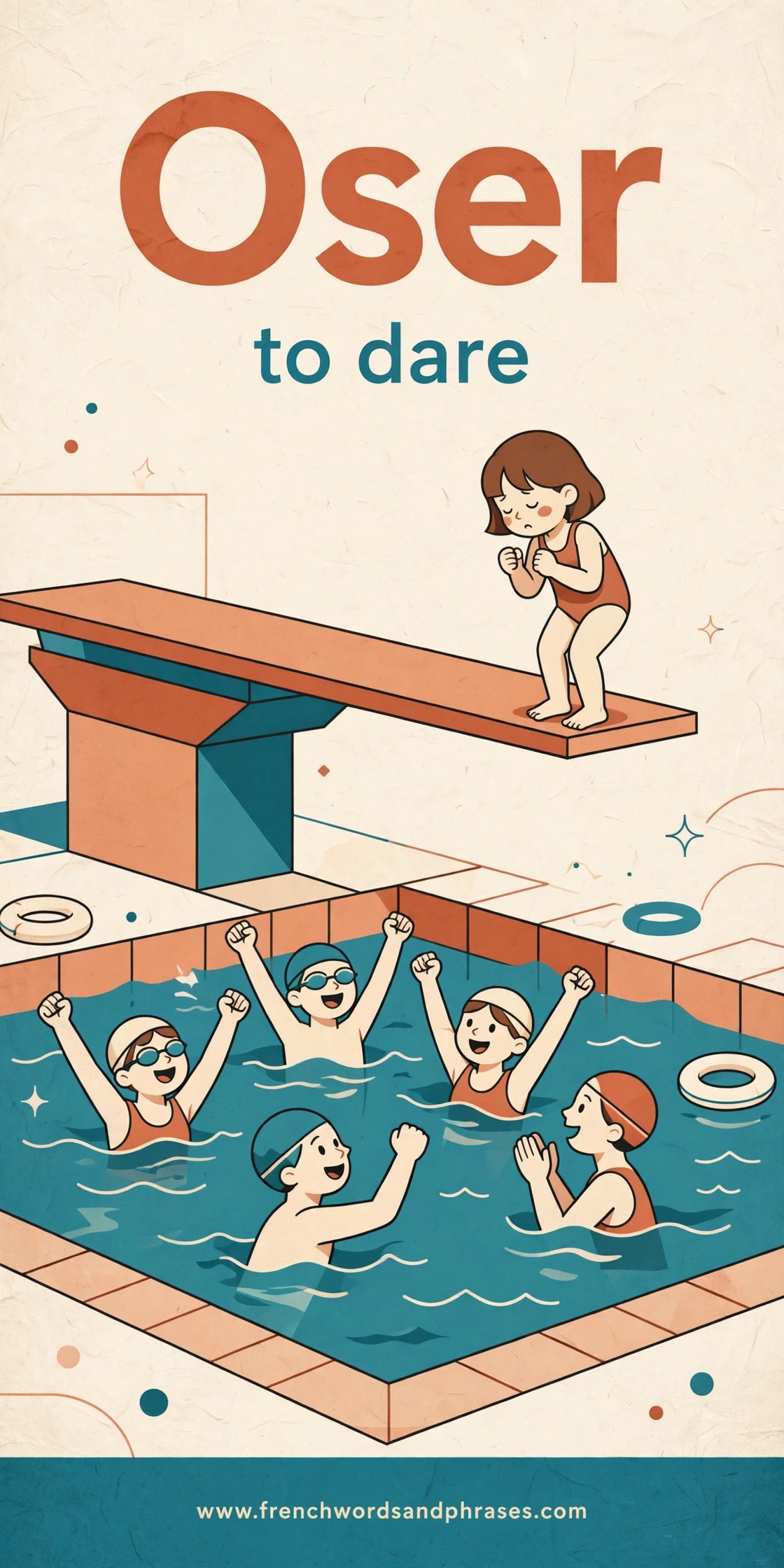
Toes curled over the edge of the high diving board, the water glittering far below, the whole pool holding its breath — oser is the verb of that half-second before the jump, when courage is decided.
In this guide, you’ll learn how to conjugate oser in all the major French tenses and moods. Explore complete conjugation tables, French examples, English translations, and practice quizzes.
Understanding the French Verb Oser
Oser is a regular French verb belonging to the first group of verbs, those ending in -er.
It means to dare. It is commonly used for daring to speak, ask, refuse, try or jump — anywhere courage has to be found — and in polite formulas that soften a request or an opinion.
Verb classification: First group (-er)
Auxiliary verb: Avoir
Past participle: osé
Present participle: osant
English equivalents: To dare; oser + infinitive — to dare to do something; je n’ose pas — I daren’t; si j’ose dire — if I may say so; oserais-je vous demander…? — may I venture to ask you…?
One important detail: oser behaves like a semi-modal verb — it is almost always followed directly by an infinitive, with no preposition: oser partir, oser dire non. In very polite, literary questions it inverts: Oserais-je vous demander un service ? — may I venture to ask you a favour? And the fixed hedge si j’ose dire softens any bold statement: if I may say so. Alone in the negative, je n’ose pas simply means I daren’t.
Experience the Word
Oser is courage in a single verb — the moment just before the brave thing.
Imagine a child at the top of the high diving board. The water is very far below, her toes curl over the edge, the whole pool is watching — and then she dares. She jumps. The verb lives in the half-second before her feet leave the board.
Everything after is just falling and splashing. The daring — oser — happened first.
How to Conjugate Oser: Complete French Conjugation Guide
Let’s explore every major conjugation of oser, beginning with the indicative mood.
How to Conjugate Oser in the Indicative Mood
The indicative mood is used to express facts, observations, actions, and events.
How to Conjugate Oser in the Present Tense (Présent)
Used for actions happening now, habitual actions, and general truths.
| Subject | Conjugation |
|---|---|
| je | ose |
| tu | oses |
| il / elle | ose |
| nous | osons |
| vous | osez |
| ils / elles | osent |
Example
Elle ose dire ce que tout le monde pense tout bas.
She dares to say what everyone thinks quietly.
Quick Quiz 1
Complete the sentence:
Elle ______ dire ce que tout le monde pense.
Reveal the answer
ose
Elle ose dire ce que tout le monde pense.
She dares to say what everyone thinks.
How to Conjugate Oser in the Passé Composé
Used for completed actions in the past. Oser takes the auxiliary verb avoir.
| Subject | Conjugation |
|---|---|
| j’ | ai osé |
| tu | as osé |
| il / elle | a osé |
| nous | avons osé |
| vous | avez osé |
| ils / elles | ont osé |
Example
Il a enfin osé demander une augmentation.
He finally dared to ask for a raise.
How to Conjugate Oser in the Imparfait (Imperfect Tense)
Used for habitual past actions, descriptions, and ongoing situations in the past.
| Subject | Conjugation |
|---|---|
| je | osais |
| tu | osais |
| il / elle | osait |
| nous | osions |
| vous | osiez |
| ils / elles | osaient |
Example
Enfant, je n’osais jamais lever la main en classe.
As a child, I never dared raise my hand in class.
Quick Quiz 2
Choose the correct form:
She dared to say no.
Elle ______ dire non. (a osé / est osée)
Reveal the answer
a osé
Elle a osé dire non.
Oser takes avoir.
How to Conjugate Oser in the Plus-que-parfait
Used to describe an action that had already been completed before another past event.
| Subject | Conjugation |
|---|---|
| j’ | avais osé |
| tu | avais osé |
| il / elle | avait osé |
| nous | avions osé |
| vous | aviez osé |
| ils / elles | avaient osé |
Example
Elle avait osé porter la robe rouge au mariage.
She had dared to wear the red dress to the wedding.
How to Conjugate Oser in the Passé Simple
Primarily used in formal writing, literature, and historical narratives. It is rarely used in everyday conversation.
| Subject | Conjugation |
|---|---|
| je | osai |
| tu | osas |
| il / elle | osa |
| nous | osâmes |
| vous | osâtes |
| ils / elles | osèrent |
Example
Le jeune soldat osa s’avancer devant le général.
The young soldier dared to step forward before the general.
How to Conjugate Oser in the Passé Antérieur
A literary tense used to express an action completed immediately before another past action, generally in the passé simple.
| Subject | Conjugation |
|---|---|
| j’ | eus osé |
| tu | eus osé |
| il / elle | eut osé |
| nous | eûmes osé |
| vous | eûtes osé |
| ils / elles | eurent osé |
Example
Quand il eut osé frapper à la porte, on lui ouvrit aussitôt.
When he had dared to knock at the door, it was opened to him at once.
How to Conjugate Oser in the Future Tense (Futur Simple)
Used to describe actions that will take place in the future.
| Subject | Conjugation |
|---|---|
| je | oserai |
| tu | oseras |
| il / elle | osera |
| nous | oserons |
| vous | oserez |
| ils / elles | oseront |
Example
Un jour, tu oseras parler en public.
One day, you will dare to speak in public.
How to Conjugate Oser in the Futur Antérieur (Future Perfect)
Used for an action that will have been completed before a particular point in the future.
| Subject | Conjugation |
|---|---|
| j’ | aurai osé |
| tu | auras osé |
| il / elle | aura osé |
| nous | aurons osé |
| vous | aurez osé |
| ils / elles | auront osé |
Example
À la fin du cours, elle aura osé chanter devant tout le monde.
By the end of the class, she will have dared to sing in front of everyone.
How to Conjugate Oser in the Near Future (Futur Proche)
Used to describe something that is going to happen soon. Formed with aller + infinitive.
| Subject | Conjugation |
|---|---|
| je | vais oser |
| tu | vas oser |
| il / elle | va oser |
| nous | allons oser |
| vous | allez oser |
| ils / elles | vont oser |
Example
Je vais oser lui dire la vérité.
I am going to dare to tell him the truth.
How to Conjugate Oser in the Conditional Mood
The conditional mood expresses what would happen under certain circumstances. It is also frequently used to make polite requests or express wishes.
How to Conjugate Oser in the Present Conditional
| Subject | Conjugation |
|---|---|
| je | oserais |
| tu | oserais |
| il / elle | oserait |
| nous | oserions |
| vous | oseriez |
| ils / elles | oseraient |
Example
Oserais-tu sauter du grand plongeoir ?
Would you dare to jump from the high diving board?
How to Conjugate Oser in the Past Conditional
| Subject | Conjugation |
|---|---|
| j’ | aurais osé |
| tu | aurais osé |
| il / elle | aurait osé |
| nous | aurions osé |
| vous | auriez osé |
| ils / elles | auraient osé |
Example
Il aurait osé se présenter si on l’avait encouragé.
He would have dared to apply if he had been encouraged.
Oser in the Literary Past Conditional Form
This less common literary form uses the imperfect subjunctive of avoir.
| Subject | Conjugation |
|---|---|
| j’ | eusse osé |
| tu | eusses osé |
| il / elle | eût osé |
| nous | eussions osé |
| vous | eussiez osé |
| ils / elles | eussent osé |
Example
Qui eût osé contredire le roi en pleine cour ?
Who would have dared to contradict the king in open court?
How to Conjugate Oser in the Subjunctive Mood
The subjunctive is used to express wishes, emotions, doubts, necessity, and uncertainty. It frequently follows expressions such as il faut que (it is necessary that) or bien que (although).
How to Conjugate Oser in the Present Subjunctive
| Subject | Conjugation |
|---|---|
| que je | ose |
| que tu | oses |
| qu’il / qu’elle | ose |
| que nous | osions |
| que vous | osiez |
| qu’ils / qu’elles | osent |
Example
Il faut que tu oses prendre la parole.
You must dare to speak up.
Quick Quiz 3
Complete the sentence using the subjunctive:
Il faut que tu ______ prendre la parole.
Reveal the answer
oses
Il faut que tu oses prendre la parole.
You must dare to speak up.
How to Conjugate Oser in the Imperfect Subjunctive
A literary tense, rarely encountered in modern spoken French.
| Subject | Conjugation |
|---|---|
| que je | osasse |
| que tu | osasses |
| qu’il / qu’elle | osât |
| que nous | osassions |
| que vous | osassiez |
| qu’ils / qu’elles | osassent |
Example
Je ne pensais pas qu’il osât l’aborder.
I did not think he would dare approach her.
How to Conjugate Oser in the Pluperfect Subjunctive
A literary construction used to express an action completed before another past action.
| Subject | Conjugation |
|---|---|
| que j’ | eusse osé |
| que tu | eusses osé |
| qu’il / qu’elle | eût osé |
| que nous | eussions osé |
| que vous | eussiez osé |
| qu’ils / qu’elles | eussent osé |
Example
On racontait qu’elle eût osé traverser la rivière à la nage.
People told how she had dared to swim across the river.
How to Conjugate Oser in the Past Subjunctive
| Subject | Conjugation |
|---|---|
| que j’ | aie osé |
| que tu | aies osé |
| qu’il / qu’elle | ait osé |
| que nous | ayons osé |
| que vous | ayez osé |
| qu’ils / qu’elles | aient osé |
Example
Je suis fier que tu aies osé essayer.
I am proud that you dared to try.
How to Conjugate Oser in the Imperative
The imperative is used to give commands, instructions, invitations, or suggestions. Subject pronouns are omitted.
How to Conjugate Oser in the Present Imperative
| Person | Conjugation |
|---|---|
| (tu) | ose |
| (nous) | osons |
| (vous) | osez |
Example
Ose ! Le pire qui puisse arriver, c’est un non.
Dare! The worst that can happen is a no.
Quick Quiz 4
How would you say Dare to come in (vous form)?
Reveal the answer
Osez entrer !
French Participles of Oser
Participles are verb forms that can be used in compound tenses and other grammatical constructions.
Present Participle of Oser
osant
En osant poser la question, il a débloqué la réunion.
By daring to ask the question, he unblocked the meeting.
Past Participle of Oser
osé
Osée avec tact, la critique a été bien reçue.
Ventured with tact, the criticism was well received.
Oser in Everyday French: Real-Life Examples
Now that you know the conjugations, let’s see how oser appears in everyday French.
Example 1 — Present
Je n’ose pas lui téléphoner si tard.
I don’t dare phone him so late.
Example 2 — Passé composé
Elle a osé dire non.
She dared to say no.
Example 3 — Imparfait
Nous n’osions pas entrer sans frapper.
We didn’t dare go in without knocking.
Example 4 — Future
Demain, j’oserai poser la question.
Tomorrow, I will dare to ask the question.
Example 5 — Conditional
Oseriez-vous goûter ce plat épicé ?
Would you dare to taste this spicy dish?
Example 6 — Imperative
Osez entrer, la porte est ouverte !
Dare to come in, the door is open!
Beyond Translation: The Meaning of Oser
English says dare to do; French oser takes its infinitive bare — oser partir, no to, no preposition, nothing between the courage and the act.
Oser is also France’s politest verb.
Si j’ose dire — if I may say so — and the grand, old-fashioned oserais-je…? let you smuggle a bold request past anyone’s defences, wrapped in daring itself.
How to Remember the French Verb Oser
Remember it this way: Oser is about the deep breath before the brave thing.
- Oser + infinitive, nothing between: oser dire, oser partir.
- Je n’ose pas — I daren’t; si j’ose dire — if I may say so.
- Regular -er: j’ose, nous osons, past participle osé.
The key idea is the deep breath before the brave thing.
Test Your Knowledge of Oser
Let’s see how much you’ve learned. Try answering these questions before revealing the answers.
Question 1
How do you say to dare to say no in French?
Reveal the answer
Oser dire non.
Question 2
How do you say I don’t dare phone him so late in French?
Reveal the answer
Je n’ose pas lui téléphoner si tard.
Question 3
Translate: He finally dared to ask for a raise.
Reveal the answer
Il a enfin osé demander une augmentation.
Question 4
What is the past participle of oser?
Reveal the answer
Osé.
Question 5
Complete the sentence:
Il faut que tu ______ prendre la parole.
Reveal the answer
oses
Il faut que tu oses prendre la parole.
You must dare to speak up.
Your Final Challenge
Can You Use It?
How would you say this in French?
She finally dares to say yes to adventure, and her life changes colour.
Reveal the answer
Elle ose enfin dire oui à l’aventure, et sa vie change de couleur.
She finally dares to say yes to adventure, and her life changes colour.
A little French. A little curiosity. A richer everyday life.
LEARN FRENCH ONE WORD AT A TIME




