A French Word to Live By
Translate Oreille to English
/ɔ.ʁɛj/
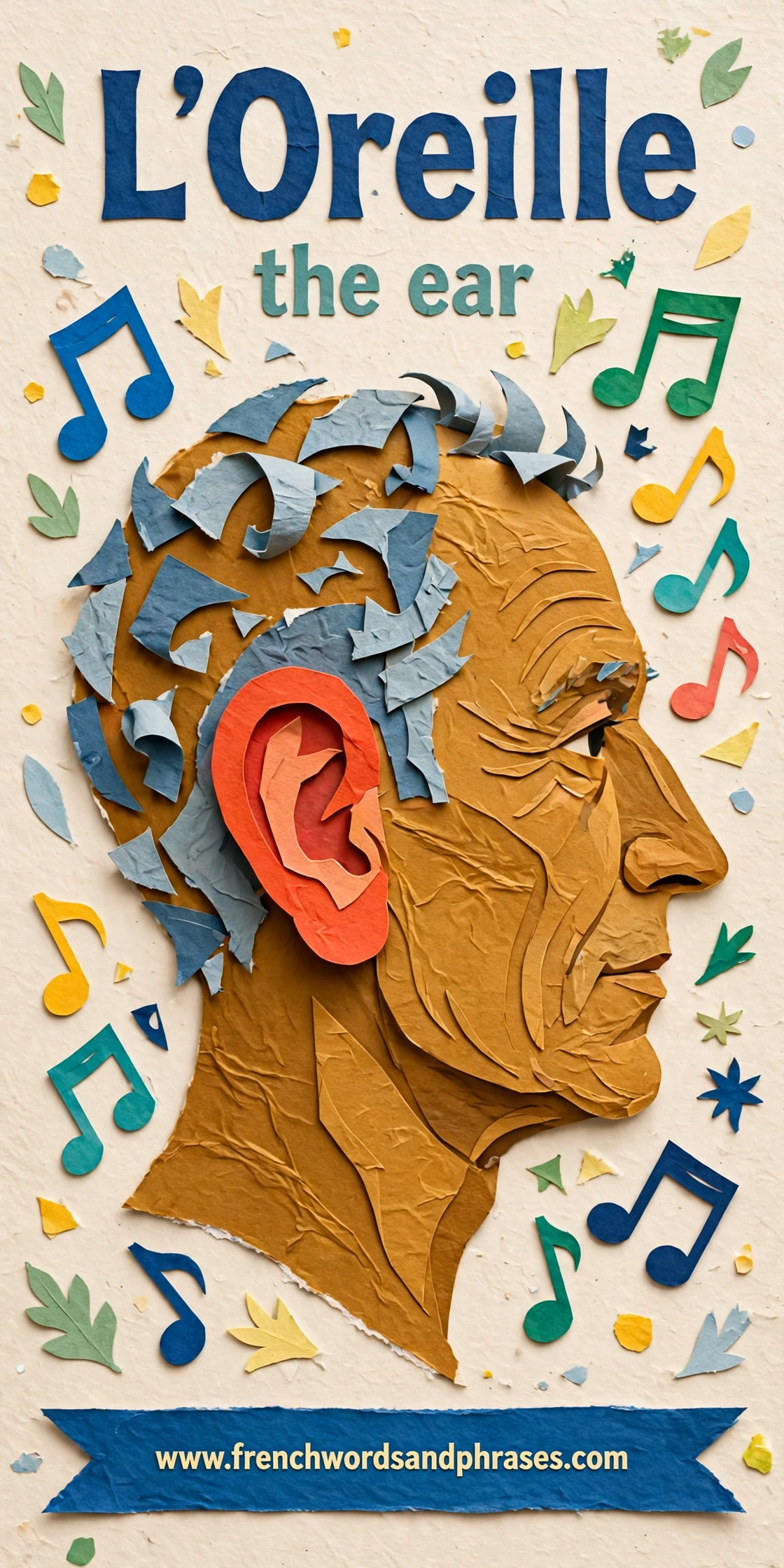
L’oreille means the ear.
The violin teacher stops the lesson with one raised hand: « Écoute. » Not the fingers, not the bow — everything depends on a small, patient word: l’oreille.
In this guide, you’ll learn what oreille means in English, how to use it with its articles, how to form its plural, and how it appears in everyday French. Explore French examples, English translations, and practice quizzes.
Understanding the French Noun Oreille
Oreille is a feminine French noun, learned with its article: l’oreille, une oreille — because it begins with a vowel, la shrinks to l’, and the feminine shows itself in une and in the adjectives. The -eille ending sounds like « ay » in « pay ».
It means the ear — the organ of hearing, and the talent that lives in it. French separates the two carefully: the ear you wash is l’oreille, but the gift for music is also l’oreille — avoir de l’oreille, to have an ear, is the musician’s highest praise, and l’oreille absolue is perfect pitch. Secrets travel à l’oreille, whispered, and bad news is met by la sourde oreille, the deaf ear.
Gender: Feminine — l’oreille, une oreille
Definite article: l’ — l’oreille (the ear), because of the vowel start
Indefinite article: une — une oreille (an ear)
Plural: les oreilles
Sound note: The -eille ending sounds like « ay »: oreille ≈ « or-ay »
A musical gift: avoir de l’oreille — to have a good ear for music
English equivalents: The ear.
Two traps in one word. First, the article: l’oreille hides the gender, so learn the pair l’oreille, une oreille together. Second, the whisper: in French you say things à l’oreille de quelqu’un, into someone’s ear — and if your own ears ring or burn (les oreilles qui sifflent), tradition says someone somewhere is talking about you.
Experience the Word
Oreille is the musician’s true instrument. Instruments can be bought; l’oreille cannot — it is grown, note by note, from childhood songs to midnight jazz.
Imagine the old luthier in his workshop, tapping a violin’s body and listening with closed eyes: his whole craft lives in two small curves of flesh and cartilage.
You have not just heard. You have listened — vraiment écouté, the French way.
How to Use Oreille in French: Complete Guide
Let’s explore how oreille works in French, beginning with its articles — l’oreille, une oreille, les oreilles.
Oreille with the Definite Article (L’, Les)
L’ for one ear, les for the pair — the gender hides behind the apostrophe.
| Form | French |
|---|---|
| Feminine singular | l’oreille |
| Plural | les oreilles |
Example
L’oreille du musicien reconnaît chaque note.
The musician’s ear recognises every note.
Oreille with the Indefinite Article (Une, Des)
Une oreille reveals the feminine that l’ keeps secret.
| Form | French |
|---|---|
| Feminine singular | une oreille |
| Plural | des oreilles |
Example
Un enfant a une oreille décollée, c’est charmant.
One child has an ear that sticks out; it is charming.
Oreille with the Partitive and Quantities (De l’oreille…)
The ear as a talent is measured with de — here is the partitive of the musician.
| Quantity | French |
|---|---|
| a good ear (for music) | de l’oreille |
| perfect pitch | l’oreille absolue |
| both ears | les deux oreilles |
| a whisper in the ear | un mot à l’oreille |
| music learned by ear | la musique d’oreille |
Example
Il joue du piano d’oreille, sans jamais lire une partition.
He plays the piano by ear, without ever reading sheet music.
Quick Quiz 1
Complete the sentence:
Elle a ______ oreille très fine pour les langues. (a)
Reveal the answer
une
Elle a une oreille très fine pour les langues.
She has a very fine ear for languages — oreille is feminine, so une.
The Plural of Oreille
Oreille adds an -s in the plural — les oreilles, the pair that hears the world in stereo.
| Number | French |
|---|---|
| Singular | l’oreille |
| Plural | les oreilles |
Example
Le casque couvre les oreilles et coupe le bruit de la rue.
The headphones cover the ears and cut out the noise of the street.
Oreille with Possessive Adjectives (Mon, Ton, Son…)
A famous exception: oreille is feminine but begins with a vowel, so it takes mon, ton, son — mon oreille, never « ma oreille ».
| Owner | French |
|---|---|
| my | mon oreille |
| your (tu) | ton oreille |
| his / her | son oreille |
| our | notre oreille |
| your (vous) | votre oreille |
| their | leur oreille |
Example
Mon oreille gauche entend moins bien que la droite.
My left ear hears less well than the right one.
Quick Quiz 2
Complete the sentence:
______ oreilles sifflent après le concert. (My)
Reveal the answer
Mes
Mes oreilles sifflent après le concert.
My ears are ringing after the concert.
Oreille with Demonstrative Adjectives (Cette, Ces)
Used to point: cette oreille, this ear.
| Form | French |
|---|---|
| Feminine singular | cette oreille |
| Plural | ces oreilles |
Example
Cette oreille est un peu rouge à cause du froid.
This ear is a little red from the cold.
Oreille with Adjectives
Adjectives agree with oreille — feminine singular: une oreille fine, une oreille attentive.
| Adjective | With Oreille |
|---|---|
| fin (fine, sharp) | une oreille fine |
| musical (musical) | une oreille musicale |
| attentif (attentive) | une oreille attentive |
| décollé (sticking out) | une oreille décollée |
| absolu (absolute — perfect pitch) | l’oreille absolue |
Example
La professeure de chant a une oreille musicale remarquable.
The singing teacher has a remarkable musical ear.
Quick Quiz 3
Complete the sentence:
C’est une oreille très ______ : elle entend tout. (attentive)
Reveal the answer
attentive
C’est une oreille très attentive : elle entend tout.
It is a very attentive ear: it hears everything.
Everyday Expressions with Oreille
Deaf ears and sleeping soundly — the oreille phrases of daily life.
| Expression | In English |
|---|---|
| faire la sourde oreille | to turn a deaf ear |
| dormir sur ses deux oreilles | to sleep soundly, without a worry |
| dire quelque chose à l’oreille | to whisper something in someone’s ear |
| avoir l’oreille absolue | to have perfect pitch |
| les oreilles qui sifflent | ringing ears — someone is talking about you |
| casser les oreilles | to be deafening, to grate on the ears |
Example
Tu peux dormir sur tes deux oreilles, tout est prêt.
You can sleep soundly; everything is ready.
Words from the Same Family as Oreille
Pillows, earrings and listening — the words that travel with oreille.
| French | In English |
|---|---|
| l’oreiller | the pillow — the ear’s resting place |
| la boucle d’oreille | the earring |
| écouter | to listen |
| entendre | to hear |
| le son | the sound |
Example
Elle porte des boucles d’oreille en or de sa grand-mère.
She wears her grandmother’s gold earrings.
Quick Quiz 4
What does faire la sourde oreille mean?
Reveal the answer
To turn a deaf ear — to pretend not to hear, on purpose.
Je lui demande de ranger sa chambre, mais il fait la sourde oreille.
I ask him to tidy his room, but he turns a deaf ear.
Oreille in Everyday French: Real-Life Examples
Now that you know the word, let’s see how oreille appears in everyday French.
Example 1 — A secret
Elle lui dit un secret à l’oreille.
She whispers a secret in his ear.
Example 2 — Music
Ce pianiste a une oreille extraordinaire.
This pianist has an extraordinary ear.
Example 3 — At the doctor’s
Le médecin regarde dans l’oreille de l’enfant.
The doctor looks inside the child’s ear.
Example 4 — Sleeping well
Après cette longue journée, il dort sur ses deux oreilles.
After that long day, he is sleeping soundly.
Example 5 — Jewellery
Elle choisit des boucles d’oreille simples et élégantes.
She chooses simple, elegant earrings.
Example 6 — Too loud
Baisse le son, tu nous casses les oreilles !
Turn the sound down, you are deafening us!
Beyond Translation: The Meaning of Oreille
The oreille keeps a secret inside its own family: l’oreiller, the pillow, is nothing but the ear’s little cushion — French named the pillow after the ear that rests on it. And the ear rules French politeness and music alike: secrets are told à l’oreille, insults are refused by la sourde oreille, and the greatest compliment a musician can receive is not about the hands at all — elle a de l’oreille, she has ear. In a country that prizes the spoken word, the listening organ was bound to become a talent, a metaphor and a pillow, all in one.
To say oreille is to name the door through which music and secrets enter.
It evokes the whispered confidence, the luthier’s closed eyes, and the pillow waiting at the end of the day.
How to Remember the French Noun Oreille
Remember it this way: Oreille is the ear — feminine behind its l’, and the seat of the musician’s gift: avoir de l’oreille.
- The hidden feminine — l’oreille, but une oreille, cette oreille.
- The vowel rule — mon oreille, never ma oreille.
- The pillow’s secret — l’oreiller is the ear’s cushion.
The key idea is l’oreille — the ear, feminine, mon oreille.
Test Your Knowledge of Oreille
Let’s see how much you’ve learned. Try answering these questions before revealing the answers.
Question 1
Is oreille masculine or feminine?
Reveal the answer
Feminine — une oreille, cette oreille. The l’ hides it, so learn the pair together.
Question 2
Why do we say mon oreille and not ma oreille?
Reveal the answer
Because oreille begins with a vowel sound — feminine nouns starting with a vowel take mon, ton, son.
Question 3
Translate: She whispers a secret in his ear.
Reveal the answer
Elle lui dit un secret à l’oreille.
Question 4
What is l’oreille absolue?
Reveal the answer
Perfect pitch — the rare gift of naming any note you hear.
Question 5
Complete the sentence:
Dors tranquille, dors sur tes deux ______. (ears)
Reveal the answer
oreilles
Dors sur tes deux oreilles.
Sleep soundly — literally, sleep on both your ears.
Your Final Challenge
Can You Use It?
How would you say this in French?
“She whispers a secret in his ear.”
Reveal the answer
Elle lui dit un secret à l’oreille.
She whispers a secret in his ear.
A little French. A little curiosity. A richer everyday life.
LEARN FRENCH ONE WORD AT A TIME