A French Word to Live By
Translate Ordre to English
/ɔʁdʁ/
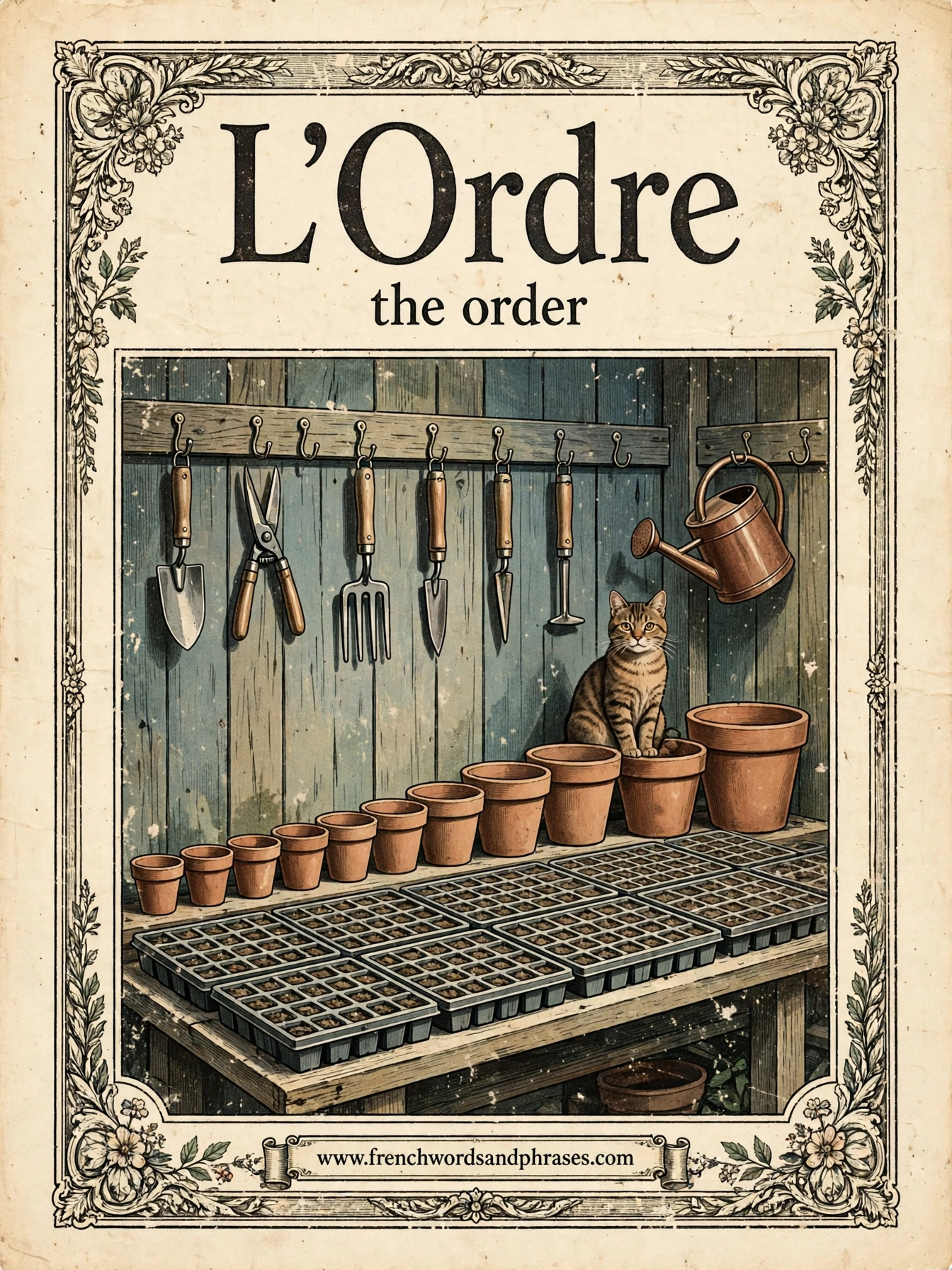
L’Ordre means the order.
The sergeant’s voice crosses the parade ground and a hundred boots move as one: l’ordre, the order — a command to obey, and in the quiet room afterwards, the same word for everything in its right place, nothing shouting at all.
In this guide, you’ll learn what ordre means in English, how to use it with its articles, how to form its plural, and how it appears in everyday French. Explore French examples, English translations, and practice quizzes.
Understanding the French Noun Ordre
Ordre is a masculine French noun, learned with its article: l’ordre, un ordre. It begins with a vowel, so the article melts into it: l’ordre, never le ordre. From the Latin ordo, a row, a rank, a regular arrangement — the word has always meant both the line things stand in and the voice that puts them there.
It means order — first the command: donner un ordre, to give an order, obéir aux ordres, to obey orders, aux ordres de, under the orders of. Then the arrangement: mettre de l’ordre, to tidy up, to put things in order, par ordre alphabétique, in alphabetical order, l’ordre du jour, the agenda, literally the order of the day. Then the great abstractions: l’ordre public, public order, and the orders of knights, monks and medals — l’ordre de la Légion d’honneur.
Gender: Masculine — l’ordre
Definite article: l’ — l’ordre (the order), melted before the vowel
Indefinite article: un — un ordre (an order)
Plural: les ordres — regular, with a simple -s
Spelling note: from Latin ordo, a row, a rank — the line and the command that forms it
Double life: a command to obey, and the tidiness of things in their places
English equivalents: The order; tidiness, arrangement.
In the kitchen and the office, the everyday phrase is mettre de l’ordre dans: mettre de l’ordre dans ses affaires, to tidy one’s things. For sequence, the frame is par ordre de or dans l’ordre: dans l’ordre alphabétique. For commands, the verb pair rules: donner un ordre and recevoir un ordre — and the soldier’s answer is à vos ordres, at your command. Do not confuse the restaurant order: a dish ordered is une commande.
Experience the Word
Ordre is the word that stands at both ends of discipline: the shout that starts the march, and the silence of the desk where every paper lies squared.
Imagine the grandmother’s kitchen after the storm of Sunday lunch — chairs back, cloth folded, jars aligned by size. No one gave an order; l’ordre simply returned, the way order does when someone who loves it enters a room.
You have not just named a command. You have named arrangement itself — l’ordre, the order, in the ranks, on the desk, in the state.
How to Use Ordre in French: Complete Guide
Let’s explore how ordre works in French, beginning with its articles — l’ordre, un ordre, mettre de l’ordre.
Ordre with the Definite Article (L’, Les)
Used for a specific order — the command given, the order of the day. The vowel opening makes le melt into l’.
| Form | French |
|---|---|
| Masculine singular | l’ordre |
| Plural | les ordres |
Example
L’ordre du jour est affiché dans le hall.
The agenda is posted in the hall.
Ordre with the Indefinite Article (Un, Des)
Used for an order in general — any command, any arrangement.
| Form | French |
|---|---|
| Masculine singular | un ordre |
| Plural | des ordres |
Example
Le général donne un ordre bref et clair.
The general gives a short, clear order.
Ordre in Its Working Phrases (Mettre de l’ordre, Par ordre…)
Ordre earns its living in phrases — commands, tidying and sequences.
| Quantity | French |
|---|---|
| to tidy up, put in order | mettre de l’ordre |
| to give an order | donner un ordre |
| in alphabetical order | par ordre alphabétique |
| the agenda | l’ordre du jour |
| public order | l’ordre public |
Example
Je mets de l’ordre dans mon bureau ce matin.
I’m tidying my office this morning.
Quick Quiz 1
Complete the sentence:
______ ordre est formel : personne ne sort. (the)
Reveal the answer
L’
L’ordre est formel : personne ne sort.
The order is formal: nobody leaves — le melts into l’ before the vowel.
The Plural of Ordre
Ordre takes a regular plural in -s — commands in a chain, orders of chivalry in a museum.
| Number | French |
|---|---|
| Singular | l’ordre |
| Plural | les ordres |
Example
Les soldats attendent les ordres du capitaine.
The soldiers are waiting for the captain’s orders.
Ordre with Possessive Adjectives (Mon, Ton, Son…)
Possessives agree with the noun: ordre is masculine, so mon, ton, son in the singular.
| Owner | French |
|---|---|
| my | mon ordre |
| your (tu) | ton ordre |
| his / her | son ordre |
| our | notre ordre |
| your (vous) | votre ordre |
| their | leur ordre |
Example
Chacun range ses outils à son ordre à lui.
Everyone puts his tools away in his own order.
Quick Quiz 2
Complete the sentence:
Le capitaine transmet ______ ordre aux soldats. (his)
Reveal the answer
son
Le capitaine transmet son ordre aux soldats.
The captain passes his order to the soldiers — son, because ordre is masculine.
Ordre with Demonstrative Adjectives (Cet, Ces)
Used to point: cet ordre, this order — cet, because the noun begins with a vowel.
| Form | French |
|---|---|
| Masculine singular | cet ordre |
| Plural | ces ordres |
Example
Cet ordre vient directement du ministre.
This order comes directly from the minister.
Ordre with Adjectives
Adjectives agree with ordre — masculine singular: un ordre strict, l’ordre public.
| Adjective | With Ordre |
|---|---|
| strict (strict) | un ordre strict |
| public (public) | l’ordre public |
| alphabétique (alphabetical) | l’ordre alphabétique |
| nouveau (new) | un ordre nouveau |
| établi (established) | l’ordre établi |
Example
La police maintient l’ordre public pendant la fête.
The police maintain public order during the festival.
Quick Quiz 3
Complete the sentence:
Range les livres par ordre ______. (alphabetical)
Reveal the answer
alphabétique
Range les livres par ordre alphabétique.
Arrange the books in alphabetical order — alphabétique agrees with the masculine noun.
Everyday Expressions with Ordre
Barracks, desks and meeting rooms — the ordre phrases of daily life.
| Expression | In English |
|---|---|
| mettre de l’ordre | to tidy up, to put in order |
| donner un ordre | to give an order |
| l’ordre du jour | the agenda |
| à vos ordres | at your command (reporting for duty) |
| par ordre alphabétique | in alphabetical order |
Example
Premier point à l’ordre du jour : le budget.
First item on the agenda: the budget.
Words from the Same Family as Ordre
Commanding and arranging — the words that travel with ordre.
| French | In English |
|---|---|
| ordonner | to order, to command (the verb) |
| un commandement | a commandment, a command |
| le désordre | disorder, mess — the opposite |
| ranger | to tidy, to put away |
| une commande | an order (for goods, at a restaurant) |
Example
Le désordre de sa chambre désespère sa mère.
The mess in his room drives his mother to despair.
Quick Quiz 4
What does l’ordre du jour mean in a meeting?
Reveal the answer
The agenda — literally the order of the day, the list of points to be treated.
L’ordre du jour compte cinq points.
The agenda has five items.
Ordre in Everyday French: Real-Life Examples
Now that you know the word, let’s see how ordre appears in everyday French.
Example 1 — Tidying
Je mets de l’ordre dans la cuisine.
I’m tidying up the kitchen.
Example 2 — The army
Le soldat obéit aux ordres sans discuter.
The soldier obeys orders without arguing.
Example 3 — A meeting
L’ordre du jour est chargé aujourd’hui.
The agenda is full today.
Example 4 — Filing
Classe ces lettres par ordre alphabétique.
File these letters in alphabetical order.
Example 5 — Reporting
À vos ordres, mon capitaine !
At your command, captain!
Example 6 — The street
La police rétablit l’ordre après le match.
The police restore order after the match.
Beyond Translation: The Meaning of Ordre
Ordre is Rome’s straight line: ordo was the row of soldiers, the rank of citizens, the thread’s row in the weaver’s loom. French inherited all of it and added the meeting room: l’ordre du jour is the row the discussion must walk. Between the parade ground and the tidy desk, the word holds one idea — things, people and words each in the place where they can be found and counted on.
To say ordre is to draw the line and stand things along it.
It evokes the aligned boots, the squared papers, and the agenda pinned where everyone can see it.
How to Remember the French Noun Ordre
Remember it this way: Ordre is the order — l’ordre: the command, the agenda, and the tidiness you make with mettre de l’ordre.
- Masculine, vowel first — l’ordre, un ordre, mon ordre, cet ordre.
- The tidy phrase — mettre de l’ordre, to put things in order; the opposite is le désordre.
- The restaurant trap — an order for food or goods is une commande, not un ordre.
The key idea is l’ordre — the order, the agenda, tidiness, masculine; food order = une commande.
Test Your Knowledge of Ordre
Let’s see how much you’ve learned. Try answering these questions before revealing the answers.
Question 1
Is ordre masculine or feminine?
Reveal the answer
Masculine — l’ordre, un ordre.
Question 2
How do you say to tidy up?
Reveal the answer
Mettre de l’ordre.
Question 3
Translate: The agenda has five items.
Reveal the answer
L’ordre du jour compte cinq points.
Question 4
How do you say an order at a restaurant?
Reveal the answer
Une commande — un ordre is a command or an arrangement.
Question 5
Complete the sentence:
______ ordres du général sont exécutés immédiatement. (the)
Reveal the answer
Les
Les ordres du général sont exécutés immédiatement.
The general’s orders are carried out immediately.
Your Final Challenge
Can You Use It?
How would you say this in French?
“First item on the agenda: the budget.”
Reveal the answer
Premier point à l’ordre du jour : le budget.
First item on the agenda: the budget.
A little French. A little curiosity. A richer everyday life.
LEARN FRENCH ONE WORD AT A TIME