A French Word to Live By
Translate Œuf to English
/œf/
L’œuf means the egg.
The shell taps against the side of the egg cup, the top lifts away, and the golden yolk is waiting inside, soft and warm. Breakfast in France begins with a small ceremony — l’œuf.
In this guide, you’ll learn what œuf means in English, how to use it with its articles, how to form its plural, and how it appears in everyday French. Explore French examples, English translations, and practice quizzes.
Understanding the French Noun Œuf
Œuf is a masculine French noun. It is learned together with its article: l’œuf, un œuf — because it begins with a vowel sound, le shrinks to l’. It hides a famous trap in its plural: les œufs is pronounced /ø/, with no f sound at all.
It means the egg — the one laid by la poule (the hen) that ends up boiled, fried, scrambled or folded into an omelette. The œuf is a cornerstone of French cooking: le jaune is the yolk, le blanc the white, and la coquille the shell you crack and throw away.
Gender: Masculine
Definite article: l’ — l’œuf (the egg)
Indefinite article: un — un œuf (an egg)
Plural: les œufs — pronounced /ø/, the f goes silent
Partitive: de l’œuf — as an ingredient: de l’œuf battu
English equivalents: The egg; an egg.
One detail about the sound is worth its own line: singular un œuf sounds like « uff », but plural les œufs sounds like « eux » — the f is only heard in the singular. The same trick appears in bœuf: un bœuf, des bœufs.
Experience the Word
Œuf is more than an ingredient. It is the soft centre of a slow French breakfast, the œuf à la coque eaten with little soldiers of toasted bread — les mouillettes — dipped one by one into the yolk.
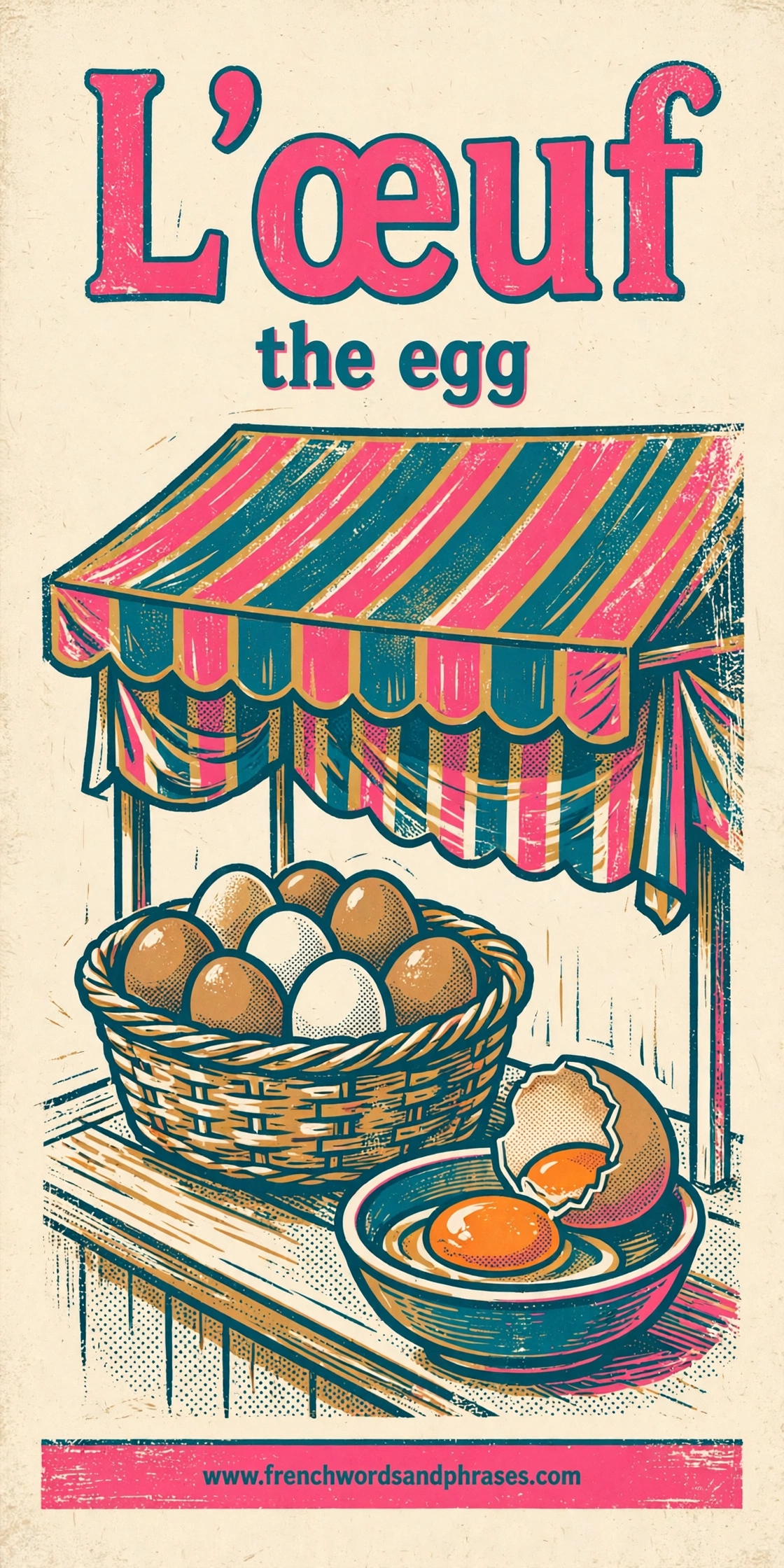
Imagine the market stall: neat rows of brown eggs, stamped with their farm and their date, chosen as carefully as cheese or wine.
You have not just eaten an egg. You have started the day the gentle way — à la coque, with mouillettes.
How to Use Œuf in French: Complete Guide
Let’s explore how œuf works in French, beginning with its articles — and listen out for the plural, where the f quietly disappears.
Œuf with the Definite Article (L’, Les)
Œuf begins with a vowel sound, so le shrinks to l’ — and the plural is les œufs, pronounced without the f.
| Form | French |
|---|---|
| Singular | l’œuf |
| Plural | les œufs |
Example
L’œuf est encore chaud, sers-le tout de suite.
The egg is still warm, serve it at once.
Œuf with the Indefinite Article (Un, Des)
Used for an egg in general — un œuf, and des œufs for several.
| Form | French |
|---|---|
| Singular | un œuf |
| Plural | des œufs |
Example
Elle achète une boîte de six œufs au marché.
She is buying a box of six eggs at the market.
Cooking the Œuf: Six Ways
Boiled, fried or scrambled — French has a name for every way of cooking an egg.
| French | In English |
|---|---|
| un œuf à la coque | a soft-boiled egg |
| un œuf dur | a hard-boiled egg |
| un œuf mollet | a medium-boiled egg |
| un œuf sur le plat | a fried egg |
| un œuf brouillé | a scrambled egg |
| un œuf poché | a poached egg |
Example
Pour le petit déjeuner, je prends un œuf à la coque.
For breakfast, I have a soft-boiled egg.
Quick Quiz 1
Complete the sentence:
Elle casse ______ dans un bol pour faire une omelette. (an egg)
Reveal the answer
un œuf
Elle casse un œuf dans un bol pour faire une omelette.
She cracks an egg into a bowl to make an omelette.
The Plural of Œuf
The spelling adds an -s, but the sound loses the f: les œufs is pronounced /ø/.
| Number | French |
|---|---|
| Singular | un œuf /œf/ |
| Plural | des œufs /ø/ |
Example
Il reste trois œufs dans le frigo.
There are three eggs left in the fridge.
Œuf with Possessive Adjectives (Mon, Ton, Son…)
Œuf begins with a vowel, so it takes mon, ton, son like every masculine noun.
| Owner | French |
|---|---|
| my | mon œuf |
| your (tu) | ton œuf |
| his / her | son œuf |
| our | notre œuf |
| your (vous) | votre œuf |
| their | leur œuf |
Example
Mon œuf à la coque est parfait ce matin.
My soft-boiled egg is perfect this morning.
Quick Quiz 2
How is the plural les œufs pronounced?
Reveal the answer
/ø/ — like « eux »
The f is heard in un œuf but disappears in les œufs.
Elle achète des œufs frais.
Œuf with Demonstrative Adjectives (Cet, Ces)
Used to point: cet œuf, with cet because the noun begins with a vowel.
| Form | French |
|---|---|
| Singular | cet œuf |
| Plural | ces œufs |
Example
Cet œuf vient de nos propres poules.
This egg comes from our own hens.
Œuf with Adjectives
Adjectives agree with œuf, masculine: frais, dur, gros.
| Adjective | With Œuf |
|---|---|
| frais (fresh) | un œuf frais |
| dur (hard-boiled) | un œuf dur |
| gros (big) | un gros œuf |
| bio (organic) | un œuf bio |
| cassé (broken) | un œuf cassé |
Example
Ce gros œuf frais vient du marché.
This big fresh egg comes from the market.
Quick Quiz 3
Complete the sentence:
Je voudrais un œuf ______, s’il vous plaît. (hard-boiled)
Reveal the answer
dur
Je voudrais un œuf dur, s’il vous plaît.
I would like a hard-boiled egg, please.
Everyday Expressions with Œuf
Egg cups and Easter hunts — and two idioms every learner meets.
| Expression | In English |
|---|---|
| un œuf de Pâques | an Easter egg |
| marcher sur des œufs | to tread very carefully, to walk on eggshells |
| mettre tous ses œufs dans le même panier | to put all one’s eggs in one basket |
| un œuf à la coque | a soft-boiled egg |
| plein comme un œuf | absolutely full, stuffed (informal) |
| tuer dans l’œuf | to nip in the bud |
Example
Avec ce client fragile, il faut marcher sur des œufs.
With this delicate client, you have to walk on eggshells.
Words from the Same Family as Œuf
Shells, yolks and hens — the words that travel with œuf.
| French | In English |
|---|---|
| la poule | the hen |
| la coquille | the shell |
| le jaune d’œuf | the egg yolk |
| le blanc d’œuf | the egg white |
| pondre | to lay (an egg) |
| l’omelette | the omelette |
Example
La poule pond un œuf tous les matins.
The hen lays an egg every morning.
Quick Quiz 4
What does marcher sur des œufs mean?
Reveal the answer
To tread very carefully — literally, to walk on eggs.
Dans cette famille, on marche sur des œufs après la dispute.
In this family, everyone is walking on eggshells after the argument.
Œuf in Everyday French: Real-Life Examples
Now that you know the word, let’s see how œuf appears in everyday French.
Example 1 — At breakfast
Elle mange un œuf à la coque avec des mouillettes.
She eats a soft-boiled egg with toast soldiers.
Example 2 — At the market
Ces œufs sont frais, ils viennent de la ferme voisine.
These eggs are fresh, they come from the neighbouring farm.
Example 3 — In the kitchen
Casse deux œufs dans le saladier, s’il te plaît.
Crack two eggs into the mixing bowl, please.
Example 4 — A broken egg
Attention, un œuf est tombé dans le sac !
Careful, an egg has fallen in the bag!
Example 5 — Ordering lunch
Je prends une salade avec un œuf dur.
I’ll have a salad with a hard-boiled egg.
Example 6 — Easter
Les enfants cherchent les œufs de Pâques dans le jardin.
The children are hunting for Easter eggs in the garden.
Beyond Translation: The Meaning of Œuf
The œuf has a quiet starring role in French life: the œuf mayonnaise of the bistro starter menu, the œuf en meurette poached in red wine sauce in Burgundy, the chocolate œufs hidden in gardens at Pâques. Even the language plays with it — to walk on eggs is to be diplomatic, and to kill something dans l’œuf is to stop it before it starts.
To say œuf is to hold breakfast, and a little philosophy, in one small shell.
And remember its party trick: one œuf keeps its f, but a whole box of œufs lets it go — /ø/, soft as the yolk inside.
How to Remember the French Noun Œuf
Remember it this way: Œuf is the egg — masculine, vowel-first, and famous for a plural that swallows its own f: un œuf, des œufs /ø/.
- You crack one — un œuf, with the f sounded.
- You buy six — des œufs, pronounced like « eux ».
- You eat it soft — un œuf à la coque, avec des mouillettes.
The key idea is un œuf /œf/, des œufs /ø/ — the f vanishes in the plural.
Test Your Knowledge of Œuf
Let’s see how much you’ve learned. Try answering these questions before revealing the answers.
Question 1
How do you say an egg in French?
Reveal the answer
Un œuf — and the egg you know is l’œuf.
Question 2
Is œuf masculine or feminine?
Reveal the answer
Masculine — un œuf, l’œuf.
Question 3
Translate: She buys six eggs.
Reveal the answer
Elle achète six œufs.
Question 4
What is un œuf à la coque?
Reveal the answer
A soft-boiled egg — eaten from the shell with mouillettes, little strips of toast.
Question 5
Complete the sentence:
La poule pond ______ tous les matins.
Reveal the answer
un œuf
La poule pond un œuf tous les matins.
The hen lays an egg every morning.
Your Final Challenge
Can You Use It?
How would you say this in French?
“She eats a soft-boiled egg every morning.”
Reveal the answer
Elle mange un œuf à la coque tous les matins.
She eats a soft-boiled egg every morning.
A little French. A little curiosity. A richer everyday life.
LEARN FRENCH ONE WORD AT A TIME