A French Word to Live By
How to Conjugate Obvenir in French
/ɔb.və.niʁ/
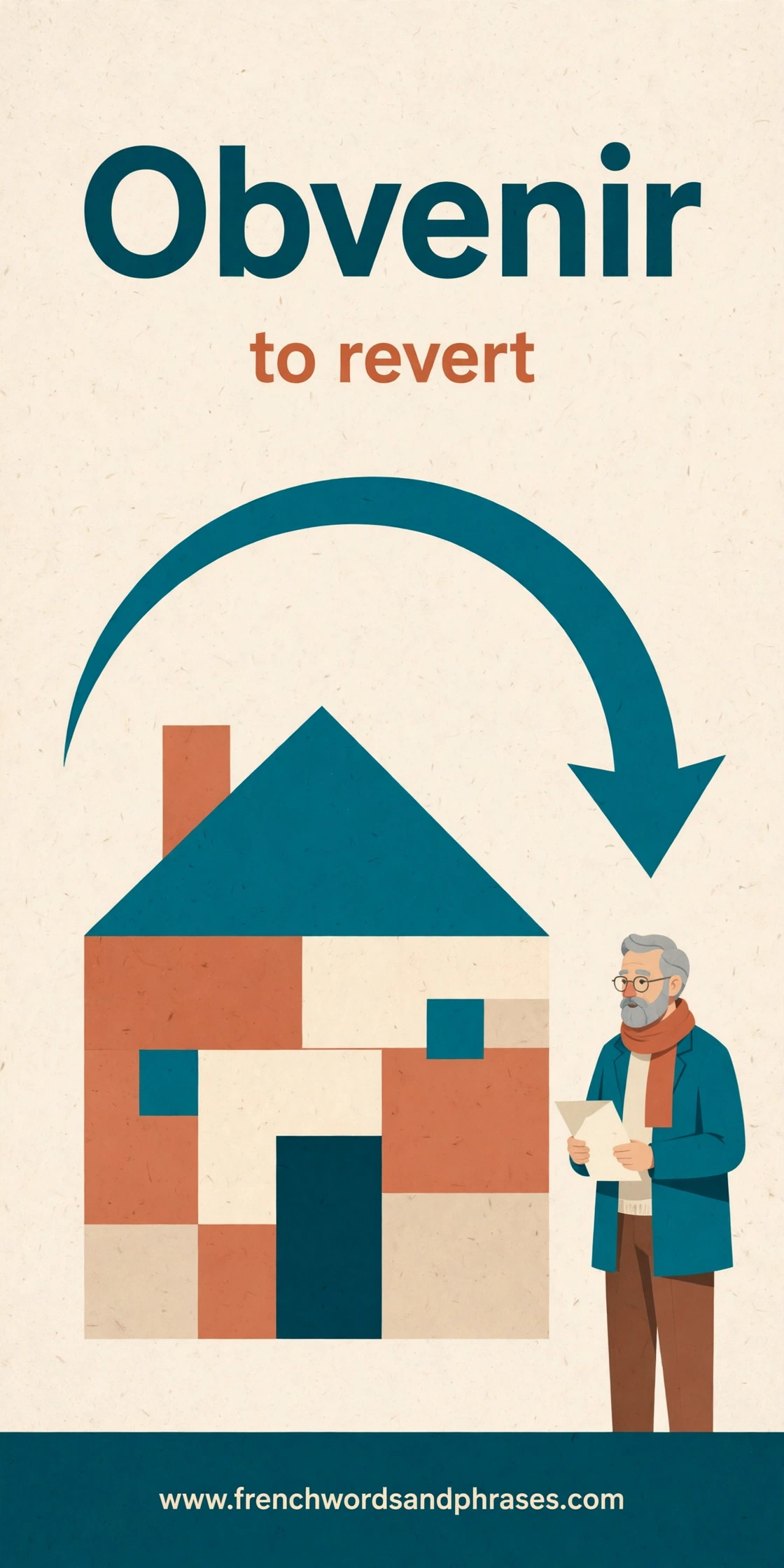
Obvenir means to revert — to fall to someone in law, when property or a debt passes to them by rule.
A dusty clause in a notary’s deed, an estate with no heirs, a debt quietly landing on a new desk — obvenir is one of the rarest verbs in this book: a legal term meaning that property or obligations fall to someone by law.
In this guide, you’ll learn how to conjugate obvenir in all the major French tenses and moods. Explore complete conjugation tables, French examples, English translations, and practice quizzes.
Understanding the French Verb Obvenir
Obvenir is an irregular French verb ending in -ir, conjugated exactly like venir.
It means to revert. It is used almost only in law, for property, estates or debts that fall to an heir, a creditor or the State by legal rule — never for everyday coming and going. People do not obvenir anywhere; only goods and obligations do.
Verb classification: Irregular (-ir, venir family)
Auxiliary verb: Avoir
Past participle: obvenu
Present participle: obvenant
English equivalents: To revert, to fall to (in law); un bien qui obvient à l’État — property that falls to the State; les dettes obviennent aux héritiers — the debts pass to the heirs.
One important detail: obvenir is venir with the prefix ob-, and it follows venir everywhere: je viens gives j’obviens, je viendrai gives j’obviendrai, past participle obvenu. But honesty matters with this verb: it is rare. Outside notaries’ deeds and old legal texts you may never meet it, and lawyers today often reach for revenir or échoir to say that property falls to someone.
Experience the Word
Obvenir is the verb of the fine print — what the law quietly moves from one name to another.
Imagine a notary reading a century-old deed aloud. The farm had no heirs left; clause by clause, the land, the house and even the old debts pass to the commune, written in ink that has outlived everyone in the room.
The land never moved at all. It obvenait — it fell to a new name, by law alone.
How to Conjugate Obvenir: Complete French Conjugation Guide
Let’s explore every major conjugation of obvenir, beginning with the indicative mood.
How to Conjugate Obvenir in the Indicative Mood
The indicative mood is used to express facts, observations, actions, and events.
How to Conjugate Obvenir in the Present Tense (Présent)
Used for actions happening now, habitual actions, and general truths.
| Subject | Conjugation |
|---|---|
| je | obviens |
| tu | obviens |
| il / elle | obvient |
| nous | obvenons |
| vous | obvenez |
| ils / elles | obviennent |
Example
Sans héritiers, ce bien obvient à l’État.
Without heirs, this property falls to the State.
Quick Quiz 1
Complete the sentence:
Selon cet acte, les dettes ______ aux héritiers.
Reveal the answer
obviennent
Selon cet acte, les dettes obviennent aux héritiers.
According to this deed, the debts fall to the heirs.
How to Conjugate Obvenir in the Passé Composé
Used for completed actions in the past. Obvenir takes the auxiliary verb avoir.
| Subject | Conjugation |
|---|---|
| j’ | ai obvenu |
| tu | as obvenu |
| il / elle | a obvenu |
| nous | avons obvenu |
| vous | avez obvenu |
| ils / elles | ont obvenu |
Example
La ferme a obvenu à la commune après la mort du dernier héritier.
The farm fell to the commune after the death of the last heir.
How to Conjugate Obvenir in the Imparfait (Imperfect Tense)
Used for habitual past actions, descriptions, and ongoing situations in the past.
| Subject | Conjugation |
|---|---|
| je | obvenais |
| tu | obvenais |
| il / elle | obvenait |
| nous | obvenions |
| vous | obveniez |
| ils / elles | obvenaient |
Example
Selon l’ancien droit, les dettes obvenaient aux enfants.
Under the old law, the debts fell to the children.
Quick Quiz 2
Choose the correct form:
The estate fell to a cousin.
Le domaine ______ à un cousin. (a obvenu / est obvenu)
Reveal the answer
a obvenu
Le domaine a obvenu à un cousin.
Obvenir takes avoir.
How to Conjugate Obvenir in the Plus-que-parfait
Used to describe an action that had already been completed before another past event.
| Subject | Conjugation |
|---|---|
| j’ | avais obvenu |
| tu | avais obvenu |
| il / elle | avait obvenu |
| nous | avions obvenu |
| vous | aviez obvenu |
| ils / elles | avaient obvenu |
Example
Le domaine avait obvenu à un cousin avant la guerre.
The estate had fallen to a cousin before the war.
How to Conjugate Obvenir in the Passé Simple
Primarily used in formal writing, literature, and historical narratives. It is rarely used in everyday conversation.
| Subject | Conjugation |
|---|---|
| je | obvins |
| tu | obvins |
| il / elle | obvint |
| nous | obvînmes |
| vous | obvîntes |
| ils / elles | obvinrent |
Example
Faute d’héritiers, la maison obvint à l’État.
For want of heirs, the house fell to the State.
How to Conjugate Obvenir in the Passé Antérieur
A literary tense used to express an action completed immediately before another past action, generally in the passé simple.
| Subject | Conjugation |
|---|---|
| j’ | eus obvenu |
| tu | eus obvenu |
| il / elle | eut obvenu |
| nous | eûmes obvenu |
| vous | eûtes obvenu |
| ils / elles | eurent obvenu |
Example
Quand le bien eut obvenu à la commune, on en fit une école.
When the property had fallen to the commune, they made a school of it.
How to Conjugate Obvenir in the Future Tense (Futur Simple)
Used to describe actions that will take place in the future.
| Subject | Conjugation |
|---|---|
| je | obviendrai |
| tu | obviendras |
| il / elle | obviendra |
| nous | obviendrons |
| vous | obviendrez |
| ils / elles | obviendront |
Example
Si personne ne réclame l’héritage, il obviendra au Trésor public.
If nobody claims the inheritance, it will fall to the public Treasury.
How to Conjugate Obvenir in the Futur Antérieur (Future Perfect)
Used for an action that will have been completed before a particular point in the future.
| Subject | Conjugation |
|---|---|
| j’ | aurai obvenu |
| tu | auras obvenu |
| il / elle | aura obvenu |
| nous | aurons obvenu |
| vous | aurez obvenu |
| ils / elles | auront obvenu |
Example
À la clôture du dossier, les biens auront obvenu à leurs nouveaux propriétaires.
By the closing of the file, the goods will have fallen to their new owners.
How to Conjugate Obvenir in the Near Future (Futur Proche)
Used to describe something that is going to happen soon. Formed with aller + infinitive.
| Subject | Conjugation |
|---|---|
| je | vais obvenir |
| tu | vas obvenir |
| il / elle | va obvenir |
| nous | allons obvenir |
| vous | allez obvenir |
| ils / elles | vont obvenir |
Example
Ce terrain va obvenir à la mairie, c’est écrit dans l’acte.
This land is going to fall to the town hall, it is written in the deed.
How to Conjugate Obvenir in the Conditional Mood
The conditional mood expresses what would happen under certain circumstances. It is also frequently used to make polite requests or express wishes.
How to Conjugate Obvenir in the Present Conditional
| Subject | Conjugation |
|---|---|
| je | obviendrais |
| tu | obviendrais |
| il / elle | obviendrait |
| nous | obviendrions |
| vous | obviendriez |
| ils / elles | obviendraient |
Example
Sans ce testament, la maison obviendrait à l’État.
Without this will, the house would fall to the State.
How to Conjugate Obvenir in the Past Conditional
| Subject | Conjugation |
|---|---|
| j’ | aurais obvenu |
| tu | aurais obvenu |
| il / elle | aurait obvenu |
| nous | aurions obvenu |
| vous | auriez obvenu |
| ils / elles | auraient obvenu |
Example
Les dettes auraient obvenu aux héritiers s’ils avaient accepté la succession.
The debts would have fallen to the heirs if they had accepted the estate.
Obvenir in the Literary Past Conditional Form
This less common literary form uses the imperfect subjunctive of avoir.
| Subject | Conjugation |
|---|---|
| j’ | eusse obvenu |
| tu | eusses obvenu |
| il / elle | eût obvenu |
| nous | eussions obvenu |
| vous | eussiez obvenu |
| ils / elles | eussent obvenu |
Example
Le fief eût obvenu au cadet, selon la vieille coutume.
The fief would have fallen to the younger son, according to the old custom.
How to Conjugate Obvenir in the Subjunctive Mood
The subjunctive is used to express wishes, emotions, doubts, necessity, and uncertainty. It frequently follows expressions such as il faut que (it is necessary that) or bien que (although).
How to Conjugate Obvenir in the Present Subjunctive
| Subject | Conjugation |
|---|---|
| que je | obvienne |
| que tu | obviennes |
| qu’il / qu’elle | obvienne |
| que nous | obvenions |
| que vous | obveniez |
| qu’ils / qu’elles | obviennent |
Example
Il est possible que ce bien obvienne à un parent éloigné.
It is possible that this property may fall to a distant relative.
Quick Quiz 3
Complete the sentence using the subjunctive:
Il est possible que ce bien ______ à un parent éloigné.
Reveal the answer
obvienne
Il est possible que ce bien obvienne à un parent éloigné.
It is possible this property may fall to a distant relative.
How to Conjugate Obvenir in the Imperfect Subjunctive
A literary tense, rarely encountered in modern spoken French.
| Subject | Conjugation |
|---|---|
| que je | obvinsse |
| que tu | obvinsses |
| qu’il / qu’elle | obvînt |
| que nous | obvinssions |
| que vous | obvinssiez |
| qu’ils / qu’elles | obvinssent |
Example
L’acte prévoyait que le domaine obvînt à la commune.
The deed provided that the estate should fall to the commune.
How to Conjugate Obvenir in the Pluperfect Subjunctive
A literary construction used to express an action completed before another past action.
| Subject | Conjugation |
|---|---|
| que j’ | eusse obvenu |
| que tu | eusses obvenu |
| qu’il / qu’elle | eût obvenu |
| que nous | eussions obvenu |
| que vous | eussiez obvenu |
| qu’ils / qu’elles | eussent obvenu |
Example
On affirmait que le bien fût obvenu à l’État dès 1900.
People claimed the property had fallen to the State as early as 1900.
How to Conjugate Obvenir in the Past Subjunctive
| Subject | Conjugation |
|---|---|
| que j’ | aie obvenu |
| que tu | aies obvenu |
| qu’il / qu’elle | ait obvenu |
| que nous | ayons obvenu |
| que vous | ayez obvenu |
| qu’ils / qu’elles | aient obvenu |
Example
Le notaire confirme que la ferme ait obvenu à la commune.
The notary confirms that the farm fell to the commune.
How to Conjugate Obvenir in the Imperative
The imperative is used to give commands, instructions, invitations, or suggestions. Subject pronouns are omitted.
How to Conjugate Obvenir in the Present Imperative
| Person | Conjugation |
|---|---|
| (tu) | obviens |
| (nous) | obvenons |
| (vous) | obvenez |
Example
Obvenir n’a pas d’impératif vivant : la loi décide, personne n’ordonne.
Obvenir has no living imperative: the law decides, nobody gives the order.
Quick Quiz 4
How would you say The debts fall to the heirs, in French?
Reveal the answer
Les dettes obviennent aux héritiers.
French Participles of Obvenir
Participles are verb forms that can be used in compound tenses and other grammatical constructions.
Present Participle of Obvenir
obvenant
Les biens obvenant à l’État sont vendus aux enchères.
Property falling to the State is sold at auction.
Past Participle of Obvenir
obvenu
Obvenu à la commune, le vieux moulin est devenu un musée.
Having fallen to the commune, the old mill became a museum.
Obvenir in Everyday French: Real-Life Examples
Now that you know the conjugations, let’s see how obvenir appears in everyday French.
Example 1 — Present
Ce bien obvient à l’État faute d’héritiers.
This property falls to the State for want of heirs.
Example 2 — Passé composé
La ferme a obvenu à la commune.
The farm fell to the commune.
Example 3 — Imparfait
Les dettes obvenaient aux enfants.
The debts used to fall to the children.
Example 4 — Future
L’héritage obviendra au Trésor public.
The inheritance will fall to the public Treasury.
Example 5 — Conditional
La maison obviendrait à l’État sans testament.
The house would fall to the State without a will.
Example 6 — Imperative
Obvenir n’a pas d’impératif.
Obvenir has no imperative.
Beyond Translation: The Meaning of Obvenir
English revert is the lawyer’s everyday word; French obvenir is its rarer cousin, hiding in deeds and successions.
A venir that goes nowhere.
Venir is the great verb of coming; obvenir keeps the whole conjugation but sends only property and debts on the journey — they come to you whether you want them or not.
How to Remember the French Verb Obvenir
Remember it this way: Obvenir is about venir in a notary’s office — property falling to a new name.
- Obvenir copies venir exactly: j’obviens, j’obviendrai, past participle obvenu.
- A rare legal verb: property and debts obviennent — people never do.
- In modern legal French, revenir and échoir often do the same job.
The key idea is venir in a notary’s office — property falling to a new name.
Test Your Knowledge of Obvenir
Let’s see how much you’ve learned. Try answering these questions before revealing the answers.
Question 1
Obvenir is conjugated exactly like which verb?
Reveal the answer
Venir — j’obviens like je viens, j’obviendrai like je viendrai, past participle obvenu.
Question 2
How do you say The farm fell to the commune in French?
Reveal the answer
La ferme a obvenu à la commune.
Question 3
Translate: Without heirs, the house falls to the State.
Reveal the answer
Sans héritiers, la maison obvient à l’État.
Question 4
What is the past participle of obvenir?
Reveal the answer
Obvenu — as in le bien a obvenu à l’État.
Question 5
Complete the sentence:
Si personne ne réclame l’héritage, il ______ au Trésor public.
Reveal the answer
obviendra
Si personne ne réclame l’héritage, il obviendra au Trésor public.
If nobody claims the inheritance, it will fall to the public Treasury.
Your Final Challenge
Can You Use It?
How would you say this in French?
Without heirs, the old farm falls to the commune, and its fields will one day fall to young farmers.
Reveal the answer
Sans héritiers, la vieille ferme obvient à la commune, et ses champs obviendront un jour à de jeunes agriculteurs.
Without heirs, the old farm falls to the commune, and its fields will one day fall to young farmers.
A little French. A little curiosity. A richer everyday life.
LEARN FRENCH ONE WORD AT A TIME