A French Word to Live By
How to Conjugate Obombrer in French
/ɔ.bɔ̃.bʁe/
Obombrer means to darken, to shadow — to cast a shade over something and dim its light.
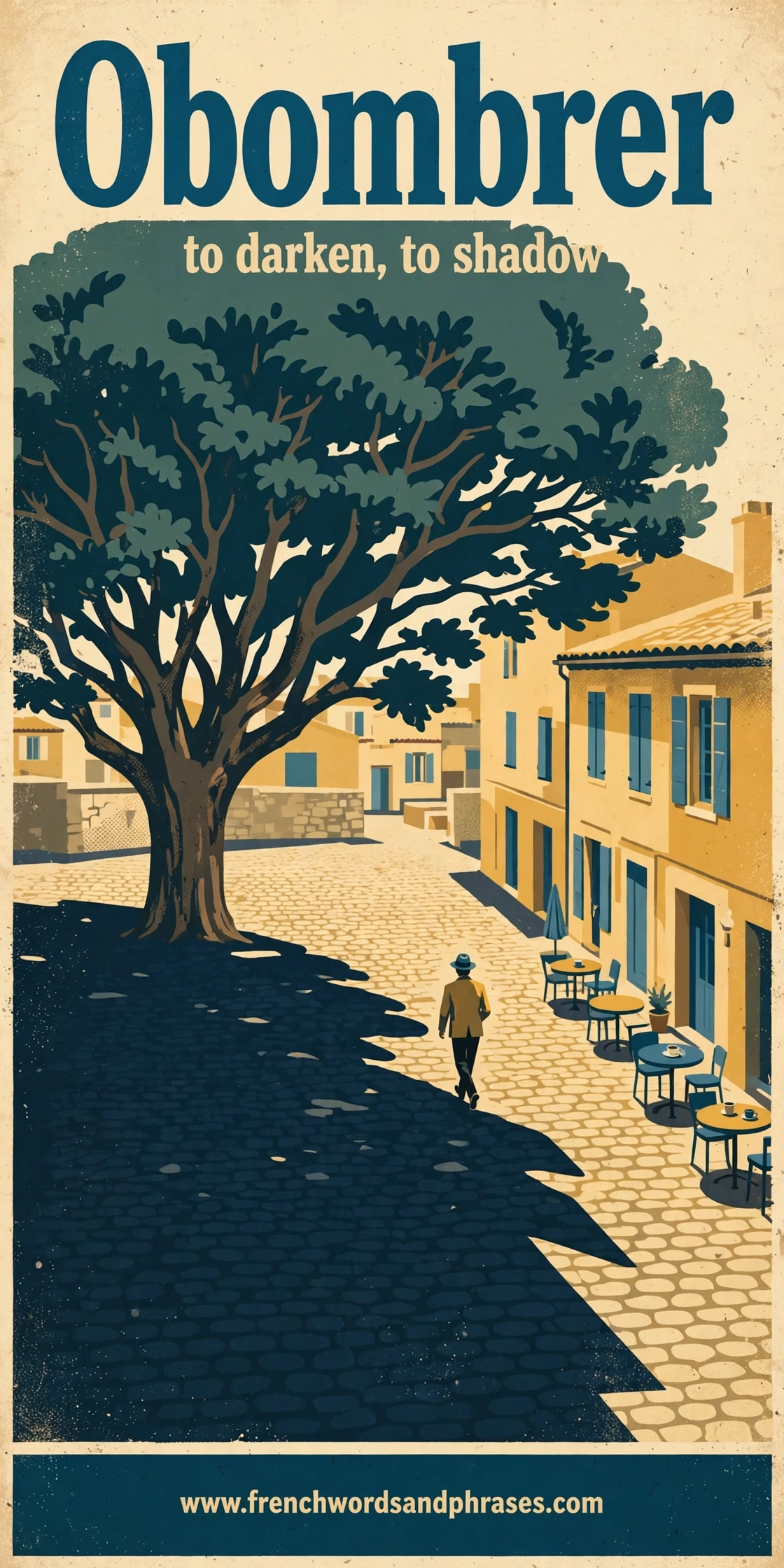
A great cedar leans over the garden wall, and by three o’clock its shadow has taken the whole terrace — obombrer is the quiet, literary verb of that shade falling, of light gently covered rather than switched off.
In this guide, you’ll learn how to conjugate obombrer in all the major French tenses and moods. Explore complete conjugation tables, French examples, English translations, and practice quizzes.
Understanding the French Verb Obombrer
Obombrer is a regular French verb belonging to the first group of verbs, those ending in -er.
It means to darken, to shadow. It is commonly used in literature for skies, landscapes and faces darkened by cloud, foliage or sadness, and occasionally in painting for deepening the shadows of a canvas.
Verb classification: First group (-er)
Auxiliary verb: Avoir
Past participle: obombré
Present participle: obombrant
English equivalents: To darken, to shadow, to cast shade over; un ciel obombré — a darkened, overcast sky; obombrer un tableau — to darken the tones of a painting.
One important detail: obombrer is built on ombre, a shadow, with the prefix ob- in front of it: to put something into shadow. It is a bookish, poetic verb — everyday French more often says assombrir or faire de l’ombre — but obombrer is the word novels reach for when a sky, a valley or a face darkens. Its conjugation is a calm regular -er: j’obombre, nous obombrons, past participle obombré.
Experience the Word
Obombrer is shade with a slow hand — light not extinguished, but gently covered over.
Imagine a small cemetery in Provence at dusk. The cypresses lean a little further over the graves as the light thins, the stones cool, and one by one the names pass into shadow — les cyprès obombrent les tombes, and the whole place exhales.
The light has not gone. It has been shadowed — obombré, softened into dusk.
How to Conjugate Obombrer: Complete French Conjugation Guide
Let’s explore every major conjugation of obombrer, beginning with the indicative mood.
How to Conjugate Obombrer in the Indicative Mood
The indicative mood is used to express facts, observations, actions, and events.
How to Conjugate Obombrer in the Present Tense (Présent)
Used for actions happening now, habitual actions, and general truths.
| Subject | Conjugation |
|---|---|
| je | obombre |
| tu | obombres |
| il / elle | obombre |
| nous | obombrons |
| vous | obombrez |
| ils / elles | obombrent |
Example
Un grand pin obombre la terrasse dès midi.
A tall pine shades the terrace from midday on.
Quick Quiz 1
Complete the sentence:
Le vieux chêne ______ le banc.
Reveal the answer
obombre
Le vieux chêne obombre le banc.
The old oak shades the bench.
How to Conjugate Obombrer in the Passé Composé
Used for completed actions in the past. Obombrer takes the auxiliary verb avoir.
| Subject | Conjugation |
|---|---|
| j’ | ai obombré |
| tu | as obombré |
| il / elle | a obombré |
| nous | avons obombré |
| vous | avez obombré |
| ils / elles | ont obombré |
Example
Des nuages noirs ont obombré la vallée en quelques minutes.
Black clouds darkened the valley in a few minutes.
How to Conjugate Obombrer in the Imparfait (Imperfect Tense)
Used for habitual past actions, descriptions, and ongoing situations in the past.
| Subject | Conjugation |
|---|---|
| je | obombrais |
| tu | obombrais |
| il / elle | obombrait |
| nous | obombrions |
| vous | obombriez |
| ils / elles | obombraient |
Example
Le vieux chêne obombrait le banc des amoureux.
The old oak used to shade the lovers’ bench.
Quick Quiz 2
Choose the correct form:
The clouds darkened the valley.
Les nuages ______ la vallée. (ont obombré / sont obombrés)
Reveal the answer
ont obombré
Les nuages ont obombré la vallée.
Obombrer takes avoir.
How to Conjugate Obombrer in the Plus-que-parfait
Used to describe an action that had already been completed before another past event.
| Subject | Conjugation |
|---|---|
| j’ | avais obombré |
| tu | avais obombré |
| il / elle | avait obombré |
| nous | avions obombré |
| vous | aviez obombré |
| ils / elles | avaient obombré |
Example
La fumée avait obombré le ciel de la ville.
The smoke had darkened the city’s sky.
How to Conjugate Obombrer in the Passé Simple
Primarily used in formal writing, literature, and historical narratives. It is rarely used in everyday conversation.
| Subject | Conjugation |
|---|---|
| je | obombrai |
| tu | obombras |
| il / elle | obombra |
| nous | obombrâmes |
| vous | obombrâtes |
| ils / elles | obombrèrent |
Example
Soudain, un nuage obombra le soleil.
Suddenly, a cloud darkened the sun.
How to Conjugate Obombrer in the Passé Antérieur
A literary tense used to express an action completed immediately before another past action, generally in the passé simple.
| Subject | Conjugation |
|---|---|
| j’ | eus obombré |
| tu | eus obombré |
| il / elle | eut obombré |
| nous | eûmes obombré |
| vous | eûtes obombré |
| ils / elles | eurent obombré |
Example
Quand la nuit eut obombré les champs, ils rentrèrent.
When night had darkened the fields, they went home.
How to Conjugate Obombrer in the Future Tense (Futur Simple)
Used to describe actions that will take place in the future.
| Subject | Conjugation |
|---|---|
| je | obombrerai |
| tu | obombreras |
| il / elle | obombrera |
| nous | obombrerons |
| vous | obombrerez |
| ils / elles | obombreront |
Example
Demain, des nuages obombreront le ciel dès l’aube.
Tomorrow, clouds will darken the sky from dawn.
How to Conjugate Obombrer in the Futur Antérieur (Future Perfect)
Used for an action that will have been completed before a particular point in the future.
| Subject | Conjugation |
|---|---|
| j’ | aurai obombré |
| tu | auras obombré |
| il / elle | aura obombré |
| nous | aurons obombré |
| vous | aurez obombré |
| ils / elles | auront obombré |
Example
À midi, la brume aura obombré tout le port.
By noon, the mist will have darkened the whole harbour.
How to Conjugate Obombrer in the Near Future (Futur Proche)
Used to describe something that is going to happen soon. Formed with aller + infinitive.
| Subject | Conjugation |
|---|---|
| je | vais obombrer |
| tu | vas obombrer |
| il / elle | va obombrer |
| nous | allons obombrer |
| vous | allez obombrer |
| ils / elles | vont obombrer |
Example
Regarde, ce nuage va obombrer le jardin.
Look, that cloud is going to shadow the garden.
How to Conjugate Obombrer in the Conditional Mood
The conditional mood expresses what would happen under certain circumstances. It is also frequently used to make polite requests or express wishes.
How to Conjugate Obombrer in the Present Conditional
| Subject | Conjugation |
|---|---|
| je | obombrerais |
| tu | obombrerais |
| il / elle | obombrerait |
| nous | obombrerions |
| vous | obombreriez |
| ils / elles | obombreraient |
Example
Un store obombrerait agréablement la véranda.
An awning would pleasantly shade the veranda.
How to Conjugate Obombrer in the Past Conditional
| Subject | Conjugation |
|---|---|
| j’ | aurais obombré |
| tu | aurais obombré |
| il / elle | aurait obombré |
| nous | aurions obombré |
| vous | auriez obombré |
| ils / elles | auraient obombré |
Example
Le pin aurait obombré la maison si on ne l’avait pas taillé.
The pine would have shaded the house if it had not been pruned.
Obombrer in the Literary Past Conditional Form
This less common literary form uses the imperfect subjunctive of avoir.
| Subject | Conjugation |
|---|---|
| j’ | eusse obombré |
| tu | eusses obombré |
| il / elle | eût obombré |
| nous | eussions obombré |
| vous | eussiez obombré |
| ils / elles | eussent obombré |
Example
La montagne eût obombré le village dès quatre heures.
The mountain would have shadowed the village from four o’clock.
How to Conjugate Obombrer in the Subjunctive Mood
The subjunctive is used to express wishes, emotions, doubts, necessity, and uncertainty. It frequently follows expressions such as il faut que (it is necessary that) or bien que (although).
How to Conjugate Obombrer in the Present Subjunctive
| Subject | Conjugation |
|---|---|
| que je | obombre |
| que tu | obombres |
| qu’il / qu’elle | obombre |
| que nous | obombrions |
| que vous | obombriez |
| qu’ils / qu’elles | obombrent |
Example
Il est rare qu’un nuage obombre le ciel ici en été.
It is rare for a cloud to darken the sky here in summer.
Quick Quiz 3
Complete the sentence using the subjunctive:
On craint que la fumée ______ la ville.
Reveal the answer
obombre
On craint que la fumée obombre la ville.
People fear the smoke will darken the city.
How to Conjugate Obombrer in the Imperfect Subjunctive
A literary tense, rarely encountered in modern spoken French.
| Subject | Conjugation |
|---|---|
| que je | obombrasse |
| que tu | obombrasses |
| qu’il / qu’elle | obombrât |
| que nous | obombrassions |
| que vous | obombrassiez |
| qu’ils / qu’elles | obombrassent |
Example
On craignait que la fumée n’obombrât la ville entière.
People feared the smoke would darken the whole city.
How to Conjugate Obombrer in the Pluperfect Subjunctive
A literary construction used to express an action completed before another past action.
| Subject | Conjugation |
|---|---|
| que j’ | eusse obombré |
| que tu | eusses obombré |
| qu’il / qu’elle | eût obombré |
| que nous | eussions obombré |
| que vous | eussiez obombré |
| qu’ils / qu’elles | eussent obombré |
Example
Le poète écrivit que les cyprès eussent obombré la tombe.
The poet wrote that the cypresses had shadowed the grave.
How to Conjugate Obombrer in the Past Subjunctive
| Subject | Conjugation |
|---|---|
| que j’ | aie obombré |
| que tu | aies obombré |
| qu’il / qu’elle | ait obombré |
| que nous | ayons obombré |
| que vous | ayez obombré |
| qu’ils / qu’elles | aient obombré |
Example
Je suis content que le store ait obombré la terrasse.
I am glad the awning shaded the terrace.
How to Conjugate Obombrer in the Imperative
The imperative is used to give commands, instructions, invitations, or suggestions. Subject pronouns are omitted.
How to Conjugate Obombrer in the Present Imperative
| Person | Conjugation |
|---|---|
| (tu) | obombre |
| (nous) | obombrons |
| (vous) | obombrez |
Example
Obombre un peu ce coin, le soleil tape trop fort !
Shade this corner a little, the sun is beating down!
Quick Quiz 4
How would you say Shade this corner (tu form)?
Reveal the answer
Obombre ce coin !
French Participles of Obombrer
Participles are verb forms that can be used in compound tenses and other grammatical constructions.
Present Participle of Obombrer
obombrant
En obombrant la fenêtre, le lierre rend la pièce fraîche.
By shading the window, the ivy keeps the room cool.
Past Participle of Obombrer
obombré
Obombrée par les cyprès, la tombe reste fraîche même en août.
Shadowed by the cypresses, the grave stays cool even in August.
Obombrer in Everyday French: Real-Life Examples
Now that you know the conjugations, let’s see how obombrer appears in everyday French.
Example 1 — Present
Le pin obombre la terrasse.
The pine shades the terrace.
Example 2 — Passé composé
Les nuages ont obombré la vallée.
The clouds darkened the valley.
Example 3 — Imparfait
Le chêne obombrait le banc.
The oak used to shade the bench.
Example 4 — Future
La brume obombrera le port demain.
The mist will darken the harbour tomorrow.
Example 5 — Conditional
Un store obombrerait la véranda.
An awning would shade the veranda.
Example 6 — Imperative
Obombre ce coin, vite !
Shade this corner, quick!
Beyond Translation: The Meaning of Obombrer
French ombre comes from Latin umbra — the same root that gives English umbrella and the phrase to take umbrage.
Obombrer keeps the literal shade.
Before it ever meant offence or gloom, the word was about a tree, a cloud, a wall — something standing between you and the sun, dimming the world by one soft degree.
How to Remember the French Verb Obombrer
Remember it this way: Obombrer is about shade falling slowly over the terrace at noon.
- Obombrer is built on ombre — a shadow: to put something into shadow.
- A literary verb: everyday French says assombrir or faire de l’ombre.
- Regular -er: j’obombre, nous obombrons, past participle obombré.
The key idea is shade falling slowly over the terrace at noon.
Test Your Knowledge of Obombrer
Let’s see how much you’ve learned. Try answering these questions before revealing the answers.
Question 1
How do you say to shade the terrace in French?
Reveal the answer
Obombrer la terrasse.
Question 2
How do you say A tall pine shades the garden in French?
Reveal the answer
Un grand pin obombre le jardin.
Question 3
Translate: Black clouds darkened the valley.
Reveal the answer
Des nuages noirs ont obombré la vallée.
Question 4
What is the past participle of obombrer?
Reveal the answer
Obombré.
Question 5
Complete the sentence:
Il est rare qu’un nuage ______ le ciel ici.
Reveal the answer
obombre
Il est rare qu’un nuage obombre le ciel ici.
It is rare for a cloud to darken the sky here.
Your Final Challenge
Can You Use It?
How would you say this in French?
When evening comes, the cypresses shade the little cemetery, and everything falls silent.
Reveal the answer
Le soir venu, les cyprès obombrent le petit cimetière, et tout devient silence.
When evening comes, the cypresses shade the little cemetery, and everything falls silent.
A little French. A little curiosity. A richer everyday life.
LEARN FRENCH ONE WORD AT A TIME