A French Word to Live By
How to Conjugate Objecter in French
/ɔb.ʒɛk.te/
Objecter means to object — to raise an objection, to put a counter-argument in the way of a proposal.
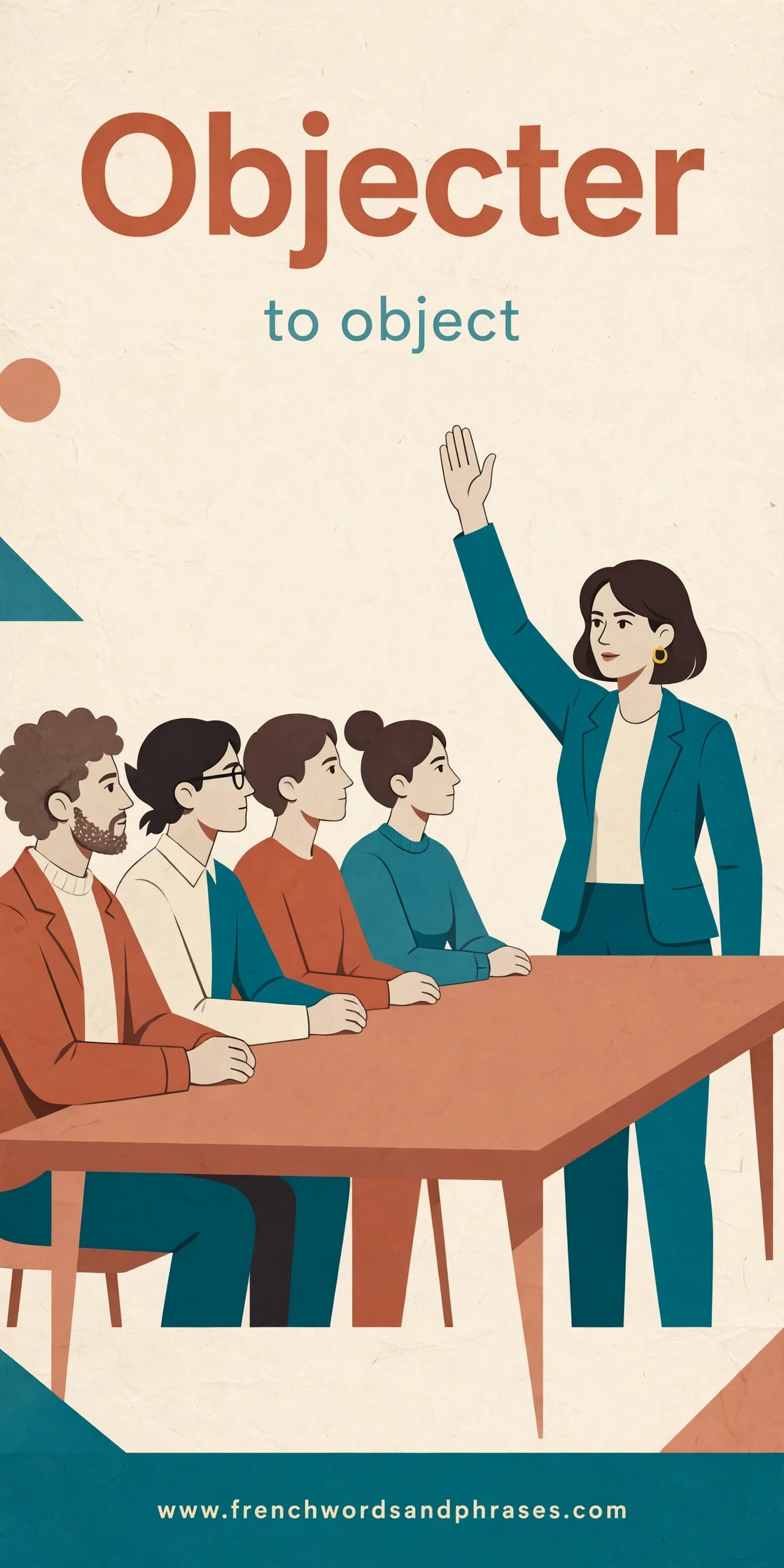
A hand rising at the back of a meeting room, a lawyer on her feet before the judge has finished — objecter is the verb of the formal objection, the moment someone says: wait, that will not do.
In this guide, you’ll learn how to conjugate objecter in all the major French tenses and moods. Explore complete conjugation tables, French examples, English translations, and practice quizzes.
Understanding the French Verb Objecter
Objecter is a regular French verb belonging to the first group of verbs, those ending in -er.
It means to object. It is commonly used in meetings, debates, courts and formal discussions, wherever a proposal meets a reasoned no — and in reported speech, where an objection raised earlier is passed on: on lui a objecté que le budget ne suivrait pas.
Verb classification: First group (-er)
Auxiliary verb: Avoir
Past participle: objecté
Present participle: objectant
English equivalents: To object, to raise as an objection; objecter que… — to object that…; objecter une difficulté à quelqu’un — to raise a difficulty with someone; on m’a objecté que… — it was objected to me that…
One important detail: objecter begins with a vowel sound, so je becomes j’ — j’objecte, j’ai objecté — and the -ct- in the middle is fully sounded. The verb is built like a courtroom: objecter quelque chose à quelqu’un, to put something as an objection to someone, and objecter que plus a clause for the argument itself. The noun is une objection.
Experience the Word
Objecter is the verb of the reasoned no — not refusal, but a difficulty placed on the table.
Imagine a village council debating a new road. The mayor presents the plan, the room nods — then the schoolteacher stands and objecte, calmly, that the road would cut the children’s path to school in two.
The plan survives, but changed. An objection has been raised — on a objecté — and everyone must now answer it.
How to Conjugate Objecter: Complete French Conjugation Guide
Let’s explore every major conjugation of objecter, beginning with the indicative mood.
How to Conjugate Objecter in the Indicative Mood
The indicative mood is used to express facts, observations, actions, and events.
How to Conjugate Objecter in the Present Tense (Présent)
Used for actions happening now, habitual actions, and general truths.
| Subject | Conjugation |
|---|---|
| je | objecte |
| tu | objectes |
| il / elle | objecte |
| nous | objectons |
| vous | objectez |
| ils / elles | objectent |
Example
J’objecte que ce plan coûte trop cher.
I object that this plan costs too much.
Quick Quiz 1
Complete the sentence:
Nous ______ que le budget est trop serré.
Reveal the answer
objectons
Nous objectons que le budget est trop serré.
We object that the budget is too tight.
How to Conjugate Objecter in the Passé Composé
Used for completed actions in the past. Objecter takes the auxiliary verb avoir.
| Subject | Conjugation |
|---|---|
| j’ | ai objecté |
| tu | as objecté |
| il / elle | a objecté |
| nous | avons objecté |
| vous | avez objecté |
| ils / elles | ont objecté |
Example
Elle a objecté que le délai était impossible.
She objected that the deadline was impossible.
How to Conjugate Objecter in the Imparfait (Imperfect Tense)
Used for habitual past actions, descriptions, and ongoing situations in the past.
| Subject | Conjugation |
|---|---|
| je | objectais |
| tu | objectais |
| il / elle | objectait |
| nous | objections |
| vous | objectiez |
| ils / elles | objectaient |
Example
À chaque réunion, il objectait le même argument.
At every meeting, he used to raise the same objection.
Quick Quiz 2
Choose the correct form:
She objected that the deadline was impossible.
Elle ______ que le délai était impossible. (a objecté / est objectée)
Reveal the answer
a objecté
Elle a objecté que le délai était impossible.
Objecter takes avoir.
How to Conjugate Objecter in the Plus-que-parfait
Used to describe an action that had already been completed before another past event.
| Subject | Conjugation |
|---|---|
| j’ | avais objecté |
| tu | avais objecté |
| il / elle | avait objecté |
| nous | avions objecté |
| vous | aviez objecté |
| ils / elles | avaient objecté |
Example
On lui avait objecté les risques, mais il avait signé.
The risks had been pointed out to him, but he had signed.
How to Conjugate Objecter in the Passé Simple
Primarily used in formal writing, literature, and historical narratives. It is rarely used in everyday conversation.
| Subject | Conjugation |
|---|---|
| je | objectai |
| tu | objectas |
| il / elle | objecta |
| nous | objectâmes |
| vous | objectâtes |
| ils / elles | objectèrent |
Example
L’avocate objecta que la preuve était irrecevable.
The lawyer objected that the evidence was inadmissible.
How to Conjugate Objecter in the Passé Antérieur
A literary tense used to express an action completed immediately before another past action, generally in the passé simple.
| Subject | Conjugation |
|---|---|
| j’ | eus objecté |
| tu | eus objecté |
| il / elle | eut objecté |
| nous | eûmes objecté |
| vous | eûtes objecté |
| ils / elles | eurent objecté |
Example
Quand il eut objecté le prix, la discussion changea de ton.
When he had raised the price as an objection, the discussion changed tone.
How to Conjugate Objecter in the Future Tense (Futur Simple)
Used to describe actions that will take place in the future.
| Subject | Conjugation |
|---|---|
| je | objecterai |
| tu | objecteras |
| il / elle | objectera |
| nous | objecterons |
| vous | objecterez |
| ils / elles | objecteront |
Example
Je sais que vous objecterez le coût, et vous aurez raison.
I know you will object to the cost, and you will be right.
How to Conjugate Objecter in the Futur Antérieur (Future Perfect)
Used for an action that will have been completed before a particular point in the future.
| Subject | Conjugation |
|---|---|
| j’ | aurai objecté |
| tu | auras objecté |
| il / elle | aura objecté |
| nous | aurons objecté |
| vous | aurez objecté |
| ils / elles | auront objecté |
Example
D’ici la fin de la séance, chacun aura objecté au moins une fois.
By the end of the session, everyone will have objected at least once.
How to Conjugate Objecter in the Near Future (Futur Proche)
Used to describe something that is going to happen soon. Formed with aller + infinitive.
| Subject | Conjugation |
|---|---|
| je | vais objecter |
| tu | vas objecter |
| il / elle | va objecter |
| nous | allons objecter |
| vous | allez objecter |
| ils / elles | vont objecter |
Example
Je vais objecter que le calendrier est irréaliste.
I am going to object that the schedule is unrealistic.
How to Conjugate Objecter in the Conditional Mood
The conditional mood expresses what would happen under certain circumstances. It is also frequently used to make polite requests or express wishes.
How to Conjugate Objecter in the Present Conditional
| Subject | Conjugation |
|---|---|
| je | objecterais |
| tu | objecterais |
| il / elle | objecterait |
| nous | objecterions |
| vous | objecteriez |
| ils / elles | objecteraient |
Example
À ta place, j’objecterais la même chose.
In your place, I would raise the same objection.
How to Conjugate Objecter in the Past Conditional
| Subject | Conjugation |
|---|---|
| j’ | aurais objecté |
| tu | aurais objecté |
| il / elle | aurait objecté |
| nous | aurions objecté |
| vous | auriez objecté |
| ils / elles | auraient objecté |
Example
Il aurait objecté le retard si on l’avait écouté.
He would have objected to the delay if anyone had listened to him.
Objecter in the Literary Past Conditional Form
This less common literary form uses the imperfect subjunctive of avoir.
| Subject | Conjugation |
|---|---|
| j’ | eusse objecté |
| tu | eusses objecté |
| il / elle | eût objecté |
| nous | eussions objecté |
| vous | eussiez objecté |
| ils / elles | eussent objecté |
Example
Elle eût objecté le prix dès la première séance.
She would have objected to the price from the very first session.
How to Conjugate Objecter in the Subjunctive Mood
The subjunctive is used to express wishes, emotions, doubts, necessity, and uncertainty. It frequently follows expressions such as il faut que (it is necessary that) or bien que (although).
How to Conjugate Objecter in the Present Subjunctive
| Subject | Conjugation |
|---|---|
| que je | objecte |
| que tu | objectes |
| qu’il / qu’elle | objecte |
| que nous | objections |
| que vous | objectiez |
| qu’ils / qu’elles | objectent |
Example
Il est possible qu’elle objecte que le texte est flou.
It is possible that she objects that the text is vague.
Quick Quiz 3
Complete the sentence using the subjunctive:
Il est normal que vous ______ dès le début.
Reveal the answer
objectiez
Il est normal que vous objectiez dès le début.
It is normal for you to object right from the start.
How to Conjugate Objecter in the Imperfect Subjunctive
A literary tense, rarely encountered in modern spoken French.
| Subject | Conjugation |
|---|---|
| que je | objectasse |
| que tu | objectasses |
| qu’il / qu’elle | objectât |
| que nous | objectassions |
| que vous | objectassiez |
| qu’ils / qu’elles | objectassent |
Example
Le président ne voulait pas qu’on objectât pendant son discours.
The chairman did not want anyone objecting during his speech.
How to Conjugate Objecter in the Pluperfect Subjunctive
A literary construction used to express an action completed before another past action.
| Subject | Conjugation |
|---|---|
| que j’ | eusse objecté |
| que tu | eusses objecté |
| qu’il / qu’elle | eût objecté |
| que nous | eussions objecté |
| que vous | eussiez objecté |
| qu’ils / qu’elles | eussent objecté |
Example
On rapporta qu’il eût objecté le coût dès le début.
It was reported that he had objected to the cost from the start.
How to Conjugate Objecter in the Past Subjunctive
| Subject | Conjugation |
|---|---|
| que j’ | aie objecté |
| que tu | aies objecté |
| qu’il / qu’elle | ait objecté |
| que nous | ayons objecté |
| que vous | ayez objecté |
| qu’ils / elles | aient objecté |
Example
Je suis surpris qu’elle ait objecté si tard.
I am surprised that she objected so late.
How to Conjugate Objecter in the Imperative
The imperative is used to give commands, instructions, invitations, or suggestions. Subject pronouns are omitted.
How to Conjugate Objecter in the Present Imperative
| Person | Conjugation |
|---|---|
| (tu) | objecte |
| (nous) | objectons |
| (vous) | objectez |
Example
Objectez si quelque chose vous semble faux !
Object if anything seems wrong to you!
Quick Quiz 4
How would you say Object if you disagree (vous form)?
Reveal the answer
Objectez si vous n’êtes pas d’accord !
French Participles of Objecter
Participles are verb forms that can be used in compound tenses and other grammatical constructions.
Present Participle of Objecter
objectant
En objectant le délai, elle a sauvé le projet.
By objecting to the deadline, she saved the project.
Past Participle of Objecter
objecté
La difficulté, objectée dès le départ, a fini par convaincre.
The difficulty, raised as an objection from the start, ended up convincing everyone.
Objecter in Everyday French: Real-Life Examples
Now that you know the conjugations, let’s see how objecter appears in everyday French.
Example 1 — Present
J’objecte que ce plan coûte trop cher.
I object that this plan costs too much.
Example 2 — Passé composé
Elle a objecté que le délai était impossible.
She objected that the deadline was impossible.
Example 3 — Imparfait
Il objectait toujours le même argument.
He always used to raise the same objection.
Example 4 — Future
Vous objecterez le coût, je le sais.
You will object to the cost, I know it.
Example 5 — Conditional
À ta place, j’objecterais la même chose.
In your place, I would raise the same objection.
Example 6 — Imperative
Objecte si tu n’es pas d’accord !
Object if you do not agree!
Beyond Translation: The Meaning of Objecter
English objection! rings out in courtrooms on television; French objecter is the same gesture in verb form, but it lives a quieter, broader life.
It objects with arguments, not with shouts.
You objecter a price, a deadline, a choice of site — you place a difficulty on the table and oblige everyone to deal with it. It is the polite machinery of disagreement.
How to Remember the French Verb Objecter
Remember it this way: Objecter is about a hand rising in the meeting — the reasoned no.
- Objecter que… — to object that…; objecter quelque chose à quelqu’un — to put an objection to someone.
- Vowel start: je becomes j’ — j’objecte, j’ai objecté.
- Regular -er: past participle objecté; the noun is une objection.
The key idea is a hand rising in the meeting — the reasoned no.
Test Your Knowledge of Objecter
Let’s see how much you’ve learned. Try answering these questions before revealing the answers.
Question 1
How do you say to object that the plan costs too much in French?
Reveal the answer
Objecter que le plan coûte trop cher.
Question 2
Translate: She objected that the deadline was impossible.
Reveal the answer
Elle a objecté que le délai était impossible.
Question 3
What is the past participle of objecter?
Reveal the answer
Objecté.
Question 4
Complete the sentence:
Il est normal que vous ______ dès le début.
Reveal the answer
objectiez
Il est normal que vous objectiez dès le début.
It is normal for you to object right from the start.
Question 5
What is the French noun for an objection?
Reveal the answer
Une objection.
Your Final Challenge
Can You Use It?
How would you say this in French?
She objects that the deadline is impossible, and the whole room falls silent to listen to her.
Reveal the answer
Elle objecte que le délai est impossible, et toute la salle se tait pour l’écouter.
She objects that the deadline is impossible, and the whole room falls silent to listen to her.
A little French. A little curiosity. A richer everyday life.
LEARN FRENCH ONE WORD AT A TIME