
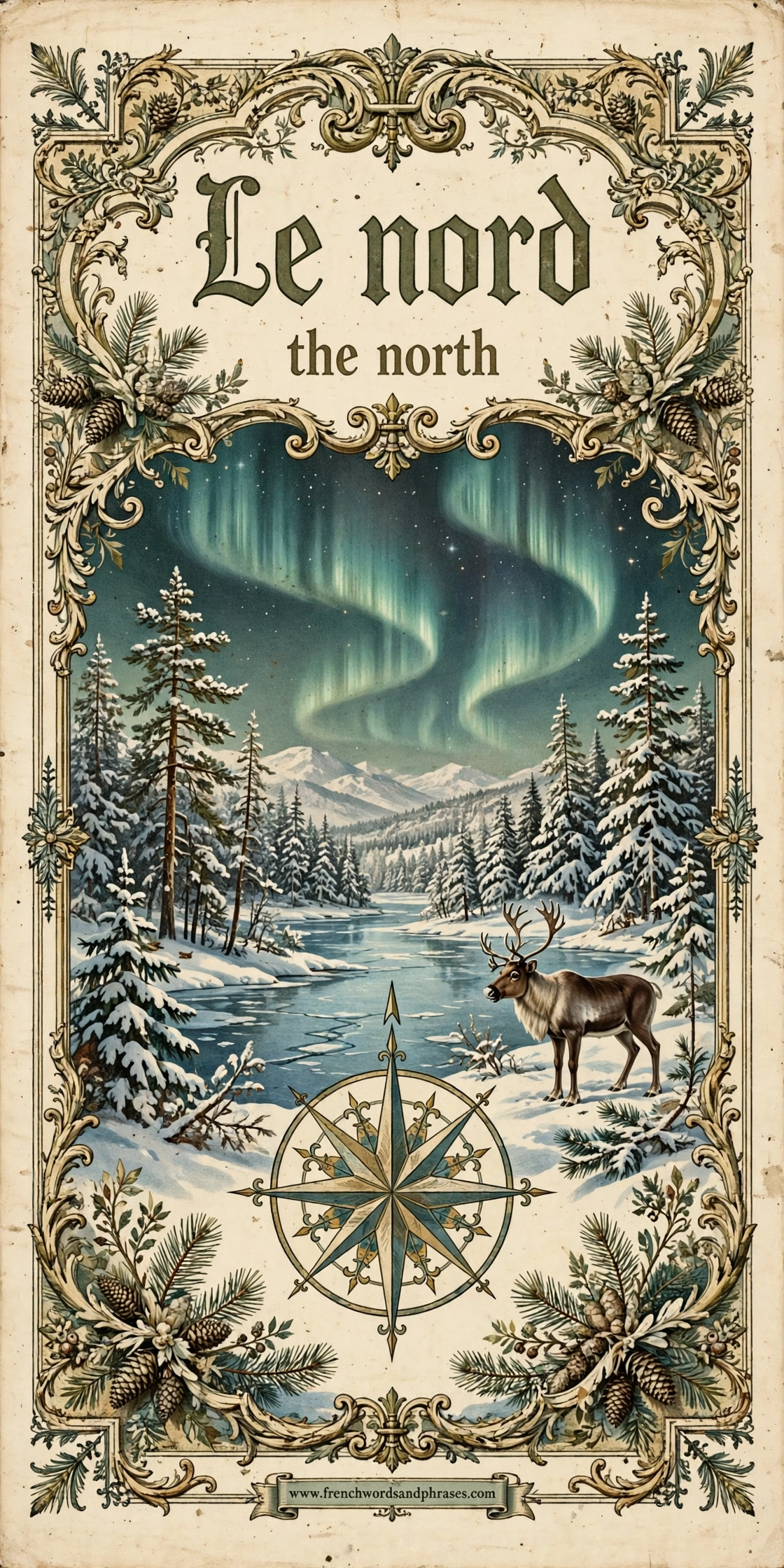
A French Word to Live By
Translate Nord to English
/nɔʁ/
Le nord means the north.
The old sailor licks his finger, holds it to the wind, and points past the harbour wall: « Le vent vient du nord. » — The wind comes from the north. Nord is the noun of the compass’s top: the cold quarter, the direction of the pole star, the top of every map.
In this guide, you’ll learn what nord means in English, how to use it with its articles, how to form its plural, and how it appears in everyday French. Explore French examples, English translations, and practice quizzes.
Understanding the French Noun Nord
Nord is a masculine French noun, learned with its article: le nord, au nord. It is a Germanic word that sailed into French with the Normans’ ships. It names the direction, the region (le Nord, the North of France — even a département named simply Nord), and the wind that comes from there.
It means the north: aller vers le nord, to go north, au nord de Paris, north of Paris, le nord du pays, the north of the country. With a capital, le Nord is France’s northern region and its cold reputation: les gens du Nord, the people of the North. The compass family stands together: le nord, le sud, l’est, l’ouest.
Gender: Masculine — le nord
Definite article: le — le nord (the north)
Indefinite article: rarely used — directions take le or no article (vers le nord, au nord)
Plural: none in daily use — there is only one north
Key phrase: au nord de — to the north of
Close neighbour: le sud — the south, its opposite; septentrional — northern, the learned adjective
English equivalents: The north.
Directions in French run on fixed frames: au nord (in/to the north, for a region), vers le nord (towards the north), du nord (from the north — le vent du nord), au nord de Lyon (north of Lyon). Small compass points take no capital (le nord), but a region wearing the name takes one: le Nord de la France, and the département du Nord. The adjective for northern in careful French is septentrional — but everyday French simply says du nord: les villes du nord.
Experience the Word
Nord is the noun of the top of the map — the direction every compass needle loves.
Imagine the geese in October crossing the farmyard sky in their long V, calling as they go: « Elles partent vers le sud », dit le grand-père — et au printemps, elles reviendront du nord. Nord is half of that ancient calendar, the cold half that sends the birds away and promises their return.
You have not just named a direction. You have pointed at the pole star — le nord, where the maps end and the cold begins.
How to Use Nord in French: Complete Guide
Let’s explore how nord works in French, beginning with its frames — le nord, au nord, vers le nord.
Nord with the Definite Article (Le)
Directions live with le: the north as a region, a quarter of the country, a side of the map.
| Form | French |
|---|---|
| Masculine singular | le nord |
| The region (capital) | le Nord |
Example
Le nord du pays est plus froid que le sud.
The north of the country is colder than the south.
Nord in Its Frames: Au, Vers, Du
A direction is almost never alone: the little preposition before nord tells you whether you are there, going there, or coming from there.
| Frame | French |
|---|---|
| in the north (place) | au nord |
| towards the north (movement) | vers le nord |
| from the north (origin) | du nord |
| north of (a place) | au nord de Paris |
| in the far north | dans le Grand Nord |
Example
Le vent du nord apporte le froid.
The north wind brings the cold.
Nord Among the Compass Points
The four points stand together in every school atlas — nord at the top, as the maps decree.
| Point | French |
|---|---|
| north | le nord |
| south | le sud |
| east | l’est |
| west | l’ouest |
| north-east / north-west | le nord-est / le nord-ouest |
Example
Le soleil se lève à l’est et se couche à l’ouest.
The sun rises in the east and sets in the west.
Quick Quiz 1
Complete the sentence:
Lille est ______ nord de la France. (in the)
Reveal the answer
au
Lille est au nord de la France.
Lille is in the north of France — au nord is the place frame.
The Plural of Nord
Nord has no working plural: the compass gives one north to the whole world, and French respects the geometry.
| Number | French |
|---|---|
| Singular | le nord |
| Plural | — (no plural in daily use) |
Example
Tous les chemins de montagne montent vers le nord.
All the mountain paths climb towards the north.
Nord with Possessive Adjectives (Mon, Ton, Son…)
Possessives agree with the noun: nord is masculine, so mon, ton, son — heard mostly in the traveller’s phrase perdre le nord.
| Owner | French |
|---|---|
| my | mon nord (rare — see perdre le nord below) |
| your (tu) | ton nord |
| his / her | son nord |
| our | notre nord |
| your (vous) | votre nord |
| their | leur nord |
Example
Après trois jours de mer, il a perdu le nord.
After three days at sea, he lost his bearings (literally: he lost the north).
Quick Quiz 2
What does perdre le nord mean?
Reveal the answer
To lose one’s bearings, to get disoriented — literally, to lose the north.
Dans la tempête, le capitaine a perdu le nord.
In the storm, the captain lost his bearings.
Nord with Demonstrative Adjectives (Ce, Ces)
Used to point: ce nord, this north — rare, and mostly in the geographer’s poetry.
| Form | French |
|---|---|
| Masculine singular | ce nord |
| Plural | ces nords (very rare) |
Example
Ce nord lointain attire les explorateurs.
This far north attracts the explorers.
Nord with Adjectives
Adjectives agree with nord — masculine singular: le Grand Nord, le nord industriel.
| Adjective | With Nord |
|---|---|
| grand (great, far) | le Grand Nord — the Far North |
| industriel (industrial) | le nord industriel |
| froid (cold) | le nord froid (in descriptions) |
| magnétique (magnetic) | le nord magnétique |
| vrai (true) | le nord vrai (of the compass) |
Example
Les explorateurs rêvent du Grand Nord.
The explorers dream of the Far North.
Quick Quiz 3
Complete the sentence:
La boussole montre toujours le ______. (north)
Reveal the answer
nord
La boussole montre toujours le nord.
The compass always shows the north.
Everyday Expressions with Nord
Winds, maps and lost travellers — the nord phrases of daily life.
| Expression | In English |
|---|---|
| au nord de | to the north of |
| vers le nord | northwards, towards the north |
| le vent du nord | the north wind |
| perdre le nord | to lose one’s bearings |
| le pôle Nord | the North Pole |
Example
Le pôle Nord est couvert de glace toute l’année.
The North Pole is covered in ice all year round.
Words from the Same Family as Nord
Compasses and cold quarters — the words that travel with nord.
| French | In English |
|---|---|
| le sud | the south — the opposite point |
| une boussole | a compass |
| septentrional | northern — the learned adjective |
| un nordiste | a northerner (in history, a Union soldier) |
| s’orienter | to get one’s bearings, to orient oneself |
Example
Sans boussole, le randonneur ne peut pas s’orienter.
Without a compass, the hiker cannot get his bearings.
Quick Quiz 4
What is the opposite of le nord?
Reveal the answer
Le sud — the south.
Les oiseaux volent vers le sud en automne.
The birds fly south in autumn.
Nord in Everyday French: Real-Life Examples
Now that you know the word, let’s see how nord appears in everyday French.
Example 1 — Geography
Lille est au nord de la France.
Lille is in the north of France.
Example 2 — Weather
Le vent du nord apporte la neige.
The north wind brings the snow.
Example 3 — Travel
Nous roulons vers le nord depuis ce matin.
We have been driving north since this morning.
Example 4 — The compass
La boussole montre le nord, suis-la.
The compass shows the north, follow it.
Example 5 — Lost
Dans le brouillard, j’ai perdu le nord.
In the fog, I lost my bearings.
Example 6 — The pole
Les ours blancs vivent près du pôle Nord.
Polar bears live near the North Pole.
Beyond Translation: The Meaning of Nord
Nord sailed into French from the Germanic seas — the word of the Normans, the north-men, whose name is the direction itself. French maps put it at the top, French weather fears its wind, and French geography honours it with a capital: le Nord, the region of miners, sailors and famously warm welcomes under cold skies.
To say nord is to face the pole star and feel the temperature drop.
And the language keeps its poetry: perdre le nord, to lose the north, is how French says a mind has lost its way — as if every traveller carried a small compass in the head.
How to Remember the French Noun Nord
Remember it this way: Nord is the north — masculine: le nord, framed by au, vers and du, and losing it means losing your way.
- Always masculine — le nord, au nord, le vent du nord.
- The three frames — au nord (there), vers le nord (going), du nord (from).
- The idiom — perdre le nord, to lose one’s bearings.
The key idea is le nord — the north, masculine; au nord de = north of; perdre le nord = to lose one’s bearings.
Test Your Knowledge of Nord
Let’s see how much you’ve learned. Try answering these questions before revealing the answers.
Question 1
Is nord masculine or feminine?
Reveal the answer
Masculine — le nord, au nord.
Question 2
How do you say « north of Paris »?
Reveal the answer
Au nord de Paris.
Question 3
Translate: The north wind brings the cold.
Reveal the answer
Le vent du nord apporte le froid.
Question 4
What does perdre le nord mean?
Reveal the answer
To lose one’s bearings — to become disoriented, literally to lose the north.
Question 5
Complete the sentence:
Les oiseaux reviennent du ______ au printemps. (north)
Reveal the answer
nord
Les oiseaux reviennent du nord au printemps.
The birds come back from the north in spring.
Your Final Challenge
Can You Use It?
How would you say this in French?
“Lille is in the north of France.”
Reveal the answer
Lille est au nord de la France.
Lille is in the north of France.
A little French. A little curiosity. A richer everyday life.
LEARN FRENCH ONE WORD AT A TIME




