A French Word to Live By
How to Conjugate Naître in French
/nɛtʁ/
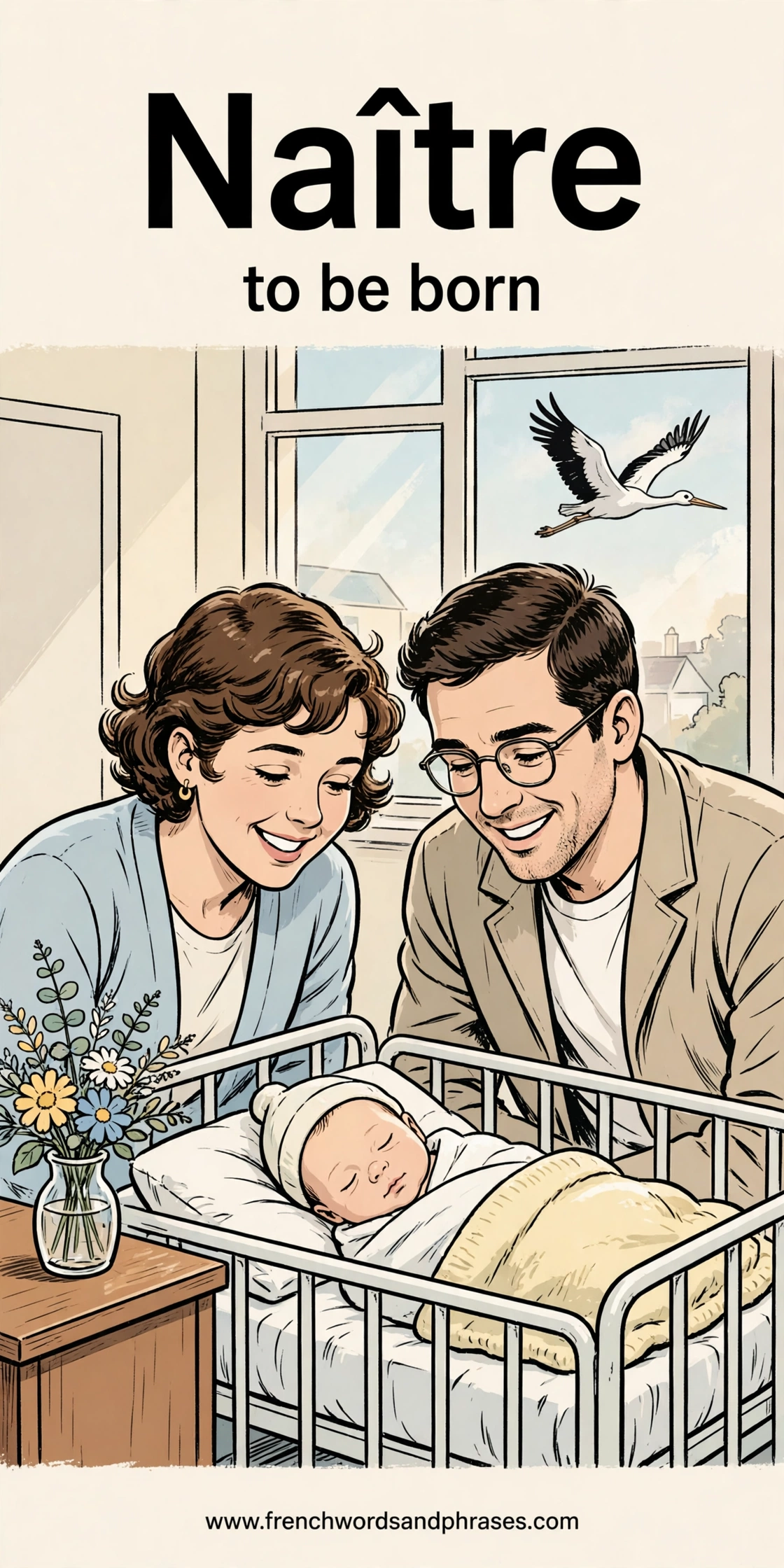
Naître means to be born — to come into the world, and by extension to begin, to arise: a day dawns, an idea is born, a movement is born.
A first cry in a delivery room, a date on every identity card, the opening line of every biography — naître is the verb of beginnings: je suis né, I was born, the sentence with which every French life story quietly starts.
In this guide, you’ll learn how to conjugate naître in all the major French tenses and moods. Explore complete conjugation tables, French examples, English translations, and practice quizzes.
Understanding the French Verb Naître
Naître is an irregular French verb, one of the handful conjugated with être in compound tenses.
It means to be born. Its everyday home is the first line of every form and story: né le… à… — born on… at… — and the figurative dawns: le jour naît, day is breaking; une idée est née, an idea was born; naître à quelque chose, to awaken to something. With être as its auxiliary, the participle agrees: elle est née, ils sont nés.
Verb classification: Irregular (-aître), être
Auxiliary verb: Être
Past participle: né
Present participle: naissant
English equivalents: To be born; je suis né à Paris — I was born in Paris; né le 3 mai — born on 3 May; naître à la poésie — to awaken to poetry; le jour naît — the day is dawning.
One important detail: naître keeps its circumflex in the present where the î meets a t — je nais, tu nais, il naît — and in the future, je naîtrai; but the passé simple turns to qu: je naquis, il naquit, and the past participle is the short, famous né: je suis né, elle est née, ils sont nés.
Experience the Word
Naître is the verb nobody performs and everybody undergoes — the one action of a life that happens entirely to you, before you can agree to anything.
Imagine the maternity ward at dawn: a window open on the first light, a grandmother counting fingers through happy tears, and a nurse writing the hour in a register — l’enfant est né à six heures douze. The register will outlive everyone in the room, and its first verb is naître.
Every biography ever written starts here. That is naître — the door of the world, opening once.
How to Conjugate Naître: Complete French Conjugation Guide
Let’s explore every major conjugation of naître, beginning with the indicative mood.
How to Conjugate Naître in the Indicative Mood
The indicative mood is used to express facts, observations, actions, and events.
How to Conjugate Naître in the Present Tense (Présent)
Used for actions happening now, habitual actions, and general truths.
| Subject | Conjugation |
|---|---|
| je | nais |
| tu | nais |
| il / elle | naît |
| nous | naissons |
| vous | naissez |
| ils / elles | naissent |
Example
Le bébé naît à la maternité.
The baby is born at the maternity hospital.
Quick Quiz 1
Complete the sentence:
Je ______ né à Paris.
Reveal the answer
suis
Je suis né à Paris.
I was born in Paris — naître takes être, and né agrees.
How to Conjugate Naître in the Passé Composé
Used for completed actions in the past. Naître takes the auxiliary verb être.
| Subject | Conjugation |
|---|---|
| je | suis né / suis née |
| tu | es né / es née |
| il / elle | est né / est née |
| nous | sommes nés / sommes nées |
| vous | êtes nés / êtes nées / êtes né / êtes née |
| ils / elles | sont nés / sont nées |
Example
Je suis né à Lyon.
I was born in Lyon.
How to Conjugate Naître in the Imparfait (Imperfect Tense)
Used for habitual past actions, descriptions, and ongoing situations in the past.
| Subject | Conjugation |
|---|---|
| je | naissais |
| tu | naissais |
| il / elle | naissait |
| nous | naissions |
| vous | naissiez |
| ils / elles | naissaient |
Example
Autrefois, les enfants naissaient à la maison.
In the old days, children were born at home.
Quick Quiz 2
Choose the correct form:
Elle ______ le trois mai. (was born)
Reveal the answer
est née
Elle est née le trois mai.
She was born on 3 May — feminine subject, so née.
How to Conjugate Naître in the Plus-que-parfait
Used to describe an action that had already been completed before another past event.
| Subject | Conjugation |
|---|---|
| je | étais né / étais née |
| tu | étais né / étais née |
| il / elle | était né / était née |
| nous | étions nés / étions nées |
| vous | étiez nés / étiez nées / étiez né / étiez née |
| ils / elles | étaient nés / étaient nées |
Example
Il était né avant la guerre.
He had been born before the war.
How to Conjugate Naître in the Passé Simple
Primarily used in formal writing, literature, and historical narratives. It is rarely used in everyday conversation.
| Subject | Conjugation |
|---|---|
| je | naquis |
| tu | naquis |
| il / elle | naquit |
| nous | naquîmes |
| vous | naquîtes |
| ils / elles | naquirent |
Example
Elle naquit un matin de printemps.
She was born one spring morning.
How to Conjugate Naître in the Passé Antérieur
A literary tense used to express an action completed immediately before another past action, generally in the passé simple.
| Subject | Conjugation |
|---|---|
| je | fus né / fus née |
| tu | fus né / fus née |
| il / elle | fut né / fut née |
| nous | fûmes nés / fûmes nées |
| vous | fûtes nés / fûtes nées / fûtes né / fûtes née |
| ils / elles | furent nés / furent nées |
Example
Quand il fut né, la famille se rassembla.
When he had been born, the family gathered.
How to Conjugate Naître in the Future Tense (Futur Simple)
Used to describe actions that will take place in the future.
| Subject | Conjugation |
|---|---|
| je | naîtrai |
| tu | naîtras |
| il / elle | naîtra |
| nous | naîtrons |
| vous | naîtrez |
| ils / elles | naîtront |
Example
Le bébé naîtra en décembre.
The baby will be born in December.
How to Conjugate Naître in the Futur Antérieur (Future Perfect)
Used for an action that will have been completed before a particular point in the future.
| Subject | Conjugation |
|---|---|
| je | serai né / serai née |
| tu | seras né / seras née |
| il / elle | sera né / sera née |
| nous | serons nés / serons nées |
| vous | serez nés / serez nées / serez né / serez née |
| ils / elles | seront nés / seront nées |
Example
D’ici là, l’enfant sera né.
By then, the child will have been born.
How to Conjugate Naître in the Near Future (Futur Proche)
Used to describe something that is going to happen soon. Formed with aller + infinitive.
| Subject | Conjugation |
|---|---|
| je | vais naître |
| tu | vas naître |
| il / elle | va naître |
| nous | allons naître |
| vous | allez naître |
| ils / elles | vont naître |
Example
Elle va naître, la petite, d’un moment à l’autre.
She is about to be born, the little one, any moment now.
How to Conjugate Naître in the Conditional Mood
The conditional mood expresses what would happen under certain circumstances. It is also frequently used to make polite requests or express wishes.
How to Conjugate Naître in the Present Conditional
| Subject | Conjugation |
|---|---|
| je | naîtrais |
| tu | naîtrais |
| il / elle | naîtrait |
| nous | naîtrions |
| vous | naîtriez |
| ils / elles | naîtraient |
Example
Dans un monde idéal, chaque enfant naîtrait entouré d’amour.
In an ideal world, every child would be born surrounded by love.
How to Conjugate Naître in the Past Conditional
| Subject | Conjugation |
|---|---|
| je | serais né / serais née |
| tu | serais né / serais née |
| il / elle | serait né / serait née |
| nous | serions nés / serions nées |
| vous | seriez nés / seriez nées / seriez né / seriez née |
| ils / elles | seraient nés / seraient nées |
Example
Il serait né riche, sa vie aurait été tout autre.
Had he been born rich, his life would have been entirely different.
Naître in the Literary Past Conditional Form
This less common literary form uses the imperfect subjunctive of être.
| Subject | Conjugation |
|---|---|
| je | fusse né / fusse née |
| tu | fusses né / fusses née |
| il / elle | fût né / fût née |
| nous | fussions nés / fussions nées |
| vous | fussiez nés / fussiez nées / fussiez né / fussiez née |
| ils / elles | fussent nés / fussent nées |
Example
Il fût né à Paris, si sa mère y avait vécu.
He would have been born in Paris, if his mother had lived there.
How to Conjugate Naître in the Subjunctive Mood
The subjunctive is used to express wishes, emotions, doubts, necessity, and uncertainty. It frequently follows expressions such as il faut que (it is necessary that) or bien que (although).
How to Conjugate Naître in the Present Subjunctive
| Subject | Conjugation |
|---|---|
| que je | naisse |
| que tu | naisses |
| qu’il / qu’elle | naisse |
| que nous | naissions |
| que vous | naissiez |
| qu’ils / qu’elles | naissent |
Example
Il faut que le bébé naisse en bonne santé.
The baby must be born in good health.
Quick Quiz 3
Complete the sentence:
Le bébé ______ en décembre. (will be born)
Reveal the answer
naîtra
Le bébé naîtra en décembre.
The baby will be born in December.
How to Conjugate Naître in the Imperfect Subjunctive
A literary tense, rarely encountered in modern spoken French.
| Subject | Conjugation |
|---|---|
| que je | naquisse |
| que tu | naquisses |
| qu’il / qu’elle | naquît |
| que nous | naquissions |
| que vous | naquissiez |
| qu’ils / qu’elles | naquissent |
Example
Il fallait qu’elle naquît à terme.
She had to be born at full term.
How to Conjugate Naître in the Pluperfect Subjunctive
A literary construction used to express an action completed before another past action.
| Subject | Conjugation |
|---|---|
| que je | fusse né / fusse née |
| que tu | fusses né / fusses née |
| qu’il / qu’elle | fût né / fût née |
| que nous | fussions nés / fussions nées |
| que vous | fussiez nés / fussiez nées / fussiez né / fussiez née |
| qu’ils / qu’elles | fussent nés / fussent nées |
Example
Je ne pensais pas qu’il fût né si tôt.
I did not think he had been born so early.
How to Conjugate Naître in the Past Subjunctive
| Subject | Conjugation |
|---|---|
| que je | sois né / sois née |
| que tu | sois né / sois née |
| qu’il / qu’elle | soit né / soit née |
| que nous | soyons nés / soyons nées |
| que vous | soyez nés / soyez nées / soyez né / soyez née |
| qu’ils / qu’elles | soient nés / soient nées |
Example
Je suis heureux qu’elle soit née.
I am happy that she has been born.
How to Conjugate Naître in the Imperative
The imperative is used to give commands, instructions, invitations, or suggestions. Subject pronouns are omitted.
How to Conjugate Naître in the Present Imperative
| Person | Conjugation |
|---|---|
| (tu) | nais |
| (nous) | naissons |
| (vous) | naissez |
Example
Nais, petit, nais à la lumière !
Be born, little one, be born into the light!
Quick Quiz 4
Choose the correct form:
Il faut que l’enfant ______ en bonne santé. (be born)
Reveal the answer
naisse
Il faut que l’enfant naisse en bonne santé.
The child must be born in good health — subjunctive after il faut que.
French Participles of Naître
Participles are verb forms that can be used in compound tenses and other grammatical constructions.
Present Participle of Naître
naissant
En naissant, le bébé pousse son premier cri.
On being born, the baby gives its first cry.
Past Participle of Naître
né
Né à Lyon, il n’a jamais quitté sa ville.
Born in Lyon, he never left his city.
Naître in Everyday French: Real-Life Examples
Now that you know the conjugations, let’s see how naître appears in everyday French.
Example 1 — Present
Le jour naît à peine.
The day is just dawning.
Example 2 — Passé composé
Elle est née le trois mai.
She was born on the third of May.
Example 3 — Imparfait
Les enfants naissaient à la maison, autrefois.
Children were born at home, in the old days.
Example 4 — Future
Le bébé naîtra en décembre.
The baby will be born in December.
Example 5 — Futur proche
Une étoile va naître dans la nébuleuse.
A star is about to be born in the nebula.
Example 6 — Conditional
Chaque enfant naîtrait libre, dans un monde juste.
Every child would be born free, in a just world.
Example 7 — Subjunctive
Il faut que le poussin naisse au printemps.
The chick must be born in spring.
Example 8 — Past participle
Né en Bretagne, il aime la mer.
Born in Brittany, he loves the sea.
Beyond Translation: The Meaning of Naître
Naître descends from the Latin nasci, to be born — the root of nation, nature, natal and Noël’s cousin words: a nation is, etymologically, a great being-born. French keeps the verb for far more than babies: le jour naît, an era naît, un amour naît — everything that begins by emerging into light borrows the verb of the delivery room.
To say naître is to use the verb of every beginning — the one tense of a life that is pure arrival.
Its participle né is among the most written words in France: it opens every curriculum vitae, every register, every story.
How to Remember the French Verb Naître
Remember it this way: Naître is about je suis né à Lyon, né le 3 mai — the register line of every French life.
- Être, always: je suis né, elle est née — the participle agrees.
- The circumflex keeps watch: il naît, je naîtrai — but the passé simple turns: je naquis.
- The participle is tiny: né, née, nés, nées — born in two letters.
The key idea is je suis né à Lyon, né le 3 mai — the register line of every French life.
Test Your Knowledge of Naître
Let’s see how much you’ve learned. Try answering these questions before revealing the answers.
Question 1
What is the past participle of naître?
Reveal the answer
né — je suis né, elle est née, ils sont nés.
Question 2
How do you say I was born in Paris in French?
Reveal the answer
Je suis né à Paris.
Question 3
Translate: She was born on 3 May.
Reveal the answer
Elle est née le trois mai.
Question 4
Which auxiliary does naître take — avoir or être?
Reveal the answer
Être — je suis né, nous sommes nés; the participle agrees with the subject.
Question 5
Complete the sentence:
Le bébé ______ en décembre. (future)
Reveal the answer
naîtra
Le bébé naîtra en décembre.
The baby will be born in December.
Your Final Challenge
Can You Use It?
How would you say this in French?
I was born in Lyon, one spring morning.
Reveal the answer
Je suis né à Lyon, un matin de printemps.
I was born in Lyon, one spring morning.
A little French. A little curiosity. A richer everyday life.
LEARN FRENCH ONE WORD AT A TIME