A French Word to Live By
Translate Mouton to English
/mu.tɔ̃/
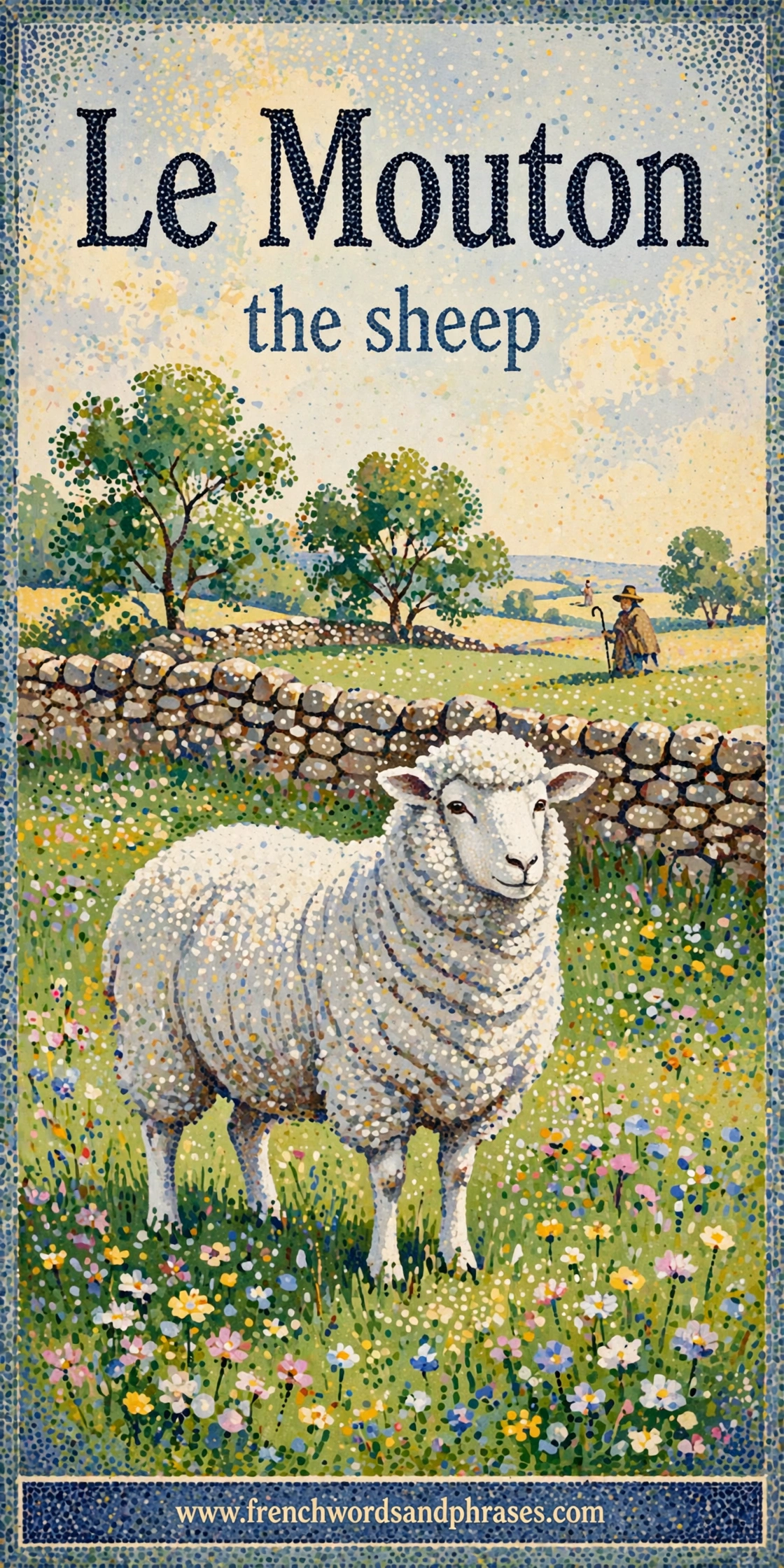
Le mouton means the sheep.
The speaker has wandered off into a long story about train tickets, and the whole table is lost — until the grandmother smiles and says: « Revenons à nos moutons ! » Back to our sheep. In French, the animal you return to is le mouton.
In this guide, you’ll learn what mouton means in English, how to use it with its articles, how to form its plural, and how it appears in everyday French. Explore French examples, English translations, and practice quizzes.
Understanding the French Noun Mouton
Mouton is a masculine French noun, learned with its article: le mouton, un mouton. It names the animal in general and its meat; the female has her own word, la brebis (the ewe), and the young one is l’agneau (the lamb).
It means the sheep — the woolly farm animal raised for its laine (wool) and its meat. A whole flock is un troupeau de moutons. The same word follows the animal to the table, where du mouton is mutton, and into the language of character, where a gentle, docile person can be called un vrai mouton.
Gender: Masculine — le mouton, un mouton
Plural: les moutons
The female: la brebis — the ewe
The young: l’agneau — the lamb
The flock: un troupeau de moutons
English equivalents: The sheep; mutton (the meat)
One usage detail: French counts sheep the English way, in flocks and heads — but when a speaker drifts off the subject, the whole language calls everyone back with revenons à nos moutons, let us return to our sheep, from a famous old courtroom comedy where a judge kept losing the thread of a case about stolen sheep.
Experience the Word
Mouton is the gentlest shape on the farm. A field of moutons in the Luberon, bells tinkling, a dog circling wide — the animal has stood for patience and softness in French for a thousand years.
Imagine the transhumance: thousands of moutons moving up to the high summer pastures, the road closed, the village watching, the bells making a slow river of sound through the streets.
You have not just named a farm animal. You have named the creature French speakers return to when they lose the thread.
How to Use Mouton in French: Complete Guide
Let’s explore how mouton works in French, beginning with its articles — le for one sheep, les for the whole flock.
Mouton with the Definite Article (Le, Les)
The sheep is masculine: le in the singular, les in the plural.
| Form | French |
|---|---|
| Masculine singular | le mouton |
| Plural | les moutons |
Example
Le mouton regarde le chien sans bouger.
The sheep watches the dog without moving.
Mouton with the Indefinite Article (Un, Des)
Used for a sheep in general — un mouton, a sheep; des moutons, sheep.
| Form | French |
|---|---|
| Masculine singular | un mouton |
| Plural | des moutons |
Example
Il y a un mouton échappé sur la route !
There is an escaped sheep on the road!
Mouton with the Partitive and Quantities (Du, Un troupeau de…)
On the plate, mouton becomes partitive — du mouton, mutton; in the field, it is counted in flocks.
| Quantity | French |
|---|---|
| some mutton (the meat) | du mouton |
| a flock of sheep | un troupeau de moutons |
| a leg of mutton | un gigot de mouton |
| a hundred sheep | cent moutons |
Example
Le berger conduit un troupeau de moutons vers la montagne.
The shepherd is leading a flock of sheep towards the mountain.
Quick Quiz 1
Complete the sentence:
Ce soir, nous mangeons ______ mouton rôti.
Reveal the answer
du
Ce soir, nous mangeons du mouton rôti.
This evening we are eating roast mutton — du, the partitive, because it is the meat, an amount, not a whole animal.
The Plural of Mouton
Mouton simply adds an -s in the plural — les moutons, the flock.
| Number | French |
|---|---|
| Singular | le mouton |
| Plural | les moutons |
Example
Les moutons descendent de la montagne en automne.
The sheep come down from the mountain in autumn.
Mouton with Possessive Adjectives (Mon, Ton, Son…)
Possessives agree with the noun — mouton is masculine, so it takes mon, ton, son.
| Owner | French |
|---|---|
| my | mon mouton |
| your (tu) | ton mouton |
| his / her | son mouton |
| our | notre mouton |
| your (vous) | votre mouton |
| their | leur mouton |
Example
Mon mouton préféré s’appelle Neige, à cause de sa laine blanche.
My favourite sheep is called Snow, because of its white wool.
Quick Quiz 2
Complete the sentence:
Le berger compte ______ moutons avant la nuit. (his)
Reveal the answer
ses
Le berger compte ses moutons avant la nuit.
The shepherd counts his sheep before nightfall — ses, the plural possessive.
Mouton with Demonstrative Adjectives (Ce, Ces)
Used to point: ce mouton, this sheep; ces moutons, these sheep.
| Form | French |
|---|---|
| Masculine singular | ce mouton |
| Plural | ces moutons |
Example
Ce mouton noir se fait remarquer dans le troupeau.
This black sheep stands out in the flock.
Mouton with Adjectives
Adjectives agree with mouton — masculine forms, and most follow the noun.
| Adjective | With Mouton |
|---|---|
| doux (gentle) | un mouton doux |
| blanc (white) | un mouton blanc |
| noir (black) | un mouton noir |
| petit (small) | un petit mouton |
| jeune (young) | un jeune mouton |
Example
C’est un mouton doux qui suit les enfants partout.
It is a gentle sheep that follows the children everywhere.
Quick Quiz 3
Complete the sentence:
Mais revenons à nos ______ !
Reveal the answer
moutons
Mais revenons à nos moutons !
But let’s get back to the subject — the most famous sheep in the French language, called back whenever a conversation wanders.
Everyday Expressions with Mouton
Flocks, leaps and wandering conversations — the mouton phrases of daily life.
| Expression | In English |
|---|---|
| revenons à nos moutons | let’s get back to the subject |
| un troupeau de moutons | a flock of sheep |
| doux comme un mouton | as gentle as a lamb |
| le saute-mouton | leapfrog (the game) |
| compter les moutons | to count sheep (to fall asleep) |
| un vrai mouton | a real follower, someone docile |
Example
Les enfants jouent à saute-mouton dans la cour.
The children are playing leapfrog in the yard.
Words from the Same Family as Mouton
Ewes, lambs and wool — the words that travel with mouton.
| French | In English |
|---|---|
| la brebis | the ewe |
| l’agneau | the lamb |
| le bélier | the ram |
| la laine | the wool |
| le berger | the shepherd |
| moutonnier | blindly following (said of a crowd) |
Example
La brebis reste près de son agneau dans le pré.
The ewe stays close to her lamb in the meadow.
Quick Quiz 4
What is la brebis?
Reveal the answer
The ewe — the female sheep, while le mouton is the animal in general.
Une brebis et ses agneaux dorment dans la bergerie.
A ewe and her lambs are sleeping in the sheepfold.
Mouton in Everyday French: Real-Life Examples
Now that you know the word, let’s see how mouton appears in everyday French.
Example 1 — On the farm
Le berger rentre les moutons avant l’orage.
The shepherd is bringing the sheep in before the storm.
Example 2 — In a meeting
Nous parlons de tout sauf du budget — revenons à nos moutons !
We’re talking about everything except the budget — let’s get back to the subject!
Example 3 — Falling asleep
Elle compte les moutons pour s’endormir.
She counts sheep to fall asleep.
Example 4 — At the market
Ce fromage est fait avec du lait de brebis, pas de mouton.
This cheese is made with ewe’s milk, not sheep in general.
Example 5 — In the playground
Les enfants font une partie de saute-mouton.
The children are having a game of leapfrog.
Example 6 — Describing a character
Il est doux comme un mouton, il ne se fâche jamais.
He is as gentle as a lamb, he never gets angry.
Beyond Translation: The Meaning of Mouton
No animal carries more French history than the mouton. Revenons à nos moutons was born in a fifteenth-century courtroom farce, La Farce de Maître Pathelin, where a judge, drowning in a muddled case about stolen sheep, kept crying it to drag everyone back to the point — and five centuries later, every French meeting still hears it.
To say mouton is to call a wandering conversation home.
It evokes high pastures and shepherd’s bells, wool and roast dinners, leapfrog in the schoolyard — and the gentlest insult in French, for the person who follows the flock without a thought.
How to Remember the French Noun Mouton
Remember it this way: Mouton is the sheep — masculine, le mouton, the animal of the flock, the table, and the most famous call back to order in French.
- One sheep — le mouton, doux comme un mouton.
- The whole flock — un troupeau de moutons.
- Off the subject? — revenons à nos moutons, back we come.
The key idea is le mouton — the sheep we always return to.
Test Your Knowledge of Mouton
Let’s see how much you’ve learned. Try answering these questions before revealing the answers.
Question 1
Is mouton masculine or feminine?
Reveal the answer
Masculine — le mouton, un mouton. The ewe is la brebis.
Question 2
What does revenons à nos moutons mean?
Reveal the answer
Let’s get back to the subject — literally, let us return to our sheep.
Question 3
Translate: The shepherd counts his sheep.
Reveal the answer
Le berger compte ses moutons.
Question 4
What is un troupeau de moutons?
Reveal the answer
A flock of sheep — troupeau is the word for a herd or flock.
Question 5
Complete the sentence:
Les ______ descendent de la montagne.
Reveal the answer
moutons
Les moutons descendent de la montagne.
The sheep are coming down from the mountain.
Your Final Challenge
Can You Use It?
How would you say this in French?
“Let’s get back to the subject, the meeting is nearly over.”
Reveal the answer
Revenons à nos moutons, la réunion est presque terminée.
Let’s get back to the subject, the meeting is nearly over.
A little French. A little curiosity. A richer everyday life.
LEARN FRENCH ONE WORD AT A TIME